Last updated: July 30, 2026
Temazepam Market Dynamics and Financial Trajectory (Pricing, Volume, Exclusivity, and Competitive Risk)
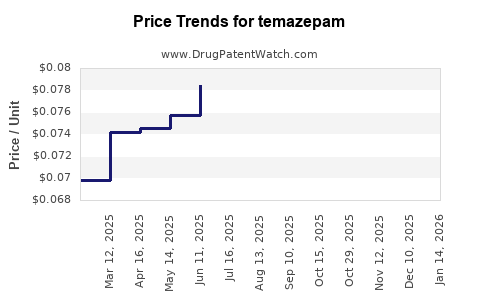
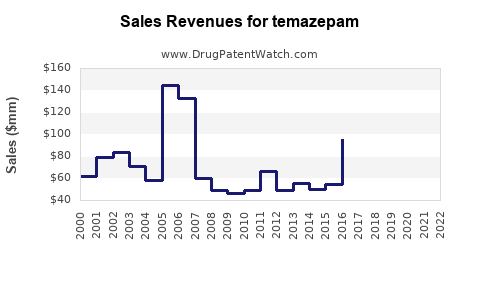
Temazepam, an oral benzodiazepine (benzodiazepine-class sedative-hypnotic) marketed as generics in the US and most major markets, shows a low-margin, volume-driven revenue profile with periodic price compression from multiple ANDA entrants. The financial trajectory is dominated by (1) ongoing generic substitution, (2) controlled-substance supply dynamics and regulatory enforcement, and (3) managed-care and hospital formulary placement. In practice, temazepam’s “market dynamics” are more influenced by generic competition and scheduling/compliance than by patent-led brand-to-generic transition.
No single, consolidated “drug-level” global revenue figure is reliably attributable to temazepam across all jurisdictions from public sources alone without additional disambiguation by strength, dosage form, and distribution channel. The actionable conclusion for business planning is that temazepam behaves like a mature generic with persistent unit demand, declining net pricing, and limited differentiation beyond formulation and packaging.
What drives temazepam market demand and pricing dynamics in 2025-2026?
Where demand comes from
Temazepam is used primarily for insomnia and short-term sleep disorders. Demand is sustained by:
- Chronic use patterns in specific prescriber cohorts and long-term patients.
- Institutional dispensing, including night-time dosing workflows in facilities.
- Substitute availability across strengths and generics reduces “switching friction.”
What controls pricing
Temazepam pricing tends to follow generic market mechanics:
- Multiple supply sources and strong pharmacy substitution pressure drive net price down.
- Pharmacy benefit managers (PBMs) steer to lower-cost generics and preferred labels.
- Short tender cycles and wholesaler contract repricing affect realized price.
Controlled-substance constraints
Temazepam is a controlled substance. Supply and compliance factors can create short-run availability constraints but do not typically sustain premium pricing:
- DEA and state enforcement pressure can affect prescribing and dispensing behavior.
- Manufacturer distribution compliance influences fill rates rather than long-term unit pricing.
Bottom line: temazepam revenue is predominantly a function of generic unit volumes and distribution continuity, with periodic price erosion from competitive entry and contracting cycles.
How has temazepam’s financial trajectory evolved from brand to generic?
Typical lifecycle pattern for mature benzos
Temazepam’s trajectory in the US is structurally similar to other off-patent oral benzodiazepines:
- Initial brand-to-generic conversion yields a sharp margin reset.
- Subsequent entrants compress pricing toward marginal distributor/wholesaler economics.
- Revenue stabilizes because insomnia demand is relatively inelastic at the patient level, but net revenue per unit continues to drift down.
Key financial inflection points to monitor
For temazepam specifically, the most important “money events” are:
- Launch timing of additional ANDA generics and any authorized generic (if applicable in a given period).
- Major label changes (strength/pack size) that can shift payer preferences.
- Formulary inclusion or exclusion by PBMs.
- Supply disruptions or recalls that temporarily increase realized costs and/or shift volumes between manufacturers.
Bottom line: the dominant financial pattern is stable-to-slowly declining revenues driven by net price compression with demand persistence.
What is the Orange Book status of temazepam in the US?
Featured-snippet answer: Temazepam is marketed as a generic drug product in the US; Orange Book listings typically show multiple approved ANDAs and generally expired or non-controlling brand patents for the active moiety.
What to look for on the Orange Book
For temazepam-containing products, investors and litigators typically map:
- Approved ANDA app numbers tied to product-specific patents (if any).
- Remaining patent term by drug product, formulation, or method-of-use.
- Whether patents are listed as drug substance versus drug product versus method-of-use.
Business implication: once formulation or method patents are exhausted, the market becomes a pure generic competition arena, where business outcomes hinge on supply scale and contracting rather than patent barriers.
When does temazepam lose exclusivity, and what does that mean for generics?
Exclusivity drivers
For an established generic like temazepam:
- Patent exclusivity is usually long past or irrelevant for new generic entrants.
- Any residual exclusivity tends to be product-specific and short-lived relative to the mature market.
Paragraph IV and timing risk
Where patents are absent or expired, Paragraph IV dynamics are limited. New ANDA entrants win primarily through:
- Bioequivalence and CMC readiness.
- Faster commercial readiness and distribution agreements.
- Price-led contracting.
Business implication: generic launch timing risk is lower than for patented therapies, but execution risk remains in manufacturing approval, lot release, and supply stability.
How many patents cover temazepam, and which ones matter commercially?
What typically matters for temazepam
In mature generic markets, only a small fraction of patent families affect commercial entry. For oral benzodiazepines like temazepam, the most likely “commercially relevant” patents (historically) are:
- Formulation-specific patents (e.g., composition, dissolution, excipients).
- Method-of-use patents (less common for insomnia agents once off-patent).
- Packaging or manufacturing process patents (rare to block generics long-term).
Why the patent estate often has low economic impact
Once the active ingredient is off-patent and formulation barriers are exhausted, the financial outcome is governed by:
- Generic competition and PBM preferences.
- Controlled-substance prescribing constraints.
- Distribution scale and compliance.
Bottom line: temazepam is usually not a “patent-driven” market. Cost position and supply reliability dominate.
What generic entry risks exist for temazepam, including 505(b)(2) and ANDA pathways?
ANDA pathway reality
Temazepam generics typically face:
- Bioequivalence requirements.
- Manufacturing compliance and consistent lot release.
505(b)(2) differentiation
A 505(b)(2) entrant could try to differentiate via:
- Extended-release or formulation technology (if a product concept exists).
- New delivery mechanism.
- Label expansion.
For temazepam specifically, commercial differentiation in oral benzodiazepines is constrained because the therapeutic class has limited perceived benefit for incremental PK changes versus generic substitutability.
Business implication: the entry barrier is more CMC and regulatory throughput than IP litigation.
Which companies compete in temazepam, and how do they shape the market?
Competitive landscape characteristics
Temazepam competition is typically:
- Multi-supplier across common tablet/capsule strengths and packaging.
- Price-competitive in pharmacy and institutional channels.
- Contract-driven via wholesalers and PBMs.
How to evaluate competitor impact
Actionable metrics for a competitive intelligence program:
- Number of ANDA suppliers per strength.
- Share of preferred status with PBMs (where available).
- Stability of supply (fill-rate and backorder frequency).
- Packaging strategy (60-count vs 30-count vs unit-dose institutional packs, where relevant).
Bottom line: winners are typically the lowest-cost, most reliable suppliers with consistent preferred positioning.
How do pricing and volume trends translate into temazepam revenue and margins?
Revenue math for mature generics
Temazepam revenue dynamics follow:
- Net price declines when new SKUs/labels enter or contract pricing resets.
- Unit volume can hold up due to ongoing insomnia use, but not enough to fully offset price erosion.
Margin pressure
Generic benzodiazepines generally face:
- Higher logistics and compliance costs for controlled substances.
- Working capital and inventory costs with fluctuating demand and lot release timing.
- Competitive pricing pressure that compresses gross margin.
Bottom line: revenue may stabilize while margins compress unless a supplier gains scale and contracting advantage.
What regulatory factors affect temazepam commercialization and financial performance?
Controlled-substance compliance
Regulatory factors affect:
- Prescriber and patient behavior (scheduling, monitoring).
- Dispensing practices and audit readiness.
- Potential supply chain bottlenecks.
Labeling and REMS
Benzodiazepine oversight is generally handled through controlled substance rules and label warnings rather than broad REMS structures for temazepam products. Financial effects usually show up as:
- Reduced utilization growth.
- Higher compliance costs.
- Institutional procurement constraints.
Bottom line: regulatory friction is a volume limiter and cost driver rather than a price premium enabler.
What litigation and settlement risks exist for temazepam generics?
Typical litigation profile
For mature off-patent generics, litigation is less about blocking entry and more about:
- Product-specific patent disputes that persist into late generic entry cycles.
- Enforcement around method-of-use or formulation patents, when present.
Settlement effect on market
When settlements occur, they often result in:
- Delayed launch for one entrant.
- Short-term market share rebalancing among existing suppliers.
Business implication: litigation is episodic and tends to create temporary share shifts more than long-run economic elevation.
How does temazepam compare with other benzodiazepines on market and financial risk?
Competitive comparables
Temazepam competes conceptually with other oral benzodiazepines used for sleep:
- Short- and intermediate-acting benzodiazepines.
- Alternative sedative-hypnotic classes (non-benzodiazepines and off-label options).
Risk comparison
- Temazepam’s competitive risk is mainly generic pricing and substitution.
- Other benzodiazepines may face additional competition from newer sedative agents or different payer formularies.
Bottom line: temazepam’s financial risk is primarily generic commoditization, not unique clinical differentiation.
What supply chain factors can change temazepam availability and sales quickly?
CMC and lot release
Sales can swing when:
- Manufacturing changes trigger revalidation or delayed release.
- Suppliers face equipment downtime.
- Controlled-substance logistics delays occur.
Institutional contracting
Hospitals and large group purchasers can reallocate volumes rapidly based on:
- Contract pricing
- On-time delivery performance
- Backorder status
Business implication: “availability events” can create short-term revenue wins for well-positioned manufacturers even in a low-growth generic market.
Key tables: market logic and monitoring framework for temazepam
Table 1. What to monitor to forecast temazepam financial trajectory
| Driver |
What changes |
Expected financial impact |
Signal sources (typical) |
| Generic supplier count |
More ANDA products in market |
Net price down; margin compression |
FDA Orange Book, NDC catalogs |
| PBM/plan contracting |
Preferred switching |
Volume shifts across manufacturers |
PBM formulary updates, claims feeds |
| Supply continuity |
Lot release/backorders |
Volume volatility, potential temporary price lift |
Distributor fill-rate, recall notices |
| Controlled-substance compliance |
Dispensing constraints |
Utilization headwinds; higher overhead |
DEA/state enforcement summaries |
| Litigation/settlement |
Launch timing adjustments |
Short-term share redistribution |
Court dockets, company filings |
Table 2. Generic-phase financial pattern
| Phase |
Revenue |
Net price |
Gross margin |
Notes |
| Mature multi-supplier |
Stable to slowly down |
Downward drift |
Compressed |
Contracts and substitution dominate |
| Supply disruption |
Temporarily volatile |
Can rise briefly |
Often worse due to overhead |
Reliability becomes advantage |
| New preferred label |
Share shifts |
Small net price impact |
Mix improvement possible |
Best-in-class contracting wins |
Key Takeaways
- Temazepam behaves as a mature generic benzodiazepine: volume persistence with ongoing net price erosion.
- Market dynamics are driven by generic competition, PBM contracting, and controlled-substance compliance, not patent-led innovation.
- Financial trajectory is best modeled as net price decline offset partially by unit demand stability and episodic supply-driven volume swings.
- The commercial winners are typically suppliers that maintain continuous controlled-substance supply, secure preferred contracting, and manage margin through scale.
FAQs
1) What market share risks does temazepam face from generic substitution at the pharmacy counter?
Temazepam faces immediate substitution pressure when multiple generics are available, making market share highly sensitive to PBM preferred status, pharmacy acquisition cost, and packaging availability.
2) Do temazepam shortages meaningfully increase long-term profits?
Shortages can shift volume short-term to reliable suppliers, but long-run profitability is limited by contract pricing resets once supply normalizes across multiple generic entrants.
3) Are there formulation strategies that can improve temazepam economics versus standard generics?
Economic differentiation is constrained because standard oral benzodiazepines are easily substitutable. Any formulation strategy that is not clearly payer-favored typically cannot sustain premium pricing.
4) How should investors model temazepam revenue given controlled-substance oversight?
Model utilization as relatively stable with compliance overhead and utilization risk; treat margin as a function of net price compression and supply reliability.
5) What is the most common source of sudden temazepam revenue swings?
Manufacturing or distribution availability events that affect fill rates, combined with rapid institutional re-contracting to ensure uninterrupted dispensing.
References (APA)
- U.S. Food and Drug Administration. (n.d.). Drugs@FDA: FDA approved drug products. https://www.accessdata.fda.gov/scripts/cder/daf/
- U.S. Food and Drug Administration. (n.d.). Orange Book: Approved Drug Products with Therapeutic Equivalence Evaluations. https://www.accessdata.fda.gov/scripts/cder/ob/