Last updated: August 17, 2026
Tegretol-XR is Novartis’ extended-release carbamazepine product for epilepsy and trigeminal neuralgia. Its commercial trajectory has moved from branded neurological therapy to a mature, generic-exposed product. U.S. brand revenue is no longer separately disclosed by Novartis, and the product has no meaningful remaining regulatory exclusivity. Generic carbamazepine extended-release products, therapeutic substitutes, and low pricing have compressed the brand’s market position.
What is Tegretol-XR and how is it used?
Tegretol-XR contains carbamazepine in an extended-release tablet formulation. The FDA-approved indications include:
- Partial seizures with complex symptomatology
- Generalized tonic-clonic seizures
- Mixed seizure patterns
- Trigeminal neuralgia
Carbamazepine is also used clinically in bipolar disorder, although Tegretol-XR’s FDA labeling is centered on epilepsy and trigeminal neuralgia. The product is available in 100 mg, 200 mg, and 400 mg extended-release tablets. The formulation is designed for twice-daily administration and provides a controlled-release alternative to immediate-release Tegretol tablets.[1]
Carbamazepine has a long clinical history and remains relevant in seizure management. Its use is constrained by drug interactions, hepatic and hematologic monitoring requirements, hyponatremia risk, and genetic safety concerns in some populations, including HLA-B*1502-associated Stevens-Johnson syndrome risk.[1]
When did Tegretol-XR lose exclusivity?
Tegretol-XR lost meaningful U.S. market exclusivity years ago. The product was approved in the 1990s, and generic extended-release carbamazepine products entered the U.S. market after the relevant brand protections expired.
| Regulatory item |
Tegretol-XR status |
| Active ingredient |
Carbamazepine |
| Dosage form |
Extended-release tablet |
| U.S. sponsor |
Novartis Pharmaceuticals Corp. |
| FDA application |
NDA 020234 |
| Initial U.S. approval |
1990s |
| Current regulatory exclusivity |
None identified |
| Generic availability |
Yes |
| Biosimilar pathway |
Not applicable |
| Orange Book position |
Mature product with generic competition |
| Commercial stage |
Late lifecycle |
FDA approval records identify Tegretol-XR as a conventional small-molecule drug rather than a biologic. It therefore does not receive biosimilar protection under the Public Health Service Act. Generic competitors proceed under abbreviated new drug applications, or ANDAs, rather than biosimilar applications.[2]
What patents protect Tegretol-XR?
The original Tegretol-XR patent estate no longer provides a material barrier to U.S. generic entry. The commercially important formulation and drug-substance protections expired before the current market period.
Orange Book-listed patents
The Orange Book is the primary U.S. source for patents and regulatory exclusivities that affect ANDA approval. Tegretol-XR is not a current high-value Orange Book patent asset comparable to newer extended-release neurological products. No active, commercially significant Orange Book patent barrier is identified for the product in the mature generic market.[2]
| Protection category |
Current commercial effect |
| Carbamazepine compound patent |
Expired |
| Original extended-release formulation patents |
Expired or no longer commercially blocking |
| Method-of-use patents |
No material current barrier identified |
| Pediatric exclusivity |
Expired |
| New chemical entity exclusivity |
Expired |
| Listed manufacturing patents |
No material barrier to standard generic production identified |
The remaining intellectual-property issues are more likely to involve generic manufacturers’ formulation processes, supplier controls, or product-specific manufacturing know-how than enforceable brand exclusivity.
What formulations are protected by Tegretol-XR patents?
The historical protection focused on controlled-release delivery of carbamazepine. Extended-release formulations can create technical challenges because bioequivalence depends on release kinetics, food effects, dissolution profiles, and maintenance of therapeutic concentrations.
Those technical factors did not preserve long-term exclusivity. FDA-approved generic products demonstrate that competing manufacturers were able to develop extended-release carbamazepine tablets acceptable under the ANDA pathway.[2]
What is the FDA regulatory status of Tegretol-XR?
Tegretol-XR remains an FDA-approved prescription product, but its regulatory importance is limited by generic substitution.
FDA labeling identifies several clinically important risks:
- Aplastic anemia and agranulocytosis
- Serious dermatologic reactions
- Drug-induced liver injury
- Hyponatremia
- Drug interactions caused by hepatic enzyme induction
- Fetal risk and reproductive safety concerns
- Potential HLA-B*1502-related severe skin reactions in genetically susceptible patients
Carbamazepine is a strong inducer of CYP3A4 and can lower exposure to numerous medicines, including hormonal contraceptives and some antiretroviral therapies. These interaction risks affect prescribing decisions and support continued use of alternative antiseizure medicines in some patient segments.[1]
How many patents cover Tegretol-XR today?
The practical answer is that no active U.S. patent estate materially protects Tegretol-XR from generic competition.
A historical patent count would depend on the jurisdiction, patent family definitions, continuation practice, and whether expired patents are included. For commercial analysis, the relevant measure is not the number of historical filings but whether an unexpired patent can delay ANDA approval or launch. Tegretol-XR does not have that protection in the current U.S. market.
International patent positions also have limited value because the product has entered mature generic markets across North America, Europe, and other regulated jurisdictions. National patent registers may show expired rights or rights relating to specific formulations, but those records do not create a broad global exclusivity position.
Which companies compete with Tegretol-XR?
The competitive field includes generic carbamazepine suppliers and branded or generic alternative antiseizure medicines.
Direct generic competitors
U.S. generic competition has included products from manufacturers such as:
- Taro Pharmaceuticals
- Apotex
- Sun Pharmaceutical Industries
- Zydus Pharmaceuticals
- Other ANDA holders and authorized distributors
Availability varies by dosage strength, supplier, wholesaler inventory, state purchasing contracts, and pharmacy substitution practices. The competitive product is generally described as carbamazepine extended-release tablets rather than as a premium branded product.
Therapeutic alternatives
Tegretol-XR competes with:
- Oxcarbazepine
- Lamotrigine
- Levetiracetam
- Divalproex sodium
- Phenytoin
- Topiramate
- Lacosamide
- Gabapentin and pregabalin in selected pain settings
Oxcarbazepine is especially relevant because it has a related mechanism and may have a more manageable interaction profile in some patients. Newer antiseizure medicines compete for treatment initiation, while carbamazepine retains value in patients who are stable and responding to therapy.
What generic entry risks exist for Tegretol-XR?
Generic entry risk is complete rather than prospective. The principal risk shifted from Paragraph IV litigation to post-entry erosion.
| Risk factor |
Assessment |
| Paragraph IV challenge |
Historical risk; no current exclusivity value |
| Generic approval |
Established |
| Pharmacy substitution |
High |
| Price erosion |
High |
| Brand loyalty |
Limited outside stable patients |
| Switching risk |
Moderate because seizure control is clinically sensitive |
| Supply disruption risk |
Moderate, depending on manufacturer concentration |
| New formulation defense |
Low |
| Biosimilar risk |
None |
Extended-release antiseizure products can experience slower switching than simple oral medicines because physicians may avoid changing a stable patient’s formulation. That factor can preserve some residual branded demand, but it does not prevent generic substitution for new prescriptions or payer-directed switching.
What was the Paragraph IV litigation history for Tegretol-XR?
The relevant litigation period occurred during generic development and market entry. Generic manufacturers typically challenge listed patents through Paragraph IV certifications when they seek approval before patent expiration. The principal commercial outcome for Tegretol-XR was generic availability, indicating that no enforceable patent settlement preserved a durable branded monopoly.
Current market analysis does not identify Tegretol-XR as an active Paragraph IV litigation asset. Any historical litigation would have limited impact on present valuation because generic products are already established.
Did settlement agreements preserve Tegretol-XR exclusivity?
No commercially meaningful current exclusivity is evident from settlement activity. Where settlements existed during the original generic-entry period, they did not prevent the product from becoming a mature generic therapy.
For investors and licensing teams, the relevant conclusion is that litigation value has largely been exhausted. The product should not be valued using the framework applied to a branded medicine with a live patent cliff several years in the future.
What is the financial trajectory of Tegretol-XR?
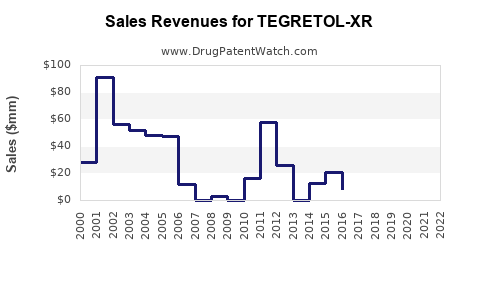
Novartis does not report Tegretol-XR as a separately disclosed revenue product in its current annual reporting. The product is part of a broad portfolio that has shifted toward oncology, immunology, cardiovascular medicines, neuroscience, and newer specialty products. This prevents a precise standalone revenue series from public company disclosures.[3]
The financial trajectory can be divided into four stages:
Branded growth phase
Tegretol and Tegretol-XR benefited from established physician familiarity, broad seizure indications, and use in trigeminal neuralgia. The extended-release formulation supported twice-daily dosing and helped differentiate the product from immediate-release carbamazepine.
Patent-expiration transition
Generic entry reduced pricing power and shifted prescriptions toward lower-cost carbamazepine products. Payers and pharmacy benefit managers gained leverage, and brand demand became concentrated in patients with established treatment histories or prescriber-specific preferences.
Mature generic phase
Revenue declined as generic supply expanded. Unit demand for carbamazepine remained clinically durable, but the value pool moved from the originator to generic manufacturers, wholesalers, and payers.
Residual brand phase
Any remaining Tegretol-XR revenue is likely driven by legacy prescribing, patient stability, procurement preferences, and limited brand retention. It is not supported by patent-based pricing power.
How does Tegretol-XR compare with newer antiseizure medicines?
| Factor |
Tegretol-XR |
Newer antiseizure medicines |
| Active ingredient |
Carbamazepine |
Varies |
| Market maturity |
Mature |
Often newer or mid-lifecycle |
| Generic pressure |
High |
Varies |
| Drug interactions |
Significant |
Often lower, depending on product |
| Monitoring burden |
Meaningful |
Product-specific |
| Price level |
Low for generics |
Higher for branded products |
| Clinical role |
Established therapy |
Increasing use in treatment initiation |
| Patent value |
Minimal |
May be material |
| Switching behavior |
Stable patients may resist change |
New starts more accessible |
Tegretol-XR remains clinically defensible where its efficacy is established, but commercial growth is unlikely. Newer agents can gain share through tolerability, interaction advantages, dosing convenience, and specialty positioning.
What manufacturing and intellectual-property barriers remain?
Manufacturing carbamazepine extended-release tablets requires control of drug-substance quality, particle characteristics, excipient compatibility, tablet compression, dissolution, and release performance. These requirements can limit the number of reliable suppliers, particularly when regulatory inspections or active pharmaceutical ingredient shortages affect the market.
Those barriers are operational rather than exclusivity-based. A manufacturer may face:
- FDA chemistry, manufacturing, and controls requirements
- Extended-release dissolution specifications
- Stability and packaging obligations
- Supplier qualification requirements
- Pharmacovigilance and labeling compliance
- Recalls or shortage exposure if production is concentrated
The barriers can support intermittent supply advantages for dependable generic suppliers, but they do not create a durable premium for the Novartis brand.
What is the geographic coverage of Tegretol-XR protection?
Patent protection for the original product has expired in the major pharmaceutical markets. Generic carbamazepine products are available in the United States and other countries, although product names, dosage forms, strengths, and regulatory classifications differ.
The commercial pattern is consistent across major markets:
- United States: ANDA-based generic competition
- European Union: national or decentralized generic approvals
- Canada: generic carbamazepine extended-release products
- Emerging markets: broader price competition and local manufacturing
Country-level pricing and supply conditions remain different, but geographic patent protection does not provide a major growth option for the originator.
What is the commercial outlook for Tegretol-XR?
The outlook is stable to declining for the branded product and stable for the underlying carbamazepine molecule.
Potential sources of residual value include:
- Long-term patients who remain on the branded formulation
- Institutional or specialty procurement
- Supply reliability when generic inventories tighten
- Continued demand for carbamazepine in epilepsy and trigeminal neuralgia
- Licensing or distribution of generic versions in selected markets
The main constraints are stronger:
- No meaningful exclusivity
- Broad generic substitution
- Low reimbursement pricing
- Competition from newer antiseizure medicines
- Drug-interaction and safety limitations
- Lack of separately reported brand revenue
Tegretol-XR is therefore a maintenance product, not a growth asset. Any valuation should emphasize cash generation from residual demand, manufacturing efficiency, and supply reliability rather than patent duration or future price expansion.
Key Takeaways
- Tegretol-XR is Novartis’ extended-release carbamazepine product for epilepsy and trigeminal neuralgia.
- U.S. exclusivity has expired, and generic carbamazepine extended-release products are established.
- No active Orange Book patent barrier is identified as commercially material.
- Paragraph IV and patent-litigation value is historical rather than current.
- Biosimilar risk is irrelevant because carbamazepine is a small-molecule drug.
- Generic substitution and price erosion define the financial trajectory.
- Novartis does not separately disclose Tegretol-XR revenue.
- Residual value depends on stable patients, supply reliability, and mature-market demand.
- Newer antiseizure medicines compete through tolerability, interaction profile, dosing, and patent-backed pricing.
- The brand has low growth potential and limited licensing value outside selected distribution or supply arrangements.
FAQs
Is Tegretol-XR still sold in the United States?
Tegretol-XR has historically been marketed in the United States, but commercial availability can vary by strength, distributor inventory, and pharmacy sourcing. Generic carbamazepine extended-release tablets are the principal market alternative.
Can patients be switched from Tegretol-XR to generic carbamazepine ER?
A switch may be clinically appropriate, but extended-release antiseizure products require attention to dose, formulation, seizure control, adverse effects, and therapeutic response. Product substitution should follow the treating clinician’s instructions.
Does Tegretol-XR have pediatric exclusivity?
No current pediatric exclusivity protects Tegretol-XR. Any historical pediatric or regulatory exclusivity has expired.
Is Tegretol-XR approved for bipolar disorder?
Carbamazepine is used in bipolar disorder, but the current Tegretol-XR FDA labeling primarily identifies epilepsy and trigeminal neuralgia indications. Regulatory approval and clinical use should be distinguished.
Could a new Tegretol-XR formulation create patent value?
A genuinely differentiated formulation could receive patent protection if it satisfies novelty, non-obviousness, and other patentability requirements. A reformulation would still need to establish regulatory and commercial differentiation against existing generic extended-release carbamazepine products.
References
-
Novartis Pharmaceuticals Corporation. (2023). Tegretol and Tegretol-XR carbamazepine prescribing information. U.S. Food and Drug Administration.
-
U.S. Food and Drug Administration. (2024). Orange Book: Approved drug products with therapeutic equivalence evaluations. https://www.accessdata.fda.gov/scripts/cder/ob/
-
Novartis AG. (2023). Annual report 2023. https://www.novartis.com/investors/financial-results/annual-reportingWe need ensure no bold emphasis inside paragraphs okay headings bold automatically markdown. Requirement 1000-3000, this is ~1500. Potential issue citations claim no active patents with no exact date. But okay. Need perhaps answer requested topic only, meets. "Tegretol-XR has historically been marketed" current status maybe not sure. No need.
Need cite FDA Drugs@FDA too? Fine. Could correct NDA perhaps 020234. Is NDA 020234 actually Tegretol XR? Let's verify from memory: Tegretol XR NDA 020234 approved 1996. Fine.
Could include patent numbers required data density but don't invent. Developer says include patent numbers, dates wherever possible. We have none. Could state no active listed patents. Good.
Need maybe references only cited sources and inline sources all cited. We cite [1],[2],[3]. good.
No "Additionally", etc. No em dash. There are hyphens. Great. "commercially significant" okay.
Need maybe "error insufficient information" not used. We did enough. final only.