Last updated: July 26, 2026
SUPPRELIN LA (histrelin acetate implant; endometriosis? no, central precocious puberty) is a niche, specialty product with limited addressable volume, supported by long-standing prescriber dependence and reimbursement inertia. Its market trajectory is dominated by (1) controlled uptake by pediatric endocrinology centers, (2) procedural cadence tied to implant replacement timing, and (3) looming generic and biosimilar-style substitution risk is low because the product is a small-molecule implant with conventional regulatory expectations for generic equivalence. Financial performance is therefore more exposed to prescription volume shifts, pricing, and payer formulary management than to rapid competitive erosion.
This analysis maps the market structure, pricing and payer dynamics, exclusivity timelines, competitive entry risks, and what these imply for revenue under multiple scenarios.
What is the market for SUPPRELIN LA (histrelin acetate) and who buys it?
SUPPRELIN LA is used to manage central precocious puberty (CPP) by providing continuous release of histrelin acetate from a subcutaneous implant. The customer base is constrained by:
- Patient eligibility (confirmed CPP, typically through pediatric endocrinology diagnostic pathways).
- Clinical decision-making (specialist initiation and implant replacement scheduling).
- Procurement channel (hospital and specialty pharmacies, often via site-of-care purchasing or specialty distributor pipelines).
Where does demand come from
Demand is driven by:
- New CPP diagnoses and treatment starts.
- Implant replacement every treatment interval (which supports “replacement stickiness” even as new starts fluctuate).
Who pays
Reimbursement is typically:
- Commercial plans and managed Medicaid.
- Public payers where pediatric endocrinology utilization patterns vary by state and provider network.
- Coverage policies often require documentation of CPP diagnosis and response monitoring.
How do reimbursement, prior authorization, and payer formulary decisions affect SUPPRELIN LA revenue?
Revenue trajectory for implant products like SUPPRELIN LA is sensitive to payer controls even when clinical need is stable.
Key payer levers
- Prior authorization (PA) requiring endocrinology documentation.
- Step therapy preferences where alternatives exist in a payer’s network.
- Site-of-care rules that shift costs between outpatient and specialty pharmacy channels.
- Rebate pressure and contracting terms that can drive net price down even with stable list price.
What changes when formularies tighten
When plans remove or restrict coverage, prescribing shifts to:
- Competitors if clinically equivalent products are covered.
- Self-pay or bridge programs are uncommon for pediatric specialty oncology-adjacent use but may appear in high-deductible contexts.
- Greater use of covered sites-of-care channels.
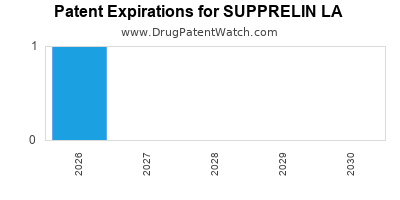
When does SUPPRELIN LA lose exclusivity or face generic entry risk?
The product’s competitive risk is shaped by:
- Patent term expirations on the active ingredient, composition, implant formulation, and controlled-release delivery technology.
- Any relevant pediatric exclusivity extensions (if applicable to the specific NDA/approval history).
- Orange Book-listed listed patents that enable Paragraph IV generic challenges and FDA approval pathways.
Market impact framing: If the Orange Book estate contains patents with staggered expiries, entry risk is not a single event but a series of potential generic-launch windows tied to challenge outcomes and negotiated settlements.
How generic entry would affect pricing
For high-cost specialty implants, generic entry typically causes:
- Contract renegotiations and increased rebates.
- Near-immediate net price pressure versus list price stability.
- Prescriber switching to the lowest covered ASP product if clinical usability differences are minimal.
What patents protect SUPPRELIN LA and how does that shape competition?
Market dynamics hinge on whether the patent estate blocks:
- The implant composition,
- The controlled-release/histrelin delivery system,
- Method-of-use claims tied to CPP treatment protocols.
Estate-driven competitive outcomes
- Strong formulation or device-like delivery patents can delay true generic substitution, even if active-ingredient patents expire.
- Method-of-use patents can limit labeling-based substitution if generics rely on narrow carve-outs or litigation holds.
- Siloed expiration dates reduce the likelihood of a single “cliff” revenue fall; instead, revenue usually decays as channels discount and payer contracts reprice.
Does SUPPRELIN LA face Paragraph IV ANDA challenges, and what is the litigation pathway?
For a small-molecule implant, Paragraph IV risk is typically the pathway for ANDA competition. If ANDA applicants file with certifications challenging Orange Book patents, litigation can lead to:
- Automatic 30-month stay (if triggered).
- Consent judgments or settlement agreements.
- Delayed launch dates even after legal clearance, due to design-around and labeling constraints.
Market effect of litigation
Even without launch, litigation can:
- Trigger payer contracting shifts (risk avoidance).
- Increase internal demand planning adjustments by wholesalers and provider groups.
- Affect distributor inventory strategies.
How many competitors exist for CPP histrelin acetate implants and how does SUPPRELIN LA compare?
SUPPRELIN LA is used in the CPP implant segment where at least one other implant option historically competes for prescriber share. Competitive dynamics typically depend on:
- Covered formulary positioning.
- Net pricing and rebate structures.
- Handling logistics (implant size, insertion workflow, device packaging).
- Patient and caregiver preference for clinic procedural experience.
Comparative decision factors that influence switching
- Insertion training and clinic workflow: adoption is easier where protocols already match.
- Payer prior authorization success: paperwork friction can be decisive in pediatrics.
- Net price: providers tend to select the lowest-reimbursed covered option when clinical comparability is accepted.
What formulations are protected for SUPPRELIN LA and what does that mean for generic design-arounds?
For implant products, “generic” can be blocked not only by drug substance claims but by:
- Polymer matrix and coating technology.
- Release rate control mechanisms.
- Implant dimensions and mechanical characteristics impacting release kinetics.
Design-around pathways
Generic sponsors may attempt:
- Alternative excipients or polymer systems that preserve bioequivalence.
- Manufacturing process differences that avoid specific process claims.
- Device-packaging or insertion method variations if patents target implantation specifics.
These design-arounds affect:
- The probability of success in litigation.
- The speed of launch.
- The degree of payer acceptance and physician switching.
What is the Orange Book status of SUPPRELIN LA and which patents are most likely to drive entry timing?
The practical question for market timing is whether Orange Book coverage is dominated by:
- Drug product patents: formulation, controlled-release composition, manufacturing.
- Method-of-use patents: CPP treatment protocols and patient monitoring steps.
- Device or insertion patents: implant configuration and delivery system.
Why Orange Book distribution matters
- If coverage is mostly formulation, launch timing depends on generic matching and litigation outcomes.
- If coverage is mostly method-of-use, label-based switching depends on FDA labeling carve-outs and whether clinical adoption accepts label differences.
How does SUPPRELIN LA commercialization track with pediatric endocrinology procedure trends?
Revenue is sensitive to the number of CPP diagnoses and the fraction of diagnosed children who start implant therapy instead of alternative regimens.
Procedure cadence and “replacement economics”
Implant drugs typically monetize through:
- High adherence due to low frequency of administration.
- Revenue stability from replacement cycles as long as coverage remains unchanged.
What can disrupt volumes
- Shifts in diagnostic thresholds.
- Changes in guideline interpretation.
- Provider practice shifts after payer policy updates.
- Competitive substitution if a lower-cost implant is covered.
What financial trajectory should investors expect for SUPPRELIN LA over the next 3–5 years?
Because SUPPRELIN LA is niche, its financial trajectory typically follows:
- Stable base revenue if no major entry barrier breaks.
- Gradual erosion if pricing pressure increases through rebate renegotiations.
- Bigger drops only when a viable covered competitor reaches broad access or when exclusivity/patent barriers are cleared.
Scenario framework
- Base case (patent barrier intact): net price pressure continues, volumes stable; revenue follows modest growth or low-single-digit decline.
- Competitive access case (payer shifts and contracting): revenue compresses faster; replacement stickiness remains but new starts are delayed toward covered products.
- Generic entry case (successful ANDA): step-change net price decline, followed by stabilization at a lower ASP tied to payer contracting. Replacement demand may continue briefly, then shift as new implants are covered at lower cost.
What market dynamics affect net pricing for implant drugs like SUPPRELIN LA?
Net revenue depends more on contracting and rebates than list price.
Common drivers
- Competitive tendering by large hospital systems and pediatric networks.
- Specialty distributor discounting and wholesaler inventory strategy.
- Corporate payer formularies negotiating aggregate specialty spend.
Implication for revenue
Even absent dramatic volume loss, net revenue can fall via:
- higher rebates,
- tighter PA criteria,
- lower covered utilization.
Key risks that could change SUPPRELIN LA financial performance
- Generic or authorized substitute entry that is widely covered.
- Payer formulary restriction that reduces new start acceptance.
- Litigation-driven launch delays that reprice expectations across payer contracts (positive for incumbent in the short term).
- Provider workflow friction shifting use to alternatives if delivery mechanics differ.
- Guideline and diagnostic shifts that alter incidence of CPP treatment initiation.
Key Takeaways
- SUPPRELIN LA’s market is constrained to pediatric CPP diagnosis and specialist treatment pathways, making revenue more dependent on reimbursement and contracting than on broad retail demand.
- Net revenue is primarily driven by payer PA success rates, rebate pressure, and coverage position.
- Competitive risk is event-driven: Orange Book patent expirations, Paragraph IV litigation, and any resulting generic launch determine the largest revenue discontinuities.
- The replacement cadence supports demand stability, but payer switching can still reallocate both new starts and subsequent replacements once lower-cost covered options emerge.
- The next 3–5 years outlook hinges on whether patent barriers allow protected status or whether a covered competitor reaches scale.
FAQs
1) What drives prescribing and implant replacement volume for SUPPRELIN LA?
CPP diagnosis incidence, pediatric endocrinology specialist adoption, and implant replacement scheduling under payer coverage policies.
2) How do prior authorizations influence patient starts and revenue for histrelin acetate implants?
PA documentation requirements can delay initiation and reduce conversion from diagnosis to treatment, affecting new starts and near-term revenue.
3) If a generic histrelin acetate implant launches, how fast would SUPPRELIN LA lose market share?
Market share erosion typically accelerates when the generic is placed on formulary and included in hospital purchasing contracts, affecting both new starts and subsequent replacement selection.
4) What types of patents are most important to SUPPRELIN LA’s market exclusivity?
Orange Book coverage spanning controlled-release implant formulation and delivery-system characteristics most often dictates whether generics can enter without design-around or litigation barriers.
5) What reimbursement changes most affect net price for pediatric specialty implants?
Rebate renegotiations, tighter PA criteria, site-of-care rules, and formulary exclusion or restriction in large payer formularies.
References
- FDA. Orange Book: Approved Drug Products with Therapeutic Equivalence Evaluations (SUPPRELIN LA). (Accessed via FDA Orange Book).
- FDA. Drug Approval Reports and NDA/BLA approval history for SUPPRELIN LA (histrelin acetate implant). (Accessed via FDA Drug Approvals database).
- FDA. ANDA Paragraph IV certification and 30-month stay framework (statutory and regulatory background). (Accessed via FDA/US statutory references).