Share This Page
SOLU-MEDROL Drug Patent Profile
✉ Email this page to a colleague
When do Solu-medrol patents expire, and when can generic versions of Solu-medrol launch?
Solu-medrol is a drug marketed by Pharmacia And Upjohn and is included in one NDA.
The generic ingredient in SOLU-MEDROL is methylprednisolone sodium succinate. There is one drug master file entry for this compound. Seventeen suppliers are listed for this compound. Additional details are available on the methylprednisolone sodium succinate profile page.
DrugPatentWatch® Litigation and Generic Entry Outlook for Solu-medrol
A generic version of SOLU-MEDROL was approved as methylprednisolone sodium succinate by FRESENIUS KABI USA on July 30th, 2004.
AI Deep Research
Questions you can ask:
- What is the 5 year forecast for SOLU-MEDROL?
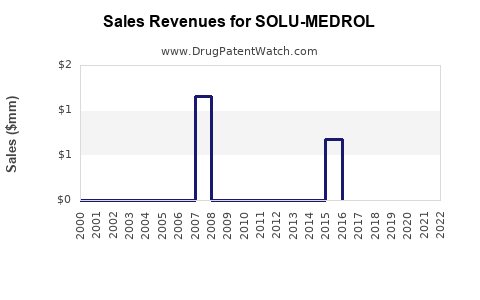
- What are the global sales for SOLU-MEDROL?
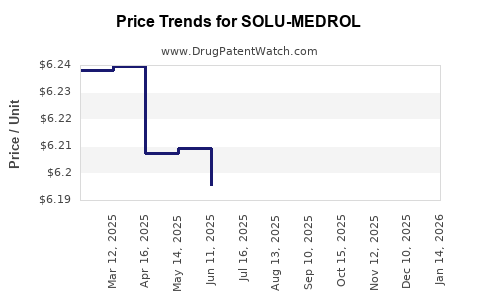
- What is Average Wholesale Price for SOLU-MEDROL?
Summary for SOLU-MEDROL
| US Patents: | 0 |
| Applicants: | 1 |
| NDAs: | 1 |
| Finished Product Suppliers / Packagers: | 10 |
| Raw Ingredient (Bulk) Api Vendors: | 46 |
| Clinical Trials: | 129 |
| Drug Prices: | Drug price information for SOLU-MEDROL |
| What excipients (inactive ingredients) are in SOLU-MEDROL? | SOLU-MEDROL excipients list |
| DailyMed Link: | SOLU-MEDROL at DailyMed |
Recent Clinical Trials for SOLU-MEDROL
Identify potential brand extensions & 505(b)(2) entrants
| Sponsor | Phase |
|---|---|
| Vanderbilt University Medical Center | PHASE4 |
| St. Louis University | PHASE4 |
| Takeda | PHASE2 |
Pharmacology for SOLU-MEDROL
| Drug Class | Corticosteroid |
| Mechanism of Action | Corticosteroid Hormone Receptor Agonists |
US Patents and Regulatory Information for SOLU-MEDROL
| Applicant | Tradename | Generic Name | Dosage | NDA | Approval Date | TE | Type | RLD | RS | Patent No. | Patent Expiration | Product | Substance | Delist Req. | Exclusivity Expiration |
|---|---|---|---|---|---|---|---|---|---|---|---|---|---|---|---|
| Pharmacia And Upjohn | SOLU-MEDROL | methylprednisolone sodium succinate | INJECTABLE;INJECTION | 011856-006 | Approved Prior to Jan 1, 1982 | AP | RX | Yes | Yes | ⤷ Start Trial | ⤷ Start Trial | ⤷ Start Trial | |||
| Pharmacia And Upjohn | SOLU-MEDROL | methylprednisolone sodium succinate | INJECTABLE;INJECTION | 011856-004 | Approved Prior to Jan 1, 1982 | AP | RX | Yes | Yes | ⤷ Start Trial | ⤷ Start Trial | ⤷ Start Trial | |||
| Pharmacia And Upjohn | SOLU-MEDROL | methylprednisolone sodium succinate | INJECTABLE;INJECTION | 011856-007 | Feb 27, 1985 | AP | RX | Yes | Yes | ⤷ Start Trial | ⤷ Start Trial | ⤷ Start Trial | |||
| >Applicant | >Tradename | >Generic Name | >Dosage | >NDA | >Approval Date | >TE | >Type | >RLD | >RS | >Patent No. | >Patent Expiration | >Product | >Substance | >Delist Req. | >Exclusivity Expiration |
SOLU-MEDROL Market Dynamics, Patent Status, and Financial Trajectory
SOLU-MEDROL, Pfizer’s injectable methylprednisolone sodium succinate, is a mature corticosteroid with limited remaining intellectual-property protection, broad generic availability, and low strategic pricing power. Its commercial outlook is driven by hospital demand, injectable supply reliability, contract pricing, and manufacturing economics rather than patent exclusivity. Pfizer does not separately report SOLU-MEDROL revenue, so its product-level financial trajectory cannot be quantified from public filings. The brand remains commercially relevant in acute-care settings, but value has shifted from innovation to supply continuity and institutional purchasing access.
What is SOLU-MEDROL and how is it used?
SOLU-MEDROL is the brand name for methylprednisolone sodium succinate, an injectable corticosteroid administered intravenously or intramuscularly. It is used when rapid systemic corticosteroid therapy is required or when oral administration is impractical.
The product label includes indications across inflammatory, allergic, rheumatic, dermatologic, respiratory, hematologic, and neurologic conditions. Hospital use includes severe asthma or allergic reactions, autoimmune flares, acute inflammatory disorders, and other conditions requiring parenteral corticosteroid treatment. The label does not position SOLU-MEDROL as a single-disease specialty product. Its demand is distributed across multiple hospital departments and treatment pathways. (Pfizer, 2023)
SOLU-MEDROL dosage forms and strengths
SOLU-MEDROL is supplied as a powder requiring reconstitution or in a dual-chamber ACT-O-VIAL presentation. Common strengths include:
| Strength | Typical commercial role |
|---|---|
| 40 mg | Lower-dose acute treatment |
| 125 mg | Emergency and hospital use |
| 500 mg | High-dose inpatient therapy |
| 1,000 mg | Pulse-dose treatment and severe disease |
The ACT-O-VIAL delivery system adds handling convenience by separating the drug powder from the diluent until activation. That delivery feature can support hospital preference but does not create the same level of switching resistance associated with complex biologics or proprietary delivery platforms.
What is the FDA regulatory status of SOLU-MEDROL?
SOLU-MEDROL is an FDA-approved prescription injectable drug. Its regulatory status is based on a conventional small-molecule corticosteroid formulation rather than a biologic license application.
The product is associated with FDA New Drug Application No. 011856, according to FDA product databases. FDA-listed presentations include methylprednisolone sodium succinate for injection in multiple strengths and packaging configurations. Generic methylprednisolone sodium succinate products are approved through abbreviated new drug applications, subject to demonstrating pharmaceutical equivalence and bioequivalence where applicable. (U.S. Food and Drug Administration, n.d.-a)
Is SOLU-MEDROL a biologic?
No. SOLU-MEDROL is a small-molecule corticosteroid salt. It does not have biosimilar exclusivity or biologic patent protections under the Public Health Service Act. Competitive products are generics, not biosimilars.
This distinction materially reduces the legal and regulatory barriers to competition. Generic manufacturers can enter through the ANDA pathway without replicating a biologic manufacturing process or conducting a full clinical development program.
What patents protect SOLU-MEDROL?
No commercially important, unexpired foundational patent protection is generally associated with SOLU-MEDROL today. Methylprednisolone sodium succinate is an established active ingredient, and the product has been marketed for decades.
The original composition, formulation, and basic use protections associated with an older corticosteroid product would have expired long ago. Any current patent risk would be expected to relate to a narrow formulation, device, packaging, manufacturing, or method-of-use claim rather than the active ingredient itself.
Does SOLU-MEDROL have Orange Book-listed patents?
The FDA Orange Book is the relevant source for patents and regulatory exclusivity associated with approved drug products. For a legacy injectable such as SOLU-MEDROL, the principal competitive fact is the absence of meaningful current patent protection around the active product. The Orange Book should be reviewed by presentation and application number because listing status can vary by product configuration and sponsor. (U.S. Food and Drug Administration, n.d.-b)
There is no known current patent position that would prevent generic methylprednisolone sodium succinate from competing with SOLU-MEDROL on a broad product basis.
| IP category | Current commercial relevance |
|---|---|
| Active-ingredient patent | None expected to remain |
| Core formulation patent | No broad, commercially decisive protection expected |
| Method-of-use patent | Limited relevance; clinical uses are mature |
| Delivery-device patent | Possible historical or narrow relevance |
| Manufacturing patent | Potentially relevant to individual suppliers, not broad market exclusivity |
| Orange Book exclusivity | No material new-drug exclusivity expected |
When did SOLU-MEDROL lose exclusivity?
SOLU-MEDROL lost meaningful market exclusivity decades ago. The product’s commercial position is therefore post-exclusivity and genericized.
The FDA does not treat the modern SOLU-MEDROL business as a newly protected product. Any remaining brand premium comes from physician familiarity, hospital formulary preference, packaging, supply reliability, and procurement contracts. It does not come from patent-based exclusion.
The product also has no practical pediatric-exclusivity or orphan-drug-exclusivity profile capable of restructuring the market. Its indications are broad and its active ingredient is long established.
Which companies compete with SOLU-MEDROL?
Competition comes from generic manufacturers and from therapeutic substitutes, depending on the clinical setting.
Generic methylprednisolone sodium succinate suppliers
The U.S. market has included generic injectable suppliers such as Hikma Pharmaceuticals, Sandoz, Fresenius Kabi, and other approved ANDA holders, subject to product availability and changes in supplier portfolios. Generic availability can vary by strength, vial configuration, and hospital purchasing channel.
A hospital may award volume to a generic supplier based on:
- contract price;
- back-order history;
- vial and presentation availability;
- pharmacy preparation requirements;
- quality and regulatory record;
- wholesaler allocation;
- group purchasing organization terms.
The competitive market is therefore more fragmented operationally than the brand-versus-generic distinction suggests.
Therapeutic alternatives
Clinicians may use other corticosteroids, including dexamethasone, hydrocortisone sodium succinate, and prednisone or prednisolone products, depending on indication and route of administration. These alternatives are not direct pharmaceutical equivalents in every setting. Dose conversion, onset, mineralocorticoid activity, indication, and institutional protocol affect substitution.
SOLU-MEDROL competes most directly with generic methylprednisolone sodium succinate. It competes indirectly with other injectable corticosteroids where treatment protocols permit substitution.
What is the market dynamic for SOLU-MEDROL?
SOLU-MEDROL operates in a mature, price-sensitive hospital market. Demand is relatively stable because corticosteroids remain embedded in emergency, inpatient, perioperative, and specialty-care protocols. Revenue growth is constrained by generic substitution and reimbursement pressure.
Demand drivers
Key demand drivers include:
- Hospital admissions requiring parenteral anti-inflammatory therapy.
- Emergency-department treatment volumes.
- Autoimmune and inflammatory disease activity.
- Use of pulse-dose corticosteroid regimens.
- Stocking requirements for emergency and critical-care formularies.
- Shortages affecting competing injectable corticosteroids.
The product can benefit temporarily when another injectable steroid is unavailable. These gains are usually supply-driven rather than evidence of durable market expansion.
Pricing dynamics
Pricing is controlled by institutional procurement. Large hospitals and group purchasing organizations negotiate aggressively, and generic products typically establish the market price. Pfizer can preserve some brand demand through supply consistency, recognized quality systems, and established distribution, but a substantial premium is difficult to sustain without a supply advantage.
Injectable products also have cost characteristics that differ from oral generics. Sterile manufacturing, aseptic filling, container closure, quality testing, and batch-release requirements increase production complexity. Those costs can reduce the number of reliable suppliers and create periodic shortages even when the active ingredient is old and inexpensive.
How strong is the SOLU-MEDROL patent estate?
The patent estate is weak from a market-exclusivity perspective but may retain operational value.
Patent-strength assessment
| Factor | Assessment |
|---|---|
| Composition-of-matter protection | Expired |
| New formulation exclusivity | No broad current barrier identified |
| Regulatory exclusivity | No meaningful current exclusivity expected |
| Generic substitution resistance | Low |
| Manufacturing complexity | Moderate for sterile injectable production |
| Brand recognition | Moderate in institutional care |
| Supply-chain differentiation | Potentially meaningful |
| Litigation leverage | Low |
The important barrier is not the patent estate. It is the ability to manufacture and distribute a sterile injectable consistently at acceptable margins.
Are there Paragraph IV challenges to SOLU-MEDROL?
Paragraph IV litigation is not expected to be a central current issue for SOLU-MEDROL. Paragraph IV certifications are used when an ANDA applicant asserts that an Orange Book-listed patent is invalid, unenforceable, or will not be infringed. A legacy injectable with no meaningful blocking patent position has less litigation exposure than a recently approved branded drug. (U.S. Food and Drug Administration, n.d.-b)
Generic applicants may still make patent certifications where patents are listed against a specific application or presentation. That process does not indicate a commercially significant patent dispute by itself.
What patent litigation affects SOLU-MEDROL?
No major current patent litigation is generally associated with the core SOLU-MEDROL product. Potential disputes would more likely concern:
- supplier manufacturing processes;
- sterile-filling technology;
- device or reconstitution systems;
- supply agreements;
- product liability;
- trade secrets;
- regulatory compliance.
Those disputes would not normally restore product-level exclusivity for methylprednisolone sodium succinate.
What is the financial trajectory of SOLU-MEDROL?
SOLU-MEDROL is a mature, non-core disclosed product within Pfizer’s broader portfolio. Pfizer reports revenue by major business segments and selected products, but does not normally disclose standalone SOLU-MEDROL sales. (Pfizer Inc., 2024)
Financial trajectory
| Period | Commercial condition | Expected financial effect |
|---|---|---|
| Early commercialization | Branded injectable corticosteroid | High relative pricing and limited competition |
| Generic-entry period | Multiple ANDA suppliers | Volume retention with price erosion |
| Mature market | Hospital and institutional purchasing | Stable demand, lower gross margins |
| Supply-disruption periods | Shortages among suppliers | Temporary brand or supplier share gains |
| Current market | Genericized sterile injectable | Low growth and procurement-driven pricing |
The product’s revenue profile is likely characterized by stable but modest demand, declining unit economics, and episodic volatility caused by shortages or contract changes. Pfizer’s financial exposure is limited relative to its major patented and specialty products because SOLU-MEDROL is not separately reported and is not a primary growth asset.
Revenue exposure for Pfizer
The absence of standalone disclosure prevents a reliable product-level revenue estimate. At the portfolio level, SOLU-MEDROL is unlikely to be a material driver of Pfizer’s consolidated growth. Its value is more likely tied to:
- recurring hospital demand;
- manufacturing utilization;
- portfolio breadth in injectable medicines;
- supply relationships with health systems;
- contribution margin after sterile-manufacturing costs.
A loss of one hospital contract would not materially affect Pfizer’s overall financial results. A broad manufacturing disruption could affect customer relationships and create temporary substitution opportunities for competitors.
What generic launch scenarios exist for SOLU-MEDROL?
Three market scenarios are commercially relevant.
Scenario 1: Continued fragmented generic supply
Multiple suppliers remain active, and hospitals use competitive tenders. SOLU-MEDROL retains a smaller branded share based on familiarity and supply confidence. Price erosion continues gradually.
Scenario 2: Injectable shortage
One or more generic suppliers experience manufacturing or regulatory disruption. Hospitals return temporarily to the Pfizer brand or allocate more volume to available suppliers. Pfizer can gain share without receiving durable patent protection.
Scenario 3: Aggressive hospital conversion
A major purchasing organization standardizes on a generic supplier or substitutes another corticosteroid. Brand volume declines, especially in price-sensitive systems. Pfizer’s ability to defend share depends on contract terms and product availability.
How does SOLU-MEDROL compare with competing corticosteroids?
| Product | Active ingredient | Direct substitutability | IP profile | Main commercial distinction |
|---|---|---|---|---|
| SOLU-MEDROL | Methylprednisolone sodium succinate | Reference product for generic equivalents | Mature and largely expired | Brand recognition and injectable presentation |
| Generic methylprednisolone sodium succinate | Same active ingredient | High, subject to approved presentation | No meaningful broad exclusivity | Lower acquisition cost |
| Solu-Cortef | Hydrocortisone sodium succinate | Clinical alternative, not equivalent | Mature product | Different steroid profile and protocols |
| Dexamethasone injection | Dexamethasone sodium phosphate | Clinical alternative | Mature product | Potency, dosing, and indication differences |
| Oral prednisone or prednisolone | Different active ingredients | Limited by route and clinical severity | Mature product | Lower administration cost where oral therapy is possible |
SOLU-MEDROL’s strongest competitive position is within its own active-ingredient class. Its position is weaker when hospitals can use another corticosteroid safely under a protocol-driven substitution policy.
What manufacturing and IP barriers affect SOLU-MEDROL?
Sterile injectable manufacturing is the principal barrier. Suppliers must maintain validated aseptic processes, qualified facilities, reliable raw-material sourcing, container-closure integrity, and FDA-compliant quality systems.
The active ingredient itself is not difficult to protect through patents. The operational challenge is producing injectable doses at scale while avoiding contamination, fill-finish failures, recalls, and shortages. Small-volume parenteral products can have unattractive economics when price competition is intense, which may reduce supplier participation over time.
Geographic supply risk is also relevant. API production, sterile filling, packaging, and release testing may occur across different jurisdictions. A disruption at any stage can affect U.S. availability. FDA manufacturing oversight and import controls can alter the competitive position of suppliers even when the drug’s patent estate is exhausted.
What licensing deals involve SOLU-MEDROL?
No major recent licensing transaction is generally associated with SOLU-MEDROL. Pfizer’s commercial position is primarily based on its own branded product and manufacturing or distribution infrastructure rather than a newly licensed technology.
Any distributor, wholesaler, group-purchasing, or contract-manufacturing arrangement would generally be commercial in nature and would not create a new patent moat around the drug.
Key Takeaways
- SOLU-MEDROL is injectable methylprednisolone sodium succinate marketed by Pfizer.
- It is an FDA-approved small-molecule drug, not a biologic, so biosimilar competition does not apply.
- Core patent and regulatory exclusivity expired long ago.
- Generic methylprednisolone sodium succinate is the principal direct competitor.
- Paragraph IV litigation and current patent litigation are not central commercial risks.
- Sterile manufacturing, supply reliability, and hospital contracts are more important than intellectual property.
- Pfizer does not separately report SOLU-MEDROL revenue.
- The product is a mature, low-growth asset with recurring hospital demand and limited pricing power.
- Temporary share gains are most likely during generic shortages or supply disruptions.
- Long-term brand erosion is likely where hospitals prioritize lowest-cost approved suppliers.
Frequently Asked Questions
Is SOLU-MEDROL still under patent?
No broad, commercially meaningful patent protection is generally expected to remain for the core methylprednisolone sodium succinate product.
Can a hospital automatically substitute generic methylprednisolone sodium succinate for SOLU-MEDROL?
Generic products approved as therapeutically equivalent may be substitutable under applicable state pharmacy laws and institutional policies. Hospital protocols, product strength, packaging, and formulary rules still control actual substitution.
Is SOLU-MEDROL interchangeable with dexamethasone?
No. Dexamethasone is a clinical alternative with different potency, dosing, pharmacology, and approved-use considerations. Conversion requires clinical judgment.
Does SOLU-MEDROL qualify for biosimilar competition?
No. It is a small-molecule corticosteroid, so competition occurs through generic drug applications rather than biosimilar applications.
Why can an old injectable drug experience shortages?
Sterile injectable production has high quality-control and facility requirements. A manufacturing deviation, facility shutdown, raw-material problem, regulatory action, or low-margin supplier exit can reduce supply even when the underlying drug has no active patent barrier.
References
-
Pfizer Inc. (2024). 2023 annual report. https://www.pfizer.com/investors/financial-reports
-
Pfizer. (2023). SOLU-MEDROL (methylprednisolone sodium succinate) prescribing information. https://labeling.pfizer.com
-
U.S. Food and Drug Administration. (n.d.-a). Drugs@FDA: FDA-approved drugs. https://www.accessdata.fda.gov/scripts/cder/daf/
-
U.S. Food and Drug Administration. (n.d.-b). Approved drug products with therapeutic equivalence evaluations, Orange Book. https://www.fda.gov/drugs/drug-approvals-and-databases/approved-drug-products-therapeutic-equivalence-evaluations-orange-book
More… ↓
