Share This Page
Drug Price Trends for SOLU-MEDROL
✉ Email this page to a colleague
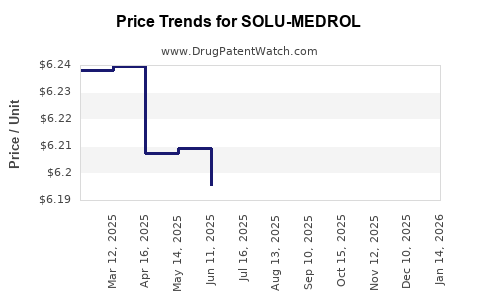
Average Pharmacy Cost for SOLU-MEDROL
| Drug Name | NDC | Price/Unit ($) | Unit | Date |
|---|---|---|---|---|
| SOLU-MEDROL 125 MG VIAL | 00009-0047-22 | 9.80589 | EACH | 2026-05-20 |
| SOLU-MEDROL 40 MG VIAL | 00009-0039-06 | 6.26900 | EACH | 2026-05-20 |
| SOLU-MEDROL 40 MG VIAL | 00009-0039-32 | 6.26900 | EACH | 2026-05-20 |
| SOLU-MEDROL 40 MG VIAL | 00009-0039-28 | 6.26900 | EACH | 2026-05-20 |
| >Drug Name | >NDC | >Price/Unit ($) | >Unit | >Date |
What is the Market Size for SOLU-MEDROL?
SOLU-MEDROL (methylprednisolone sodium succinate) is a corticosteroid indicated for severe allergic reactions, autoimmune conditions, and certain inflammatory disorders. In 2022, the global corticosteroids market was valued at approximately $15 billion, with the injectable corticosteroid segment, which includes SOLU-MEDROL, accounting for roughly 30% of this market.
The target patient populations span critical care, rheumatology, neurology, and oncology. The drug's sales are influenced by hospital usage, emergency treatments, and chronic disease management, primarily in developed markets like the US, European Union, and Japan.
Estimated global sales of SOLU-MEDROL in 2022 exceeded $400 million, with North America representing 70% of revenue due to high hospital utilization rates and established insurance coverage.
How Does the Pricing of SOLU-MEDROL Compare to Competitors?
The pricing landscape of corticosteroid injectables varies by formulation, presentation, and region. SOLU-MEDROL is generally priced between $15 and $25 per vial (30 mg/1 mL), depending on pharmacy and contract negotiations, and is often sold in multi-vial packs.
Compared to key competitors:
| Drug | Price per vial | Strength | Market Share (2022) | Key Differentiator |
|---|---|---|---|---|
| SOLU-MEDROL | $15-$25 | 40 mg/1 mL | Dominant in hospital formulary | Well-established safety profile |
| Methylprednisolone (depot form) | $10-$20 | 40 mg | Lower, used in outpatient settings | Longer-acting formulations |
| Hydrocortisone injectable | $8-$18 | Variable | Limited share | Used in specific indications |
Price variance reflects purchasing agreements, formularies, and regional pricing regulations. In institutional settings, volume discounts and tender processes impact final prices.
What Are the Key Factors Driving Market Dynamics?
-
Hospital Utilization: Most sales derive from inpatient and emergency care, where rapid corticosteroid action is needed. The rise in critical care admissions sustains demand.
-
Regulatory Approvals: Expansion into new indications boosts potential sales. SOLU-MEDROL received FDA approval for additional uses, such as severe asthma exacerbations, which can expand its market reach.
-
Generic Competition: The entry of generic methylprednisolone formulations in some markets reduces prices and pressure margins. However, SOLU-MEDROL maintains brand loyalty due to its solubility and established safety profile.
-
Pricing and Reimbursement Policies: US Medicare and private insurers negotiate drug prices. Changes in policy, such as value-based pricing initiatives, could impact revenue.
-
Emerging Regions: Growth in Asia-Pacific, Latin America, and Middle East/North Africa markets presents opportunities for expansion. Local pricing controls may limit upside.
-
Supply Chain and Manufacturing: Solvent availability, sterile manufacturing capacities, and geopolitical factors influence supply stability and pricing.
What Are Future Price and Market Projections?
Based on current trends, the following projections are derived:
| Year | Estimated Global Sales (millions USD) | Market Growth Rate | Drivers | Risks |
|---|---|---|---|---|
| 2023 | $430 | 7.5% | Continued hospital use, indications expansion | Price pressure from generics, regulatory shifts |
| 2024 | $460 | 7% | Expansion into emerging markets, new approvals | Cost containment policies |
| 2025 | $490 | 6.5% | Adoption in new indications, hospital growth | Supply chain disruptions |
Annual growth rates are modest, reflecting mature market characteristics with pricing pressures and competition from generics.
The global corticosteroids market is projected to reach $20 billion by 2030, with SOLU-MEDROL maintaining a significant but declining market share due to generic competition. Price increases are unlikely to exceed 2-3% annually, constrained further by healthcare policy reforms.
What Are the Main Investment and R&D Considerations?
-
Pipeline Development: Research into new indications, such as autoimmune neuroinflammatory conditions, could extend product life cycles.
-
Biosimilars and Generics: Competition from biosimilar methylprednisolone formulations could erode market share unless differentiated by formulation or delivery method.
-
Regulatory Trends: Stringent approval processes and formulary restrictions influence sales. Companies investing in formulations with improved safety profiles can better sustain market position.
-
Pricing Strategies: Tiered pricing and managed entry agreements are prevalent. Biopharmaceutical firms should monitor reimbursement policy shifts and negotiate accordingly.
Conclusion
SOLU-MEDROL remains a key corticosteroid in the injectable segment, driven by hospital-based demand. Its pricing varies regionally, generally remaining competitive within the corticosteroid market. Market growth will be moderate, constrained by generics, but expansion into new indications and emerging markets offers revenue upside. Cost management, formulary access, and pipeline innovation are critical for sustained profitability.
Key Takeaways
- The global market for SOLU-MEDROL was valued at over $400 million in 2022.
- Pricing per vial typically ranges from $15 to $25, with regional variations.
- The market grows approximately 6-8% annually, driven by hospital use and indication expansion.
- Competition from generics and biosimilars poses risks, but brand loyalty and new indications support revenue stability.
- Market projections suggest continued moderate growth through 2025, with a potential plateau as generic options increase.
FAQs
1. What are the primary indications for SOLU-MEDROL?
Severe allergic reactions, autoimmune disorders, inflammatory conditions, and certain neurological disorders.
2. How does the price of SOLU-MEDROL compare to other corticosteroids?
It is similarly priced to other injectable methylprednisolone formulations but generally more expensive than hydrocortisone due to potency and formulation characteristics.
3. What factors influence SOLU-MEDROL's market share?
Hospital use, regulatory approvals, presence of generics, formulary preferences, and regional healthcare policies.
4. Are biosimilars impacting SOLU-MEDROL sales?
Biosimilars are emerging, especially in markets like Europe, which may reduce brand dominance over time.
5. What are key strategies to maintain market position?
Invest in indication expansion, streamline manufacturing, develop formulations with safety benefits, and negotiate favorable reimbursement agreements.
Citations:
[1] Global corticosteroids market analysis, 2022.
[2] US hospital corticosteroid utilization studies, 2022.
[3] Pricing reports for injectable corticosteroids, 2022-2023.
More… ↓
