Last updated: September 8, 2026
Rectiv is the U.S. brand for nitroglycerin 0.4% ointment, approved for moderate-to-severe pain associated with chronic anal fissure. Its commercial opportunity is limited by the condition's small treated population, low treatment duration, physician preference for compounded alternatives, and the availability of generic nitroglycerin ointment. No standalone Rectiv revenue is publicly reported by its current or prior commercial owners. The product is therefore best viewed as a mature, niche prescription asset rather than a material growth driver.
What is RECTIV and what market does it address?
Rectiv contains nitroglycerin, also called glyceryl trinitrate, in a 0.4% topical ointment. Patients apply a measured amount to the anal canal, generally every 12 hours, for chronic anal fissure pain. The product relaxes the internal anal sphincter and increases local blood flow, which can reduce pain and support healing.[1]
| Attribute |
RECTIV |
| Active ingredient |
Nitroglycerin |
| Strength |
0.4% ointment |
| Dosage form |
Topical anorectal ointment |
| FDA indication |
Moderate-to-severe pain associated with chronic anal fissure |
| U.S. regulatory pathway |
NDA approval |
| Initial U.S. approval |
2011 |
| Prescription status |
Prescription-only |
| Primary commercial market |
United States |
| Treatment duration |
Up to 8 weeks under the U.S. label |
| Main competitors |
Compounded nitroglycerin, compounded diltiazem, compounded nifedipine, botulinum toxin, lateral internal sphincterotomy |
| Biosimilar relevance |
None |
The product addresses a specialized colorectal market. Chronic anal fissure is less prevalent than hemorrhoidal disease, inflammatory bowel disease, or colorectal cancer. Treatment is often initiated with conservative measures, stool softeners, fiber, sitz baths, and topical anesthetics before prescription vasodilator therapy.
When did RECTIV receive FDA approval?
Rectiv received FDA approval for pain associated with chronic anal fissure in 2011. The approval established nitroglycerin ointment as an FDA-approved branded treatment in a market where physicians had long used compounded topical formulations.
The FDA-approved indication is narrower than the broader clinical use of topical nitroglycerin. Rectiv is not approved for hemorrhoids, general anorectal pain, postoperative pain, or erectile dysfunction. Use in those settings does not expand the product's labeled commercial market.
The product's label carries important contraindications and warnings. Concurrent use with phosphodiesterase-5 inhibitors, such as sildenafil, tadalafil, or vardenafil, can produce severe hypotension. Headache is a common dose-limiting adverse event, which can reduce adherence and encourage substitution with topical calcium-channel blockers.[1]
What patents protect RECTIV?
The principal historical patent protection for Rectiv was associated with the use of nitroglycerin ointment for treating anal fissures. Public patent records identify U.S. Patent No. 6,699,493 as a key patent in the historical estate. The patent covered methods involving topical nitroglycerin for anorectal conditions and was assigned to entities associated with the product's development and commercialization.
| Patent asset |
Subject matter |
Commercial significance |
| U.S. Patent No. 6,699,493 |
Use of topical nitroglycerin for anal fissure and related anorectal conditions |
Historical method-of-use protection |
| Rectiv NDA |
FDA-approved 0.4% nitroglycerin ointment |
Regulatory protection and brand recognition |
| Manufacturing and formulation know-how |
Ointment preparation, dosing, packaging, and measurement |
Practical barrier, but weaker than active-ingredient exclusivity |
The key commercial limitation is that nitroglycerin is an old, well-known active ingredient. The product does not benefit from new-molecule exclusivity. Its protection depended primarily on method-of-use claims, formulation implementation, regulatory labeling, and commercial execution.
Patent expiry materially reduced the ability to prevent generic or compounded competition. Exact Orange Book patent listings and expiration dates should be assessed from the current FDA Orange Book edition because listed patents, delistings, pediatric adjustments, and marketing-status changes can affect the operative legal position.[2]
When does RECTIV lose exclusivity?
Rectiv's new-drug exclusivity period has expired. Because nitroglycerin was an established active ingredient, the product did not receive five-year new chemical entity exclusivity. Its commercial protection came from the NDA approval, any applicable three-year clinical-investigation exclusivity, and patents.
The practical loss of exclusivity occurred through a combination of:
- Expiration of historical method-of-use patent protection.
- Availability of pharmacy-compounded nitroglycerin.
- Generic approval or distribution of nitroglycerin ointment products.
- Physician willingness to prescribe alternative topical agents.
- Limited treatment duration, which weakens brand retention.
Rectiv does not have the type of durable regulatory moat associated with biologics, long-acting injectables, or recently approved small-molecule therapies.
What is the Orange Book status of RECTIV?
Rectiv is an FDA-approved prescription product associated with an NDA. The Orange Book is the controlling source for active listing status, approved dosage form, therapeutic equivalence evaluations, and patents or exclusivity associated with the NDA.[2]
The commercial value of an Orange Book listing is constrained in this case by the product's niche indication and the possibility of compounding. Even where a generic product must address listed patents through a Paragraph IV certification, compounding pharmacies can compete outside the conventional ANDA pathway.
A company seeking to launch an ANDA product would normally evaluate:
- Listed method-of-use patents.
- Labeling requirements for the chronic anal fissure indication.
- Whether a proposed label must carve out patented use language.
- Formulation equivalence.
- Container-closure and dose-measurement requirements.
- Bioequivalence or other FDA requirements for a topical ointment.
Have companies filed Paragraph IV challenges to RECTIV?
Publicly visible commercial activity around Rectiv has been limited compared with high-revenue drugs. There is no widely reported, high-value Paragraph IV litigation campaign comparable with those involving blockbuster medicines.
A Paragraph IV challenge would be commercially difficult to justify unless the challenger could obtain meaningful reimbursement and physician uptake. The market is small, the treatment course is short, and compounded alternatives already place pressure on the branded price. Litigation costs could therefore consume a large portion of expected gross profit.
The more important competitive threat has historically been non-ANDA substitution, particularly compounded diltiazem and nifedipine. Those products can be prescribed for anal fissure without reproducing the Rectiv brand or pursuing a conventional generic launch.
What formulations are protected by RECTIV?
Rectiv's commercial differentiation is its standardized 0.4% nitroglycerin ointment formulation, measured dosing instructions, FDA-reviewed manufacturing controls, and labeled indication. The active ingredient itself is not proprietary.
The formulation creates some practical advantages:
- Consistent concentration.
- Standardized packaging.
- FDA-reviewed quality controls.
- Patient instructions for application.
- Prescription recognition among colorectal specialists.
- Reduced dependence on individual compounding pharmacies.
Those advantages are real but limited. A compounded formulation can be less expensive and may use diltiazem or nifedipine, which can avoid nitroglycerin-associated headaches. Compounded products also allow prescribers to adjust strength, vehicle, and quantity.
How strong is the RECTIV patent estate?
The Rectiv patent estate is weak to moderate from a current commercial perspective.
Factors supporting the estate
- FDA-approved indication.
- Established clinical use.
- Branded formulation and packaging.
- Historical method-of-use patent protection.
- Physician familiarity in colorectal practice.
Factors limiting the estate
- Old, off-patent active ingredient.
- No biologic or device component.
- No durable NCE exclusivity.
- Compounding pharmacies can offer substitutes.
- Alternative active ingredients are clinically accepted.
- Short treatment duration limits recurring revenue.
- Headache risk reduces patient persistence.
The product's most defensible assets are regulatory quality, brand familiarity, and supply reliability rather than broad exclusionary patent rights.
How does RECTIV compare with competing treatments?
| Treatment |
Regulatory and commercial position |
Main advantage |
Main limitation |
| Rectiv |
FDA-approved nitroglycerin ointment |
Standardized, labeled product |
Cost, headache, limited market |
| Compounded nitroglycerin |
Pharmacy-compounded |
Lower price and flexible formulation |
Variable availability and quality controls |
| Compounded diltiazem |
Widely used off-label |
Often fewer headaches |
No FDA-approved anal-fissure indication |
| Compounded nifedipine |
Widely used off-label |
Alternative mechanism and tolerability |
Compounding dependence |
| Botulinum toxin |
Procedural treatment |
Option after topical failure |
Injection, cost, recurrence |
| Lateral internal sphincterotomy |
Surgical treatment |
High healing rates |
Incontinence risk and surgical burden |
Rectiv's primary economic competitor is compounded diltiazem, not another branded pharmaceutical. The physician's decision often depends on payer coverage, local compounding access, headache tolerance, symptom severity, and willingness to proceed to surgery.
What is the financial trajectory of RECTIV?
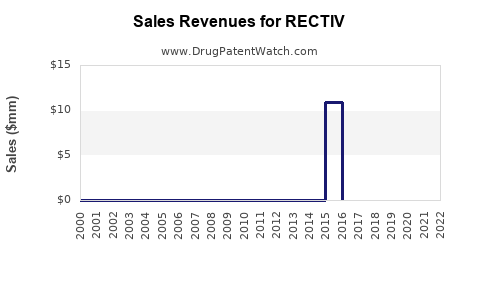
No standalone annual revenue series for Rectiv is publicly disclosed in the SEC filings of its prior or current corporate owners. Public companies have generally reported the product within broader prescription-product, specialty-pharmaceutical, or established-brand portfolios rather than as a separate revenue line.
The financial trajectory is therefore best characterized by market structure:
| Period |
Commercial profile |
Financial implication |
| Launch period |
First FDA-approved branded nitroglycerin product for chronic anal fissure pain |
Initial pricing and brand-creation opportunity |
| Early post-launch |
Specialist adoption and reimbursement development |
Limited but defensible niche revenue |
| Patent erosion period |
Increased generic and compounded competition |
Pricing pressure and reduced share |
| Mature market |
Short-course use and multiple substitutes |
Low recurring revenue and limited growth |
| Current opportunity |
Specialty or generic supply strategy |
Margin depends on manufacturing and reimbursement |
Revenue exposure to Rectiv is likely immaterial for a diversified pharmaceutical company. The product can still have value for a focused specialty-pharma owner because manufacturing costs may be low, commercial infrastructure may already exist, and colorectal specialists can be targeted efficiently. The asset is less attractive as a standalone acquisition if the buyer must fund a large sales force, new clinical studies, or patent litigation.
Which companies are challenging RECTIV commercially?
Commercial competition comes from several groups:
- Generic manufacturers of nitroglycerin ointment.
- Compounding pharmacies producing nitroglycerin 0.2% or 0.4% formulations.
- Compounding pharmacies producing diltiazem or nifedipine.
- Manufacturers of botulinum toxin products used in refractory fissure.
- Surgical providers offering sphincterotomy.
The competitive field is fragmented. No single rival needs to replace Rectiv nationally. Local formulary decisions and regional compounding capacity can redirect demand.
What generic launch risks exist for RECTIV?
A generic launch would face regulatory, commercial, and technical issues.
Regulatory risks
The applicant must establish pharmaceutical equivalence and satisfy FDA requirements for a topical anorectal ointment. A label carve-out may be needed if method-of-use patents remain listed and enforceable.
Manufacturing risks
Nitroglycerin is potent and requires controlled handling. The manufacturer must manage content uniformity, stability, packaging compatibility, worker exposure, and dose delivery. These requirements are manageable but more demanding than ordinary dermatologic ointments.
Commercial risks
The addressable population is small. A generic entrant may face:
- Low prescription volume.
- Payer substitution requirements.
- Limited pharmacy stocking.
- Competition from compounding.
- Weak physician switching incentives.
- Price compression after multiple entrants.
Litigation risks
Any remaining Orange Book patent could trigger a Paragraph IV dispute. The expected value of litigation is constrained by the market's modest size and the availability of non-ANDA substitutes.
What licensing deals and ownership changes affect RECTIV?
Rectiv has been associated with specialty-pharma commercialization structures rather than a major multinational growth platform. Ownership and distribution arrangements have changed over time as specialty-product portfolios moved through corporate transactions.
No major recent licensing transaction has been publicly identified as a material driver of Rectiv's market value. The commercial asset is more likely to change hands through portfolio acquisitions, product divestitures, or distributor arrangements than through a large strategic licensing deal.
For valuation purposes, the relevant diligence points are:
- Current NDA holder.
- Current labeler and manufacturer.
- Supply continuity.
- Active Orange Book status.
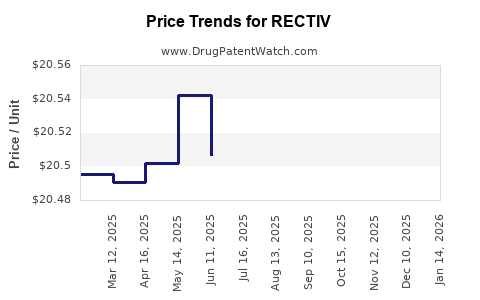
- Current wholesale acquisition cost.
- Payer coverage.
- Generic and compounded availability.
- Product complaints and recalls.
- Remaining patent or regulatory exclusivity.
What is the outlook for RECTIV?
Rectiv's outlook is stable to declining in branded terms. Demand should remain supported by patients and physicians seeking an FDA-approved, standardized prescription product. Growth is constrained by the small indication, short treatment duration, generic availability, and off-label alternatives.
The strongest commercial scenarios are:
- A focused specialty company maintains premium pricing through reliable supply and colorectal-specialist promotion.
- The brand retains a reimbursement advantage over compounded products.
- A manufacturer uses Rectiv as part of a broader anorectal or gastroenterology portfolio.
- A generic entrant gains volume but accepts low margins.
The weakest scenario is a standalone branded strategy requiring substantial promotional spending. The addressable market is unlikely to support blockbuster economics.
Key Takeaways
- Rectiv is nitroglycerin 0.4% ointment for pain associated with chronic anal fissure.
- FDA approval was obtained in 2011; the active ingredient is old and lacks NCE exclusivity.
- Historical protection relied on method-of-use patents, including U.S. Patent No. 6,699,493.
- Compounded nitroglycerin, diltiazem, and nifedipine are major competitive substitutes.
- No standalone Rectiv revenue trajectory is publicly reported.
- The brand is a mature niche product with limited recurring revenue.
- Generic entry risk is commercially meaningful even without major Paragraph IV litigation.
- The strongest asset attributes are standardized quality, FDA labeling, and supply reliability.
- Rectiv is more suitable for a focused specialty portfolio than for a standalone growth investment.
- Biosimilar risk is irrelevant because Rectiv is a small-molecule topical drug, not a biologic.
FAQs
Is Rectiv still FDA approved?
Yes. Rectiv is an FDA-approved prescription nitroglycerin 0.4% ointment for pain associated with chronic anal fissure, subject to current FDA labeling and marketing status.
Is Rectiv the same as compounded nitroglycerin?
The active ingredient and nominal concentration can be the same, but Rectiv is an FDA-approved standardized product. Compounded nitroglycerin is prepared by a pharmacy under applicable compounding rules and may differ in vehicle, packaging, quality controls, and availability.
Can diltiazem replace Rectiv?
Physicians commonly use compounded diltiazem as an off-label alternative. It may cause fewer headaches than nitroglycerin, but it does not have the same FDA-approved labeling for chronic anal fissure pain.
Does Rectiv have biosimilar competition?
No. Biosimilars apply to biologic products. Rectiv is a small-molecule nitroglycerin ointment, so its relevant competitors are generic products and compounded formulations.
Is Rectiv an attractive pharmaceutical acquisition target?
It can be attractive as a low-overhead specialty product within an existing gastroenterology or colorectal portfolio. Its limited indication, short treatment course, patent erosion, and compounded competition make it a weak standalone platform asset.
References
- U.S. Food and Drug Administration. (2011). Rectiv (nitroglycerin) ointment, 0.4% prescribing information.
- U.S. Food and Drug Administration. (2024). Approved drug products with therapeutic equivalence evaluations: Orange Book.
- U.S. Patent and Trademark Office. (2004). U.S. Patent No. 6,699,493: Treatment of anal fissures with nitroglycerin.
- U.S. Food and Drug Administration. (2023). Approved drug products and patent and exclusivity information.
- American Society of Colon and Rectal Surgeons. (2023). Clinical practice guidelines for the management of anal fissures. Diseases of the Colon & Rectum.