Last Updated: May 9, 2026

NITROGLYCERIN - Generic Drug Details


✉ Email this page to a colleague

« Back to Dashboard


What are the generic drug sources for nitroglycerin and what is the scope of patent protection?

Nitroglycerin is the generic ingredient in sixteen branded drugs marketed by Evus, Pohl Boskamp, Bausch, Valeant Pharms, Valeant Pharms North, Uspharma, Lannett Co Inc, Mylan Technologies, Zydus Pharms, Novartis, Sanofi Aventis Us, Abraxis Pharm, Am Regent, Hospira, Intl Medication, Luitpold, Smith And Nephew, Baxter Hlthcare, Rorer, Parke Davis, Cosette, Encube, Solaris Pharma Corp, Tp Anda Holdings, Abbvie, Fougera Pharms Inc, Padagis Israel, Actavis Labs Fl Inc, Aurobindo Pharma, Dr Reddys, Glenmark Speclt, Mankind Pharma, Natco, Rubicon Research, Sigmapharm Labs Llc, Viwit Pharm, and Viatris, and is included in fifty-six NDAs. There are two patents protecting this compound and four Paragraph IV challenges. Additional information is available in the individual branded drug profile pages.

Nitroglycerin has twenty patent family members in nine countries.

There are thirty-six drug master file entries for nitroglycerin. Thirty-seven suppliers are listed for this compound. There are three tentative approvals for this compound.

Summary for NITROGLYCERIN
International Patents:20
US Patents:2
Tradenames:16
Applicants:37
NDAs:56
Drug Master File Entries: 36
Finished Product Suppliers / Packagers: 37
Raw Ingredient (Bulk) Api Vendors: 1
Clinical Trials: 211
Patent Applications: 6,626
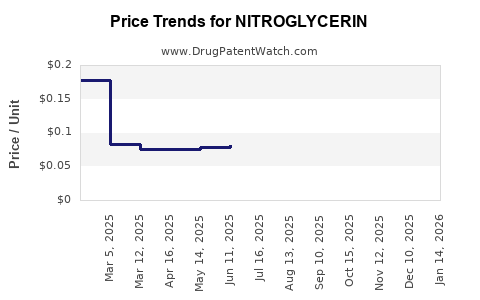
Drug Prices: Drug price trends for NITROGLYCERIN
What excipients (inactive ingredients) are in NITROGLYCERIN?NITROGLYCERIN excipients list
DailyMed Link:NITROGLYCERIN at DailyMed
Drug Prices for NITROGLYCERIN

See drug prices for NITROGLYCERIN

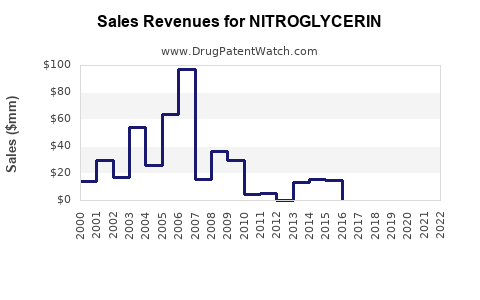
Drug Sales Revenue Trends for NITROGLYCERIN

See drug sales revenues for NITROGLYCERIN

Recent Clinical Trials for NITROGLYCERIN

Identify potential brand extensions & 505(b)(2) entrants

SponsorPhase
Pi Research and Development Center, BangladeshPHASE2
Beacon Pharmaceuticals PLCPHASE2
Chittagong Medical CollegePHASE2

See all NITROGLYCERIN clinical trials

Generic filers with tentative approvals for NITROGLYCERIN
Applicant Application No. Strength Dosage Form
⤷  Start Trial⤷  Start Trial0.2MG/HRFilm, Extended Release; Transdermal
⤷  Start Trial⤷  Start Trial0.4MG/HRFilm, Extended Release; Transdermal
⤷  Start Trial⤷  Start Trial0.6MG/HRFilm, Extended Release; Transdermal

The 'tentative' approval signifies that the product meets all FDA standards for marketing, and, but for the patents / regulatory protections, it would approved.

Pharmacology for NITROGLYCERIN
Drug ClassNitrate Vasodilator
Physiological EffectVasodilation
Medical Subject Heading (MeSH) Categories for NITROGLYCERIN
Paragraph IV (Patent) Challenges for NITROGLYCERIN
Tradename Dosage Ingredient Strength NDA ANDAs Submitted Submissiondate
NITROLINGUAL PUMPSPRAY Sublingual Spray nitroglycerin 400 mcg/spray, 4.9 g and 12 g bottles 018705 1 2012-04-17
NITROSTAT Sublingual Tablets nitroglycerin 0.3 mg, 0.4 mg, and 0.6 mg 021134 1 2005-10-19

US Patents and Regulatory Information for NITROGLYCERIN

Applicant Tradename Generic Name Dosage NDA Approval Date TE Type RLD RS Patent No. Patent Expiration Product Substance Delist Req. Exclusivity Expiration
Parke Davis NITROSTAT nitroglycerin INJECTABLE;INJECTION 070863-001 Jan 8, 1987 DISCN No No ⤷  Start Trial ⤷  Start Trial ⤷  Start Trial
Bausch MINITRAN nitroglycerin FILM, EXTENDED RELEASE;TRANSDERMAL 089773-001 Aug 30, 1996 DISCN No No ⤷  Start Trial ⤷  Start Trial ⤷  Start Trial
Hospira NITROGLYCERIN IN DEXTROSE 5% nitroglycerin INJECTABLE;INJECTION 071848-001 Aug 31, 1990 DISCN No No ⤷  Start Trial ⤷  Start Trial ⤷  Start Trial
Valeant Pharms MINITRAN nitroglycerin FILM, EXTENDED RELEASE;TRANSDERMAL 089771-001 Aug 30, 1996 DISCN No No ⤷  Start Trial ⤷  Start Trial ⤷  Start Trial
Mylan Technologies NITROGLYCERIN nitroglycerin FILM, EXTENDED RELEASE;TRANSDERMAL 074992-003 Nov 12, 1999 DISCN No No ⤷  Start Trial ⤷  Start Trial ⤷  Start Trial
Dr Reddys NITROGLYCERIN nitroglycerin TABLET;SUBLINGUAL 208191-002 Aug 26, 2016 AB RX No No ⤷  Start Trial ⤷  Start Trial ⤷  Start Trial
Rubicon Research NITROGLYCERIN nitroglycerin TABLET;SUBLINGUAL 209779-002 May 3, 2021 AB RX No No ⤷  Start Trial ⤷  Start Trial ⤷  Start Trial
>Applicant >Tradename >Generic Name >Dosage >NDA >Approval Date >TE >Type >RLD >RS >Patent No. >Patent Expiration >Product >Substance >Delist Req. >Exclusivity Expiration

Expired US Patents for NITROGLYCERIN

Applicant Tradename Generic Name Dosage NDA Approval Date Patent No. Patent Expiration
Pohl Boskamp NITROLINGUAL PUMPSPRAY nitroglycerin SPRAY, METERED;SUBLINGUAL 018705-002 Jan 10, 1997 5,186,925 ⤷  Start Trial
Uspharma NITRO-DUR nitroglycerin FILM, EXTENDED RELEASE;TRANSDERMAL 020145-006 Apr 4, 1995 5,186,938 ⤷  Start Trial
Uspharma NITRO-DUR nitroglycerin FILM, EXTENDED RELEASE;TRANSDERMAL 020145-002 Apr 4, 1995 5,186,938 ⤷  Start Trial
Viatris NITROSTAT nitroglycerin TABLET;SUBLINGUAL 021134-001 May 1, 2000 6,500,456 ⤷  Start Trial
Novartis TRANSDERM-NITRO nitroglycerin FILM, EXTENDED RELEASE;TRANSDERMAL 020144-005 Feb 27, 1996 4,812,313 ⤷  Start Trial
Evus NITROMIST nitroglycerin AEROSOL, METERED;SUBLINGUAL 021780-001 Nov 2, 2006 5,869,082 ⤷  Start Trial
Novartis TRANSDERM-NITRO nitroglycerin FILM, EXTENDED RELEASE;TRANSDERMAL 020144-001 Feb 27, 1996 4,954,344 ⤷  Start Trial
>Applicant >Tradename >Generic Name >Dosage >NDA >Approval Date >Patent No. >Patent Expiration

International Patents for NITROGLYCERIN

Country Patent Number Title Estimated Expiration
Brazil PI0908577 preparação farmacêutica estável por longo tempo com a substância ativa trinitrato de glicerol ⤷  Start Trial
Canada 2718345 PREPARATION PHARMACEUTIQUE A GRANDE STABILITE, CONTENANT LE PRINCIPE ACTIF TRINITRATE DE GLYCEROL (LONG-TERM STABLE PHARMACEUTICAL PREPARATION HAVING THE ACTIVE INGREDIENT GLYCEROL TRINITRATE) ⤷  Start Trial
European Patent Office 2678000 GRANULES STABILISÉS CONTENANT DU TRINITRATE DE GLYCÉRYLE (STABILIZED GRANULES CONTAINING GLYCERYL TRINITRATE) ⤷  Start Trial
Australia 2009224968 Long-term stable pharmaceutical preparation having the active ingredient glycerol trinitrate ⤷  Start Trial
World Intellectual Property Organization (WIPO) 2009112258 ⤷  Start Trial
Poland 2678000 ⤷  Start Trial
Germany 202008007318 ⤷  Start Trial
>Country >Patent Number >Title >Estimated Expiration

Market Dynamics and Financial Trajectory for Nitroglycerin

Last updated: April 23, 2026

Nitroglycerin is a long-established cardiovascular drug used primarily for acute angina and, depending on formulation, chronic angina. Its market trajectory is defined less by patent-led entry waves and more by (1) the scale of legacy supply, (2) steady generic availability, (3) persistent demand for anti-anginal therapy, and (4) competitive pressure on pricing across oral, sublingual, and transdermal delivery routes.

What does the nitroglycerin market look like by use case?

Core clinical use

Nitroglycerin is used in two high-volume therapy categories:

  • Acute angina relief (fast onset, typically sublingual or spray depending on country/label)
  • Chronic angina prophylaxis via extended-release oral and transdermal formulations (patch/ointment across markets)

Practical implication for demand stability

Demand is structurally supported by:

  • Chronic cardiovascular disease prevalence and recurrent angina management cycles
  • Broad clinician familiarity with nitroglycerin across emergency and outpatient settings
  • Continued use as a rapid-acting symptomatic therapy even as long-term risk management (statins, antiplatelets, beta-blockers) evolves

How do formulation and route shape competitive dynamics?

Delivery route determines competitive “buckets”

Nitroglycerin competes within distinct product-format categories:

  • Sublingual / buccal (acute relief)
  • Oral extended-release (chronic dosing)
  • Transdermal (chronic dosing)
  • Intravenous (acute hospital settings, if offered as a distinct supply stream)

Route-level economics

These route buckets create pricing and supply differences:

  • Acute relief products face less direct substitution at the point of care because onset matters and switching can affect perceived symptom control.
  • Chronic formulations face more substitution across classes of anti-anginals (beta-blockers, calcium channel blockers, ranolazine where used), which increases downward pricing pressure in some geographies.
  • Transdermal faces manufacturing quality constraints (content uniformity, skin absorption profile, adhesion/irritation tolerance), which can reduce the number of viable suppliers even in generic-heavy markets.

What are the main market drivers and headwinds?

Market drivers

  • Ubiquitous cardiovascular need: Angina remains a large global indication class.
  • Established clinical workflow: Emergency departments and outpatient cardiology programs maintain routine access pathways.
  • Low “switching cost” for payers: Generic dominance lowers reimbursement barriers versus newer branded drugs.

Market headwinds

  • Generic price erosion: With legacy compounds, pricing tends to compress toward low-cost supply.
  • Class-level substitution: In chronic angina, competitors across multiple mechanisms can displace long-term nitroglycerin usage for parts of the patient population.
  • Formulation-specific limits: Transdermal and oral regimens have dosing schedules and tolerability constraints (headache, tolerance/withdrawal patterns) that affect adherence and refill rates.

How does regulation and IP status influence the financial trajectory?

IP outcome: legacy and generic environment

Nitroglycerin is an older molecule with no sustained, proprietary revenue stream typical of late-stage patented brands. In practice, financial trajectory is tied to:

  • Generic entry cycles
  • Copy/authorized generic expansion
  • Fragmented supply networks across oral and transdermal categories

Regulatory positioning

Nitroglycerin has long-established inclusion on national formularies for cardiovascular emergency and anti-anginal therapy. That keeps volume demand resilient but shifts financial outcomes toward manufacturing efficiency and contract pricing rather than product differentiation.

What does a “financial trajectory” look like for nitroglycerin in a generic-led market?

Revenue mechanics by stage

For legacy generics, the typical revenue pattern is:

  1. Baseline demand stability from continuous clinical use
  2. Margin compression as additional generic competitors enter
  3. Volume consolidation toward the lowest-cost suppliers and pharmacy benefit managers (PBMs)
  4. Occasional bumps from supply constraints, manufacturing disruptions, or formulation-level demand shifts (for example, transdermal preferences in certain populations)

What investors and R&D teams should infer

  • Growth is harder to “engineer” through new clinical claims because nitroglycerin’s clinical role is already defined.
  • Differentiation is more likely to come from formulation improvements (tolerability, adherence, delivery reliability) or regional supply contracts, rather than new molecular IP.

Where does nitroglycerin compete financially: alternatives and substitution risk

Substitution by therapy class

In chronic angina, clinicians often balance:

  • Beta-blockers
  • Calcium channel blockers
  • Long-acting nitrates
  • Other anti-anginals

This increases competitive pressure particularly on long-acting nitroglycerin formulations. In acute settings, substitution tends to be narrower because rapid symptom relief is the immediate target.

Pricing pressure profile

Generic competition drives:

  • Lower acquisition costs for payers
  • Higher inventory turnover for distributors
  • Margin thinning at retail and wholesaler levels

Market and product structure: what categories drive the bulk of sales?

Most economically meaningful segments

Across most mature markets, the revenue mix is typically weighted toward:

  • Chronic angina maintenance formats (transdermal and extended-release oral)
  • Acute relief supply (sublingual)

Why the mix matters

  • Chronic formats usually have repeat dosing patterns and steady refill volumes.
  • Acute relief is event-driven but still scales with cardiovascular incidence and emergency utilization.

Competitive landscape: what types of companies win share?

Nitroglycerin competition is dominated by suppliers that can manage:

  • Cost-per-tablet or cost-per-dose manufacturing
  • Regulatory compliance and batch release stability
  • Distribution contracts and payer formulary placement
  • Supply continuity (reducing pharmacy backorders that force switching)

In practical terms, winners are often large generic manufacturers and regional distributors with mature supply chains for legacy cardiovascular products.

How does demand vary across geographies and procurement channels?

Geographical variation

Volume is driven by cardiovascular disease prevalence and prescribing habits, but financial outcomes vary by:

  • Generic penetration rates
  • PBM contracting structures
  • Tendering and hospital procurement rules
  • Reimbursement ceilings and reference pricing

Procurement channels

  • Hospital procurement influences IV and acute relief distribution more directly.
  • Retail pharmacy networks shape oral and sublingual access.
  • Institutional formularies influence chronic transdermal and oral sustained-release positioning.

Key implications for business planning

1) Expect low-price, high-volume dynamics

Nitroglycerin tends to operate in a market where incremental unit price changes matter less than:

  • supply reliability
  • manufacturing yield
  • contracting terms

2) Formulation strategy is the main lever

New development is most likely to translate into value if it improves:

  • adherence (less dosing friction)
  • tolerability (headache mitigation strategies)
  • pharmacokinetic consistency (less variability across batches)

3) Commercial strategy must prioritize payer economics

In legacy cardiovascular drugs, durable revenue is more connected to:

  • formulary position
  • tender awards
  • pharmacy reimbursement design than to differentiation claims that have limited market room.

Key Takeaways

  • Nitroglycerin’s market trajectory is defined by legacy demand plus generic-led pricing pressure.
  • Revenue mechanics are shaped by delivery route: acute relief products compete within onset-critical use, while chronic formulations face broader class substitution.
  • Financial performance depends more on manufacturing scale, supply continuity, and contracting than on patent-protected differentiation.
  • Long-acting and transdermal categories carry repeat dosing economics but operate under sustained margin compression.

FAQs

1) Is nitroglycerin growth likely driven by innovation or by market share shifts?

Market economics favor share shifts via supply, contracting, and formulation-level improvements rather than breakthrough innovation, because the molecule’s clinical role is established in mature therapy pathways.

2) Which formulation types face the most substitution risk?

Long-acting formats used for chronic angina typically face the highest substitution risk across competing anti-anginal classes.

3) What determines supplier profitability most in a generic nitroglycerin environment?

Profitability usually hinges on manufacturing efficiency, regulatory batch release performance, and payer or tender contracting terms that set net price.

4) Does nitroglycerin demand remain stable during economic downturns?

Demand for symptomatic cardiovascular therapy tends to remain resilient, but net revenues still compress as pricing pressure and reference pricing intensify.

5) Where are the most realistic commercial “edges” for new entrants?

Edges typically come from formulation performance (tolerability and delivery consistency), reliable supply, and securing formulary or tender placement rather than new IP-driven market creation.


References

[1] U.S. National Library of Medicine. “Nitroglycerin.” DailyMed. https://dailymed.nlm.nih.gov/
[2] World Health Organization. “WHO Model List of Essential Medicines.” WHO. https://www.who.int/teams/health-product-policy-and-standards/essential-medicines/
[3] National Institute for Health and Care Excellence (NICE). “Stable angina: management.” NICE guideline. https://www.nice.org.uk/

More… ↓

⤷  Start Trial

Make Better Decisions: Try a trial or see plans & pricing

Drugs may be covered by multiple patents or regulatory protections. All trademarks and applicant names are the property of their respective owners or licensors. Although great care is taken in the proper and correct provision of this service, thinkBiotech LLC does not accept any responsibility for possible consequences of errors or omissions in the provided data. The data presented herein is for information purposes only. There is no warranty that the data contained herein is error free. We do not provide individual investment advice. This service is not registered with any financial regulatory agency. The information we publish is educational only and based on our opinions plus our models. By using DrugPatentWatch you acknowledge that we do not provide personalized recommendations or advice. thinkBiotech performs no independent verification of facts as provided by public sources nor are attempts made to provide legal or investing advice. Any reliance on data provided herein is done solely at the discretion of the user. Users of this service are advised to seek professional advice and independent confirmation before considering acting on any of the provided information. thinkBiotech LLC reserves the right to amend, extend or withdraw any part or all of the offered service without notice.