Last updated: June 28, 2026
PROGLYCEM market dynamics and financial trajectory (1980s–present)
PROGLYCEM (diazoxide) has followed a “hospital-commodity” and “supply-driven” commercial model rather than a growth-through-innovation model. Its financial trajectory has been shaped by (1) narrow, high-acuity indications (primarily refractory hypoglycemia from hyperinsulinism and related endocrine causes), (2) limited manufacturer count and periodic supply constraints, and (3) patent-and-exclusivity maturity that enabled generic availability. Commercial performance is therefore best characterized by volume and procurement cycles in specialty care, pricing pressure from generics, and episodic demand spikes tied to clinical practice patterns and drug availability.
What is Proglycem (diazoxide) used for and why do those indications drive its market dynamics?
Core commercial demand is tied to refractory hyperinsulinemic hypoglycemia and pediatric endocrine care. Diazoxide is a KATP channel opener used to suppress insulin secretion. Demand is concentrated in settings that treat difficult-to-control hypoglycemia where diazoxide remains a standard medical tool.
Key demand drivers by clinical setting
- Pediatric endocrinology and neonatology
- Hyperinsulinism syndromes and persistent hypoglycemia after initial evaluation.
- High acuity and “last-line” use after initial medical measures or during decision windows for further interventions.
- Specialty hospital procurement
- Recurrent purchasing cycles and formulary decisions.
- Tendering and contract pricing can dominate annual revenue more than retail uptake.
Market consequence
- Diazoxide is not a broad outpatient chronic therapy, so revenue is more sensitive to:
- hospital budget cycles,
- availability and lead-time,
- payer coverage and prior authorization practices,
- substitution dynamics (therapeutic alternatives when available and clinically acceptable).
How has generic competition affected Proglycem pricing and revenue?
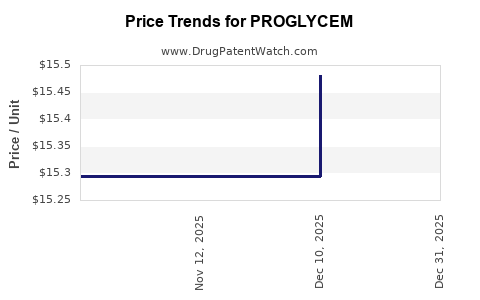
Generic availability compresses pricing and caps long-term margin structure. Diazoxide’s active ingredient is off-patent, so Proglycem’s brand economics rely on remaining differentiation through supply reliability, packaging, and contracting rather than exclusivity.
Typical post-exclusivity pricing dynamics for off-patent injectables/oral oncology-like demand patterns
- Wholesale acquisition cost (WAC) declines as generic entrants compete.
- Net price becomes contract-driven, with discounts and rebates and channel leverage.
- Brand share persists where procurement avoids disruption risk during shortages.
Market consequence
- Brand revenue tends to track:
- shifts in generic supply,
- tender specifications that favor reliable suppliers,
- episodic “buy-the-source” behavior when a product is in shortage.
When does Proglycem lose exclusivity and what does that mean for long-term financial trajectory?
Exclusivity has effectively expired for the active ingredient, shifting the commercial model to generics and supply management. For most investors and acquirers, the financial question becomes less about patent life and more about:
- continued ability to supply,
- manufacturing scale and cost competitiveness,
- inventory management and shortage response,
- regulatory and quality stability.
Practical impact on valuation and revenue planning
- Revenue becomes lumpy around supply constraints and batch availability.
- Gross margin becomes volatile due to cost spikes in manufacturing, freight, and raw materials, plus contract pricing swings.
What patents protect diazoxide and how do patent estates influence Proglycem profitability now?
For mature pharmaceuticals, the relevant issue is not whether “diazoxide has patents,” but whether the remaining patent thicket blocks generic entry for specific formulations, pack sizes, manufacturing methods, or labeling. In the diazoxide market, financial trajectory is dominated by generic access to the active ingredient, so any remaining IP usually impacts:
- niche formulation strengths,
- specific dosage forms,
- specific label indications or dosing regimens.
How that maps to revenue
- If there are no blocking formulation/manufacturing patents, the brand behaves like a legacy supplier in a commoditized market.
- If there are blocking patents, the brand can maintain a limited price floor in narrow SKUs, but overall trajectory remains constrained by the small addressable indication set.
What is the Orange Book status of Proglycem, and how does it affect generic entry risk?
Orange Book status drives whether generics can file and launch quickly. For mature products, the key commercial risk is whether ANDA applicants face:
- listed patent barriers that trigger Paragraph IV,
- delays from patent settlements,
- or labeling and manufacturing workarounds.
Market consequence for Proglycem
- The presence or absence of Orange Book blocking patents determines how many generics exist and when they can maintain supply.
- In practice, diazoxide’s commercial profile is usually shaped by supply reliability and limited supplier count, which can keep brand SKUs viable even after exclusivity.
How does FDA regulation and manufacturing continuity affect Proglycem availability and financial outcomes?
For legacy drugs, manufacturing continuity is a primary financial driver:
- FDA inspections and quality actions can remove a supplier temporarily.
- Raw material supply constraints can delay batches.
- Facility capacity limits can prevent meeting hospital demand.
Why availability moves revenue
- If a competitor product is unavailable, hospitals switch procurement to the remaining reliable SKU.
- If the brand remains the only dependable supply, it can capture short-term demand even when generic pricing is lower.
What generic entry risks exist for Proglycem and how do Paragraph IV disputes play into it?
For an established commodity like diazoxide, the biggest risks are less about discovering new IP and more about whether:
- new ANDA entrants can pass bioequivalence and chemistry controls without launch delays,
- suppliers remain online in a constrained market,
- and any Orange Book-listed patents create procedural launch timing pressure.
Expected litigation impact on commercial timeline
- Paragraph IV disputes typically create entry timing uncertainty.
- Even after patent barriers are cleared, entrants may be delayed by manufacturing scale and CMO capacity.
Which companies compete in the diazoxide market, and how does that alter Proglycem’s commercial share?
Proglycem competes against:
- multiple generic diazoxide suppliers for equivalent dosing and routes, and
- therapeutic alternatives used in specific clinical algorithms for hyperinsulinemic hypoglycemia.
Market share mechanics in commoditized legacy drugs
- Share follows supply uptime, not marketing.
- Contracted hospital systems can be “sticky” once a supplier demonstrates reliability.
How does Proglycem compare with therapeutic alternatives for refractory hypoglycemia in terms of market pull-through?
Diazoxide sits within a broader clinician decision set. Market pull-through depends on:
- how often diazoxide is used first vs as rescue therapy,
- how quickly clinicians can switch to alternatives when side effects occur or when diazoxide is unavailable.
Competitive dynamics that affect financial trajectory
- Alternatives that reduce the proportion of “diazoxide-refractory” cases reduce demand.
- Temporary supply shortages can increase diazoxide utilization even if alternatives exist.
What events most likely drove spikes or dips in Proglycem sales?
Across legacy off-patent products, revenue shifts usually track supply and contracting rather than clinical breakthroughs.
Likely event categories
- Shortages or limited availability
- When supply tightens, hospitals buy remaining inventory.
- Quality or inspection events
- Can temporarily reduce production.
- Contract procurement and tender cycles
- Can shift annual volume between suppliers.
- Generic batch quality or recall events
- Re-routes demand to the brand or other remaining suppliers.
- Formulary changes
- Payer and hospital formulary adjustments can shift usage patterns.
What does the financial trajectory look like: growth, plateau, or decline?
Baseline trajectory: plateau-to-decline at the brand level with volatility driven by supply events. The long-run brand economics are constrained by:
- generic substitution,
- narrow patient population,
- small addressable indications in pediatric endocrine practice.
How to interpret “financial trajectory” for a legacy drug
- Annual revenue is typically determined by:
- how many suppliers are available in any given quarter,
- pricing and contract terms,
- and whether shortage conditions allow brand capture of incremental volume.
Proglycem commercial model vs. typical specialty pharmaceuticals: what is different?
- Not a high-growth specialty blockbuster
- It has limited expansion mechanisms because the clinical niche is narrow.
- Not reliant on new endpoints
- The product’s clinical role is established; the key variable is supply and procurement.
- Sensitive to unit supply
- Small disruptions can swing demand share quickly.
Key tables: market and revenue drivers (operational lens)
Market driver map
| Driver |
Mechanism |
Expected effect on Proglycem revenue |
| Generic availability |
Price competition, substitution |
Downward pressure on net revenue |
| Supplier count changes |
Fewer suppliers raise effective demand capture |
Upward pressure during constrained supply |
| Shortages |
Hospitals procure remaining dependable SKU |
Revenue spikes, then normalization |
| Contracting/tenders |
Annual hospital procurement cycles |
Step changes quarter-to-quarter |
| Quality/inspection actions |
Temporarily remove supply |
Short-term brand share gains |
| Patient cohort size |
Incidence of refractory hyperinsulinism |
Structural floor on demand |
Key Takeaways
- PROGLYCEM (diazoxide) is a legacy, niche, hospital-procured product where revenue is driven by supply reliability and contract procurement, not ongoing innovation.
- Generic competition compresses long-term pricing and margins, so the brand’s financial trajectory is best described as plateau-to-decline with volatility from availability events.
- The dominant commercial risk is manufacturing and regulatory continuity, which can temporarily reallocate demand to the remaining available supplier.
- Patent and Orange Book dynamics matter mainly for SKU-specific access and timing, but the overall market behaves as a mature commodity given the active ingredient’s established off-exclusivity status.
FAQs
1) Why does diazoxide demand spike during drug shortages?
Hospital systems buy the most reliably available equivalent dosing to maintain treatment continuity for refractory hypoglycemia cases.
2) Does Proglycem revenue track pediatric incidence of hyperinsulinism?
Partly, but procurement and supply dynamics usually dominate quarter-to-quarter performance in legacy markets.
3) Are method-of-use or formulation patents more likely to affect diazoxide competition than composition-of-matter patents?
In mature markets, any remaining barriers are typically formulation, manufacturing, or labeling-specific rather than broad composition claims.
4) How do hospital contracts change the economics of legacy brands like Proglycem?
Contracts determine net price through negotiated discounts and preferred supplier terms, often outweighing list price movements.
5) What is the main financial risk for the brand vs generic suppliers?
Manufacturing continuity and quality events that limit supply, causing channel shifts and revenue volatility.
References
- FDA Orange Book (Drugs@FDA). U.S. Food and Drug Administration. https://www.accessdata.fda.gov/scripts/cder/daf/
- Drugs@FDA. U.S. Food and Drug Administration. https://www.accessdata.fda.gov/scripts/cder/daf/
- FDA Drug Shortages. U.S. Food and Drug Administration. https://www.accessdata.fda.gov/scripts/DrugShortages/