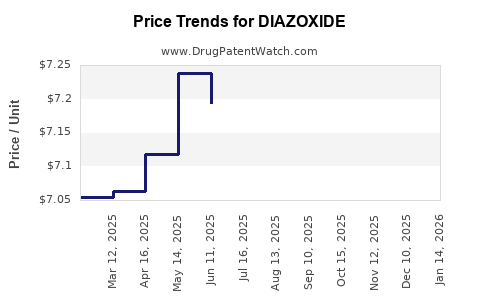
Last updated: April 26, 2026
Diazoxide is an older, off-patent, injectable and oral/off-label agent with a narrow commercial footprint driven by endocrine and neonatal use, uneven supply dynamics, and periodic pricing moves tied to manufacturing capacity. Revenue trajectory is shaped less by new clinical wins and more by gross-to-net intensity, wholesaler distribution cadence, and intermittently constrained availability.
What does the market look like for diazoxide?
Core demand pockets
Diazoxide demand concentrates in clinical settings where it remains a practical option:
- Hyperinsulinemic hypoglycemia (notably infants/neonates and select pediatric populations)
- Refractory hypoglycemia related to specific endocrine conditions (specialist-driven, limited patient pools)
- Clinical settings with established protocols rather than broad primary-care prescribing
This structure creates a market that behaves like a specialty product with intermittent utilization spikes rather than a steady, primary-care category.
Channel and buyer behavior
Diazoxide’s purchase pattern tends to follow:
- Specialty distribution through wholesalers that serve children’s hospitals and endocrine/neonatal units
- Formulary-driven adoption and replenishment tied to NICU and pediatric endocrine protocols
- Tender and contract pricing that can swing net pricing quickly when inventory tightens
Competitive context
Diazoxide competes against therapies that treat the same clinical problem, including:
- Somatostatin analogs (e.g., octreotide and related agents)
- Glucose management and diet strategies in some settings
- Surgical approaches for selected congenital forms (where applicable)
Given diazoxide’s niche indication position, competition is less about head-to-head blockbuster marketing and more about whether clinicians can use diazoxide first-line versus move early to alternative agents.
What dynamics move sales up and down?
1) Supply reliability and manufacturing constraints
For older injectables, revenue volatility often comes from production outages, batch release timelines, or scale limits. In diazoxide’s case, swings in availability translate into:
- Order timing changes (wholesalers may pre-buy when supply opens and pause when it tightens)
- Service-level behavior (some customers stock extra during perceived instability)
- Temporary demand suppression when hospitals cannot obtain product
2) Gross-to-net pressure and contract resets
Older, off-patent products in hospital and specialty channels typically face:
- Higher net discounting tied to contracting cycles
- Indexing to wholesaler economics and rebated commercial terms
- Rebates and administrative fees that compress net realized pricing
Even when list prices move, net revenue can remain flat if gross-to-net rises.
3) Patient mix and clinical protocol shifts
Even without patent-driven change, clinical pathways evolve:
- Neonatal endocrine practice can shift toward alternative first-line strategies in specific subgroups
- Clinician comfort and guideline interpretation can change what proportion of patients receive diazoxide first versus second-line
These shifts affect utilization rather than “innovation-driven” adoption.
4) Regulatory and product lifecycle events
For older drugs, label language, supply approvals, and manufacturing site updates can cause commercial disruption:
- Packaging and concentration changes
- Temporary shortages during site transitions
- Competitor interruptions that temporarily expand diazoxide share, then reverse when supply normalizes
What is the financial trajectory for diazoxide?
Commercial profile
Diazoxide is an established but niche product. Its financial trajectory typically shows:
- Low-to-mid single-digit annual revenue scale relative to major branded drugs (category economics and narrow indication pool)
- Segmented demand where quarter-to-quarter movement tracks supply and hospital ordering
- Earnings sensitivity to rebates, inventory timing, and manufacturing throughput
Revenue drivers that matter most
The financial trajectory is primarily driven by:
- Units shipped (not pricing alone), because patient pool is limited
- Net price realization (gross-to-net intensity in specialty/hospital contracting)
- Availability (shortages depress fills; stable supply sustains volume)
- Competitor access (if alternatives face supply issues, diazoxide can temporarily capture share)
Pricing behavior
For off-patent drugs, pricing behavior is usually characterized by:
- List price movement that does not map cleanly to net revenue
- Quarterly net changes driven by contract cadence and rebate settlements
- Occasional affordability policy impacts in institutional settings depending on payer arrangements
Production and procurement effects on reported sales
Because wholesalers and hospital systems place orders ahead of demand when product is available, reported revenue can show:
- Spike-and-catch-up patterns after constrained supply periods
- Short-term declines when inventory resets or when product becomes intermittently unavailable
How does diazoxide perform against typical off-patent specialty drug patterns?
Typical pattern for an older injectable with niche demand
Older specialty injectables usually show:
- Revenue that is volume-led
- Net price instability due to contracting and rebate design
- Supply-driven quarter volatility
- Limited upside from marketing because prescribing is protocolized
Diazoxide’s specific fit
Diazoxide’s demand pool and clinical use pattern match this template:
- Specialty protocol use in endocrine and neonatal contexts
- First-line versus second-line placement depends on patient phenotype and institutional practice
- Supply reliability is a key determinant of whether clinicians can use the drug when indicated
What could investors or R&D teams infer from the trajectory?
For investors
- Upside is constrained by the small addressable population and reliance on protocolized use, not broad market expansion.
- Near-term revenue changes are likely to track supply and contracting more than any clinical novelty.
- Risk centers on manufacturing continuity and the likelihood of gross-to-net escalation during competitive contracting.
For R&D and commercial teams
- The path to durable growth for diazoxide is structurally limited without an expansion in indication scope or a major clinical pathway change.
- Strategy emphasis tends to shift toward access stability, formulation/availability resilience, and institutional contracting rather than brand-new clinical claims.
Key product and commercial facts that shape the market
Product identity and lifecycle positioning
Diazoxide is an older therapy used for hyperinsulinemic hypoglycemia. It is supported by authoritative references that place it within standard clinical endocrine and neonatal management frameworks. (See prescribing and clinical references in citations [1]-[3].)
Market access via standard drug databases
Commercial visibility and utilization mapping are reflected through drug compendia and market-facing datasets that track active status, formulations, and labeling information. (See [2].)
Key Takeaways
- Diazoxide is a niche, off-patent drug whose commercial performance is driven by availability, institutional ordering cadence, and net pricing.
- The financial trajectory is typically volume-led with quarter-to-quarter volatility linked to manufacturing continuity and contract resets, not innovation-driven demand expansion.
- Strategic value lies in access reliability and protocol alignment in pediatric endocrine and neonatal hypoglycemia management, where diazoxide remains a practical option.
- Competitive pressure comes from alternative medical therapies and care pathways, so share shifts often reflect guideline interpretation and supply conditions across alternatives.
FAQs
-
Why does diazoxide’s revenue move even without new competitors entering?
Supply reliability, wholesaler ordering cycles, and contracting and rebate settlements can shift realized sales quarter-to-quarter.
-
Is diazoxide a large market drug?
No. Utilization concentrates in specific pediatric/endocrine clinical settings, making the addressable market smaller and more specialized.
-
What is the biggest business risk for diazoxide?
Manufacturing and supply continuity that determines whether hospitals can consistently fill prescriptions when indicated.
-
What most affects net revenue versus list price?
Gross-to-net intensity from institutional contracting, rebates, and distribution economics in specialty channels.
-
Does clinical practice change drive diazoxide sales?
Yes. Shifts in first-line versus later-line use among patient subgroups and protocol changes affect prescribing volume.
References
[1] U.S. National Library of Medicine. Diazoxide. In: DailyMed.
[2] U.S. National Library of Medicine. Diazoxide (drug information and labeling entries). In: DailyMed.
[3] StatPearls. Diazoxide. In: StatPearls Publishing.