Share This Page
Drug Sales Trends for PROCHLORPERAZINE MALEATE
✉ Email this page to a colleague
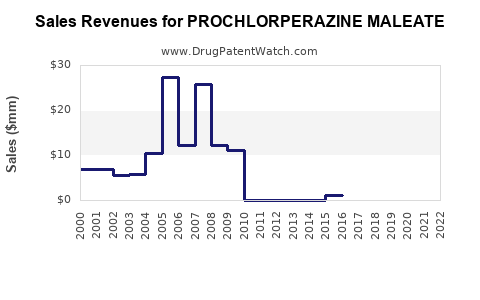
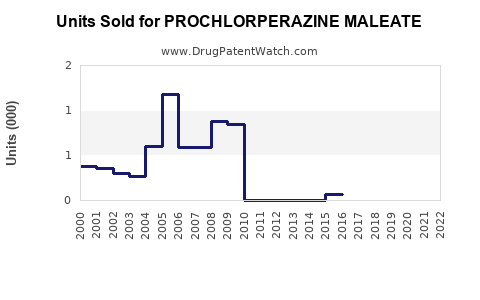
Annual Sales Revenues and Units Sold for PROCHLORPERAZINE MALEATE
| Drug Name | Revenues (USD) | Units | Year |
|---|---|---|---|
| PROCHLORPERAZINE MALEATE | ⤷ Start Trial | ⤷ Start Trial | 2022 |
| PROCHLORPERAZINE MALEATE | ⤷ Start Trial | ⤷ Start Trial | 2021 |
| PROCHLORPERAZINE MALEATE | ⤷ Start Trial | ⤷ Start Trial | 2020 |
| PROCHLORPERAZINE MALEATE | ⤷ Start Trial | ⤷ Start Trial | 2019 |
| PROCHLORPERAZINE MALEATE | ⤷ Start Trial | ⤷ Start Trial | 2018 |
| >Drug Name | >Revenues (USD) | >Units | >Year |
Prochlorperazine Maleate Market Analysis and Sales Projections
Prochlorperazine maleate is a mature, low-cost generic phenothiazine used mainly for severe nausea and vomiting, migraine-associated symptoms, and psychotic disorders. The U.S. market is generic, fragmented, and price-sensitive. Brand-level revenue is limited because Compazine has largely been replaced by generic prochlorperazine products. The commercial opportunity is concentrated in manufacturing reliability, hospital supply contracts, alternative dosage forms, and selected international markets rather than patent-protected pricing.
A reasonable base-case forecast is for low-single-digit annual revenue growth through 2029, driven by prescription-volume stability and modest price increases. Unit growth is likely to remain flat or decline slightly as clinicians favor ondansetron and newer antiemetic regimens.
What is prochlorperazine maleate used for?
Prochlorperazine maleate is the oral salt form of prochlorperazine, a dopamine D2 receptor antagonist in the phenothiazine class. U.S. labeling identifies the drug for:
- Severe nausea and vomiting in adults
- Schizophrenia in adults
- Severe behavioral disorders in adults
The oral product is generally marketed in 5 mg and 10 mg tablets. Prochlorperazine is also available in other formulations and salt forms, including suppositories and injectable products, although product availability varies by manufacturer and jurisdiction. The FDA label warns about extrapyramidal symptoms, tardive dyskinesia, neuroleptic malignant syndrome, seizures, orthostatic hypotension, and anticholinergic effects. It carries a boxed warning regarding increased mortality in elderly patients with dementia-related psychosis and is not approved for that use.[1]
Main demand segments
| Segment | Commercial role | Market outlook |
|---|---|---|
| Nausea and vomiting | Primary oral demand driver | Stable to modest decline |
| Emergency-department antiemetic use | Important institutional use | Vulnerable to ondansetron substitution |
| Migraine-associated nausea | Off-label or protocol-driven use | Stable in selected practices |
| Schizophrenia | Small current demand relative to modern antipsychotics | Long-term decline |
| Compounding and hospital supply | Secondary opportunity | Dependent on shortages and contracts |
How large is the prochlorperazine maleate market?
No reliable public source reports a standalone global revenue figure for prochlorperazine maleate across all manufacturers, strengths, dosage forms, and countries. Public company filings generally aggregate mature generic products, and prescription databases may report prescriptions without net sales.
The market should therefore be valued through a bottom-up model using:
- Prescription or administered-unit volume
- Net price per tablet or treatment course
- Dosage-form mix
- Retail versus institutional purchasing
- Geographic scope
- Manufacturer and wholesaler discounts
The U.S. oral tablet market is likely a small generic market in pharmaceutical terms. Its value is materially below large antiemetic categories such as ondansetron and below branded or specialty neuropsychiatric products.
Indicative market structure
| Metric | Assessment |
|---|---|
| Product type | Mature generic small molecule |
| U.S. brand position | Limited or absent in routine retail supply |
| Pricing power | Low |
| Buyer concentration | High among wholesalers, hospitals, and group purchasing organizations |
| Prescriber concentration | Emergency medicine, primary care, psychiatry, oncology-supportive care |
| Substitution risk | High |
| Patent barrier | No meaningful current U.S. composition-of-matter barrier identified |
| Regulatory barrier | Abbreviated New Drug Application pathway for qualifying generics |
| Supply-chain risk | Moderate, particularly for low-volume presentations |
What are the sales projections for prochlorperazine maleate?
Because audited product-level revenue is not publicly available, the following projection is an analytical scenario rather than reported company guidance. It assumes a mature U.S. oral generic market with stable clinical demand, no major shortage, and no major change in reimbursement.
U.S. oral prochlorperazine maleate revenue scenarios
| Year | Downside case | Base case | Upside case |
|---|---|---|---|
| 2024 estimated market | $8 million | $12 million | $18 million |
| 2025 | $7.4 million | $12.1 million | $18.9 million |
| 2026 | $6.7 million | $12.2 million | $19.8 million |
| 2027 | $6.1 million | $12.3 million | $20.8 million |
| 2028 | $5.5 million | $12.4 million | $21.8 million |
| 2029 | $5.0 million | $12.5 million | $22.9 million |
| 2024-2029 CAGR | -7.1% | 0.8% | 4.9% |
These figures exclude injectable and suppository products, international sales, wholesaler inventory effects, and non-U.S. salt or dosage-form variations. The low and high cases represent market-size boundaries rather than specific company forecasts.
Base-case assumptions
The base case assumes:
- Flat to slightly declining tablet volume
- Stable generic competition
- Small annual price increases
- No sustained shortage
- Continued use in emergency and acute-care settings
- Ongoing substitution by ondansetron and other antiemetics
- Continued decline in schizophrenia use as a commercial driver
- No return of a premium-priced branded product
The most likely commercial outcome is revenue stability with limited volume growth. A manufacturer can outperform the market through supply reliability, hospital contracting, and low-cost production, but the category does not support sustained premium pricing under normal competitive conditions.
Which companies manufacture prochlorperazine maleate?
The manufacturer landscape changes as suppliers enter and exit the market. Generic prochlorperazine products have been associated with multiple U.S. and international pharmaceutical companies over time, including manufacturers and labelers operating through the ANDA system.
Current supplier identification should rely on FDA product databases, DailyMed listings, National Drug Code records, and active wholesaler catalogs. A historical labeler should not be treated as a current commercial supplier because generic portfolios are frequently transferred, discontinued, or placed on inactive status.
Competitive factors
The main competitive factors are:
- Tablet availability in 5 mg and 10 mg strengths
- Reliable supply to wholesalers and hospitals
- Contract pricing
- FDA manufacturing compliance
- Product discontinuation risk
- Ability to supply multiple dosage forms
- International registration and local distribution
The market is unlikely to reward broad promotional spending. Sales are primarily procurement-driven.
What is the FDA regulatory status of prochlorperazine maleate?
Prochlorperazine maleate is an established prescription drug with longstanding FDA regulatory history. Generic oral products generally enter through the ANDA pathway by demonstrating pharmaceutical equivalence and bioequivalence to a reference product, rather than repeating full clinical efficacy trials.
The FDA labeling establishes the approved uses, warnings, dosing information, contraindications, and adverse reactions. Generic applicants must meet applicable requirements for identity, strength, quality, manufacturing, labeling, and bioequivalence.[1]
Regulatory risks
Regulatory risks include:
- Manufacturing observations or warning letters
- Product-quality failures
- Inactive or discontinued ANDAs
- Inability to maintain adequate supply
- Labeling deviations
- Nitrosamine or other impurity concerns where applicable to the manufacturing process
- Shortage-related scrutiny if the product becomes difficult to source
For a mature generic, regulatory execution is more important than clinical differentiation.
What patents protect prochlorperazine maleate?
The original composition-of-matter and early use patents for prochlorperazine are long expired. Prochlorperazine maleate is not commercially protected by a modern U.S. exclusivity period comparable to a newly approved branded drug.
Patent and exclusivity profile
| Protection type | Current commercial significance |
|---|---|
| Original compound patent | Expired |
| Original formulation protection | Expired or no longer commercially limiting |
| New chemical entity exclusivity | Expired |
| U.S. pediatric exclusivity | Not a current barrier |
| Active Orange Book patent blocking routine generic entry | No material barrier identified |
| Formulation patents | Potentially relevant only to specific newer products or delivery systems |
| Method-of-use patents | Unlikely to block established generic indications |
| Manufacturing patents | May protect a process but generally do not prevent sale of a non-infringing generic |
The absence of a meaningful patent barrier does not eliminate commercial protection from manufacturing know-how, supplier relationships, approved facilities, or scarce production capacity.
When does prochlorperazine maleate lose exclusivity?
Prochlorperazine maleate lost meaningful U.S. market exclusivity decades ago. It is now a mature generic product. Generic entry is not dependent on a pending patent expiration date in the way it is for a newly launched branded drug.
Orange Book status
The FDA Orange Book is relevant for approved reference-listed drugs and associated patents or exclusivities. For a mature generic such as prochlorperazine maleate, the commercial question is usually not whether a listed patent blocks entry, but whether an applicant can obtain approval and compete profitably.
The relevant FDA records are the Orange Book, Drugs@FDA, and the FDA’s drug-shortage and discontinued-drug databases.[2-4]
Are there Paragraph IV challenges for prochlorperazine maleate?
Paragraph IV litigation is not a meaningful current market issue for the established prochlorperazine maleate tablet market. Paragraph IV certifications are used by ANDA applicants that assert listed patents are invalid, unenforceable, or not infringed. That mechanism is most commercially important when a branded reference product has active Orange Book patents.
For an old genericized product with no material blocking patent estate, competitive entry is more likely to occur through ordinary ANDA approval, product acquisition, or reactivation of an existing generic file. Paragraph IV litigation could arise if a new branded formulation or delivery system were introduced, but that would concern the specific formulation rather than the legacy molecule.
What formulation patents protect prochlorperazine products?
The standard prochlorperazine maleate tablet has limited differentiation. Potentially protectable features could include:
- Modified-release tablets
- Orally disintegrating tablets
- Abuse-deterrent delivery systems
- Novel combination products
- New injectable delivery technologies
- Stability-enhancing excipient systems
- Device-linked administration formats
A formulation patent would need to claim a commercially meaningful technical feature and withstand invalidity and obviousness challenges. A patent on a conventional immediate-release tablet would face substantial validity risk because the active ingredient, salt form, dosage strengths, and general dosage technology are well established.
What generic entry risks exist for prochlorperazine maleate?
Generic entry risk is already realized rather than pending. The commercial threat is price erosion from existing suppliers, not a future loss of exclusivity.
Principal risks
- Price compression: Multiple approved suppliers can reduce contract prices.
- Substitution: Ondansetron is widely used for nausea and vomiting and can replace prochlorperazine in institutional protocols.
- Clinical preference: Modern antipsychotics have displaced phenothiazines in long-term schizophrenia treatment.
- Procurement concentration: Large wholesalers and group purchasing organizations can pressure margins.
- Low-volume discontinuation: A supplier may exit if revenue does not support regulatory and manufacturing costs.
- Supply interruption: A small supplier base can create temporary shortages and short-term price spikes.
Shortages can improve near-term revenue for remaining suppliers, but the effect is unstable and can attract new entrants or regulatory attention.
How does prochlorperazine compare with competing antiemetics?
| Product | Primary advantage | Competitive effect on prochlorperazine |
|---|---|---|
| Ondansetron | Broad use, favorable familiarity, multiple dosage forms | Strong substitute in acute nausea |
| Metoclopramide | Established use in nausea and gastrointestinal indications | Competes in selected settings |
| Promethazine | Low cost and broad antiemetic use | Competes in outpatient and emergency care |
| Droperidol | Emergency and migraine protocols | Competes in institutional settings |
| Atypical antipsychotics | Modern psychiatric efficacy profiles | Reduces psychiatric demand for prochlorperazine |
| Prochlorperazine | Low cost, established availability, antiemetic efficacy | Retains protocol-based and price-sensitive demand |
Prochlorperazine’s strongest position is in low-cost acute treatment where clinicians are familiar with the drug and the product is available. Its weakest position is in long-term psychiatric treatment and settings where adverse-effect profiles drive selection.
What licensing deals affect prochlorperazine maleate?
No major recent licensing transaction is publicly associated with prochlorperazine maleate as a standalone commercial asset. Licensing value is limited because the active ingredient is old, generic, and broadly available.
Potential transaction structures would more likely involve:
- Acquisition of an ANDA
- Transfer of a product license
- Contract manufacturing
- Regional distribution rights
- Portfolio purchases involving several mature generic products
- Rights to a novel formulation rather than the conventional tablet
A deal valuation would depend on approved strengths, manufacturing site status, historical sales, supply obligations, customer contracts, and any shortage-related demand. Royalty-bearing licenses on the legacy molecule alone would have limited economic rationale.
What is the commercial outlook for prochlorperazine maleate?
The commercial outlook is stable but defensive. The product can generate recurring revenue for a low-cost manufacturer with reliable supply, but it has limited strategic value as a standalone growth asset.
Revenue exposure by market driver
| Driver | Direction through 2029 | Expected impact |
|---|---|---|
| Acute nausea demand | Stable | Supports baseline volume |
| Ondansetron substitution | Negative | Reduces share |
| Psychiatric use | Negative | Long-term volume erosion |
| Generic price inflation | Slightly positive | Supports nominal revenue |
| Hospital shortages | Volatile positive | Creates temporary upside |
| New suppliers | Negative | Increases price pressure |
| Novel formulation launch | Potentially positive | Could create a separate premium segment |
The most attractive strategy is operational: maintain high fill rates, secure low-cost API and packaging supply, and target institutional buyers. A differentiated formulation could create greater value, but it would require clinical, regulatory, and patent investment that may be difficult to justify for a low-revenue legacy molecule.
Key Takeaways
- Prochlorperazine maleate is a mature generic phenothiazine with limited standalone market value.
- The principal uses are severe nausea and vomiting, with smaller residual demand in schizophrenia.
- Original patent and regulatory exclusivity have expired; no meaningful current patent barrier is expected for conventional tablets.
- The U.S. market is likely small, fragmented, and procurement-driven.
- A reasonable base-case estimate is approximately $12 million in U.S. oral-market revenue in 2024, rising to about $12.5 million by 2029.
- Ondansetron, promethazine, metoclopramide, and modern antipsychotics constrain demand.
- The main commercial risks are price erosion, supplier exits, substitution, and manufacturing interruptions.
- The strongest value drivers are reliable supply, hospital contracts, low manufacturing cost, and potentially differentiated dosage forms.
FAQs About Prochlorperazine Maleate Market Potential
Is prochlorperazine maleate still commercially available?
Yes. Availability varies by strength, dosage form, manufacturer, wholesaler inventory, and country. The FDA and DailyMed databases provide the most relevant product-level status information.[2,3]
Is prochlorperazine maleate a branded or generic drug?
The conventional product is primarily generic in the U.S. Compazine was the historical brand associated with prochlorperazine, but current routine supply is largely generic.
Can prochlorperazine maleate support a premium price?
The conventional immediate-release tablet generally cannot support durable premium pricing. A premium could be possible for a novel delivery system, shortage-constrained supply, or a clinically differentiated formulation.
Does prochlorperazine maleate have biosimilar competition?
No. Prochlorperazine maleate is a small-molecule drug, not a biologic. Competition occurs through generic drug applications rather than the biosimilar pathway.
What would increase prochlorperazine maleate sales?
Sales could increase through a sustained shortage among competing suppliers, new hospital contracts, expansion into underpenetrated international markets, or approval of a differentiated formulation. These drivers would not remove the underlying price-sensitive nature of the category.
References
-
U.S. Food and Drug Administration. (2024). Prochlorperazine maleate tablets prescribing information. FDA-approved labeling.
-
U.S. Food and Drug Administration. (2024). Approved drug products with therapeutic equivalence evaluations: Orange Book. https://www.fda.gov
-
National Library of Medicine. (2024). DailyMed: Prochlorperazine maleate. https://dailymed.nlm.nih.gov
-
U.S. Food and Drug Administration. (2024). Drugs@FDA. https://www.accessdata.fda.gov/scripts/cder/daf/
More… ↓
