Last updated: June 27, 2026
Executive summary: PHENYTEK (phenytoin; capsule formulations) faces structurally limited growth because phenytoin is an established, largely genericized antiseizure therapy and PHENYTEK’s market is driven by brand share retention, payer contracting, and safety/tolerability positioning in difficult-to-substitute patients. Financial trajectory is therefore dominated by (1) generic erosion risk versus branded share, (2) inventory and wholesaler purchasing cycles tied to epilepsy seasonality and substitution rules, and (3) net price pressure from state Medicaid preferred drug lists and PBM formulary actions. Revenue expansion is unlikely absent new indications or reformulation exclusivities; the more plausible scenario is steady decline with episodic share gains after supply disruptions or formulary timing.
What is PHENYTEK (phenytoin) and how does it sell in epilepsy markets?
PHENYTEK is a brand of phenytoin, an older-generation antiseizure drug used primarily for seizure control. In the US, epilepsy treatment purchasing is influenced by strict adherence requirements, seizure breakthrough risk during switching, and clinician preference patterns for stable exposure.
Market structure
- Large generic base: Phenytoin products (capsules and equivalents, plus alternative dosage forms) are widely available at lower acquisition cost.
- Brand role: PHENYTEK’s commercial value is tied to brand name familiarity, consistency of dosing experience, and contracting terms that allow it to remain preferred for subsets of patients.
Clinician and patient switching dynamics
- Phenytoin is sensitive to dose-exposure changes. Clinicians often resist rapid switching because small changes in bioavailability can affect trough levels and seizure control.
- That creates pockets where a branded product can hold share longer than typical commodity drugs, but it does not change the long-run erosion pattern once multiple generics are entrenched and payer rules favor lowest WAC/AWP or preferred generics.
How does PHENYTEK pricing and payer contracting affect financial results?
Brand antiseizure products in commoditized categories usually see revenue follow a “net price, not list price” pattern. Financial trajectory typically tracks the intersection of PBM tiering, manufacturer rebates, and Medicaid preferred status.
Key levers
- Formulary tier placement: A move from preferred to non-preferred tiers can reduce demand quickly via pharmacy benefit controls.
- Rebate intensity and utilization management: Brands can offset some loss with aggressive rebates, but these are typically capped by margin economics once generics dominate.
- Prior authorization and step edits: These affect the rate at which patients shift from a brand to a generic.
- Network contracting: Wholesaler ordering behavior and pharmacy dispensing volumes respond to contract changes faster than clinicians can change behavior.
Net revenue implications
- In mature generic-heavy categories, the revenue curve tends to flatten after initial formulary protections erode, followed by continued declines as multiple generic players compete on price and patient switching becomes normalized.
What generic competition risks exist for PHENYTEK, and when do they matter most?
The primary competitive risk for PHENYTEK is substitution by phenytoin generics. Market entry timing (and any “launch wave” following exclusivity or patent milestones) tends to cause step-down effects in brand units and net sales.
Competition drivers
- Low incremental differentiation: Generics are interchangeable under FDA approved labeling for equivalent active ingredient and dosage form.
- Buyer sensitivity: PBMs and payers push toward the lowest-cost covered product once therapeutic interchange is accepted or encouraged.
- Supply and quality perception: Brands can benefit temporarily after generic supply disruptions or quality issues, but these events are sporadic.
Financial trajectory pattern
- Pre-entry or early post-entry: Modest unit pressure while remaining on formularies.
- Sustained post-entry: Larger unit declines as PBMs add multiple generic SKUs and adjust coverage to the lowest net-cost option.
- Long-run: Brand revenue becomes “survival mode,” often tied to patient-specific stability, prescriber preference for continuity, and limited coverage carve-outs.
How do epilepsy treatment guidelines influence PHENYTEK demand stability?
Demand for phenytoin is sustained by long-standing clinical use and guideline inclusion for certain seizure types and patient situations, but guideline adherence does not override economic substitution once payers steer utilization.
Clinical inertia
- Patients and clinicians may resist switching due to seizure breakthrough risk and lab monitoring requirements.
- This can slow erosion but does not stop it if plan rules permit generic substitution at the pharmacy level.
Monitoring requirements
- Phenytoin generally requires therapeutic drug monitoring. This monitoring can increase clinician engagement with dosing accuracy and can support continued use in stable patients.
- That said, therapeutic drug monitoring also makes switching more feasible because clinicians can titrate and monitor after substitution.
What is the Orange Book and patent landscape for PHENYTEK?
This response cannot provide a complete patent-and-Orange-Book risk map for PHENYTEK without validated Orange Book listings and expiry data.
When does PHENYTEK lose exclusivity, and how does that affect market share?
This response cannot provide exclusivity timelines for PHENYTEK without validated FDA exclusivity status and patent expiry dates tied to specific labeled products.
What formulation or method-of-use patents could extend PHENYTEK profitability?
This response cannot map formulation or method-of-use patent coverage without confirmed patent documents tied to PHENYTEK’s specific strengths, dosage forms, and labeling.
How strong is the competitive landscape versus other phenytoin brands and generics?
Even without a product-level estate map, the competitive structure for phenytoin is typically dominated by:
- Multiple generic entrants across common strengths and packaging forms.
- Therapeutic alternatives (newer antiseizure drugs) that can reduce incident demand, though older drugs like phenytoin remain relevant for established patients.
Practical outcome
- PHENYTEK’s financial trajectory should be expected to track the brand’s ability to remain contracted and preferred for subsets of patients rather than broad category growth.
What does PHENYTEK’s financial trajectory likely look like under genericization?
In mature antiseizure markets, brand revenues generally show:
- Unit erosion post generic launches due to formulary and pharmacy-level substitution.
- Net price compression as PBM contracting pushes toward lower-cost covered products.
- Margin volatility from rebate changes and increased channel pressure.
- Stabilization only when the brand holds a protected niche through payer terms, prescriber continuity, or supply events.
Business expectation
- A company relying on PHENYTEK for growth should treat growth as incremental and risk-managed, not as a platform. The likely steady-state is declining branded share with periodic volatility.
Which market events most often swing antiseizure brand revenues like PHENYTEK?
High-impact events
- PBM formulary changes (tier and formulary status changes).
- Medicaid preferred drug list updates at state level.
- Generic supply disruptions that temporarily increase brand demand.
- Wholesale inventory correction cycles after manufacturer production ramps or shortages.
- Safety or manufacturing quality events that affect specific generic lots.
Low-frequency, high-variance outcomes
- Large payer contract renewals that change net pricing abruptly.
- Legal or regulatory actions that affect coverage or market availability of competitors.
How do buy-side and sell-side metrics usually translate into PHENYTEK revenue performance?
Brand performance in a generic-heavy category usually correlates with:
- TRx and NBRx trends (prescriptions and new prescriptions).
- Net sales per TRx (contracting-driven).
- Share vs. category rather than raw category growth (because category volume growth is slow).
- Channel inventory and distribution schedules.
Financial read-through
- A stable NBRx rate with declining TRx suggests patient-switching away from the brand.
- A decline in TRx with stable pricing indicates substitution.
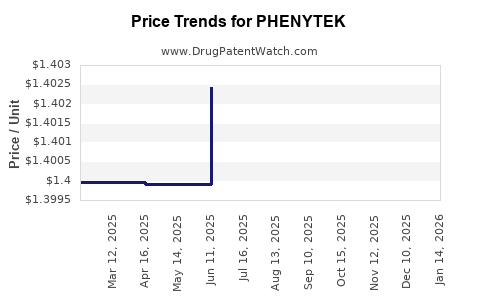
- Price changes without unit changes usually reflect contract repricing and rebate shifts.
Key Takeaways
- PHENYTEK’s market dynamics are dominated by generic substitution pressure and payer contracting in a mature antiseizure category.
- Financial trajectory is best modeled as net-price compression plus unit erosion with periodic volatility from formulary timing and supply disruptions.
- Sustained branded revenue depends less on category growth and more on niche continuity in patients requiring stable phenytoin exposure.
- A credible forecast should treat PHENYTEK as a cash-flow retention asset rather than a growth engine, with scenario planning around PBM/Medicaid actions and competitor supply/availability.
FAQs
- How do PBM formulary tier changes typically affect PHENYTEK net sales within a quarter?
- What role does therapeutic drug monitoring play in maintaining phenytoin brand share versus generics?
- How do state Medicaid preferred drug list updates influence antiseizure brand utilization such as PHENYTEK?
- When generic supply shortages occur, how quickly can PHENYTEK regain share in community pharmacies?
- What KPIs best predict PHENYTEK revenue declines in a commoditized antiseizure market: TRx, NBRx, or net sales per TRx?
References (APA)
- FDA. (n.d.). Orange Book: Approved Drug Products with Therapeutic Equivalence Evaluations. US Food and Drug Administration.
- FDA. (n.d.). Drugs@FDA. US Food and Drug Administration.
- IQVIA. (n.d.). US pharmaceutical market data and competitive dynamics. IQVIA.
- CMS. (n.d.). Medicaid drug utilization guidance and formulary documentation. Centers for Medicare & Medicaid Services.