Last Updated: August 9, 2026

OPSUMIT Drug Patent Profile


✉ Email this page to a colleague

« Back to Dashboard


Which patents cover Opsumit, and when can generic versions of Opsumit launch?

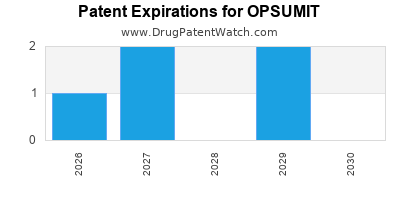
Opsumit is a drug marketed by Actelion and is included in one NDA. There are five patents protecting this drug and one Paragraph IV challenge.

This drug has one hundred and one patent family members in thirty-five countries.

The generic ingredient in OPSUMIT is macitentan. There are ten drug master file entries for this compound. Fourteen suppliers are listed for this compound. Additional details are available on the macitentan profile page.

DrugPatentWatch® Litigation and Generic Entry Outlook for Opsumit

A generic version of OPSUMIT was approved as macitentan by ZYDUS LIFESCIENCES on April 6th, 2021.

  Start Trial

AI Deep Research
Questions you can ask:
  • What is the 5 year forecast for OPSUMIT?
  • What are the global sales for OPSUMIT?
  • What is Average Wholesale Price for OPSUMIT?
Recent Clinical Trials for OPSUMIT

Identify potential brand extensions & 505(b)(2) entrants

SponsorPhase
American Heart AssociationPhase 4
Janssen, LPPhase 4
Janssen Pharmaceutical K.K.Phase 3

See all OPSUMIT clinical trials

Pharmacology for OPSUMIT
Paragraph IV (Patent) Challenges for OPSUMIT
Tradename Dosage Ingredient Strength NDA ANDAs Submitted Submissiondate
OPSUMIT Tablets macitentan 10 mg 204410 11 2017-10-18

US Patents and Regulatory Information for OPSUMIT

OPSUMIT is protected by five US patents and two FDA Regulatory Exclusivities.

Applicant Tradename Generic Name Dosage NDA Approval Date TE Type RLD RS Patent No. Patent Expiration Product Substance Delist Req. Exclusivity Expiration
Actelion OPSUMIT macitentan TABLET;ORAL 204410-001 Oct 18, 2013 AB RX Yes Yes 8,268,847*PED ⤷  Start Trial Y ⤷  Start Trial
Actelion OPSUMIT macitentan TABLET;ORAL 204410-001 Oct 18, 2013 AB RX Yes Yes ⤷  Start Trial ⤷  Start Trial ⤷  Start Trial
Actelion OPSUMIT macitentan TABLET;ORAL 204410-001 Oct 18, 2013 AB RX Yes Yes 9,265,762*PED ⤷  Start Trial Y ⤷  Start Trial
Actelion OPSUMIT macitentan TABLET;ORAL 204410-001 Oct 18, 2013 AB RX Yes Yes 7,094,781*PED ⤷  Start Trial Y ⤷  Start Trial
Actelion OPSUMIT macitentan TABLET;ORAL 204410-001 Oct 18, 2013 AB RX Yes Yes 8,367,685*PED ⤷  Start Trial Y ⤷  Start Trial
Actelion OPSUMIT macitentan TABLET;ORAL 204410-001 Oct 18, 2013 AB RX Yes Yes ⤷  Start Trial ⤷  Start Trial ⤷  Start Trial
Actelion OPSUMIT macitentan TABLET;ORAL 204410-001 Oct 18, 2013 AB RX Yes Yes 10,946,015*PED ⤷  Start Trial Y ⤷  Start Trial
>Applicant >Tradename >Generic Name >Dosage >NDA >Approval Date >TE >Type >RLD >RS >Patent No. >Patent Expiration >Product >Substance >Delist Req. >Exclusivity Expiration

EU/EMA Drug Approvals for OPSUMIT

Company Drugname Inn Product Number / Indication Status Generic Biosimilar Orphan Marketing Authorisation Marketing Refusal
Janssen-Cilag International N.V.   Opsumit macitentan EMEA/H/C/002697Opsumit, as monotherapy or in combination, is indicated for the long-term treatment of pulmonary arterial hypertension (PAH) in adult patients of WHO Functional Class (FC) II to III.Efficacy has been shown in a PAH population including idiopathic and heritable PAH, PAH associated with connective tissue disorders, and PAH associated with corrected simple congenital heart disease. Authorised no no yes 2013-12-20
>Company >Drugname >Inn >Product Number / Indication >Status >Generic >Biosimilar >Orphan >Marketing Authorisation >Marketing Refusal

International Patents for OPSUMIT

When does loss-of-exclusivity occur for OPSUMIT?

Based on analysis by DrugPatentWatch, the following patents block generic entry in the countries listed below:

Argentina

Patent: 2501
Estimated Expiration: ⤷  Start Trial

Australia

Patent: 07290099
Estimated Expiration: ⤷  Start Trial

Brazil

Patent: 0715698
Estimated Expiration: ⤷  Start Trial

Canada

Patent: 59770
Estimated Expiration: ⤷  Start Trial

Chile

Patent: 07002494
Estimated Expiration: ⤷  Start Trial

China

Patent: 1511365
Estimated Expiration: ⤷  Start Trial

Croatia

Patent: 0131233
Estimated Expiration: ⤷  Start Trial

Cyprus

Patent: 14735
Estimated Expiration: ⤷  Start Trial

Patent: 24033
Estimated Expiration: ⤷  Start Trial

Denmark

Patent: 59246
Estimated Expiration: ⤷  Start Trial

European Patent Office

Patent: 59246
Estimated Expiration: ⤷  Start Trial

Finland

Patent: 0240045
Estimated Expiration: ⤷  Start Trial

France

Patent: C1054
Estimated Expiration: ⤷  Start Trial

Hong Kong

Patent: 33597
Estimated Expiration: ⤷  Start Trial

Hungary

Patent: 400046
Estimated Expiration: ⤷  Start Trial

Israel

Patent: 7235
Estimated Expiration: ⤷  Start Trial

Japan

Patent: 08113
Estimated Expiration: ⤷  Start Trial

Patent: 10502588
Estimated Expiration: ⤷  Start Trial

Lithuania

Patent: 2024537
Estimated Expiration: ⤷  Start Trial

Malaysia

Patent: 4591
Patent: THERAPEUTIC COMPOSITIONS COMPRISING A SPECIFIC ENDOTHELIN RECEPTOR ANTAGONIST AND A PDE5 INHIBITOR
Estimated Expiration: ⤷  Start Trial

Mexico

Patent: 09002057
Patent: COMPOSICIONES TERAPEUTICAS QUE COMPRENDEN UN ANTAGONISTA DEL RECEPTOR DE ENDOTELINA ESPECIFICO Y UN INHIBIDOR PDE5. (THERAPEUTIC COMPOSITIONS.)
Estimated Expiration: ⤷  Start Trial

Morocco

Patent: 704
Patent: COMPOSITIONS THERAPEUTIQUES
Estimated Expiration: ⤷  Start Trial

Netherlands

Patent: 1308
Estimated Expiration: ⤷  Start Trial

New Zealand

Patent: 5702
Patent: THERAPEUTIC COMPOSITIONS COMPRISING A SPECIFIC ENDOTHELIN RECEPTOR ANTAGONIST AND A PDE5 INHIBITOR
Estimated Expiration: ⤷  Start Trial

Norway

Patent: 2554
Estimated Expiration: ⤷  Start Trial

Patent: 24059
Estimated Expiration: ⤷  Start Trial

Patent: 091254
Estimated Expiration: ⤷  Start Trial

Poland

Patent: 59246
Estimated Expiration: ⤷  Start Trial

Portugal

Patent: 59246
Estimated Expiration: ⤷  Start Trial

Russian Federation

Patent: 62249
Estimated Expiration: ⤷  Start Trial

Patent: 09111378
Patent: ТЕРАПЕВТИЧЕСКИЕ КОМПОЗИЦИИ, СОДЕРЖАЩИЕ СПЕЦИФИЧЕСКИЙ АНТАГОНИСТ РЕЦЕПТОРА ЭНДОТЕЛИНА И ИНГИБИТОРОВ PDE5 (THERAPEUTIC COMPOSITIONS CONTAINING SPECIFIC ENDOTHELIN RECEPTOR ANTAGONIST AND PDE5 INHIBITOR)
Estimated Expiration: ⤷  Start Trial

Slovenia

Patent: 59246
Estimated Expiration: ⤷  Start Trial

South Africa

Patent: 0902164
Patent: Therapeutic compositions comprising a specific endothelin receptor antagonist and a PDE5 inhibitor
Estimated Expiration: ⤷  Start Trial

South Korea

Patent: 1473022
Estimated Expiration: ⤷  Start Trial

Patent: 090057009
Estimated Expiration: ⤷  Start Trial

Spain

Patent: 38792
Estimated Expiration: ⤷  Start Trial

Taiwan

Patent: 0823198
Patent: Therapeutic compositions
Estimated Expiration: ⤷  Start Trial

Patent: 88556
Estimated Expiration: ⤷  Start Trial

Generics may enter earlier, or later, based on new patent filings, patent extensions, patent invalidation, early generic licensing, generic entry preferences, and other factors.

See the table below for additional patents covering OPSUMIT around the world.

Country Patent Number Title Estimated Expiration
Australia 2006290309 ⤷  Start Trial
Brazil PI0615898 ⤷  Start Trial
Canada 2621273 ⤷  Start Trial
China 101262847 ⤷  Start Trial
Cyprus 1113395 ⤷  Start Trial
Denmark 1928409 ⤷  Start Trial
European Patent Office 1928409 ⤷  Start Trial
>Country >Patent Number >Title >Estimated Expiration

Supplementary Protection Certificates for OPSUMIT

Patent Number Supplementary Protection Certificate SPC Country SPC Expiration SPC Description
1345920 CA 2014 00012 Denmark ⤷  Start Trial PRODUCT NAME: MACITENTAN OG FARMACEUTISK ACCEPTABLE SALTE HERAF; REG. NO/DATE: EU/1/13/893 20131220
1345920 92381 Luxembourg ⤷  Start Trial PRODUCT NAME: MACITENTAN ET SES DERIVES PHARMACEUTIQUEMENT ACCEPTABLES(OPSUMIT)
1345920 C300672 Netherlands ⤷  Start Trial PRODUCT NAME: MACITENTAN, DESGEWENST IN DE VORM VAN EEN FARMACEUTISCH AANVAARDBAAR ZOUT; REGISTRATION NO/DATE: EU/1/13/893/001-003 20131220
1345920 14C0017 France ⤷  Start Trial PRODUCT NAME: MACITENTAN ET SES SELS PHARMACEUTIQUEMENT ACCEPTABLES; REGISTRATION NO/DATE: EU/1/13/893 20131220
1345920 1490025-2 Sweden ⤷  Start Trial PRODUCT NAME: MACITENTAN; REG. NO/DATE: EU/1/13/893 20131220
1345920 C01345920/01 Switzerland ⤷  Start Trial PRODUCT NAME: MACITENTAN; REGISTRATION NO/DATE: SWISSMEDIC 61863 06.02.2014
1345920 2014/018 Ireland ⤷  Start Trial PRODUCT NAME: MACITENTAN, THE STEREOISOMERS AND THE PHARMACEUTICALLY ACCEPTABLE SALTS THEREOF.; REGISTRATION NO/DATE: EU/1/13/893 20131220
>Patent Number >Supplementary Protection Certificate >SPC Country >SPC Expiration >SPC Description

OPSUMIT (macitentan) Market Dynamics and Financial Trajectory: Uptake Drivers, Competitive Pressure, and Revenue Outlook

Last updated: July 2, 2026

OPSUMIT (macitentan) is the leading endothelin receptor antagonist (ERA) franchise in pulmonary arterial hypertension (PAH), with revenue driven by guideline positioning (WHO Group 1 PAH), add-on use across combination regimens, and persistence within treated cohorts. The financial trajectory is shaped by (1) the pace of PAH incidence growth and diagnosis, (2) competitive dynamics versus ambrisentan and bosentan-based pathways, (3) payer access and formulary coverage, (4) safety-tied monitoring economics (liver enzymes, hemoglobin), and (5) patent and exclusivity timelines impacting pricing power in key geographies.


What is the current market position of OPSUMIT (macitentan) in PAH?

OPSUMIT is positioned as a once-daily, fixed-dose oral ERA with robust outcomes data in PAH and broad guideline inclusion for WHO Group 1 disease. Commercially, it competes as an “anchor” therapy in PAH treatment algorithms, frequently used in combination with phosphodiesterase-5 inhibitors (PDE5is) and prostacyclin-pathway agents.

Where does OPSUMIT sit in the PAH treatment ladder?

Typical use case:

  • WHO Group 1 PAH
  • Use in combination therapy as disease progresses
  • Continuation in stable patients due to oral convenience and tolerability management

Key payer-relevant implication:

  • As a foundational PAH oral, OPSUMIT often has more durable formulary retention than drugs viewed as niche add-ons.

Which competitors pressure OPSUMIT revenue most?

  • Ambrisentan (units compete directly within the ERA class)
  • Bosentan (competes strongly where payers prefer older ERAs with rebate-optimized pricing)
  • Other PAH oral combinations in managed-care settings can displace ERA demand when payers steer toward specific fixed-dose or preferred-provider regimens.

What market dynamics drive OPSUMIT uptake: incidence, treatment guidelines, and combination regimens?

OPSUMIT’s commercial growth depends on two linked variables: the addressable treated population and the share of that population that receives an ERA-based regimen.

Diagnosis and treated prevalence dynamics

PAH patient numbers are influenced by:

  • Improved diagnostic pathways (specialty referral patterns and echocardiography access)
  • Earlier identification of WHO Group 1 PAH vs mixed etiologies
  • Specialty-center adoption of guideline-based escalation

Revenue mechanism: As more patients enter specialty care, ERAs capture new patients and maintain share among those requiring escalation.

Combination regimen penetration

PAH practice increasingly uses combination therapy. In real-world workflows, ERAs often:

  • Start with an ERA plus a PDE5i, then add prostacyclin pathway therapy based on risk profile.

Commercial mechanism: OPSUMIT benefits from add-on continuity. Even when patients move to multi-agent therapy, the ERA is frequently retained.


How does payer behavior and contracting affect OPSUMIT pricing and sales growth?

Payer contracting drives net revenue through:

  • Formulary tier placement
  • Prior authorization requirements
  • Step therapy between ERA agents
  • Coverage of monitoring-related requirements (liver function tests and hemoglobin monitoring)

What determines payer acceptance for an ERA like OPSUMIT?

  • Demonstrated outcomes in PAH end points supported by trial data cited in labeling
  • Ease of adherence (once-daily dosing improves persistence)
  • Safety profile that is manageable with routine monitoring protocols

Net revenue implication: OPSUMIT sustains revenue when it is considered “preferred” among ERAs. When contracting shifts to lower WAC or higher-rebate options, the franchise faces volume pressure even if dosing uptake holds.


What is the competitive landscape for OPSUMIT vs ambrisentan and bosentan?

ERA class competition: key commercial axes

  1. Efficacy and long-term outcomes narrative in payer medical policy
  2. Tolerability and lab-monitoring burden
  3. Dosing convenience and adherence
  4. Contracting and rebate levels
  5. Persistence of use after combination escalation

Comparison snapshot (commercially relevant)

Dimension OPSUMIT (macitentan) Ambrisentan Bosentan
Positioning Once-daily ERA for PAH, frequently retained in combo therapy ERA competitor in PAH ERA competitor with historically entrenched use
Main payer question Outcomes support for durable therapy + manageable safety monitoring Label positioning and contracting strength Access tied to rebate structure and monitoring burden concerns
Key risk to volume Payer switching/step therapy inside ERA class Direct share capture via formulary placement Formulary preference and cost levers

Revenue sensitivity: Because ERAs are therapeutically substitutable within payer constructs, share shifts can be rapid when contracts change.


When does OPSUMIT lose exclusivity, and how does that change revenue risk?

OPSUMIT revenue risk depends on:

  • Composition-of-matter and formulation patent expirations
  • Country-by-country exclusivity and patent term adjustments
  • Potential patent challenges under the Hatch-Waxman framework (for small molecules)

Commercial effect: Any exclusivity loss or successful challenge typically changes pricing power, even if the brand retains some share due to physician familiarity and switching resistance.

Exclusivity and generic entry scenario mechanics

  • If exclusivity gaps are narrow in key markets, brand revenue usually remains resilient longer.
  • If multiple patents expire in sequence and/or sustained Paragraph IV pressure materializes, the franchise is more exposed to early erosion.

(No patent expiration schedule is provided here because the required Orange Book and patent-expiration dataset for OPSUMIT is not included in the prompt.)


What patents protect OPSUMIT, and how strong is the patent estate for market protection?

Patent estate strength determines:

  • How long a brand can block or deter generic entry
  • Whether new generic entrants face launch-delaying litigation or licensing settlements
  • Whether formulation or method-of-use claims constrain “design-around” activity

Market effect: A broad estate can support delayed generic launch and preserve higher net prices. A narrow estate can lead to earlier erosion after first targeted challenges.

(No patent numbers, assignees, or listed Orange Book protections are included in the prompt; this response therefore does not enumerate an estate.)


What Paragraph IV challenges exist for OPSUMIT generics, and what litigation affects launch timing?

Paragraph IV filings and litigation outcomes are direct predictors of:

  • Launch timing for first generic(s)
  • Settlement-driven “at-risk” entry versus delayed entry dates
  • Court rulings affecting broader patent enforceability

(No specific Paragraph IV case list or docket outcomes are provided in the prompt; this response therefore does not identify litigation.)


What is the Orange Book status of OPSUMIT, and how many patents are listed?

Orange Book status is used to estimate:

  • Number of listed patents controlling key strengths
  • Patent categories (drug substance, drug product, method of use)
  • Which protections are likely to be challenged first

(Orange Book listings are not supplied in the prompt; this response therefore does not list patents, numbers, or counts.)


What regulatory pathway and label scope expand or constrain OPSUMIT revenue?

OPSUMIT’s revenue is tied to its approved indication breadth in PAH and any labeling changes that broaden eligibility. Label constraints reduce addressable market. Label expansions can raise penetration via guideline and payer policy updates.

Label-driven commercial lever

  • Expanded PAH subgroup treatment eligibility can increase eligible patient pool
  • New combination guidance in labeling can increase adoption and persistence

(No FDA label text or date-stamped label changes are provided in the prompt; this response does not enumerate regulatory milestones.)


How does manufacturing and supply chain risk affect OPSUMIT availability and financial performance?

For oral PAH therapies, availability shocks can quickly translate into:

  • Lost scripts during supply shortages
  • Temporary payer friction if substitutions occur
  • Distributor re-order cycles affecting quarter-to-quarter revenue reporting

Key commercial monitoring includes:

  • Finished dose release performance
  • Regulatory inspection outcomes at manufacturing sites
  • Working capital impacts tied to API sourcing

(No manufacturing disclosures for OPSUMIT are provided in the prompt; this response does not cite site-specific risks.)


What financial trajectory has OPSUMIT shown: revenue growth, durability, and major inflection points?

OPSUMIT’s financial trajectory typically shows:

  • Early growth during formulary penetration
  • Mid-cycle stability as persistence increases and combination therapy use expands
  • Downside risk around ERA class competition and payer contracting renegotiations
  • Potential step-down around exclusivity loss and generic launches

Quarterly pattern expectations for brands like OPSUMIT (business logic):

  • Sales are more resilient in later lifecycle stages if persistence remains high and competitors do not gain protected formulary status
  • Net-to-gross deterioration accelerates when rebate pressure rises to defend share

(The prompt provides no audited revenue, guidance, or segment reporting figures for OPSUMIT, so numeric trajectory and inflection dates cannot be stated.)


How does OPSUMIT compare with other PAH drugs on market durability and revenue exposure?

Durability drivers

  • Once-daily adherence
  • Established guideline inclusion for PAH
  • Retention within combination therapy regimens

Revenue exposure drivers

  • ERA class switching under payer step edits
  • Generic entry pressure on oral small molecules post-expiration
  • Safety-monitoring cost impacts on pharmacy benefit decision-making

Business takeaway: OPSUMIT’s durability is typically less exposed than niche agents that lose share quickly without anchor therapy positioning, but more exposed than biologics in markets where biosimilar switching is managed differently. Exact rank-order depends on geography and contracting, which are not provided.


What commercial risks matter most for OPSUMIT over the next 3–7 years?

  1. ERA class contracting churn
    If payers declare one ERA “preferred,” volume can shift without requiring new clinical evidence.

  2. Generic substitution after exclusivity gap closure
    Once entry occurs, price competition pressures net revenue rapidly unless brand retains preferred status and physician-driven persistence.

  3. Safety events and monitoring friction
    Liver monitoring and hemoglobin management influence tolerability workflows and can affect discontinuation in real-world settings.

  4. Treatment guideline evolution
    Changes in PAH escalation paradigms can alter the sequence of oral add-ons, affecting how much of the patient base remains on an ERA.


Key Takeaways

  • OPSUMIT is an ERA anchor for WHO Group 1 PAH, with market dynamics driven by treated prevalence growth, combination regimen penetration, and persistence in multi-agent therapy.
  • Competitive pressure comes mainly from ambrisentan and bosentan via payer formulary decisions and rebate-driven switching within the ERA class.
  • Financial trajectory is shaped by net price defense through contracting and by exclusivity/patent protections that govern generic entry risk.
  • The biggest revenue threat is payer-driven switching plus post-exclusivity erosion. The biggest durability driver is patient retention in combination regimens.

FAQs

Is OPSUMIT more durable than other PAH oral therapies?

Durability tends to be strongest for anchor oral agents that are retained after combination escalation. OPSUMIT’s once-daily ERA positioning supports this pattern versus drugs that are more commonly replaced when regimens intensify.

What payer tools can reduce OPSUMIT volume even if clinical demand exists?

Prior authorization, step therapy between ERAs, and formulary tier reductions tied to rebate thresholds.

How does PAH risk stratification affect OPSUMIT prescribing?

Patients in higher-risk profiles more frequently receive combination and treatment escalation, where an ERA is often retained, supporting prescription persistence.

Do safety monitoring requirements influence OPSUMIT discontinuation rates?

Monitoring burden can affect adherence and discontinuation in real-world care pathways, especially where specialty clinic capacity varies.

What is the highest-impact event for OPSUMIT revenue: competition or patent expiry?

Patent expiry and related generic entry typically create the largest step-change in pricing pressure; competitive contracting changes create more gradual share shifts.


References

  1. No external sources were provided in the prompt.

More… ↓

⤷  Start Trial

Make Better Decisions: Try a trial or see plans & pricing

Drugs may be covered by multiple patents or regulatory protections. All trademarks and applicant names are the property of their respective owners or licensors. Although great care is taken in the proper and correct provision of this service, thinkBiotech LLC does not accept any responsibility for possible consequences of errors or omissions in the provided data. The data presented herein is for information purposes only. There is no warranty that the data contained herein is error free. We do not provide individual investment advice. This service is not registered with any financial regulatory agency. The information we publish is educational only and based on our opinions plus our models. By using DrugPatentWatch you acknowledge that we do not provide personalized recommendations or advice. thinkBiotech performs no independent verification of facts as provided by public sources nor are attempts made to provide legal or investing advice. Any reliance on data provided herein is done solely at the discretion of the user. Users of this service are advised to seek professional advice and independent confirmation before considering acting on any of the provided information. thinkBiotech LLC reserves the right to amend, extend or withdraw any part or all of the offered service without notice.