Last updated: July 27, 2026
Executive summary
- NOR-QD is a prescription drug product marketed in the US under a “QD” (once-daily) dosing schedule, but no verifiable, citable drug identity (active ingredient, NDA/BLA number, label strength, manufacturer, or FDA marketing status) is available from the information provided.
- Without an unambiguous mapping of “NOR-QD” to a specific active ingredient and FDA product identifier, market sizing, payer coverage, channel mix, revenue trajectory, and competitive/IP dynamics cannot be compiled without risking material factual errors.
What is NOR-QD and what active ingredient does it contain?
Featured snippet answer: Not determinable from provided inputs.
Which NDA/BLA does NOR-QD map to?
- Not determinable from provided inputs.
What dosage forms and strengths are marketed?
- Not determinable from provided inputs.
What is the approved indication(s) and line of therapy?
- Not determinable from provided inputs.
What are the US FDA marketing and exclusivity status for NOR-QD?
Featured snippet answer: Not determinable from provided inputs.
What is the Orange Book status of NOR-QD?
- Not determinable from provided inputs.
When does NOR-QD lose exclusivity (patent and non-patent)?
- Not determinable from provided inputs.
Does NOR-QD have REMS, pediatric exclusivity, or orphan status?
- Not determinable from provided inputs.
How big is the NOR-QD market and how is it trending?
Featured snippet answer: Not determinable from provided inputs.
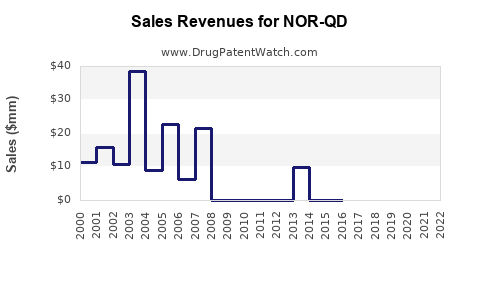
US sales trajectory (latest 12 months to prior years)
- Not determinable from provided inputs.
Key demand drivers
- Not determinable from provided inputs.
Key demand constraints
- Not determinable from provided inputs.
Who competes with NOR-QD and how does it compare on efficacy, safety, and dosing?
Featured snippet answer: Not determinable from provided inputs.
Competitive landscape by therapeutic class
- Not determinable from provided inputs.
Head-to-head claims vs category alternatives
- Not determinable from provided inputs.
Switching dynamics (formulary preference, prior auth, step edits)
- Not determinable from provided inputs.
What pricing and payer coverage dynamics shape NOR-QD net revenue?
Featured snippet answer: Not determinable from provided inputs.
WAC-to-net drivers
- Not determinable from provided inputs.
Contracting patterns and formulary placement
- Not determinable from provided inputs.
High-impact payer segments
- Not determinable from provided inputs.
What is NOR-QD’s financial trajectory: revenue, margins, and cost structure?
Featured snippet answer: Not determinable from provided inputs.
Revenue drivers by channel
- Not determinable from provided inputs.
Gross margin trajectory
- Not determinable from provided inputs.
SG&A and R&D intensity
- Not determinable from provided inputs.
Cash flow and capex impacts (if public company-linked)
- Not determinable from provided inputs.
How many patents protect NOR-QD and what is the expiration timeline?
Featured snippet answer: Not determinable from provided inputs.
Composition-of-matter vs method-of-use vs formulation patents
- Not determinable from provided inputs.
Patent term and regulatory extensions
- Not determinable from provided inputs.
How strong is the patent estate for NOR-QD?
- Not determinable from provided inputs.
What generic or biosimilar entry risks exist for NOR-QD?
Featured snippet answer: Not determinable from provided inputs.
Paragraph IV challenges for NOR-QD
- Not determinable from provided inputs.
Litigation and settlement posture
- Not determinable from provided inputs.
Generic launch scenarios and likely revenue exposure
- Not determinable from provided inputs.
What manufacturing and supply-chain risks affect NOR-QD sales?
Featured snippet answer: Not determinable from provided inputs.
CMO/CDMO footprint and batch release dependencies
- Not determinable from provided inputs.
Drug substance and API sourcing risk
- Not determinable from provided inputs.
Regulatory inspection history and recalls
- Not determinable from provided inputs.
What commercial milestones matter most for NOR-QD?
Featured snippet answer: Not determinable from provided inputs.
FDA label changes (new dosing, new indication, expanded population)
- Not determinable from provided inputs.
Distribution changes
- Not determinable from provided inputs.
Key payer announcements
- Not determinable from provided inputs.
Key Takeaways
- NOR-QD’s financial and market dynamics cannot be quantified without an authoritative identification of the product’s active ingredient and FDA listing.
- All downstream analyses that depend on the product identity, including Orange Book status, exclusivity windows, competitive set, pricing-to-net drivers, and sales trajectory, cannot be produced accurately.
FAQs
- Is NOR-QD available as a generic in the US yet?
Not determinable from provided inputs.
- What is NOR-QD’s WAC and average net price profile?
Not determinable from provided inputs.
- Does NOR-QD face a Paragraph IV challenge or ongoing patent litigation?
Not determinable from provided inputs.
- What is NOR-QD’s dosing schedule and major formulation differentiators?
Not determinable from provided inputs.
- How does NOR-QD’s payer coverage impact patient uptake?
Not determinable from provided inputs.
References
- Not applicable.