Last updated: September 7, 2026
Nizatidine is a mature, generic H2-receptor antagonist with limited commercial value. Its branded product, Axid, lost meaningful exclusivity more than two decades ago. Current market economics are driven by low-cost generic competition, substitution by famotidine and proton-pump inhibitors, and supply constraints related to N-nitrosodimethylamine (NDMA) contamination. No material patent or biosimilar barrier remains. Standalone revenue data are generally unavailable because manufacturers report nizatidine within broader generic portfolios rather than as a separate product.
What is nizatidine and how is it used?
Nizatidine is an oral histamine-2 receptor antagonist that reduces gastric acid secretion. It was developed for acid-related gastrointestinal disorders, including:
- Duodenal and gastric ulcers
- Gastroesophageal reflux disease
- Heartburn and acid indigestion
- Maintenance treatment for healed duodenal ulcers
The original branded product was Axid, commercialized by Eli Lilly. The U.S. Food and Drug Administration approved nizatidine capsules in 1988 under NDA 19-703. Available dosage strengths historically included 150 mg and 300 mg capsules, with 15 mg/mL oral solution also approved in some markets.[1]
Nizatidine competes pharmacologically with famotidine, cimetidine and ranitidine. It competes therapeutically with proton-pump inhibitors such as omeprazole, lansoprazole, pantoprazole and esomeprazole.
What is the FDA regulatory status of nizatidine?
Nizatidine has an established FDA approval pathway, but product-level market availability is fragmented.
| Regulatory item |
Status |
| Active ingredient |
Nizatidine |
| Drug class |
Histamine-2 receptor antagonist |
| Original U.S. brand |
Axid |
| Original sponsor |
Eli Lilly |
| Original approval |
1988 |
| Original NDA |
19-703 |
| U.S. dosage forms |
Capsules; oral solution historically approved |
| Current regulatory pathway |
Abbreviated New Drug Application generic products |
| Regulatory exclusivity |
Expired |
| Biosimilar pathway |
Not applicable |
| Main regulatory concern |
NDMA contamination in certain batches and products |
FDA approval of a nizatidine product does not guarantee continued commercial distribution. Drug listing, manufacturing status and pharmacy availability can diverge. Generic manufacturers may discontinue products because of low margins, quality-control costs, raw-material shortages or limited demand.
The most important regulatory event in the recent market history was the discovery of NDMA in certain nizatidine products. FDA reported that some nizatidine lots contained NDMA and that several manufacturers recalled affected products.[2] The issue followed the earlier ranitidine contamination crisis and affected prescribing and pharmacy substitution decisions across the H2-antagonist category.
When did nizatidine lose patent exclusivity?
Nizatidine lost meaningful U.S. patent exclusivity in the early 2000s. The original compound and related formulation protection have expired, allowing multiple manufacturers to market generic products.
| Exclusivity category |
Commercial status |
| Original compound patent |
Expired |
| Original Axid product protection |
Expired |
| Generic entry |
Established |
| Current blocking patent |
None of material commercial significance identified |
| Pediatric exclusivity |
Expired or no longer commercially relevant |
| Regulatory exclusivity |
Expired |
| New formulation exclusivity |
No major active barrier affecting the conventional capsule market |
The relevant commercial conclusion is that nizatidine is an off-patent small molecule. A company seeking to launch a conventional nizatidine capsule would generally face ANDA requirements, manufacturing validation, bioequivalence testing and quality compliance rather than an originator patent barrier.
How many patents cover nizatidine?
The historical nizatidine patent estate included composition-of-matter, pharmaceutical formulation and therapeutic-use protection. That estate is now functionally exhausted for the conventional oral product.
Patent risk is limited in four areas:
- The original nizatidine molecule and core chemical structure.
- Conventional capsule formulations.
- Approved treatment uses for acid-related disorders.
- Manufacturing methods tied to the original commercial product.
Those rights were filed and prosecuted decades ago. They do not create a current barrier to ordinary generic entry. A later patent could theoretically cover a specific delivery system, combination product or manufacturing process, but no such patent has become a market-defining obstacle for standard nizatidine capsules.
What formulations are protected by nizatidine patents?
Historical protection focused on immediate-release oral dosage forms and pharmaceutical compositions. The commercially relevant products were capsules and, in some jurisdictions, oral solutions.
The formulation landscape has limited differentiation:
| Formulation |
Commercial relevance |
Patent risk |
| 150 mg capsule |
Core generic market |
Low |
| 300 mg capsule |
Core generic market |
Low |
| Oral solution |
Smaller niche |
Low to moderate, depending on jurisdiction and product status |
| Modified-release formulation |
Limited commercial penetration |
Product-specific |
| Combination product |
Limited |
Product-specific |
| Injectable formulation |
Not the principal nizatidine market |
Low market relevance |
A generic manufacturer’s main barriers are operational. These include API sourcing, impurity control, validated analytical methods, stability data and compliance with FDA current good manufacturing practice requirements.
What caused the recent disruption in the nizatidine market?
NDMA contamination materially weakened nizatidine demand and reduced supply reliability.
NDMA is a probable human carcinogen classified by the International Agency for Research on Cancer. FDA identified NDMA in certain batches of nizatidine and requested or announced recalls involving affected products. The agency’s position was product- and lot-specific rather than a declaration that every nizatidine product was contaminated.[2]
The market effects were direct:
- Pharmacies removed or quarantined affected inventory.
- Prescribers shifted patients to famotidine or proton-pump inhibitors.
- Manufacturers faced testing, investigation and recall costs.
- Wholesalers reduced purchasing from uncertain suppliers.
- Generic manufacturers had less incentive to maintain low-volume products.
- Patients and payers became more sensitive to product availability.
The contamination event also affected the broader H2-antagonist category. Ranitidine was withdrawn from the U.S. market after FDA requested removal of all ranitidine products in April 2020.[3] That event initially increased demand for famotidine and other alternatives, but the long-term effect did not restore nizatidine to a major growth product.
How does nizatidine compare with famotidine, ranitidine and proton-pump inhibitors?
Famotidine is the principal H2-antagonist comparator in the current U.S. market. Ranitidine has been commercially displaced in the United States, while proton-pump inhibitors remain the strongest therapeutic substitute.
| Product |
Current commercial position |
Competitive advantage |
Main weakness |
| Nizatidine |
Small generic niche |
Effective acid suppression; established safety history apart from product-specific contamination issues |
Limited availability and weak demand |
| Famotidine |
Leading H2-antagonist alternative |
Broad availability; OTC and prescription distribution |
Less potent than PPIs for some conditions |
| Ranitidine |
Withdrawn from U.S. market |
Historical brand familiarity |
FDA-requested market removal |
| Omeprazole and other PPIs |
Large and established market |
Strong acid suppression and broad indications |
Different risk-benefit and longer treatment considerations |
| Cimetidine |
Older generic alternative |
Low price and availability in some markets |
Drug-interaction profile limits use |
Famotidine has the strongest competitive position within H2 blockers because it has a broad distribution base and benefited from the ranitidine withdrawal. Nizatidine has no comparable brand investment, OTC footprint or differentiated delivery platform.
What is the financial trajectory of nizatidine?
Nizatidine’s financial trajectory follows the standard lifecycle of an older small-molecule drug:
- Branded growth after Axid launch.
- Peak commercial value before generic entry.
- Rapid revenue erosion after loss of exclusivity.
- Fragmentation among generic suppliers.
- Further decline following substitution by PPIs and famotidine.
- Additional contraction after NDMA-related recalls.
Eli Lilly historically reported Axid as part of its pharmaceutical portfolio, but nizatidine did not remain a separately material revenue line after generic competition. Generic manufacturers generally do not disclose product-level nizatidine sales in public filings. As a result, a precise current global market size or company-by-company revenue ranking cannot be established from public financial statements.
The economic model is structurally unattractive:
| Financial driver |
Effect on nizatidine |
| Patent expiration |
Removes price protection |
| Multiple generic suppliers |
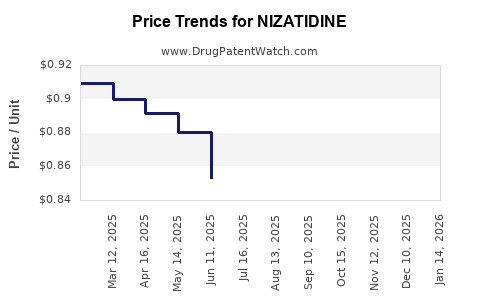
Compresses net pricing |
| Small treated population |
Limits volume |
| PPI substitution |
Reduces category demand |
| Famotidine competition |
Reduces H2-blocker share |
| NDMA testing and recalls |
Raises cost and supply risk |
| Limited differentiation |
Prevents premium pricing |
| Hospital and retail substitution |
Favors lower-cost alternatives |
Nizatidine can generate incremental portfolio revenue for a manufacturer with existing capsule capacity, but it is unlikely to support a standalone branded investment case.
What generic entry risks exist for nizatidine?
Generic entry risk is high because legal barriers are minimal. The main uncertainty is whether a manufacturer will choose to enter or remain in the market.
Paragraph IV litigation
Paragraph IV litigation is not a major current risk for conventional nizatidine products because the foundational patent estate has expired. A new ANDA sponsor would more likely face regulatory and commercial execution risks than originator patent litigation.
Potential disputes could still arise over:
- A later patent covering a specific formulation
- Labeling or method-of-use language
- Manufacturing-process claims
- Trade-secret or supplier disputes
- Product liability connected to impurity control
These issues do not amount to a broad market-entry barrier.
Generic launch scenarios
| Scenario |
Likely market effect |
| One or two reliable suppliers remain |
Stable but small niche with intermittent shortages possible |
| New generic entrants increase supply |
Lower prices and weaker incumbent economics |
| NDMA or another impurity issue recurs |
Renewed recalls and rapid substitution |
| Famotidine supply tightens |
Temporary demand recovery for nizatidine |
| PPI prescribing expands |
Continued volume erosion |
| Manufacturer exits |
Greater shortage risk despite no patent barrier |
What manufacturing and intellectual-property barriers affect nizatidine?
Manufacturing controls are more important than patent rights.
Nizatidine manufacturers must manage nitrosamine risk through:
- API supplier qualification
- Raw-material and solvent controls
- Nitrite and amine impurity monitoring
- Validated analytical testing
- Batch-release specifications
- Stability monitoring
- Supply-chain traceability
FDA’s nitrosamine guidance has increased the cost of maintaining products that generate modest revenue.[4] For a low-volume generic, these obligations can make continued commercialization uneconomic even when manufacturing technology is straightforward.
Geographic coverage also matters. U.S. availability depends on FDA-approved manufacturers and importers. European and other national markets may have different approvals, suppliers and recall histories. A product can remain approved in one jurisdiction while disappearing from retail channels in another.
What is the Orange Book status of nizatidine?
The Orange Book historically listed Axid and approved generic equivalents. The original listed patents and regulatory exclusivities are no longer commercially blocking for standard nizatidine products.
The current Orange Book question is therefore less about patent expiry and more about whether a particular product remains active, listed and marketed. FDA’s Orange Book identifies approved products, while Drugs@FDA and manufacturer information provide separate signals regarding product status and distribution.[5]
There is no biosimilar risk analysis for nizatidine. It is a chemically synthesized small molecule, so competing products are approved through the ANDA pathway rather than the Biologics Price Competition and Innovation Act pathway.
Which companies are challenging or competing with nizatidine?
Nizatidine competition comes primarily from generic and therapeutic substitutes rather than active patent challengers.
Relevant competitive groups include:
- Generic nizatidine manufacturers
- Generic famotidine manufacturers
- OTC famotidine brands
- Generic and branded PPI manufacturers
- Retail pharmacy private-label suppliers
- Contract manufacturers serving national wholesalers
The most important commercial competitors are famotidine products and OTC PPIs. Their advantage is scale, distribution and physician familiarity, not patent exclusivity.
What licensing deals affect nizatidine?
No major current licensing transaction appears to define the nizatidine market. The commercial rights associated with Axid were historically connected to Eli Lilly, but the product’s value declined after generic entry.
Any present-day transaction would likely involve:
- A generic product acquisition
- A contract manufacturing agreement
- Regional distribution rights
- API supply
- Portfolio transfer of discontinued or low-volume products
These arrangements are generally not disclosed at the product level unless they are material to a public company.
What patent litigation and settlements affect nizatidine?
No active, market-defining patent litigation or settlement agreement is known to control U.S. entry for conventional nizatidine capsules. The significant legal events are historical patent expiry and regulatory recalls rather than ongoing Paragraph IV litigation.
The absence of litigation does not mean the market is frictionless. Manufacturers still face FDA inspection risk, recall exposure, product liability and possible antitrust or supply-contract disputes. Those risks affect profitability but do not preserve originator exclusivity.
How strong is the nizatidine patent estate?
The nizatidine patent estate is weak for current commercial purposes.
| Patent-estate factor |
Assessment |
| Composition-of-matter protection |
Expired |
| Formulation protection |
Expired or commercially non-blocking |
| Method-of-use protection |
Expired |
| Active Orange Book barrier |
None of material significance |
| Paragraph IV threat |
Low |
| Generic substitution risk |
High |
| Lifecycle-management potential |
Low |
| Manufacturing complexity |
Moderate because of impurity controls |
| Commercial defensibility |
Low |
A manufacturer could still create value through reliable supply, quality assurance, regional distribution or a differentiated dosage form. Patent-based value creation is unlikely.
Key Takeaways
- Nizatidine is a mature, off-patent H2-receptor antagonist.
- Axid’s branded commercial franchise has ended; generic products dominate the product class.
- The original patent and regulatory exclusivity periods expired in the early 2000s.
- FDA-approved nizatidine products have faced NDMA-related recalls and supply disruption.
- Famotidine and proton-pump inhibitors are the principal commercial substitutes.
- Standalone nizatidine revenue is generally not disclosed by manufacturers.
- Current market value is limited by low pricing, weak differentiation and declining demand.
- Generic entry is legally easy, but manufacturing economics and impurity controls can discourage participation.
- No biosimilar pathway applies because nizatidine is a small-molecule drug.
- The product has low patent strength and limited prospects for premium pricing or branded relaunch.
FAQs
Is nizatidine still available in the United States?
Some nizatidine products may remain FDA-approved or available through selected channels, but commercial availability varies by manufacturer, wholesaler and pharmacy. FDA approval does not guarantee continuous distribution.
Was nizatidine recalled for NDMA?
Certain nizatidine products and lots were recalled after NDMA was detected. The recalls were product- and lot-specific, and the regulatory response did not establish that every nizatidine product contained NDMA.[2]
Is nizatidine stronger than famotidine?
Nizatidine and famotidine are both H2-receptor antagonists, but comparative efficacy depends on dose, indication and treatment duration. Famotidine has the stronger current commercial position because of availability and distribution.
Can a company launch a generic nizatidine product without challenging a patent?
For conventional nizatidine capsules, the principal originator patents have expired. A generic sponsor would generally rely on the ANDA pathway without facing a current blocking patent challenge, subject to FDA requirements and any product-specific listed rights.
Does nizatidine have a viable branded relaunch opportunity?
The opportunity is limited. A relaunch would face generic pricing, famotidine competition, PPI substitution, low physician demand and the commercial impact of the NDMA contamination history. A differentiated formulation or regional supply strategy would be more viable than a conventional branded capsule.
References
- U.S. Food and Drug Administration. (1988). Axid (nizatidine) prescribing information, NDA 19-703.
- U.S. Food and Drug Administration. (2019-2020). FDA updates and recalls for nizatidine products containing N-nitrosodimethylamine (NDMA).
- U.S. Food and Drug Administration. (2020, April 1). FDA requests removal of all ranitidine products from the U.S. market.
- U.S. Food and Drug Administration. (2023). Control of nitrosamine impurities in human drugs: Guidance for industry.
- U.S. Food and Drug Administration. (2024). Approved drug products with therapeutic equivalence evaluations: Orange Book.