Last updated: September 1, 2026
Nicotine polacrilex is an established nicotine-replacement therapy used in chewing gum, lozenges, and related oral products. Its commercial market is mature, fragmented, and largely driven by brand recognition, retail distribution, reimbursement, regulatory compliance, and manufacturing scale rather than active-ingredient exclusivity. The leading branded product is Nicorette, while private-label and generic products compete primarily on price.
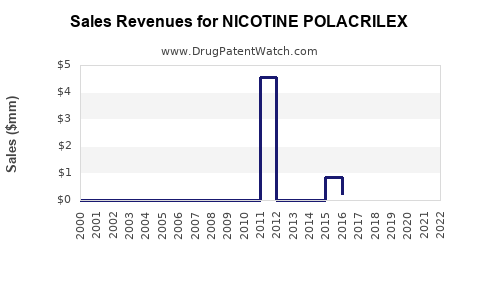
The product has no meaningful biologic or biosimilar risk. Its core composition and cessation use are old, and the principal commercial protections are trademarks, packaging, formulation know-how, manufacturing controls, and channel access. Financial reporting does not usually disclose nicotine polacrilex revenue as a standalone line item, so the product’s trajectory must be assessed through broader consumer-health portfolios and the nicotine-replacement-therapy market.
What is nicotine polacrilex and how is it used?
Nicotine polacrilex is a nicotine-ion exchange resin. The resin controls nicotine release when the product is chewed or allowed to dissolve in the mouth. It is most commonly sold in 2 mg and 4 mg strengths.
The primary dosage forms are:
- Chewing gum
- Lozenges
- Mini-lozenges or mini-tabs
- Combination regimens with nicotine patches
- Retail and private-label cessation products
The FDA permits nicotine gum and lozenges to be marketed over the counter under the applicable nonprescription-drug framework. The products are intended to reduce withdrawal symptoms and cravings when consumers stop smoking or reduce tobacco use.[1]
Nicotine polacrilex is not the same as nicotine freebase or nicotine salts used in electronic-cigarette liquids. The delivery system, release profile, labeling, and regulatory pathway differ.
How large is the nicotine-replacement-therapy market?
The market is global, but commercial demand is concentrated in North America, Western Europe, Australia, and selected Asian markets with established smoking-cessation programs. Nicotine gum and lozenges compete with transdermal patches, nicotine sprays, inhalers, varenicline, bupropion, and newer prescription or digital cessation programs.
Market growth is shaped by four factors:
- Smoking prevalence and quit attempts.
- Public-health reimbursement and employer cessation programs.
- Substitution between cigarettes, heated tobacco, vaping, and oral nicotine products.
- Retail visibility and pricing.
The mature nature of nicotine gum limits volume growth. Revenue can still rise through price increases, premium formats, multipacks, expanded distribution, and higher use of combination therapy.
Public market reports generally estimate the overall nicotine-replacement-therapy market rather than nicotine polacrilex alone. Their methodologies differ materially by geography, dosage form, and inclusion of prescription products. No single reported market figure should be treated as a definitive valuation of nicotine polacrilex.
What is the competitive structure?
The category has a branded leader and a broad generic and private-label base.
| Competitive group |
Representative products or companies |
Primary advantage |
| Branded nicotine gum and lozenges |
Nicorette, marketed in the United States by Kenvue |
Brand recognition, retail placement, product range |
| Generic and private-label products |
Retail pharmacy and supermarket brands; contract-manufactured products |
Lower price, retailer control |
| Alternative NRT |
Nicotine patches, sprays, inhalers, and combination regimens |
Different delivery profile and consumer preference |
| Prescription cessation products |
Varenicline and bupropion |
Non-nicotine mechanisms and physician-directed treatment |
| Consumer nicotine products |
E-cigarettes, nicotine pouches, heated tobacco |
Alternative nicotine delivery and strong consumer switching effects |
Kenvue identifies Nicorette among its consumer-health brands. The company reports financial results by broad business segment and product category, not as a separately audited nicotine-polacrilex revenue line.[2]
What is the financial trajectory for nicotine polacrilex products?
The financial profile is best described as stable-to-moderately growing in nominal terms, with substantial pressure on unit economics.
Revenue drivers
Branded revenue benefits from:
- Retail price increases
- Premium packaging and flavor extensions
- Larger multipacks
- E-commerce availability
- Pharmacy and grocery distribution
- Seasonal quit attempts, especially in January
- Employer and health-plan cessation programs
Volume is constrained by the maturity of the smoking-cessation category and by consumer migration to vaping and oral nicotine products. Some consumers use nicotine gum as a temporary cessation aid; others use it intermittently for craving control. That creates recurring demand but also limits treatment duration per purchaser.
Margin drivers
Nicotine polacrilex products typically have lower manufacturing complexity than prescription drugs, but margins vary by format. Gum production requires specialized nicotine-resin incorporation, flavoring, coating, compression or chewing-gum processing, packaging, and stability controls. Lozenges require controlled dissolution and dose uniformity.
The main cost pressures are:
- Nicotine resin and pharmaceutical excipients
- Flavor systems
- Blister and bottle packaging
- Contract manufacturing
- Retailer and distributor deductions
- Consumer-health advertising
- Product recalls or quality remediation
- Compliance with nicotine handling and child-resistant packaging requirements
Branded manufacturers can preserve gross margin through pricing and product differentiation. Generic and private-label suppliers usually operate with lower promotional expense but face retailer pricing pressure.
What do public-company disclosures show?
Kenvue’s public filings provide the clearest company-level reference point for the branded U.S. business, but they do not isolate Nicorette sales. Nicorette is reported within the company’s broader consumer-health portfolio, which includes multiple self-care categories.[2]
This limits the precision of any product-specific revenue model. A credible forecast should therefore use a bottom-up approach:
- Estimate category volume by dosage form.
- Separate branded, generic, and private-label shares.
- Apply average selling prices by channel.
- Model retailer discounts and promotional spending.
- Adjust for geographic mix.
- Include the impact of smoking prevalence and nicotine-product substitution.
A forecast based only on total NRT market growth will overstate nicotine polacrilex growth if patches, sprays, or prescription cessation products gain share.
When does nicotine polacrilex lose exclusivity?
Nicotine polacrilex has already lost effective active-ingredient exclusivity. The ingredient has been used in commercial cessation products for decades, and the core concept is not protected by a current composition-of-matter monopoly.
The relevant commercial position is:
| Protection category |
Current significance |
| Active ingredient |
Mature and broadly available |
| Basic nicotine gum concept |
Old technology; no practical exclusivity |
| Basic lozenge concept |
Mature dosage form with competing products |
| Specific formulation |
May have historical or limited residual protection, depending on jurisdiction |
| Trademark |
Material for branded products such as Nicorette |
| Packaging and trade dress |
Useful but narrower than a drug patent |
| Manufacturing process |
Potentially valuable as know-how or a process patent |
| Regulatory status |
Compliance barrier, not market exclusivity |
| Retail distribution |
Important commercial barrier for smaller entrants |
The commercial moat is therefore brand and execution rather than patent exclusivity.
What patents protect nicotine polacrilex products?
No single patent family protects all nicotine polacrilex products. Historical patent activity has covered resin complexes, chewing-gum compositions, lozenges, release control, flavoring, and manufacturing processes. Those rights are generally product-specific and jurisdiction-specific.
A current freedom-to-operate review would need to distinguish:
- Expired foundational patents
- Patent families covering particular release profiles
- Formulation patents for flavors, sweeteners, buffers, and stabilizers
- Process patents for resin incorporation or coating
- Packaging patents
- Continuations and foreign counterparts
- Regulatory exclusivity or market-protection provisions
Patent numbers should not be attributed to the category as a whole because nicotine polacrilex is an active ingredient and delivery platform, not a single marketed product with one patent estate.
Are nicotine polacrilex products listed in the Orange Book?
Ordinary over-the-counter nicotine gum and lozenges are generally not assessed through the same Orange Book framework used for approved prescription and certain nonprescription drug applications. The FDA Orange Book identifies approved drug products and associated patents or exclusivity for products approved under applicable new-drug applications.[3]
For OTC nicotine polacrilex products marketed under the FDA’s nonprescription framework, the relevant issues are monograph compliance, labeling, manufacturing quality, and establishment registration. An Orange Book listing should not be assumed merely because a product contains an FDA-approved active ingredient.
Are Paragraph IV challenges relevant to nicotine polacrilex?
Paragraph IV litigation is generally not the central entry mechanism for standard OTC nicotine gum and lozenges.
Paragraph IV certifications arise in the abbreviated new drug application system when a generic applicant challenges patents listed for a reference product. A conventional OTC product marketed under an applicable FDA monograph does not normally generate the same Hatch-Waxman patent-certification pathway as a prescription product approved through an NDA.
A challenge may become relevant if a particular nicotine product is approved through an NDA or ANDA and has listed patents. For the ordinary nicotine-polacrilex retail category, competitive entry is more likely to occur through:
- OTC monograph compliance
- Private-label manufacture
- New drug applications where required
- Retailer sourcing and relabeling
- Product-specific regulatory review
- Trademark clearance
What formulation patents protect nicotine gum and lozenges?
Formulation protection can apply to product characteristics that affect consumer experience or manufacturing performance. Examples include:
- Controlled nicotine release
- Reduced mouth irritation
- Improved taste masking
- Long-lasting flavor
- Moisture control
- Improved stability
- Reduced nicotine migration
- Specific resin particle size
- Compression or chewing characteristics
- Combination products with other nicotine-delivery systems
These claims are narrower than an active-ingredient patent. A competitor can sometimes design around them by changing excipients, release controls, flavor systems, dosage form, or manufacturing conditions.
For a generic or private-label entrant, the practical risk is often less about infringement of a foundational nicotine patent and more about the cost of regulatory validation, stability data, product testing, quality systems, and market launch.
What is the FDA regulatory status of nicotine polacrilex?
Nicotine gum and lozenges are FDA-regulated drug products used for smoking cessation. The FDA’s nonprescription framework establishes requirements for active ingredient strength, directions, warnings, labeling, and manufacturing quality.[1]
Key regulatory issues include:
- Correct nicotine strength
- Dose uniformity
- Dissolution or release performance
- Child-resistant packaging
- Product labeling
- Stability and shelf life
- Good manufacturing practice
- Controls for nicotine exposure during production
- Advertising claims limited to authorized uses
The regulatory burden is lower than for a new molecular entity but remains material. Nicotine is pharmacologically active and toxic at excessive exposure levels, making process control and packaging important.
What generic entry risks exist for nicotine polacrilex?
Generic-entry risk is high at the ingredient level and moderate at the brand level.
A new supplier can usually compete without overcoming a live composition-of-matter patent. Its principal challenges are:
- Securing compliant nicotine resin
- Matching taste and mouthfeel
- Achieving acceptable release characteristics
- Obtaining retail shelf space
- Funding consumer marketing
- Establishing reliable supply
- Avoiding trademark and trade-dress conflicts
- Meeting regional regulatory requirements
Branded products retain pricing power where consumers associate Nicorette with efficacy or where pharmacies prefer a recognized product. That advantage is weaker in commodity-heavy retail channels and during periods of consumer budget pressure.
What generic launch scenarios are most likely?
| Scenario |
Market effect |
Brand impact |
| Additional low-price gum entrants |
Higher price competition |
Moderate volume and margin pressure |
| Retailer private-label expansion |
Shelf-space displacement |
High pressure in pharmacies and supermarkets |
| Growth in nicotine pouches |
Reduced cessation-gum demand |
Potentially high over the long term |
| Stronger smoking-cessation reimbursement |
Category expansion |
Positive for brands and generics |
| E-commerce growth |
Wider price comparison |
Greater private-label risk |
| Regulatory tightening of alternative nicotine products |
Possible return to NRT |
Positive but difficult to quantify |
Which companies are challenging branded nicotine polacrilex products?
Competition comes from generic manufacturers, private-label suppliers, and alternative nicotine-delivery companies. The most important competitive threat is not a single patent challenger. It is substitution.
Nicotine gum competes against:
- Perrigo and other consumer-health manufacturers supplying generic or private-label products
- Retail pharmacy brands
- Haleon’s international Nicotinell and related products
- Nicotine-pouch manufacturers
- E-cigarette and heated-tobacco companies
- Prescription and digital cessation providers
Company participation varies by country because trademarks, regulatory classifications, distribution rights, and manufacturing arrangements differ.
What licensing deals and manufacturing barriers affect the market?
Public disclosures do not identify a category-wide licensing structure for nicotine polacrilex. Commercial arrangements are more likely to involve:
- Contract manufacturing
- Regional trademark licenses
- Distribution agreements
- Private-label supply agreements
- Technology or formulation licenses
- Acquisition of consumer-health brands
Manufacturing is a meaningful barrier because nicotine gum is not equivalent to ordinary confectionery gum. Dose uniformity, resin dispersion, flavor release, nicotine stability, and packaging require specialized controls. A supplier can possess the legal ability to sell an OTC product but still lack the process capability to produce a commercially acceptable one.
How does nicotine polacrilex compare with nicotine patches?
| Factor |
Nicotine polacrilex gum or lozenge |
Nicotine patch |
| Delivery |
Oral, intermittent dosing |
Transdermal, continuous dosing |
| Consumer control |
High; used for cravings |
Lower; fixed daily delivery |
| Manufacturing |
Resin, gum or lozenge formulation |
Transdermal drug-delivery system |
| Brand differentiation |
Taste, texture, release, packaging |
Adhesion, skin tolerance, dose duration |
| Patent exposure |
Mostly mature formulation and process rights |
More delivery-system and adhesive considerations |
| Retail competition |
Strong private-label pressure |
Strong private-label pressure |
| Common use |
Breakthrough cravings or standalone NRT |
Baseline nicotine replacement |
Combination use of patch plus gum or lozenge can increase product consumption per cessation attempt, but it also changes the market from a single-product purchase to a regimen.
What is the geographic patent and commercial coverage?
The United States is the most visible branded market, but product ownership and regulatory status differ by country. Europe includes national and regional variations in OTC classification, reimbursement, trademarks, and permitted claims. Australia, Canada, Japan, and emerging markets have separate requirements for nicotine strength, indications, packaging, and advertising.
Patent protection must be analyzed jurisdiction by jurisdiction. A patent expired in the United States may have a different status elsewhere, while a trademark or formulation right may remain active even after foundational drug patents expire.
What is the investment outlook for nicotine polacrilex?
Nicotine polacrilex is a cash-generating but mature consumer-health product category. Its investment profile has four defining characteristics:
- Low active-ingredient exclusivity
- Moderate regulatory barriers
- High brand and distribution sensitivity
- Exposure to substitution from newer nicotine products
Upside is most likely to come from pricing, distribution expansion, combination therapy, and cessation-program growth rather than breakthrough innovation. Downside risk comes from private-label penetration, nicotine pouches, vaping, declining smoking prevalence, and retailer bargaining power.
Revenue exposure is difficult to quantify for diversified companies because Nicorette and competing brands are embedded in broader self-care reporting. Product-level valuation should therefore rely on channel data, shipment data, market-share estimates, and consumer-health segment disclosures rather than reported corporate revenue alone.
Key Takeaways
- Nicotine polacrilex is a mature OTC nicotine-replacement ingredient used mainly in gum and lozenges.
- The active ingredient has no meaningful current composition-of-matter exclusivity.
- Nicorette is the leading branded reference product in the U.S. market, with Kenvue as the relevant brand owner and marketer.
- Generic and private-label entry risk is high, particularly in price-sensitive retail channels.
- FDA monograph compliance, manufacturing capability, trademarks, and distribution are more important than foundational drug patents.
- Paragraph IV litigation and Orange Book-listed patent risk are generally limited for ordinary OTC nicotine-polacrilex products.
- Financial growth is likely to be driven by pricing, retail execution, cessation-program access, and product extensions.
- Nicotine pouches, vaping, and other nicotine products represent the principal long-term substitution risk.
- Public-company filings do not generally disclose nicotine-polacrilex revenue separately, limiting product-level financial precision.
FAQs
Is nicotine polacrilex the same as nicotine salt?
No. Nicotine polacrilex is nicotine bound to an ion-exchange resin for controlled oral release. Nicotine salts are nicotine compounds formulated for liquid or oral nicotine delivery and have different formulation and regulatory characteristics.
Does nicotine polacrilex require a prescription?
Standard nicotine gum and lozenges are generally sold over the counter in the United States when marketed under the applicable FDA requirements. Product status can vary by country, strength, and dosage form.
Can a company launch a private-label nicotine-polacrilex gum?
Yes, subject to applicable FDA or non-U.S. regulatory requirements. The principal hurdles are compliant formulation, manufacturing, labeling, quality controls, and retail distribution.
Are nicotine-polacrilex products protected by trade secrets?
Potentially. Manufacturing parameters, resin handling, flavor systems, release performance, supplier specifications, and quality-control methods may be protected as confidential know-how even where patent protection has expired.
Is nicotine polacrilex still commercially relevant as smoking declines?
Yes. Declining smoking prevalence reduces the long-term addressable population, but quit attempts, cessation programs, combination therapy, and continued nicotine dependence support ongoing demand. The category’s growth rate is likely to remain below that of newer nicotine-delivery segments.
References
-
U.S. Food and Drug Administration. (n.d.). Smoking cessation products. https://www.fda.gov/drugs/postmarket-drug-safety-information-patients-and-providers/smoking-cessation-products
-
Kenvue Inc. (2025). Annual report for the fiscal year ended December 29, 2024. U.S. Securities and Exchange Commission. https://www.sec.gov/
-
U.S. Food and Drug Administration. (n.d.). Approved drug products with therapeutic equivalence evaluations, Orange Book. https://www.fda.gov/drugs/drug-approvals-and-databases/approved-drug-products-therapeutic-equivalence-evaluations-orange-book