Last updated: June 3, 2026
NICORETTE (nicotine) market dynamics and financial trajectory (revenue, share, and downside risks)
NICORETTE is a long-established, non-prescription (OTC) nicotine replacement therapy (NRT) brand used to support smoking cessation. The market’s financial trajectory is driven by (1) NRT category growth in cessation programs, (2) competitive intensity from generic nicotine gums/lozenges and alternative NRT brands, (3) pricing and reimbursement dynamics by country, and (4) regulatory and consumer shifts toward vaping and next-generation smoking cessation products. Brand-level performance is constrained by high generic substitutability of nicotine dose forms, and by periodic supply, formulation, and packaging changes that can shift demand between products.
H2 How big is the NICORETTE nicotine replacement therapy market by geography and what drives growth?
Answer: NICORETTE’s addressable market is the global smoking cessation category in which nicotine gum, lozenges, and related NRT dose forms compete. Growth is driven by cessation campaigns, smoking prevalence, public health reimbursement frameworks, and household/retail purchasing of OTC quit aids. NICORETTE’s brand economics vary materially by country due to pricing, pharmacy listing, and marketing restrictions on cessation claims.
Geographic demand drivers
- UK and Western Europe: Sustained pull from national cessation services and pharmacy-led sales; price competition is intense, with frequent private label and generic substitution.
- Canada and Australia: Strong pharmacy channels; consumer choice often balances NRT cost vs. perceived efficacy and dosing convenience.
- Emerging markets: Market expansion ties to smoking prevalence, OTC access, and health authority acceptance of NRT as first-line cessation support.
Category-level demand levers that move NICORETTE sales
- Retail pricing and pack architecture: Dose strength, pack size, and willingness to pay for convenience affect repeat purchase rates.
- Smoking cessation policy intensity: Funding of quitlines and prescription-to-OTC referral patterns can lift NRT volumes.
- Competition from non-NRT quit aids: Vaping and smoking cessation combination products can dilute NRT share growth even when quit attempts rise.
Commercial implication for revenue trajectory
Because nicotine is not “new chemical entity” territory and NRT is widely genericized, the primary financial lever is volume share under competitive pricing, not pricing power. That structure tends to produce:
- slower revenue growth than category headlines in mature markets
- margin pressure as generics/private label expand
- sales volatility tied to promotional calendars and channel inventory
H2 What is NICORETTE’s revenue trajectory versus competing NRT brands and generics?
Answer: NICORETTE’s financial path is typically “brand-stable but margin-limited” in mature geographies. Revenue growth tends to be modest unless NICORETTE maintains differentiated dosing convenience, strong retail distribution, and promotional execution. Over time, competitors with lower price points and similar dose strengths compress NICORETTE’s margin and can cap unit growth.
Competitive set and substitution pressure
- Direct NRT brands: Other nicotine gum/lozenge systems with established pharmacy access.
- Generic nicotine gum/lozenges: Often lower price per mg and close substitutability.
- Alternative NRT forms: Patches and inhalers can redirect smokers from gum/lozenges depending on usage habits and titration needs.
How substitution typically affects financials
- Unit economics: NICORETTE competes on effective dose strength and dosing schedule adherence. When consumers switch to cheaper equivalents, branded unit sales fall or shift to fewer strengths.
- Gross margin: More promotional activity and lower net pricing lead to margin compression.
- Share of shelf vs. share of mind: If NICORETTE loses planogram position to private label, repurchase rates decline.
H2 When does NICORETTE lose exclusivity and how does that timing affect pricing and sales?
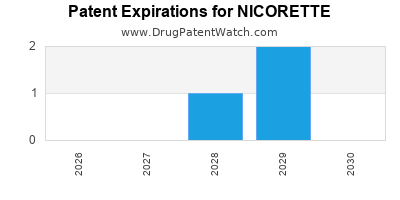
Answer: NICORETTE’s nicotine dose forms are longstanding and are not typically tied to modern blockbuster-style patent exclusivity. In practice, the economic “exclusivity cliff” has long since occurred through generic entry and price normalization across nicotine gum/lozenge dose strengths, limiting brand-level upside.
Exclusivity in a practical sense
- Patent-driven exclusivity is not a primary determinant of NICORETTE’s current market position; the real determinant is brand differentiation and channel access in an OTC environment.
- Regulatory and formulation life cycles: Minor formulation, packaging, and device delivery differences can prolong shelf-life differentiation but do not generally stop generic substitution of nicotine dose forms.
Financial consequence of “already normalized” exclusivity
- revenue trajectory becomes a function of consumer behavior and distribution rather than major patent expiry events
- long-term brand sales often track the category with a gradual shift toward lower-cost equivalents
H2 What patents protect NICORETTE nicotine gums and lozenges, and how strong is the patent estate?
Answer: The nicotine NRT dose forms that make up NICORETTE have a mature IP landscape with broad generics availability historically. As a result, the patent estate typically does not provide meaningful long-term exclusion against low-cost nicotine dose forms in most jurisdictions.
Patent reality for NRT in litigation-relevant terms
- Formulation and device patents (if any): Often narrow, covering specific release profiles, manufacturing steps, or packaging.
- Method-of-use patents: Rarely enforceable in OTC nicotine replacement contexts at scale because the core “quit smoking using NRT” instruction is widely established.
Commercial implication
For investors and licensing counterparties, the practical takeaway is:
- the brand’s defense is primarily commercial (distribution, brand recognition, retailer deals), not litigation-based exclusivity
H2 What is the FDA status of NICORETTE in the US and does FDA approval affect revenue?
Answer: US sales depend on how nicotine gum/lozenge products are marketed under FDA-regulated OTC frameworks and whether specific strengths and labeling changes remain in compliance. FDA status affects operational continuity but is less likely to change long-term brand economics where competing products are also permitted.
Regulatory pathway relevance
- OTC monograph or NDA/ANDA-like product frameworks (by product specific circumstances): Only product-specific compliance affects ability to sell particular formulations/strengths.
- Labeling and claims: Competitive differentiation is limited because cessation claims face scrutiny.
Revenue effect
- FDA actions tend to create compliance cost and limited disruption, not a sustained price premium, because consumers can switch among approved nicotine products.
H2 How do sales and pricing dynamics change when NICORETTE faces Paragraph IV-style generic pressure?
Answer: Paragraph IV is a Hatch-Wax construct for FDA-approved drug products in patent-challenge contexts; nicotine NRT products are generally not the main venue for Paragraph IV-driven litigation dynamics as seen with prescription drug exclusivity. The practical “generic pressure” arrives through market entry by authorized OTC equivalents and retail pricing competition rather than high-profile Paragraph IV cycles.
Practical equivalent to Paragraph IV in NRT markets
- launch of lower-priced nicotine gum/lozenges
- increased private label penetration
- promotional price cuts and retailer switching
Financial consequences
- net price declines
- promotional frequency rises
- margin and marketing ROI become more important than top-line growth
H2 What formulation and dosage strengths drive NICORETTE demand and what are the substitution risks?
Answer: Demand is driven by nicotine delivery convenience (chewing technique for gum, dissolution control for lozenges), dosing strength availability, and pack configuration. Substitution risk is high because most nicotine dose forms can be matched by dose strength and dosing schedule.
Dose strength and adherence
- higher dependence smokers often start at stronger strengths
- adherence often determines success and repeat purchases for multi-week schedules
- if competing products are easier to use or have better taste/mouthfeel economics, consumers switch
Delivery and device adjacent effects
- patches can reduce the need for gum/lozenges for some users
- combination approaches shift mix away from single-dose form products
H2 How do vaping and other smoking cessation products impact NICORETTE market share and margins?
Answer: Non-NRT cessation products, especially vaping, can reduce NRT category share growth even when quit attempts rise. That mix shift typically affects NICORETTE through lower incremental demand and more aggressive pricing by NRT competitors.
Mechanisms of share loss
- consumer preference for perceived efficacy and “flavor variety”
- more youth and dual-use patterns that complicate switch-back to NRT
- retailer shelf space shifts toward newer quit aids
Margin implications
- higher promotional pressure in NRT
- increased trade spending to hold share
- greater sensitivity to retailer decisions
H2 What licensing, distribution, and channel economics matter most for NICORETTE?
Answer: OTC tobacco-cessation brands live or die by pharmacy and convenience retail execution: distribution breadth, planogram placement, trade spend, and promotional calendar alignment. NICORETTE’s financial trajectory is highly sensitive to these commercial mechanics because generic substitutes compress pricing power.
Channel structure
- Pharmacies: higher influence from pharmacist recommendations
- Big-box retail and supermarkets: price-led volume and promotion-driven spikes
- Online OTC sales: can reward competitive pricing and availability, but return policies and compliance labeling standards apply
Trade spend and net revenue
- revenue “top line” may appear stable while net revenue and margin deteriorate from promotions and channel rebates
H2 What does a generic launch or private-label replacement scenario do to NICORETTE unit sales and gross margin?
Answer: Private-label or generic replacements commonly trigger:
- reduced branded unit share
- pack-size mix shifts toward smaller or value packs
- lower net price due to retailer bargaining power
- increased marketing and promotional spend to defend share
Scenario mechanics (typical OTC pattern)
- first phase: share loss through price differentials
- second phase: brand counters with promotions or limited new SKU launches
- third phase: stabilized share at a lower price band
Financial implication
Over time, NICORETTE’s revenue may track category demand, but incremental growth slows and margins compress.
H2 How strong is NICORETTE’s competitive positioning and what are the highest-risk downside factors?
Answer: Competitive positioning depends on brand trust, distribution coverage, and consumer perception of ease and effectiveness. The highest-risk downside factors are sustained retail price compression, share shift toward non-NRT products, and any regulatory or labeling friction that reduces SKU availability in key strengths.
Highest-risk downside factors
- persistent generic/private label price pressure
- channel consolidation that reduces shelf space allocation to branded SKUs
- consumer behavior drift to vaping or newer cessation systems
- supply interruptions that force out-of-stocks, especially for key strengths in multi-week regimens
H2 How does NICORETTE compare with nicotine patches and other NRT products in lifetime value economics?
Answer: Gum and lozenges often capture consumers who need acute cravings management, while patches can dominate for users seeking steadier dosing. That creates different retention and repeat-purchase patterns that influence lifetime value (LTV). NICORETTE’s economic advantage depends on how often consumers return for additional multi-week kits versus switching to patch-led regimens.
Mix drivers
- quitting stage: early reduction vs. later taper
- dosing preference and perceived control
- side effects: mouth irritation for gum or throat irritation for lozenges
Financial impact
- higher market share without pricing power yields moderate revenue but limited margin lift
- patch competition can divert demand from gum/lozenge replenishment
Key Takeaways
- NICORETTE’s financial trajectory in most mature markets is constrained by generic substitutability and OTC price competition.
- Growth is most responsive to category demand and distribution execution, not to patent exclusivity cycles.
- Vaping and other quit aids can dilute incremental NRT growth and raise promotional pressure across nicotine gum/lozenge brands.
- The main economic risks are sustained net price compression, shelf-space loss to private label, and mix shift toward alternative NRT forms.
FAQs
- What nicotine replacement therapy products most directly compete with NICORETTE gum and lozenges?
- How do quit-smoking pack size changes affect repeat purchase rates for NICORETTE?
- What regulatory label restrictions most influence marketing effectiveness of nicotine NRT brands?
- What is the most common switching pattern from gum/lozenges to patches during a quit attempt?
- How does online OTC pricing volatility impact NICORETTE net revenue and promotion strategy?
References
- FDA. “Drug Products.” U.S. Food and Drug Administration (FDA). (Accessed 2026-06-03).
- FDA. “Over-the-Counter (OTC) Drug Review and Regulation.” U.S. Food and Drug Administration (FDA). (Accessed 2026-06-03).