NAPROXEN SODIUM Drug Patent Profile
✉ Email this page to a colleague
When do Naproxen Sodium patents expire, and what generic alternatives are available?
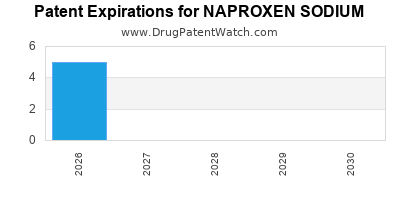
Naproxen Sodium is a drug marketed by Bionpharma, Catalent, Onesource Specialty, Patheon Softgels, Puracap Pharm Llc, Actavis Labs Fl Inc, Able, Amneal Pharms Ny, Aurobindo Pharma Ltd, Contract Pharmacal, Dr Reddys Labs Inc, Dr Reddys Labs Ltd, Glenmark Pharms Ltd, Granules India, Hamilton Pharms, Hetero Labs Ltd V, Hikma, Ivax Sub Teva Pharms, Lnk Intl Inc, Marksans Pharma, Novelgenix Theraps, Perrigo, Pharmobedient, Pld Acquisitions Llc, Pliva, Purepac Pharm, Roxane, Sandoz, Sciegen Pharms, Sun Pharm Inds Ltd, Teva, Teva Pharms, Watson Labs, Yichang Humanwell, Amneal Pharms Co, Corepharma, Granules, P And L, Perrigo R And D, and Aurobindo Pharma. and is included in forty-eight NDAs. There are five patents protecting this drug and one Paragraph IV challenge.
This drug has fifteen patent family members in thirteen countries.
The generic ingredient in NAPROXEN SODIUM is naproxen sodium; pseudoephedrine hydrochloride. There are forty-two drug master file entries for this compound. Ten suppliers are listed for this compound. Additional details are available on the naproxen sodium; pseudoephedrine hydrochloride profile page.
DrugPatentWatch® Litigation and Generic Entry Outlook for Naproxen Sodium
A generic version of NAPROXEN SODIUM was approved as naproxen sodium; pseudoephedrine hydrochloride by PERRIGO on March 17th, 2004.
AI Deep Research
Questions you can ask:
- What is the 5 year forecast for NAPROXEN SODIUM?
- What are the global sales for NAPROXEN SODIUM?
- What is Average Wholesale Price for NAPROXEN SODIUM?
Summary for NAPROXEN SODIUM
| International Patents: | 15 |
| US Patents: | 5 |
| Applicants: | 40 |
| NDAs: | 48 |
| Finished Product Suppliers / Packagers: | 120 |
| Raw Ingredient (Bulk) Api Vendors: | 93 |
| Clinical Trials: | 107 |
| Patent Applications: | 7,098 |
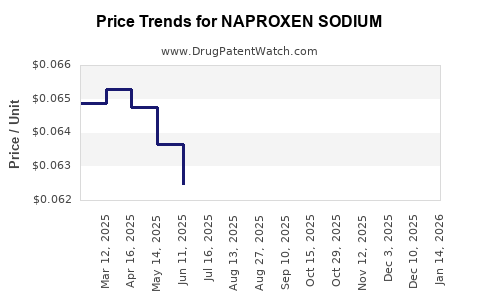
| Drug Prices: | Drug price information for NAPROXEN SODIUM |
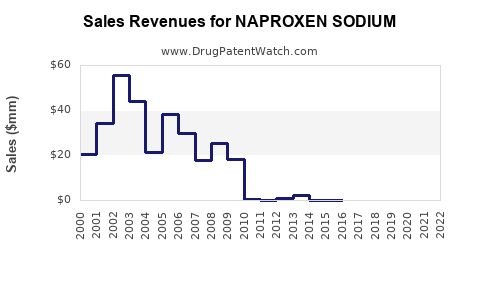
| Drug Sales Revenues: | Drug sales revenues for NAPROXEN SODIUM |
| Patent Litigation and PTAB cases: | See patent lawsuits and PTAB cases for NAPROXEN SODIUM |
| What excipients (inactive ingredients) are in NAPROXEN SODIUM? | NAPROXEN SODIUM excipients list |
| DailyMed Link: | NAPROXEN SODIUM at DailyMed |
Recent Clinical Trials for NAPROXEN SODIUM
Identify potential brand extensions & 505(b)(2) entrants
| Sponsor | Phase |
|---|---|
| University of Oklahoma | PHASE4 |
| University of Chicago | PHASE4 |
| Endeavor Health | PHASE4 |
Pharmacology for NAPROXEN SODIUM
| Drug Class | Nonsteroidal Anti-inflammatory Drug |
| Mechanism of Action | Cyclooxygenase Inhibitors |
Anatomical Therapeutic Chemical (ATC) Classes for NAPROXEN SODIUM
Paragraph IV (Patent) Challenges for NAPROXEN SODIUM
| Tradename | Dosage | Ingredient | Strength | NDA | ANDAs Submitted | Submissiondate |
|---|---|---|---|---|---|---|
| NAPROXEN SODIUM | Capsules | naproxen sodium | 200 mg | 021920 | 1 | 2017-11-15 |
US Patents and Regulatory Information for NAPROXEN SODIUM
NAPROXEN SODIUM is protected by eight US patents.
| Applicant | Tradename | Generic Name | Dosage | NDA | Approval Date | TE | Type | RLD | RS | Patent No. | Patent Expiration | Product | Substance | Delist Req. | Exclusivity Expiration |
|---|---|---|---|---|---|---|---|---|---|---|---|---|---|---|---|
| Granules | NAPROXEN SODIUM AND DIPHENHYDRAMINE HYDROCHLORIDE | diphenhydramine hydrochloride; naproxen sodium | TABLET;ORAL | 213663-001 | Sep 24, 2020 | OTC | No | No | ⤷ Start Trial | ⤷ Start Trial | ⤷ Start Trial | ||||
| Novelgenix Theraps | NAPROXEN SODIUM | naproxen sodium | TABLET;ORAL | 207612-001 | Nov 16, 2018 | DISCN | No | No | ⤷ Start Trial | ⤷ Start Trial | ⤷ Start Trial | ||||
| Hamilton Pharms | NAPROXEN SODIUM | naproxen sodium | TABLET;ORAL | 074106-001 | Aug 31, 1993 | DISCN | No | No | ⤷ Start Trial | ⤷ Start Trial | ⤷ Start Trial | ||||
| Purepac Pharm | NAPROXEN SODIUM | naproxen sodium | TABLET;ORAL | 074319-002 | Mar 20, 1995 | DISCN | No | No | ⤷ Start Trial | ⤷ Start Trial | ⤷ Start Trial | ||||
| >Applicant | >Tradename | >Generic Name | >Dosage | >NDA | >Approval Date | >TE | >Type | >RLD | >RS | >Patent No. | >Patent Expiration | >Product | >Substance | >Delist Req. | >Exclusivity Expiration |
Expired US Patents for NAPROXEN SODIUM
| Applicant | Tradename | Generic Name | Dosage | NDA | Approval Date | Patent No. | Patent Expiration |
|---|---|---|---|---|---|---|---|
| Bionpharma | NAPROXEN SODIUM | naproxen sodium | CAPSULE;ORAL | 021920-001 | Feb 17, 2006 | 10,022,344 | ⤷ Start Trial |
| Bionpharma | NAPROXEN SODIUM | naproxen sodium | CAPSULE;ORAL | 021920-001 | Feb 17, 2006 | 11,090,280 | ⤷ Start Trial |
| Bionpharma | NAPROXEN SODIUM | naproxen sodium | CAPSULE;ORAL | 021920-001 | Feb 17, 2006 | 9,693,979 | ⤷ Start Trial |
| Bionpharma | NAPROXEN SODIUM | naproxen sodium | CAPSULE;ORAL | 021920-001 | Feb 17, 2006 | 9,693,978 | ⤷ Start Trial |
| >Applicant | >Tradename | >Generic Name | >Dosage | >NDA | >Approval Date | >Patent No. | >Patent Expiration |
International Patents for NAPROXEN SODIUM
See the table below for patents covering NAPROXEN SODIUM around the world.
| Country | Patent Number | Title | Estimated Expiration |
|---|---|---|---|
| Canada | 2600023 | SYSTEME DE SOLVANT DESTINE A AMELIORER LA SOLUBILITE DES AGENTS PHARMACEUTIQUES (SOLVENT SYSTEM FOR ENHANCING THE SOLUBILITY OF PHARMACEUTICAL AGENTS) | ⤷ Start Trial |
| China | 101166520 | Solvent system for enhancing the solubility of pharmaceutical agents | ⤷ Start Trial |
| China | 102940887 | Solvent system for enhancing the solubility of pharmaceutical agents | ⤷ Start Trial |
| Cyprus | 1118321 | ⤷ Start Trial | |
| >Country | >Patent Number | >Title | >Estimated Expiration |
Supplementary Protection Certificates for NAPROXEN SODIUM
| Patent Number | Supplementary Protection Certificate | SPC Country | SPC Expiration | SPC Description |
|---|---|---|---|---|
| 0984957 | PA2011005 | Lithuania | ⤷ Start Trial | PRODUCT NAME: NAPROXENUM + ESOMEPRAZOLUM; REGISTRATION NO/DATE: LT/1/10/2302/001-LT/1/10/2302/012 20110126 |
| 1411900 | C300481 | Netherlands | ⤷ Start Trial | PRODUCT NAME: NAPROXEN EN ESOMEPRAZOL; NAT. REGISTRATION NO/DATE: RVG 106235 20101118; FIRST REGISTRATION: PL 17901/0263-001 20101105 |
| 1411900 | 1190013-1 | Sweden | ⤷ Start Trial | PRODUCT NAME: NAPROXEN OCH ESOMEPRAZOL; NAT. REG. NO/DATE: MTNR 43248 20101203; FIRST REG.: GB PL 17901/0263 20101105 |
| 1411900 | 2011/016 | Ireland | ⤷ Start Trial | PRODUCT NAME: NAPROXEN AND ESOMEPRAZOLE MODIFIED-RELEASE TABLETS; NAT REGISTRATION NO/DATE: PA0970/060/001 20101221; FIRST REGISTRATION NO/DATE: PL17901/0263-0001 20101105 |
| >Patent Number | >Supplementary Protection Certificate | >SPC Country | >SPC Expiration | >SPC Description |
Naproxen Sodium: Market Dynamics and Financial Trajectory
More… ↓
Make Better Decisions: Try a trial or see plans & pricing
Drugs may be covered by multiple patents or regulatory protections. All trademarks and applicant names are the property of their respective owners or licensors. Although great care is taken in the proper and correct provision of this service, thinkBiotech LLC does not accept any responsibility for possible consequences of errors or omissions in the provided data. The data presented herein is for information purposes only. There is no warranty that the data contained herein is error free. We do not provide individual investment advice. This service is not registered with any financial regulatory agency. The information we publish is educational only and based on our opinions plus our models. By using DrugPatentWatch you acknowledge that we do not provide personalized recommendations or advice. thinkBiotech performs no independent verification of facts as provided by public sources nor are attempts made to provide legal or investing advice. Any reliance on data provided herein is done solely at the discretion of the user. Users of this service are advised to seek professional advice and independent confirmation before considering acting on any of the provided information. thinkBiotech LLC reserves the right to amend, extend or withdraw any part or all of the offered service without notice.
ISSN: 2162-2639

Privacy and Cookies
Terms & Conditions
Site Map
DrugPatentWatch Alternatives
LOE / Major Patent Expirations 2026 - 2027
NCE-1 Patent Challenge Dates 2026 - 2027
Friedman, Yali. "DrugPatentWatch" DrugPatentWatch, thinkBiotech, 2026, www.DrugPatentWatch.com.
See Primary Research Papers Citing DrugPatentWatch