Share This Page
Drug Sales Trends for NAPROXEN SODIUM
✉ Email this page to a colleague
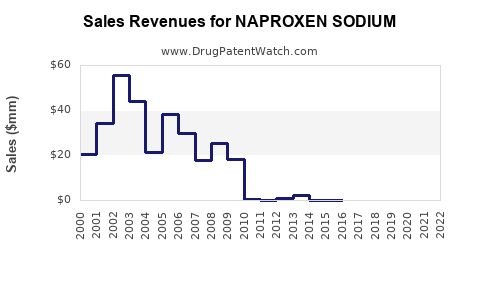
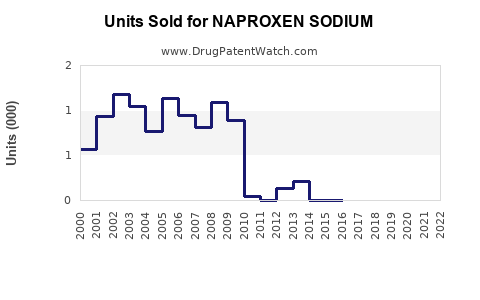
Annual Sales Revenues and Units Sold for NAPROXEN SODIUM
| Drug Name | Revenues (USD) | Units | Year |
|---|---|---|---|
| NAPROXEN SODIUM | ⤷ Start Trial | ⤷ Start Trial | 2022 |
| NAPROXEN SODIUM | ⤷ Start Trial | ⤷ Start Trial | 2021 |
| NAPROXEN SODIUM | ⤷ Start Trial | ⤷ Start Trial | 2020 |
| NAPROXEN SODIUM | ⤷ Start Trial | ⤷ Start Trial | 2019 |
| NAPROXEN SODIUM | ⤷ Start Trial | ⤷ Start Trial | 2018 |
| >Drug Name | >Revenues (USD) | >Units | >Year |
Naproxen Sodium Market Analysis and Sales Projections
Naproxen sodium is a mature, off-patent NSAID sold primarily as an over-the-counter product under the Aleve brand and as a prescription medicine under products including Anaprox and generic equivalents. The market has high volume, low pricing power, extensive generic competition, and limited potential for exclusivity-driven growth. Public companies generally do not report naproxen sodium sales as a separate line item, so precise drug-level revenue estimates are unavailable. A unit-demand scenario model indicates broadly stable global demand through 2029, with revenue growth constrained by generic and private-label price erosion.
What is the current market position of naproxen sodium?
Naproxen sodium is the sodium salt of naproxen. It is rapidly absorbed relative to naproxen and is used for temporary relief of minor aches and pains, dysmenorrhea, arthritis-related pain, and other inflammatory conditions.
| Market characteristic | Assessment |
|---|---|
| Active ingredient | Naproxen sodium |
| Drug class | Nonsteroidal anti-inflammatory drug |
| Main dosage forms | Tablets, caplets, gelcaps, oral suspensions in selected markets |
| Principal OTC brand | Aleve |
| Prescription brands | Anaprox and regional equivalents |
| Generic status | Broadly available |
| FDA pathway | OTC monograph and abbreviated new drug applications |
| Patent protection | Core composition and basic-use protection expired |
| Primary competitors | Ibuprofen, naproxen, aspirin, diclofenac, acetaminophen |
| Market structure | Fragmented branded, generic, private-label and retail-channel sales |
| Growth profile | Mature, volume-stable, price-sensitive |
The principal commercial advantage of naproxen is its longer duration of action than many ibuprofen products. Its principal disadvantages include gastrointestinal, renal and cardiovascular safety concerns associated with NSAID use. FDA labeling warns that NSAIDs can increase the risk of serious cardiovascular thrombotic events and gastrointestinal bleeding.[1]
How large is the naproxen sodium market?
A single authoritative global revenue figure does not exist because manufacturers report naproxen, naproxen sodium, prescription products and OTC products inconsistently. Private-label sales are often reported within broader analgesic categories. Market-research estimates also vary according to whether they include naproxen acid, naproxen sodium, veterinary products, hospital purchasing and combination products.
The most defensible commercial conclusion is that naproxen sodium is a large, mature analgesic ingredient with a much smaller branded opportunity than its unit volume suggests. The relevant economic split is:
- Branded OTC sales, led by Aleve.
- Store-brand and private-label OTC sales.
- Prescription generic naproxen sodium.
- Regional prescription brands and institutional purchasing.
Aleve provides the main identifiable branded revenue pool in the United States, but Haleon reports broader consumer healthcare categories rather than a consistently disclosed global Aleve revenue line.[2] Generic manufacturers also do not generally disclose naproxen sodium revenue separately.
What drives naproxen sodium demand?
Demand is tied to several relatively stable conditions:
- Musculoskeletal pain and osteoarthritis.
- Headache, back pain and minor injury.
- Menstrual pain.
- Consumer preference for longer-duration dosing.
- Aging populations and increased treatment of chronic pain.
- Retail availability and low out-of-pocket cost.
Growth is limited by substitution with ibuprofen, acetaminophen and topical NSAIDs. Safety warnings, pharmacist intervention and restrictions on chronic NSAID use also limit expansion in older and higher-risk populations.
What are the naproxen sodium sales projections through 2029?
The table below presents an indexed scenario model rather than a reported market forecast. The 2024 global naproxen sodium market is set at 100 for analytical purposes. The model separates unit demand from revenue because generic price erosion can reduce sales value even when volumes remain stable.
| Scenario | Unit-demand CAGR, 2025-2029 | Revenue CAGR, 2025-2029 | 2029 unit index | 2029 revenue index |
|---|---|---|---|---|
| Downside | -1.0% | -3.0% | 95 | 89 |
| Base case | 1.5% | 0.0% | 108 | 100 |
| Upside | 3.0% | 2.0% | 116 | 110 |
Base-case projection
The base case assumes modest volume growth from population aging and continued OTC use, offset by substitution and limited clinical differentiation. Net revenue remains approximately flat because branded products lose share to private-label products and generic pricing remains competitive.
| Year | Unit-demand index | Revenue index | Main assumption |
|---|---|---|---|
| 2024 | 100 | 100 | Reference year |
| 2025 | 102 | 100 | Stable OTC demand |
| 2026 | 103 | 100 | Continued generic substitution |
| 2027 | 105 | 100 | Moderate aging-related demand |
| 2028 | 106 | 100 | Limited pricing power |
| 2029 | 108 | 100 | Volume growth offset by price erosion |
This scenario should be applied to a verified regional revenue baseline rather than converted into an absolute dollar forecast without a defined market boundary. A forecast that combines Aleve revenue with global generic sales would overstate or understate the market depending on the data source.
How does naproxen sodium compare with competing analgesics?
| Product | Principal advantage | Principal commercial risk | Competitive position |
|---|---|---|---|
| Naproxen sodium | Longer duration of action | NSAID gastrointestinal, renal and cardiovascular warnings | Strong mature position |
| Ibuprofen | Broad consumer familiarity and multiple doses | Shorter duration and frequent dosing | Largest direct OTC substitute |
| Acetaminophen | No NSAID gastrointestinal mechanism | Liver toxicity risk at excessive doses | Major non-NSAID alternative |
| Aspirin | Low cost and established use | Bleeding and tolerability concerns | Less favored for routine pain |
| Diclofenac | Strong anti-inflammatory efficacy, including topical products | Safety and prescription restrictions vary | Stronger in selected prescription and topical markets |
Naproxen sodium is best positioned where consumers value longer dosing intervals and anti-inflammatory activity. Ibuprofen remains the strongest direct substitute because of broad brand recognition, extensive private-label availability and multiple dosage strengths.
What is the FDA regulatory status of naproxen sodium?
Naproxen sodium is marketed in the United States through both OTC and prescription pathways. OTC products are governed by the FDA’s internal analgesic, antipyretic and antirheumatic drug monograph framework, including requirements in 21 C.F.R. Part 343.[3]
Aleve labeling identifies naproxen sodium as the active ingredient and provides dosing, contraindications and cardiovascular and gastrointestinal warnings.[4] Prescription products may contain different strengths, indications or labeling conditions and are approved through individual applications.
The FDA-approved labeling generally limits consumer self-treatment and directs consumers to seek medical advice for prolonged symptoms, high-risk medical conditions or concurrent use of other NSAIDs. These restrictions limit attempts to reposition naproxen sodium for unrestricted chronic-use growth.
What patents protect naproxen sodium?
The core composition-of-matter and conventional-use patent estate for naproxen and naproxen sodium is expired. Commercial products therefore compete primarily on:
- Brand recognition.
- Retail distribution.
- Tablet or caplet presentation.
- Packaging and consumer marketing.
- Manufacturing cost.
- Private-label supply contracts.
- Product quality and supply reliability.
There is no current composition patent that provides broad exclusivity over naproxen sodium as an active ingredient. Any later patents would need to address a specific formulation, delivery system, manufacturing process or narrow method of use. Such patents would not prevent ordinary generic and OTC naproxen sodium products unless they covered the marketed product and survived validity and infringement challenges.
What formulations are protected by naproxen sodium patents?
Commercial differentiation may involve liquid-filled capsules, modified-release systems, combination products or specialized delivery technologies. These technologies can create narrow protection, but they do not recreate broad exclusivity for standard immediate-release tablets.
For an investment or licensing review, the relevant questions are whether a claimed formulation is present in the reference product, whether the patent is listed in the FDA Orange Book, and whether the claim covers a commercially important dosage form. Standard immediate-release naproxen sodium tablets generally have low formulation-barrier risk.
What is the Orange Book status of naproxen sodium?
The FDA Orange Book is relevant mainly to approved prescription products and listed patents. Standard OTC monograph products are not protected through the same Orange Book patent-certification structure used for new drug applications.
For prescription naproxen sodium products, any listed patent information must be reviewed at the specific application level. Because the active ingredient is mature and generic products are widely marketed, the principal regulatory risk is not a new Paragraph IV wave against a valuable innovator product. It is ordinary ANDA competition, product discontinuation, manufacturing compliance and supply-chain execution.[5]
Are there Paragraph IV challenges to naproxen sodium?
Paragraph IV litigation is unlikely to create material market disruption for standard naproxen sodium products because generic entry has already occurred across major markets. Paragraph IV certifications remain legally possible for later-approved prescription formulations or combination products, but they are not a central commercial issue for ordinary naproxen sodium tablets.
The more relevant generic-entry pattern is:
- Multiple ANDA approvals.
- Low barriers to substitution.
- Pharmacy and wholesaler price competition.
- Private-label sourcing.
- Periodic supply interruptions caused by manufacturing concentration.
Which companies compete in the naproxen sodium market?
Competition varies by jurisdiction. The commercial group includes Haleon through Aleve, major generic manufacturers, regional pharmaceutical companies, contract manufacturers, retailer-owned brands and online pharmacies.
Generic and private-label competition is particularly important in the United States, Canada, Europe and Australia. Product availability can change by country because OTC classification, maximum package size, dose strength, advertising rules and pharmacy controls differ.
The relevant competitive advantages are manufacturing scale, regulatory compliance, retail access and reliable supply. A new entrant would have limited ability to command a premium without a differentiated formulation, a strong retail position or a lower-cost manufacturing platform.
What licensing deals affect naproxen sodium?
Naproxen sodium has no widely disclosed, high-value licensing structure comparable to innovative drugs or biologics. Commercial agreements are more likely to involve:
- Private-label supply.
- Contract manufacturing.
- Regional distribution.
- Brand licensing.
- Retailer arrangements.
- Packaging and commercialization rights.
These agreements are often confidential and do not create durable exclusivity over the active ingredient. The commercial value typically lies in volume commitments, channel access and manufacturing economics.
What generic launch scenarios exist for naproxen sodium?
A new standard tablet entrant would face low regulatory complexity but severe pricing pressure. The most likely launch outcomes are:
| Launch type | Commercial outlook |
|---|---|
| Standard immediate-release tablet | Low margin, high competition |
| Private-label OTC product | Viable with retail or distributor access |
| Prescription generic | Viable but vulnerable to price compression |
| Modified-release formulation | Higher technical barrier, narrower market |
| Combination product | Potential differentiation, added regulatory complexity |
| Specialty delivery system | Requires clinical or commercial evidence to justify premium |
Manufacturing risk is more important than patent risk. Active pharmaceutical ingredient sourcing, validated processes, FDA current good manufacturing practice compliance and dependable finished-dose supply determine whether an entrant can maintain distribution.
What is the investment outlook for naproxen sodium?
Naproxen sodium is a defensive, low-growth product rather than an exclusivity-driven asset. Revenue stability is more likely than rapid expansion. Attractive opportunities may exist in:
- Efficient API and finished-dose manufacturing.
- Retailer private-label supply.
- Geographic markets with rising OTC conversion.
- High-compliance suppliers replacing unreliable manufacturers.
- Specialized delivery formats with demonstrable consumer value.
The main risks are price erosion, substitution by ibuprofen or acetaminophen, regulatory scrutiny of NSAID labeling, supply concentration and retailer bargaining power.
Key Takeaways
- Naproxen sodium is a mature, broadly genericized NSAID with stable demand and limited pricing power.
- Aleve is the principal identifiable branded OTC product, but drug-level sales are not separately disclosed by most companies.
- Standard naproxen sodium products have no meaningful active-ingredient exclusivity.
- The base-case outlook is approximately 1.5% annual unit growth and flat revenue through 2029.
- Generic and private-label competition will capture most incremental volume.
- Formulation and manufacturing patents may create narrow barriers but do not protect the ordinary immediate-release market.
- The main commercial risks are price compression, substitution, safety warnings and manufacturing reliability.
- The strongest opportunities are private-label supply, low-cost manufacturing and selected differentiated dosage forms.
FAQs
Is naproxen sodium still profitable for pharmaceutical companies?
Yes, but profitability depends on manufacturing cost, volume and channel access. Standard products generally have limited margins because multiple generic and private-label suppliers compete on price.
Is Aleve losing market share to generic naproxen sodium?
Aleve faces persistent substitution from store brands and generic products. Exact global market-share changes are not consistently disclosed, but mature OTC categories generally experience private-label pressure when consumers can identify the same active ingredient.
Can a company obtain a new patent on naproxen sodium?
A new broad patent on the known active ingredient would face substantial novelty and obviousness barriers. Narrow patents may still be available for specific formulations, delivery systems, manufacturing processes or combinations.
Does naproxen sodium have biosimilar competition?
No. Biosimilars apply to biologic products. Naproxen sodium competes with chemically synthesized generic drugs.
What is the biggest threat to naproxen sodium sales?
The main threat is substitution by lower-priced ibuprofen, acetaminophen and private-label naproxen products. Safety concerns and reduced chronic NSAID use also constrain demand.
References
- U.S. Food and Drug Administration. (2020). Non-steroidal anti-inflammatory drugs (NSAIDs): Drug safety communication. https://www.fda.gov
- Haleon plc. (2024). Annual report 2023. https://www.haleon.com
- Electronic Code of Federal Regulations. (2024). 21 C.F.R. Part 343: Internal analgesic, antipyretic, and antirheumatic drug products for over-the-counter human use. https://www.ecfr.gov
- Bayer HealthCare LLC. (2024). Aleve drug facts label. https://www.aleve.com
- U.S. Food and Drug Administration. (2024). Approved drug products with therapeutic equivalence evaluations, Orange Book. https://www.fda.gov/drugs/drug-approvals-and-databases/approved-drug-products-therapeutic-equivalence-evaluations-orange-book
More… ↓
