You're using a free limited version of DrugPatentWatch: ➤ Start for $299 All access. No Commitment.

Last Updated: December 12, 2025

MIRAPEX Drug Patent Profile


✉ Email this page to a colleague

« Back to Dashboard


When do Mirapex patents expire, and what generic alternatives are available?

Mirapex is a drug marketed by Boehringer Ingelheim and is included in two NDAs. There are two patents protecting this drug and three Paragraph IV challenges.

The generic ingredient in MIRAPEX is pramipexole dihydrochloride. There are twenty-five drug master file entries for this compound. Twenty-two suppliers are listed for this compound. Additional details are available on the pramipexole dihydrochloride profile page.

AI Deep Research
Questions you can ask:
  • What is the 5 year forecast for MIRAPEX?
  • What are the global sales for MIRAPEX?
  • What is Average Wholesale Price for MIRAPEX?
Summary for MIRAPEX
US Patents:0
Applicants:1
NDAs:2
Raw Ingredient (Bulk) Api Vendors: 82
Clinical Trials: 32
Patent Applications: 4,448
Drug Prices: Drug price information for MIRAPEX
What excipients (inactive ingredients) are in MIRAPEX?MIRAPEX excipients list
DailyMed Link:MIRAPEX at DailyMed
Drug patent expirations by year for MIRAPEX
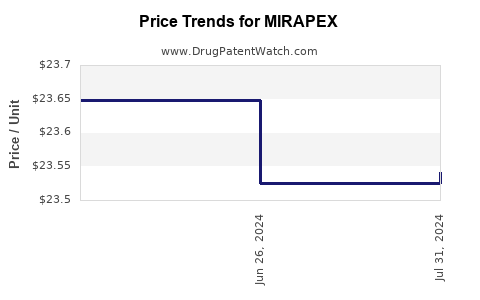
Drug Prices for MIRAPEX

See drug prices for MIRAPEX

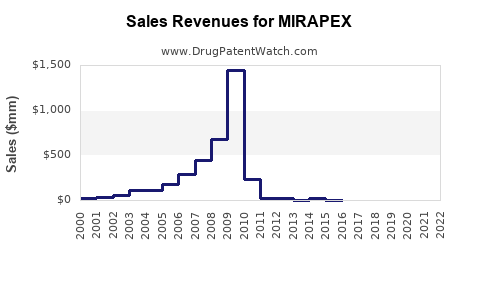
Drug Sales Revenue Trends for MIRAPEX

See drug sales revenues for MIRAPEX

Recent Clinical Trials for MIRAPEX

Identify potential brand extensions & 505(b)(2) entrants

SponsorPhase
Massachusetts General HospitalPhase 2/Phase 3
University of New MexicoEarly Phase 1
University of New Mexico Clinical and Translational Science CenterEarly Phase 1

See all MIRAPEX clinical trials

Paragraph IV (Patent) Challenges for MIRAPEX
Tradename Dosage Ingredient Strength NDA ANDAs Submitted Submissiondate
MIRAPEX Tablets pramipexole dihydrochloride 0.75 mg 020667 1 2008-07-31
MIRAPEX Tablets pramipexole dihydrochloride 0.125 mg, 0.5 mg, 1 mg and 1.5 mg 020667 1 2005-06-24
MIRAPEX Tablets pramipexole dihydrochloride 0.25 mg 020667 1 2005-05-27

US Patents and Regulatory Information for MIRAPEX

Applicant Tradename Generic Name Dosage NDA Approval Date TE Type RLD RS Patent No. Patent Expiration Product Substance Delist Req. Exclusivity Expiration
Boehringer Ingelheim MIRAPEX pramipexole dihydrochloride TABLET;ORAL 020667-001 Jul 1, 1997 DISCN Yes No ⤷  Get Started Free ⤷  Get Started Free ⤷  Get Started Free
Boehringer Ingelheim MIRAPEX ER pramipexole dihydrochloride TABLET, EXTENDED RELEASE;ORAL 022421-007 Jun 17, 2011 DISCN Yes No 8,679,533 ⤷  Get Started Free Y ⤷  Get Started Free
Boehringer Ingelheim MIRAPEX pramipexole dihydrochloride TABLET;ORAL 020667-005 Jul 1, 1997 DISCN Yes No ⤷  Get Started Free ⤷  Get Started Free ⤷  Get Started Free
Boehringer Ingelheim MIRAPEX pramipexole dihydrochloride TABLET;ORAL 020667-007 Jul 30, 2007 DISCN Yes No ⤷  Get Started Free ⤷  Get Started Free ⤷  Get Started Free
>Applicant >Tradename >Generic Name >Dosage >NDA >Approval Date >TE >Type >RLD >RS >Patent No. >Patent Expiration >Product >Substance >Delist Req. >Exclusivity Expiration

Expired US Patents for MIRAPEX

Applicant Tradename Generic Name Dosage NDA Approval Date Patent No. Patent Expiration
Boehringer Ingelheim MIRAPEX pramipexole dihydrochloride TABLET;ORAL 020667-003 Jul 1, 1997 6,194,445 ⤷  Get Started Free
Boehringer Ingelheim MIRAPEX pramipexole dihydrochloride TABLET;ORAL 020667-003 Jul 1, 1997 4,886,812 ⤷  Get Started Free
Boehringer Ingelheim MIRAPEX pramipexole dihydrochloride TABLET;ORAL 020667-002 Jul 1, 1997 6,001,861 ⤷  Get Started Free
Boehringer Ingelheim MIRAPEX pramipexole dihydrochloride TABLET;ORAL 020667-004 Jul 1, 1997 4,886,812 ⤷  Get Started Free
>Applicant >Tradename >Generic Name >Dosage >NDA >Approval Date >Patent No. >Patent Expiration

International Patents for MIRAPEX

See the table below for patents covering MIRAPEX around the world.

Country Patent Number Title Estimated Expiration
Poland 334498 ⤷  Get Started Free
South Africa 9800420 ⤷  Get Started Free
New Zealand 510007 Use of pramipexole in the treatment of restless legs syndrome ⤷  Get Started Free
Canada 1263653 TETRAHYDRO-BENZOTHIAZOLES, LEUR PREPARATION, ET LEUR EMPLOI A TITRE D'INTERMEDIAIRES OU DE PRODUITS PHARMACEUTIQUES (TETRAHYDRO-BENZTHIAZOLES, THE PREPARATION THEREOF AND THEIR USE AS INTERMEDIATE PRODUCTS OR AS PHARMACEUTICALS) ⤷  Get Started Free
>Country >Patent Number >Title >Estimated Expiration

Supplementary Protection Certificates for MIRAPEX

Patent Number Supplementary Protection Certificate SPC Country SPC Expiration SPC Description
0186087 C980002 Netherlands ⤷  Get Started Free PRODUCT NAME: PRAMIPEXOL, DESGEWENST IN DE VORM VAN EEN ZUURADDITIEZOUT, IN HET BIJZONDER PRAMIPEXOL-DIHYDROCHLORIDE-MONOHYDRAAT; REGISTRATION NO/DATE: EU/1/97/050/001 - EU/1/97/050/010 19971014
0186087 98C0013 Belgium ⤷  Get Started Free PRODUCT NAME: PRAMIPEXOL; REGISTRATION NO/DATE: EU/1/97/050/001 19971014
0186087 SPC/GB98/017 United Kingdom ⤷  Get Started Free PRODUCT NAME: PRAMIPEXOLE, OPTIONALLY IN THE FORM OF AN ACID ADDITION SALT, IN PARTICULAR PRAMIPEXOLE DIHYDROCHLORIDE MONOHYDRATE; REGISTERED: UK EU/1/97/050/001 19971014; UK EU/1/97/050/002 19971014; UK EU/1/97/050/003 19971014; UK EU/1/97/050/004 19971014; UK EU/1/97/050/005 19971014; UK EU/1/97/050/006 19971014; UK EU/1/97/050/007 19971014; UK EU/1/97/050/008 19971014; UK EU/1/97/050/009 19971014; UK EU/1/97/050/010 19971014
>Patent Number >Supplementary Protection Certificate >SPC Country >SPC Expiration >SPC Description

Market Dynamics and Financial Trajectory for MIRAPEX (Pramipexole)

Last updated: October 2, 2025

Introduction

MIRAPEX (pramipexole), a dopamine agonist primarily indicated for Parkinson’s disease and Restless Legs Syndrome (RLS), has established itself within the neurology pharmaceutical landscape. Since its approval by the FDA in 1997, MIRAPEX has experienced significant shifts influenced by market factors, competitive landscapes, regulatory changes, and evolving clinical guidelines. This report explores the intricate market dynamics shaping MIRAPEX's trajectory and forecasts its financial outlook amid current industry trends.

Market Landscape and Epidemiological Drivers

The global prevalence of Parkinson’s disease (PD) and RLS underpins MIRAPEX’s demand. According to the Parkinson’s Foundation, approximately 1 million Americans live with PD, with global estimates surpassing 6 million [1]. The aging population is a primary catalyst, as prevalence escalates with age. Projection models indicate a compound annual growth rate (CAGR) of 4-6% in PD cases over the next decade, directly impacting MIRAPEX’s market size.

Similarly, RLS affects an estimated 7-10% of the adult population worldwide, with significant health and quality-of-life implications [2]. The expansion of awareness and diagnostic rates further bolsters market size. The increasing adoption of MIRAPEX for both indications sustains steady demand, though saturation and patent expiration events influence revenue streams.

Competitive Dynamics and Product Lifecycle

Patent Status and Generics

MIRAPEX’s patent protection expired in the early 2010s, precipitating the entry of generic formulations into the market. Generic availability has exerted downward pressure on the drug’s pricing and reimbursement levels. The primary patent expiry in the U.S. occurred circa 2014, leading to a substantial erosion in branded sales.

Alternative Therapeutics

The competitive landscape has expanded with the approval and increased utilization of other dopamine agonists such as ropinirole and rotigotine, as well as classes like MAO-B inhibitors and levodopa.

Notably, newer agents often offer improved side-effect profiles or novel administration routes (patches, extended-release formulations). For RLS, gabapentinoids like gabapentin and pregabalin serve as alternatives, further fragmenting the market share.

Clinical Practice Trends

Evolving guidelines favor early use of levodopa in PD, with dopamine agonists like MIRAPEX reserved for early or maintenance therapy. The advent of deep brain stimulation and gene therapy options are also reshaping treatment paradigms but currently play a limited role in MIRAPEX’s sales.

Regulatory and Reimbursement Factors

Regulatory Changes

Ongoing post-marketing surveillance highlighted potential concerns regarding impulse control disorders and sleep attacks, associated with dopamine agonists. These adverse effects prompted updates to prescribing information and influence clinician preferences.

Reimbursement Policies

Health insurance coverage and formulary placements significantly affect MIRAPEX’s market penetration. Generic versions have generally achieved broad coverage, easing access but intensifying price competition.

Market Challenges and Opportunities

Adherence and Side Effect Profile

MIRAPEX’s side-effect profile, including nausea, hallucinations, and impulse control issues, impacts adherence, especially among elderly populations. Improving management of these adverse effects could expand its viable patient base.

Emerging Therapies and Precision Medicine

Advances in personalized medicine, including biomarkers for treatment response, may refine indications for MIRAPEX use, either expanding or contracting its applicability.

Patent and Market Exclusivity

The expiration timeline of exclusivity rights dictates future revenue streams. Strategies such as formulation enhancements or combination therapies could mitigate revenue declines.

Market Expansion in Emerging Economies

Growing healthcare infrastructure and disease awareness in Asia, Latin America, and Africa present opportunities for increased MIRAPEX utilization. However, price sensitivity and regulatory hurdles pose intrinsic challenges.

Financial Trajectory Analysis

Historical Revenue Trends

Since patent expiry, MIRAPEX’s global sales have declined sharply. The U.S. market, once accounting for a substantial share of revenue, saw branded sales diminish from approximately $1.2 billion in 2012 to under $300 million in 2021, primarily due to generics competition [3]. International markets mirror similar trends, although the pace varies according to regional patent laws and healthcare practices.

Current Market Performance

The current revenue forecast for MIRAPEX indicates a plateauing or slight decline as generics dominate, with some residual sales stemming from branded prescriptions for specific patient subsets. The total global market for dopamine agonists is projected to decline marginally, with a CAGR of -1% to -2% over the next five years, largely driven by commoditization and competition.

Future Outlook and Strategic Positioning

Pharmaceutical companies increasingly pivot toward lifecycle management, pursuing label expansions and new formulations to sustain revenue. For MIRAPEX, potential avenues include:

  • Extended-release formulations to improve adherence.

  • Combination therapies for polypharmacy reductance.

  • New indications or refined dosing regimens validated through clinical trials.

However, the major revenue driver remains the existing use for PD and RLS in established markets.

External Market Influences

Regulatory Environment

Stringent regulatory oversight, particularly concerning adverse effects, influences prescribing patterns. Recent classification of impulse control disorders as serious side effects has limited the utilization in certain patient populations.

Market Entry Barriers and Patent Strategies

Biotech industries exploring biosimilars and next-generation dopamine agonists face substantial barriers including regulatory approval timelines, patent strategies, and market inertia.

Healthcare Policy and Reimbursement

Reimbursement trends favor cost-effective therapies, emphasizing generics, which directly impacts MIRAPEX’s profitability. Hence, price pressure is anticipated to intensify.

Conclusion: Key Takeaways

  • Market Size & Demand Drivers: The sizable PD and RLS populations guarantee ongoing demand but are tempered by competition and clinical practice shifts.

  • Patent Expiry & Competition: The expiration of MIRAPEX’s patent has precipitated a branded-to-generic transition, significantly impacting revenue.

  • Therapeutic Alternatives & Clinical Guidelines: Alternatives and evolving treatment paradigms influence the drug's positioning, potentially limiting its growth.

  • Regulatory & Safety Concerns: Adverse effect profiles and safety communications impact prescribing behaviors, affecting revenue stability.

  • Financial Outlook: Anticipated revenue decline driven by generics, with strategic adjustments such as formulation innovations necessary for sustaining profitability.

  • Emerging Opportunities: Market expansion in developing regions and pipeline innovations offer future growth potential, contingent on R&D investments and regulatory navigation.


FAQs

1. What are the primary indications for MIRAPEX, and how do they influence its market size?
MIRAPEX is approved for Parkinson’s disease and Restless Legs Syndrome. The high prevalence of these neurological conditions, especially among aging populations, sustains steady demand. However, market size growth is restrained by alternatives and evolving treatment practices.

2. How has patent expiration affected MIRAPEX’s market revenue?
Patent expiration in the early 2010s led to widespread generic entry, causing significant revenue erosion of branded sales from over $1 billion annually to a fraction thereof, renowned for intensifying price competition.

3. What are the current challenges limiting MIRAPEX’s growth?
Key challenges include availability of cheaper generics, side-effect concerns such as impulse control disorders, competition from newer dopamine agonists and alternative therapies, and regulatory considerations impacting prescribing patterns.

4. What strategic moves can pharmaceutical companies undertake to sustain MIRAPEX’s profitability?
Potential strategies include developing new formulations (e.g., extended-release), exploring new indications, engaging in lifecycle management, and expanding into emerging markets with tailored pricing strategies.

5. What is the forecast for MIRAPEX’s financial performance over the next five years?
Given patent expiration and intense generic competition, revenues are expected to decline modestly. Companies focusing on innovation and market expansion could mitigate losses, but overall, the trend indicates a gradual decrease unless new opportunities are realized.


References

[1] Parkinson’s Foundation. “Parkinson’s Disease Facts & Figures.” 2022.
[2] Allen RP, et al. “Restless legs syndrome epidemiology, clinical features, and diagnosis.” Sleep Medicine Reviews, 2014.
[3] IQVIA. “Pharmaceutical Market Data and Insights,” 2022.

More… ↓

⤷  Get Started Free

Make Better Decisions: Try a trial or see plans & pricing

Drugs may be covered by multiple patents or regulatory protections. All trademarks and applicant names are the property of their respective owners or licensors. Although great care is taken in the proper and correct provision of this service, thinkBiotech LLC does not accept any responsibility for possible consequences of errors or omissions in the provided data. The data presented herein is for information purposes only. There is no warranty that the data contained herein is error free. We do not provide individual investment advice. This service is not registered with any financial regulatory agency. The information we publish is educational only and based on our opinions plus our models. By using DrugPatentWatch you acknowledge that we do not provide personalized recommendations or advice. thinkBiotech performs no independent verification of facts as provided by public sources nor are attempts made to provide legal or investing advice. Any reliance on data provided herein is done solely at the discretion of the user. Users of this service are advised to seek professional advice and independent confirmation before considering acting on any of the provided information. thinkBiotech LLC reserves the right to amend, extend or withdraw any part or all of the offered service without notice.