You're using a free limited version of DrugPatentWatch: Upgrade for Complete Access

Last Updated: December 31, 2025

MIRAPEX ER Drug Patent Profile


✉ Email this page to a colleague

« Back to Dashboard


Which patents cover Mirapex Er, and what generic alternatives are available?

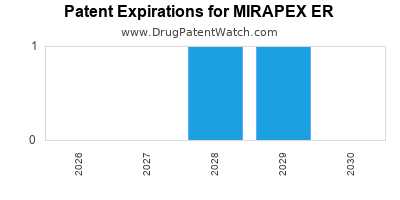
Mirapex Er is a drug marketed by Boehringer Ingelheim and is included in one NDA. There are two patents protecting this drug and two Paragraph IV challenges.

This drug has two hundred and thirty-one patent family members in forty-four countries.

The generic ingredient in MIRAPEX ER is pramipexole dihydrochloride. There are twenty-five drug master file entries for this compound. Twenty-two suppliers are listed for this compound. Additional details are available on the pramipexole dihydrochloride profile page.

AI Deep Research
Questions you can ask:
  • What is the 5 year forecast for MIRAPEX ER?
  • What are the global sales for MIRAPEX ER?
  • What is Average Wholesale Price for MIRAPEX ER?
Summary for MIRAPEX ER
Drug patent expirations by year for MIRAPEX ER
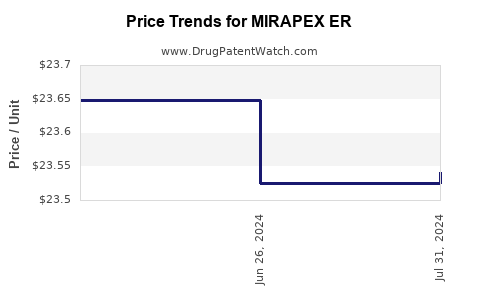
Drug Prices for MIRAPEX ER

See drug prices for MIRAPEX ER

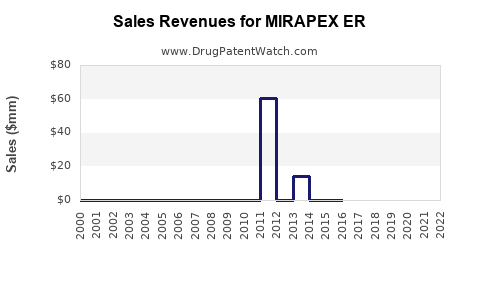
Drug Sales Revenue Trends for MIRAPEX ER

See drug sales revenues for MIRAPEX ER

Recent Clinical Trials for MIRAPEX ER

Identify potential brand extensions & 505(b)(2) entrants

SponsorPhase
Massachusetts General HospitalPhase 2/Phase 3
University of New MexicoEarly Phase 1
University of New Mexico Clinical and Translational Science CenterEarly Phase 1

See all MIRAPEX ER clinical trials

Paragraph IV (Patent) Challenges for MIRAPEX ER
Tradename Dosage Ingredient Strength NDA ANDAs Submitted Submissiondate
MIRAPEX ER Extended-release Tablets pramipexole dihydrochloride 2.25 mg and 3.75 mg 022421 1 2011-07-26
MIRAPEX ER Extended-release Tablets pramipexole dihydrochloride 0.375 mg, 0.75 mg, 1.5 mg, 3 mg and 4.5 mg 022421 1 2010-06-01

US Patents and Regulatory Information for MIRAPEX ER

MIRAPEX ER is protected by two US patents.

Applicant Tradename Generic Name Dosage NDA Approval Date TE Type RLD RS Patent No. Patent Expiration Product Substance Delist Req. Exclusivity Expiration
Boehringer Ingelheim MIRAPEX ER pramipexole dihydrochloride TABLET, EXTENDED RELEASE;ORAL 022421-001 Feb 19, 2010 DISCN Yes No ⤷  Get Started Free ⤷  Get Started Free Y ⤷  Get Started Free
Boehringer Ingelheim MIRAPEX ER pramipexole dihydrochloride TABLET, EXTENDED RELEASE;ORAL 022421-006 Jun 17, 2011 DISCN Yes No ⤷  Get Started Free ⤷  Get Started Free Y ⤷  Get Started Free
Boehringer Ingelheim MIRAPEX ER pramipexole dihydrochloride TABLET, EXTENDED RELEASE;ORAL 022421-002 Feb 19, 2010 DISCN Yes No ⤷  Get Started Free ⤷  Get Started Free Y ⤷  Get Started Free
Boehringer Ingelheim MIRAPEX ER pramipexole dihydrochloride TABLET, EXTENDED RELEASE;ORAL 022421-007 Jun 17, 2011 DISCN Yes No ⤷  Get Started Free ⤷  Get Started Free Y ⤷  Get Started Free
Boehringer Ingelheim MIRAPEX ER pramipexole dihydrochloride TABLET, EXTENDED RELEASE;ORAL 022421-006 Jun 17, 2011 DISCN Yes No ⤷  Get Started Free ⤷  Get Started Free Y ⤷  Get Started Free
>Applicant >Tradename >Generic Name >Dosage >NDA >Approval Date >TE >Type >RLD >RS >Patent No. >Patent Expiration >Product >Substance >Delist Req. >Exclusivity Expiration

Expired US Patents for MIRAPEX ER

Applicant Tradename Generic Name Dosage NDA Approval Date Patent No. Patent Expiration
Boehringer Ingelheim MIRAPEX ER pramipexole dihydrochloride TABLET, EXTENDED RELEASE;ORAL 022421-001 Feb 19, 2010 ⤷  Get Started Free ⤷  Get Started Free
Boehringer Ingelheim MIRAPEX ER pramipexole dihydrochloride TABLET, EXTENDED RELEASE;ORAL 022421-003 Feb 19, 2010 ⤷  Get Started Free ⤷  Get Started Free
Boehringer Ingelheim MIRAPEX ER pramipexole dihydrochloride TABLET, EXTENDED RELEASE;ORAL 022421-005 Feb 19, 2010 ⤷  Get Started Free ⤷  Get Started Free
Boehringer Ingelheim MIRAPEX ER pramipexole dihydrochloride TABLET, EXTENDED RELEASE;ORAL 022421-002 Feb 19, 2010 ⤷  Get Started Free ⤷  Get Started Free
Boehringer Ingelheim MIRAPEX ER pramipexole dihydrochloride TABLET, EXTENDED RELEASE;ORAL 022421-004 Feb 19, 2010 ⤷  Get Started Free ⤷  Get Started Free
>Applicant >Tradename >Generic Name >Dosage >NDA >Approval Date >Patent No. >Patent Expiration

International Patents for MIRAPEX ER

See the table below for patents covering MIRAPEX ER around the world.

Country Patent Number Title Estimated Expiration
Austria 406162 ⤷  Get Started Free
Spain 8707513 ⤷  Get Started Free
Australia 2008252073 Sustained-release tablet comprising reboxetine ⤷  Get Started Free
South Korea 101066374 ⤷  Get Started Free
Spain 556875 ⤷  Get Started Free
>Country >Patent Number >Title >Estimated Expiration

Supplementary Protection Certificates for MIRAPEX ER

Patent Number Supplementary Protection Certificate SPC Country SPC Expiration SPC Description
0186087 SPC/GB98/017 United Kingdom ⤷  Get Started Free PRODUCT NAME: PRAMIPEXOLE, OPTIONALLY IN THE FORM OF AN ACID ADDITION SALT, IN PARTICULAR PRAMIPEXOLE DIHYDROCHLORIDE MONOHYDRATE; REGISTERED: UK EU/1/97/050/001 19971014; UK EU/1/97/050/002 19971014; UK EU/1/97/050/003 19971014; UK EU/1/97/050/004 19971014; UK EU/1/97/050/005 19971014; UK EU/1/97/050/006 19971014; UK EU/1/97/050/007 19971014; UK EU/1/97/050/008 19971014; UK EU/1/97/050/009 19971014; UK EU/1/97/050/010 19971014
0186087 98C0013 Belgium ⤷  Get Started Free PRODUCT NAME: PRAMIPEXOL; REGISTRATION NO/DATE: EU/1/97/050/001 19971014
0186087 C980002 Netherlands ⤷  Get Started Free PRODUCT NAME: PRAMIPEXOL, DESGEWENST IN DE VORM VAN EEN ZUURADDITIEZOUT, IN HET BIJZONDER PRAMIPEXOL-DIHYDROCHLORIDE-MONOHYDRAAT; REGISTRATION NO/DATE: EU/1/97/050/001 - EU/1/97/050/010 19971014
>Patent Number >Supplementary Protection Certificate >SPC Country >SPC Expiration >SPC Description

Market Dynamics and Financial Trajectory for MIRAPEX ER

Last updated: July 28, 2025

Introduction

MIRAPEX ER (pramipexole dihydrochloride extended-release) is an essential therapeutic agent indicated primarily for the treatment of Parkinson’s disease (PD) and restless legs syndrome (RLS). As a long-acting dopamine agonist, MIRAPEX ER provides sustained symptom control, aligning with evolving treatment paradigms that emphasize patient adherence and quality of life. This article examines the recent market dynamics, competitive landscape, and financial trajectory for MIRAPEX ER, offering a comprehensive analysis critical for stakeholders, investors, and healthcare decision-makers.

Market Overview

Therapeutic Indications and Patient Demographics

MIRAPEX ER primarily targets two prevalent neurological disorders: Parkinson’s disease and RLS. The global PD market was valued at approximately USD 11.64 billion in 2021, with projections reaching USD 14.2 billion by 2027, growing CAGR around 4.2%[1]. RLS affects an estimated 7-10% of the adult population worldwide, with a significant portion requiring long-term management using dopaminergic agents[2].

The aging global population, coupled with increasing diagnostic rates, fuels demand. Additionally, as treatment guidelines increasingly favor extended-release formulations for improved compliance, MIRAPEX ER’s market position benefits from these shifts.

Regulatory and Patent Landscape

Initially approved in 2010, MIRAPEX ER's patent exclusivity began to face expiration threats in the late 2010s. The original patent, held by Boehringer Ingelheim, faced patent challenges, leading to generic entries in various markets, notably the U.S. in August 2019, impacting sales and market share[3]. However, patent litigations and formulations exclusivities, such as formulation patents, have offered periods of market protection.

Furthermore, regulatory approvals for new indications and formulations, alongside patent extensions in some regions, influence the financial outlook favorably, extending lifecycle opportunities.

Market Dynamics

Competitive Landscape

The competitive environment for MIRAPEX ER involves both branded competitors and generics. Notable entities include:

  • Requip (ropinirole): Another dopamine agonist with a similar profile, competing on efficacy and dosing convenience.
  • Rotigotine (Neupro): Transdermal patch offering continuous dopaminergic stimulation, appealing for compliance.
  • Generic Pramipexole: As patent protections phase out, generics capture significant market share, offering lower-cost options.

Emerging treatments in PD, such as levodopa formulations with extended-release profiles and non-dopaminergic agents (e.g., COMT inhibitors), pose competitive threats.

Market Challenges

  • Generic Competition: The expiration of key patents led to a decline in MIRAPEX ER’s market share, with generics capturing substantial segments post-2019.
  • Pricing Pressure: Increased presence of generics exerts downward pricing pressure, impacting revenue.
  • Adherence and Tolerability: Side effect profiles, including nausea and orthostatic hypotension, influence prescribing patterns, especially as newer agents with improved tolerability emerge.
  • Emerging Therapies: Research into non-dopaminergic agents and gene therapies could reshape market dynamics in the long term.

Market Opportunities

  • New Indications and Combinations: Potential for expanding uses or fixed-dose combinations could rejuvenate growth.
  • Regional Expansion: Markets in Asia-Pacific and Latin America exhibit increasing PD and RLS prevalence, expanding potential patient bases.
  • Formulation Innovations: Development of long-acting or alternative delivery systems offers avenues to differentiate.

Financial Trajectory

Historical Performance

Following initial approval, MIRAPEX ER generated substantial revenues, peaking around 2013. The patent expiry in 2019 precipitated a decline, with generic competition reducing overall sales by approximately 40-50% within two years[4].

Revenue Projections

Analysts project a continued decline in brand sales due to generic erosion, with total revenues potentially stabilizing or growing modestly through regional expansion and new formulations. For example, IQVIA data indicates U.S. sales dropped from USD 300 million in 2018 to below USD 180 million in 2021[5].

Long-term, revenue streams depend on:

  • Patent litigation success and product differentiation
  • Market penetration in emerging economies
  • Adoption of extended-release formulations with improved benefits

Profitability and Investment Outlook

Generic entry reduced margins for original manufacturers. However, niche markets—such as specific RLS subpopulations or highly regulated markets—may sustain profitability. Investment in R&D for novel formulations or combination therapies offers potential future revenue sources.

Pharmaceutical companies are also exploring partnerships and licensing agreements to bolster product lifecycle, especially where patent protections are waning[6].

Regulatory and Market Risks

  • Patent Litigation Outcomes: Legal disputes determine market exclusivity duration.
  • Pricing Policies: Healthcare reforms, especially in OECD nations, threaten price controls.
  • Efficacy and Safety Concerns: Post-marketing surveillance might prompt label updates, influencing sales.

Emerging Trends and Future Outlook

  • Personalized Medicine: Biomarker-driven approaches could refine patient selection, enhancing therapeutic outcomes.
  • Digital Health Integration: Digital adherence tools for patients on MIRAPEX ER can improve compliance, indirectly boosting sales.
  • Biosimilar and Generic Expansion: Intensive pricing competition from generics will likely persist, compressing revenue margins.

Analysts suggest that for MIRAPEX ER to maintain its market trajectory, manufacturers must innovate in delivery systems and explore new therapeutic niches, especially in non-U.S. markets with rising PD and RLS prevalence.

Key Takeaways

  • Market contraction due to patent expiry has significantly impacted MIRAPEX ER sales, with generics dominating post-2019.
  • Regional expansion and formulation innovations represent strategic opportunities to sustain revenue streams.
  • Competitive landscape dynamics favor lower-cost generics, pressuring branded prices and margins.
  • Long-term growth potential depends on clinical pipeline advancement, regulatory strategies, and market diversification.
  • Stakeholders must monitor legal outcomes of patent litigation and evolving treatment algorithms for PD and RLS.

Conclusion

The future for MIRAPEX ER remains cautiously optimistic, contingent on strategic adaptation amid patent losses and market shifts. While near-term revenues face pressures from generic competition, potential growth avenues exist through regional expansion, formulation advancements, and therapeutic innovation. Stakeholders must align investment and development strategies with these market dynamics to optimize financial trajectories.


FAQs

1. Will MIRAPEX ER regain market share after patent expiry?
While patent expiry led to significant sales declines due to generic competition, strategic repositioning through new formulations, regional growth, and expanding indications may stabilize or slightly recover market presence. However, immediate post-patent periods typically see a marked revenue drop.

2. How does the competition from generics impact MIRAPEX ER’s profitability?
Generic entries exert downward pressure on prices, leading to reduced profit margins. Branded manufacturers may offset this through legal strategies, product differentiation, or focusing on niche markets to sustain profitability.

3. Are there approved alternatives that threaten MIRAPEX ER’s market dominance?
Yes. Other dopamine agonists like ropinirole and rotigotine, alongside emerging therapies and non-dopaminergic agents, provide competing treatment options, especially as they offer different tolerability or delivery profiles.

4. What role does regional expansion play in the future for MIRAPEX ER?
Emerging markets with rising PD and RLS prevalence offer growth opportunities. Localized marketing, affordability strategies, and regulatory approvals can contribute positively to the financial trajectory.

5. How might innovations in drug delivery influence MIRAPEX ER’s market prospects?
Advancements such as transdermal patches, long-acting injectables, or implantable devices can enhance adherence and efficacy, making formulations more attractive and potentially prolonging product lifecycle.


References

[1] Grand View Research. Parkinson’s Disease Treatment Market Size & Trends (2022).
[2] Allen RP, et al. Restless legs syndrome epidemiology. Sleep Med Rev. 2019.
[3] U.S. FDA. Patent Litigation and Market Exclusivity Data (2019).
[4] BMI Research. Impact of Patent Expiration on Parkinson’s Drugs (2020).
[5] IQVIA. U.S. Prescription Sales Data, 2021.
[6] Pharma Intelligence. Strategic Licensing in Neuropharmacology.

More… ↓

⤷  Get Started Free

Make Better Decisions: Try a trial or see plans & pricing

Drugs may be covered by multiple patents or regulatory protections. All trademarks and applicant names are the property of their respective owners or licensors. Although great care is taken in the proper and correct provision of this service, thinkBiotech LLC does not accept any responsibility for possible consequences of errors or omissions in the provided data. The data presented herein is for information purposes only. There is no warranty that the data contained herein is error free. We do not provide individual investment advice. This service is not registered with any financial regulatory agency. The information we publish is educational only and based on our opinions plus our models. By using DrugPatentWatch you acknowledge that we do not provide personalized recommendations or advice. thinkBiotech performs no independent verification of facts as provided by public sources nor are attempts made to provide legal or investing advice. Any reliance on data provided herein is done solely at the discretion of the user. Users of this service are advised to seek professional advice and independent confirmation before considering acting on any of the provided information. thinkBiotech LLC reserves the right to amend, extend or withdraw any part or all of the offered service without notice.