Last updated: July 29, 2026
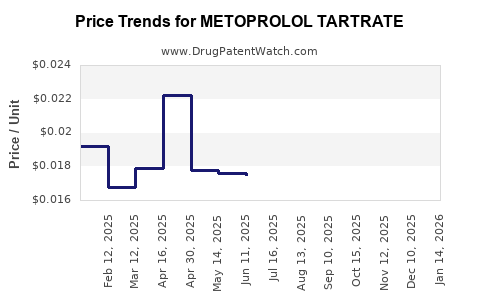
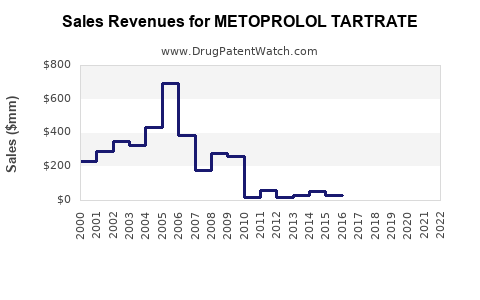
Metoprolol tartrate is an established, multi-source generic cardiovascular product with ongoing demand tied to heart failure with reduced ejection fraction (HFrEF) core-combination standards, post-myocardial infarction management, hypertension, and atrial fibrillation rate control. The financial trajectory is defined less by patent-driven exclusivity and more by (1) generic price compression, (2) formulary penetration of low-cost multisource products, (3) supply-chain execution for widely traded tablets and generics’ ability to win pharmacy and wholesaler preference, and (4) class-level substitution risk versus metoprolol succinate and other beta blockers. Net sales growth is constrained by mature market saturation and limited differentiability, with any upside concentrated in contract-driven volume shifts and geographic tendering rather than product innovation.
What drives metoprolol tartrate market dynamics in the US and EU?
Metoprolol tartrate market behavior is typical of mature oral generics: demand stability with pricing volatility driven by competitive entry, wholesaler inventory cycles, and payer contracting. Key dynamics include chronic disease prevalence, guideline-consistent beta blocker use, and substitution among metoprolol salts and beta blocker classes.
Which indications sustain baseline demand for metoprolol tartrate?
Metoprolol tartrate is used across multiple cardiovascular settings where beta-adrenergic blockade is standard. Demand drivers tend to be less indication-specific than guideline-specific because the product sits within a broad therapeutic class.
- Hypertension treatment (often in combination regimens)
- Angina and ischemic heart disease management
- Post-myocardial infarction therapy
- Atrial fibrillation and atrial flutter rate control
- Off-and-on label use patterns depending on local practice
How does payer formulary contracting affect metoprolol tartrate revenues?
For mature generics, revenue trajectory is dominated by payer contracting and pharmacy benefit manager (PBM) preferences:
- Preferred tiers drive market share to lowest-cost or contract-preferred National Drug Codes (NDCs).
- Switching costs are low because metoprolol tartrate is therapeutically substitutable across approved metoprolol immediate-release products.
- Tendering and national procurement in the EU influence who captures volume at the lowest administered cost.
What substitution risks exist versus metoprolol succinate and other beta blockers?
Metoprolol succinate (extended-release) competes for the same clinician population, with advantages in once-daily adherence for some patients. Beta blocker class competition (carvedilol, bisoprolol, atenolol, propranolol) also compresses net pricing where formularies prefer a limited set of agents.
Implication for financial trajectory: share shifts can occur without a major change in total beta blocker demand. Revenue growth is more likely from share capture and contracting cycles than from market expansion.
Where is demand most resilient?
Relative resilience is tied to:
- High chronic prevalence in older populations (where beta blockers remain standard)
- Clinical inertia in long-term regimens when patients are stable on immediate-release dosing
- Emergency and inpatient use for rate control in atrial arrhythmias
When does metoprolol tartrate lose exclusivity and how does that impact pricing?
Metoprolol tartrate is long out of meaningful “new product” exclusivity in major markets. The practical pricing inflection occurs at generic launch milestones and subsequent multi-year waves of additional entrants, not at a single patent cliff.
What does the exclusivity timeline look like for a mature metoprolol tartrate product?
For metoprolol tartrate, the market reality is:
- Brand exclusivity has already passed, leaving the product as predominantly generic.
- Remaining IP (if any) typically matters at the formulation or manufacturing level, with limited leverage for broad sales protection.
- The dominant pricing effect comes from entry count and contract tightening over time.
How does entry count correlate with net price erosion for metoprolol tartrate?
Generic pricing typically follows this pattern:
- Initial generic launch: sharp but not total price drop from brand.
- First wave of multisource: additional drops and increased rebate pressure.
- Later entrants: margin compression to near cost-plus levels in preferred channels.
- Sporadic shortages: temporary price spikes and increased wholesaler pricing, often followed by reversion.
How many companies sell metoprolol tartrate and what is the competitive landscape?
The competitive landscape is multisource by design. In the US, metoprolol tartrate is widely marketed through numerous generic manufacturers across strengths and dosage forms (primarily immediate-release tablets).
What dosage forms shape competition and stocking?
Most retail and institutional use centers on oral immediate-release tablets. Competition is segmented by:
- Tablet strength (common strengths vary by market)
- Packaging size (unit-dose patterns for institutional purchasing)
- Bottle vs unit package formats for channel preferences
How do manufacturers differentiate in a generic market?
In generic beta blocker markets, differentiation tends to be operational rather than clinical:
- Contract manufacturing scale and reliability
- Unit cost reductions through process optimization
- Supply continuity during demand spikes
Financial impact: manufacturers win by out-executing peers on availability and contract terms, not by therapeutic superiority.
What is the Orange Book status of metoprolol tartrate and how does it affect generic entry risks?
Orange Book status is usually the first-stop indicator for any remaining exclusivity or patent protection. For a mature generic like metoprolol tartrate, the Orange Book impact is typically limited to narrow formulation or manufacturing claims, if listed at all.
How to interpret Orange Book entries for a mature beta blocker
- If no unexpired patents protect the listed drug product, generic entry risk is lower and pricing pressure intensifies.
- If patents exist, Paragraph IV challenges can still occur, but the financial effect is modest where multiple generics already compete.
What generic launch risks still matter despite broad generic availability?
Even in a crowded market, barriers can include:
- CGMP manufacturing constraints
- Data package quality and FDA acceptance cycles
- Suitability of specific strengths and packaging formats for tendered contracts
What is the patent estate for metoprolol tartrate and what litigation has mattered?
For metoprolol tartrate, the patent estate is largely historical. Any remaining litigation or patent disputes tend to be secondary effects that influence specific NDCs rather than the entire molecule’s market pricing.
How does litigation affect revenue when a product is already generic?
For multisource products, litigation impacts tend to:
- Shift market share temporarily between NDCs
- Affect contract eligibility and payer pharmacy switching
- Cause supply disruptions if claims affect specific manufacturing routes
What typical litigation outcomes change market economics?
- Settlement agreements can preserve a subset of NDCs and delay a specific challenger’s launch.
- Court decisions can reallocate market share without restoring premium pricing.
How does metoprolol tartrate compare with metoprolol succinate in market and financial terms?
Metoprolol tartrate and succinate compete for overlapping patient populations. The financial question is whether immediate-release volume can offset succinate’s adherence advantage.
Which product tends to win adherence-driven contracts?
- Metoprolol succinate often aligns with once-daily adherence preferences and can gain formulary placement where PBMs target simplified regimens.
- Metoprolol tartrate retains usage where clinicians prefer immediate-release dosing patterns or established inpatient protocols.
What is the likely net effect on financial trajectory?
- Metoprolol tartrate growth typically depends on staying the low-cost contract option and maintaining stable institutional/inpatient utilization.
- Succinate can siphon marginal share when payers structure formularies by “preferred once-daily” strategies.
What is the FDA regulatory pathway impact on metoprolol tartrate competition?
Most metoprolol tartrate generics enter via ANDA routes because the drug is off-patent. The regulatory pathway shapes the speed and frequency of launches and post-marketing variations.
ANDA approvals and manufacturing changes
Financially relevant elements:
- New ANDAs expand the number of NDCs competing at retail and contract levels.
- Supplemental approvals for process changes can stabilize supply and reduce costs, affecting net pricing indirectly.
Risk points that can influence short-term availability
- Tight manufacturing capacity for tablets
- Recalls or quality system issues that temporarily remove NDCs from distribution channels
How strong is the commercial outlook for metoprolol tartrate over the next 3 to 5 years?
The next-phase trajectory for a mature generic is usually flat-to-low growth in unit volume, with ongoing margin compression. Upside is typically driven by:
- Continued stable cardiovascular incidence and chronic prevalence
- Contracting cycles that increase preferred-channel allocation for specific suppliers
- Supply reliability that captures switch volume during competitor shortages
Downside comes from:
- Continued price pressure as the lowest-cost provider set expands
- Substitution toward metoprolol succinate or other beta blockers with preferential formulary positioning
- Regulatory or quality events that reduce supply for specific NDCs
Net assessment: metoprolol tartrate’s financial trajectory is most likely steady in demand but structurally constrained by generic price compression. Competitive differentiation is operational.
What revenue exposure metrics should be used to model metoprolol tartrate financial trajectory?
For business planning, the most predictive KPIs for a mature generic include:
- Unit volume trends by strength (tablets per day)
- Net price after rebates and PBM fees, not list price
- Contract share by payer segment (commercial, Medicare Part D, Medicaid) and by channel (retail vs mail)
- Average wholesaler inventory and stockout frequency
- Supply continuity metrics (OTIF, backorders, recall events)
Key Takeaways
- Metoprolol tartrate is a mature, multi-source generic where financial trajectory is driven by PBM and contracting dynamics, supply reliability, and substitution within beta blockers rather than by patent exclusivity.
- Pricing pressure is structural and tied to ongoing multisource competition and contract preference; any temporary pricing spikes typically follow supply disruptions rather than IP changes.
- Competitive strategy centers on winning preferred-channel contracts and maintaining uninterrupted manufacturing for core strengths and packaging sizes.
- Relative share and net pricing can be pressured by metoprolol succinate and formulary narrowing in beta blocker class management.
FAQs
1) Why does metoprolol tartrate pricing change even without new patent expirations?
Because generic net pricing is driven by PBM contracting, competitor entrant counts, wholesaler inventory cycles, and supply continuity. Small shifts in supply or contract rates can materially change net price.
2) Does metoprolol tartrate have fewer generic entry barriers than newer branded products?
Yes. With mature generic status and broad multisource availability, entry barriers are mostly operational and regulatory execution (ANDA acceptance, CGMP manufacturing, and quality system performance) rather than patent cliffs.
3) Will metoprolol tartrate likely lose share to metoprolol succinate?
Over time, share can erode where formularies prefer once-daily regimens and where adherence-based protocols drive prescriber behavior toward succinate. Tartrate can still retain patients stable on existing regimens and institutional protocols.
4) What matters more for forecasting than total prescriptions?
Net price after rebates and contract share by payer segment are more predictive of revenue than prescription counts alone in mature generic categories.
5) How do shortages affect metoprolol tartrate revenue and volume?
Shortages can lift net pricing for remaining in-stock suppliers and temporarily transfer demand to available NDCs. Once supply normalizes, the category usually reverts to lower net pricing.
References
- FDA. “Drugs@FDA: FDA Approved Drug Products.” U.S. Food and Drug Administration.
- FDA. “Orange Book: Approved Drug Products with Therapeutic Equivalence Evaluations.” U.S. FDA.
- IMS Institute / IQVIA. “Medicine Use and Spending (US) and Market Trends” (latest available editions).