Share This Page
Drug Sales Trends for METOPROLOL TARTRATE
✉ Email this page to a colleague
Payment Methods and Pharmacy Types for METOPROLOL TARTRATE (2022)
Revenues by Pharmacy Type
Units Sold by Pharmacy Type
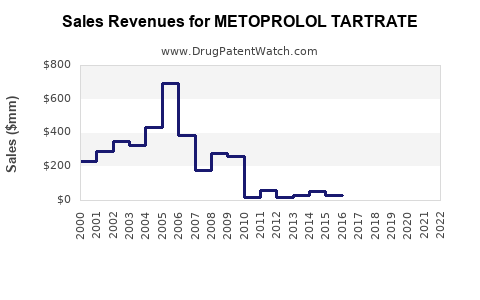
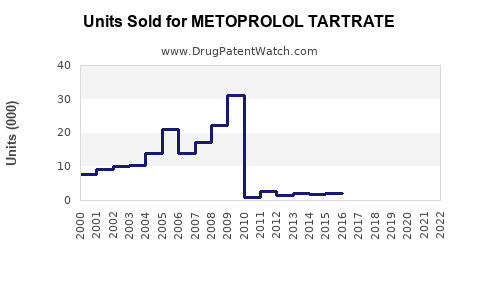
Annual Sales Revenues and Units Sold for METOPROLOL TARTRATE
| Drug Name | Revenues (USD) | Units | Year |
|---|---|---|---|
| METOPROLOL TARTRATE | ⤷ Start Trial | ⤷ Start Trial | 2022 |
| METOPROLOL TARTRATE | ⤷ Start Trial | ⤷ Start Trial | 2021 |
| METOPROLOL TARTRATE | ⤷ Start Trial | ⤷ Start Trial | 2020 |
| METOPROLOL TARTRATE | ⤷ Start Trial | ⤷ Start Trial | 2019 |
| METOPROLOL TARTRATE | ⤷ Start Trial | ⤷ Start Trial | 2018 |
| METOPROLOL TARTRATE | ⤷ Start Trial | ⤷ Start Trial | 2017 |
| >Drug Name | >Revenues (USD) | >Units | >Year |
Metoprolol Tartrate Market Analysis, Patent Status, and Sales Projections
Metoprolol tartrate is a mature, generic immediate-release beta blocker with high prescription volume and limited pricing power. The U.S. market is primarily supplied by generic manufacturers, while the branded Lopressor product has little commercial influence. Revenue growth is likely to come from prescription volume, hospital demand, and emerging-market expansion rather than price increases or patent protection.
A reasonable base-case forecast for global metoprolol tartrate product revenue is approximately $420 million in 2025, rising to $455 million by 2030 at a compound annual growth rate of about 1.6%. The forecast is a market model rather than a reported company-sales figure because public sources do not provide a complete, product-specific global revenue series for generic metoprolol tartrate.
What is metoprolol tartrate used for?
Metoprolol tartrate is an immediate-release formulation of metoprolol, a selective beta-1 adrenergic blocker. It is approved in the United States for hypertension, angina pectoris, and myocardial infarction. The product is administered in divided doses because its immediate-release profile produces shorter exposure than the extended-release metoprolol succinate formulation [1].
Common tablet strengths include:
| Strength | Typical market role |
|---|---|
| 25 mg | Dose initiation and titration |
| 37.5 mg | Available from some manufacturers |
| 50 mg | Common maintenance strength |
| 75 mg | Available from some manufacturers |
| 100 mg | Common higher-dose strength |
Metoprolol tartrate competes with other beta blockers, including atenolol, carvedilol, bisoprolol, propranolol, and nebivolol. It also competes with non-beta-blocker therapies such as ACE inhibitors, angiotensin receptor blockers, calcium-channel blockers, and thiazide diuretics.
How large is the metoprolol tartrate market?
The market is large in prescription volume but modest in revenue per prescription. Generic metoprolol tartrate is widely available through retail pharmacies, hospitals, wholesalers, mail-order channels, and government purchasing programs.
Estimated global market size
The following scenario reflects estimated manufacturer and distributor revenue, excluding downstream pharmacy dispensing margins.
| Year | Low case | Base case | High case |
|---|---|---|---|
| 2024 | $350 million | $400 million | $460 million |
| 2025 | $365 million | $420 million | $485 million |
| 2026 | $375 million | $427 million | $500 million |
| 2027 | $385 million | $434 million | $515 million |
| 2028 | $395 million | $441 million | $530 million |
| 2029 | $405 million | $448 million | $545 million |
| 2030 | $415 million | $455 million | $560 million |
The base-case compound annual growth rate from 2025 to 2030 is approximately 1.6%. The low case assumes continued price erosion and stable or declining prescriptions. The high case assumes volume growth in emerging markets, supply disruptions affecting competitors, and modest increases in institutional procurement prices.
These estimates should not be interpreted as reported sales by Novartis, generic manufacturers, or any single marketing authorization holder.
What drives metoprolol tartrate sales?
Prescription volume
Metoprolol remains a standard cardiovascular medicine with broad physician familiarity. Its use is supported by long-term clinical experience, low acquisition cost, and availability in multiple strengths.
The principal volume drivers are:
- Hypertension treatment and combination therapy
- Chronic angina management
- Post-myocardial-infarction treatment
- Hospital use for rate control and cardiovascular stabilization
- Continued use among established patients
- Demand from public-sector and institutional formularies
Volume growth is limited by the migration of some patients to once-daily extended-release metoprolol succinate and by competition from carvedilol and other beta blockers.
Pricing
Pricing is under structural pressure because multiple generic suppliers can manufacture metoprolol tartrate tablets. Retail cash prices vary by strength, quantity, pharmacy, and discount program. Institutional prices are usually lower than retail acquisition prices.
A generic manufacturer generally competes on:
- Contracted price
- Supply reliability
- FDA manufacturing compliance
- Wholesale availability
- Packaging and bottle sizes
- Ability to maintain all major strengths
- Formulary and group-purchasing access
Patent protection does not support premium pricing.
Hospital demand
Hospitals use metoprolol tartrate in oral and, where clinically appropriate, injectable metoprolol products. Oral tablets are inexpensive and commonly purchased through group purchasing organizations and hospital wholesalers. Hospital demand can produce temporary price increases when a supplier exits the market or encounters manufacturing problems.
When does metoprolol tartrate lose exclusivity?
Metoprolol tartrate lost meaningful U.S. market exclusivity decades ago. The original U.S. branded product, Lopressor, was approved before the modern generic market matured, and generic versions have been available for many years.
The product has no commercially relevant remaining small-molecule exclusivity period in the United States. It is not protected by current new chemical entity exclusivity, pediatric exclusivity, or an active branded patent strategy that would delay generic entry.
| Exclusivity category | Current status |
|---|---|
| New chemical entity exclusivity | Expired |
| Orphan-drug exclusivity | Not applicable |
| Pediatric exclusivity | No active period identified |
| Reference-product exclusivity | Expired |
| Active U.S. blocking patent | No commercially material patent barrier identified |
| Generic availability | Established |
What patents protect metoprolol tartrate?
The principal compound, formulation, and use patents associated with metoprolol tartrate are expired or commercially immaterial in the United States. Current competition is based on abbreviated new drug applications, manufacturing capability, regulatory compliance, and supply contracts rather than patent exclusivity.
The relevant U.S. intellectual-property position is therefore:
| Patent category | Commercial status |
|---|---|
| Metoprolol active ingredient | Historical patents expired |
| Immediate-release tablet formulation | Historical protection expired |
| Hypertension method of use | No meaningful blocking exclusivity |
| Angina method of use | No meaningful blocking exclusivity |
| Post-infarction use | No meaningful blocking exclusivity |
| Manufacturing process | Potentially protectable but unlikely to block routine generic supply |
| Packaging and trade dress | Limited commercial value |
What is the Orange Book status of metoprolol tartrate?
The FDA Orange Book identifies approved reference and generic products, therapeutic equivalence codes, and patent or exclusivity information where applicable. Metoprolol tartrate tablets are marketed through multiple abbreviated new drug applications and are generally eligible for substitution when assigned an applicable therapeutic-equivalence rating [2].
Orange Book relevance is limited because:
- The principal patent disputes have expired.
- Generic approval does not depend on a current Paragraph IV challenge to an active blocking patent.
- Pharmacy substitution is driven by state law, payer rules, and therapeutic-equivalence status.
- The reference brand does not retain a meaningful exclusivity advantage.
Are there Paragraph IV challenges for metoprolol tartrate?
Paragraph IV litigation is not a current central market issue for conventional metoprolol tartrate tablets. A Paragraph IV certification is used when an abbreviated new drug applicant asserts that a listed patent is invalid, unenforceable, or will not be infringed. That mechanism was important during the original generic-entry period but does not presently create a major barrier for standard metoprolol tartrate tablets.
A future Paragraph IV dispute could arise around a novel formulation, combination product, delivery system, or previously unlisted method of use. It would not normally affect established immediate-release metoprolol tartrate products unless the patent claims covered the core tablet product.
What formulations are protected by metoprolol tartrate patents?
Conventional immediate-release metoprolol tartrate tablets have no meaningful current formulation moat. Potentially differentiated products could include:
- Modified-release tablets
- Fixed-dose combinations
- Abuse-deterrent or adherence-oriented systems
- Pediatric liquid formulations
- Orally disintegrating tablets
- Hospital-ready packaging
- Combination products with diuretics or other antihypertensives
The most important formulation distinction is between metoprolol tartrate and metoprolol succinate. Metoprolol tartrate is generally immediate release, while metoprolol succinate extended release is designed for once-daily administration. The two products are not interchangeable solely because they contain the same active moiety.
How does metoprolol tartrate compare with metoprolol succinate?
| Attribute | Metoprolol tartrate | Metoprolol succinate |
|---|---|---|
| Release profile | Immediate release | Extended release |
| Typical dosing | Often twice daily | Usually once daily |
| Main commercial position | Low-cost generic | Generic plus branded Toprol-XL history |
| Adherence profile | Less convenient | More convenient |
| Patent position | Expired | Core patents expired |
| Main competitors | Atenolol, carvedilol, propranolol | Bisoprolol, carvedilol, other once-daily therapies |
| Revenue outlook | Stable, low-price | Larger formulation and adherence opportunity |
Metoprolol succinate may capture patients who prioritize once-daily dosing, while metoprolol tartrate retains advantages in dose flexibility, hospital use, and low acquisition cost.
What companies compete in metoprolol tartrate?
Competition is fragmented. U.S. generic supply has historically included large and mid-sized manufacturers such as:
- Teva Pharmaceuticals
- Mylan, now part of Viatris
- Dr. Reddy’s Laboratories
- Zydus Pharmaceuticals
- Sandoz
- Rising Pharmaceuticals
- Ingenus Pharmaceuticals
- Other FDA-approved generic suppliers
The competitive set changes as companies enter, exit, transfer products, or experience manufacturing constraints. FDA approval does not guarantee continuous commercial supply.
The branded reference product is associated with Lopressor. Novartis has historically held rights and marketing responsibility for Lopressor in the United States, but the branded product has limited influence over the current generic market.
What is the FDA regulatory status of metoprolol tartrate?
Metoprolol tartrate is an FDA-approved prescription drug. Generic tablets are approved under the abbreviated new drug application pathway, which requires demonstration of pharmaceutical equivalence and bioequivalence to the reference product, together with compliance with applicable manufacturing and quality requirements [1, 3].
The main regulatory risks are operational:
- Warning letters or facility inspections
- Manufacturing deviations
- Recalls
- Shortages of active pharmaceutical ingredient
- Inability to maintain all strengths
- Changes in contract manufacturing arrangements
- Supply-chain concentration
No biosimilar pathway applies. Metoprolol tartrate is a chemically synthesized small molecule, not a biologic. Biosimilar competition is therefore irrelevant; the appropriate competitive framework is generic substitution.
What generic entry risks exist for metoprolol tartrate?
Generic launch risk is low for the molecule but high for individual manufacturers. A new entrant faces:
- Low selling prices.
- Limited differentiation.
- Established supplier relationships.
- Buyer pressure from wholesalers and group purchasing organizations.
- FDA compliance costs.
- Working-capital requirements for inventory.
- Potential price erosion after launch.
- Difficulty securing pharmacy shelf space.
A generic manufacturer can enter without a patent settlement if the relevant patents and exclusivities have expired. Commercial success depends more on reliable supply and cost structure than on legal exclusivity.
Generic launch scenarios
| Scenario | Market effect | Revenue implication |
|---|---|---|
| New low-cost entrant | Price reduction and share fragmentation | Negative for incumbent revenue |
| Supplier exit | Temporary shortages and price recovery | Positive for remaining suppliers |
| Hospital contract win | Volume increase with lower unit price | Mixed margin effect |
| New extended-release product | Some substitution from tartrate | Negative for immediate-release volume |
| Emerging-market registration | Incremental volume | Positive, but lower unit economics |
What is the metoprolol tartrate sales forecast through 2030?
The base-case forecast assumes mature-market volume remains broadly stable, unit prices decline modestly, and emerging-market demand offsets some U.S. pricing pressure.
| Metric | 2025 estimate | 2030 base case | 2025-2030 trend |
|---|---|---|---|
| Global product revenue | $420 million | $455 million | 1.6% CAGR |
| Mature-market volume | Stable | Slight decline | Low single-digit decline |
| Emerging-market volume | Moderate growth | Stronger contribution | Mid-single-digit growth |
| Average selling price | Declining | Lower than 2025 | Low single-digit erosion |
| Patent-driven revenue | Negligible | Negligible | No material contribution |
| Supply-driven price opportunity | Intermittent | Intermittent | Event-dependent |
The low case reaches approximately $415 million in 2030. The high case reaches approximately $560 million if supply interruptions, volume growth, and new geographic registrations support better pricing.
What is the revenue exposure for pharmaceutical companies?
For diversified generic manufacturers, metoprolol tartrate is unlikely to be a material revenue driver on a company-wide basis. It is more relevant as part of a cardiovascular portfolio that includes metoprolol succinate, carvedilol, atenolol, lisinopril, losartan, hydrochlorothiazide, and combination products.
Revenue exposure is highest for:
- Small generic companies with concentrated cardiovascular portfolios
- Contract manufacturers supplying hospitals
- Firms with strong government or institutional contracts
- Suppliers with reliable access to metoprolol active pharmaceutical ingredient
- Companies holding registrations in underserved markets
The product can have operational importance even when its revenue contribution is small. A portfolio supplier may use metoprolol tartrate to retain formulary access or support broader purchasing agreements.
How strong is the metoprolol tartrate patent estate?
The patent estate is weak for commercial purposes.
| Patent-strength factor | Assessment |
|---|---|
| Core compound protection | Expired |
| Immediate-release formulation protection | Expired or immaterial |
| Method-of-use protection | No material barrier |
| Manufacturing patents | Potentially narrow and nonblocking |
| Brand differentiation | Low |
| Generic substitution resistance | Low |
| Litigation leverage | Low |
| Lifecycle-management opportunity | Moderate only with a new formulation |
The product’s defensibility comes from regulatory approvals, manufacturing quality, supply reliability, and customer relationships. It does not come from patent exclusivity.
What patent litigation and settlement agreements affect metoprolol tartrate?
No current, commercially material U.S. patent litigation or settlement agreement is central to conventional metoprolol tartrate tablets. Historical litigation associated with generic entry is no longer the main determinant of market access.
A future dispute would be more likely to involve:
- A combination product
- An extended-release delivery platform
- A liquid or pediatric dosage form
- A manufacturing process
- A new indication
- A branded successor product
Such litigation would affect the specific improved product, not the mature immediate-release market.
What geographic markets offer growth?
The strongest growth opportunity is outside the United States, where cardiovascular disease prevalence is increasing and generic medicines remain central to treatment.
North America
The United States is a mature, low-price market. Growth is limited, but supply shortages can create temporary opportunities. Canada has similar generic dynamics, with provincial reimbursement and tendering influencing margins.
Europe
European demand is stable. National reimbursement systems, reference pricing, and tender procurement constrain prices. Market access depends on country-specific registrations and reimbursement listings.
Asia-Pacific
India and China have substantial cardiovascular demand and extensive generic manufacturing capacity. Competition is intense, but local registrations and distribution reach can support volume growth.
Latin America, the Middle East, and Africa
These markets offer volume growth potential but involve registration, procurement, currency, and distribution risks. Brand loyalty and local manufacturing requirements vary by country.
What manufacturing and intellectual-property barriers remain?
The active pharmaceutical ingredient is widely known and can be sourced from multiple suppliers. Manufacturing barriers are therefore moderate rather than technological. The main requirements are:
- Validated tablet manufacturing
- Content uniformity
- Dissolution control
- Stability data
- Good manufacturing practice compliance
- Reliable packaging and serialization
- Regulatory registration in each target country
- Pharmacovigilance and supply reporting
Manufacturing know-how may protect margins at the company level, but it does not prevent competitors from developing equivalent products.
Key Takeaways
- Metoprolol tartrate is a mature, low-cost generic cardiovascular medicine.
- The U.S. market has no meaningful remaining core-patent barrier.
- Paragraph IV litigation is not a major current risk for conventional tablets.
- Generic competition, procurement pressure, and supply reliability determine commercial performance.
- Metoprolol succinate extended release is the main formulation-level alternative.
- Biosimilar risk does not apply because metoprolol tartrate is a small-molecule drug.
- A base-case global product-revenue estimate is $420 million in 2025 and $455 million in 2030.
- The estimated 2025-2030 revenue CAGR is approximately 1.6%.
- The strongest commercial opportunity is operational: reliable supply, hospital contracts, and geographic expansion.
- Patent-based pricing power is effectively absent.
FAQs
Is metoprolol tartrate still profitable for generic manufacturers?
Yes, but profitability depends on manufacturing cost, supply reliability, and contract access. The product generally has low unit margins and limited pricing power.
Can a company obtain new patents on metoprolol tartrate?
A company may seek patents on a novel formulation, delivery system, combination, manufacturing process, or use. A patent on the old immediate-release tablet would not normally be available because the relevant technology is established prior art.
Is metoprolol tartrate interchangeable with Toprol-XL?
No. Toprol-XL contains metoprolol succinate extended release, while metoprolol tartrate is generally an immediate-release product. Substitution requires attention to salt form, release profile, dosage, and clinical instructions.
Does metoprolol tartrate have pediatric exclusivity?
No active pediatric exclusivity period is associated with the established generic immediate-release product.
What is the main investment risk in metoprolol tartrate?
The main risk is margin compression from generic competition. Secondary risks include supplier exits, FDA manufacturing actions, active pharmaceutical ingredient shortages, and substitution toward extended-release or competing beta-blocker products.
References
- U.S. Food and Drug Administration. (2022). Lopressor (metoprolol tartrate) prescribing information. FDA.
- U.S. Food and Drug Administration. (2024). Approved drug products with therapeutic equivalence evaluations. FDA.
- U.S. Food and Drug Administration. (2024). Orange Book: Approved drug products with therapeutic equivalence evaluations. FDA.
- U.S. Food and Drug Administration. (2024). Drugs@FDA: FDA-approved drugs database. FDA.
- National Heart, Lung, and Blood Institute. (2023). High blood pressure and cardiovascular disease treatment resources. National Institutes of Health.
More… ↓
