Last updated: February 13, 2026
Market Overview
Methylprednisolone is a corticosteroid indicated for conditions involving inflammation, immune response suppression, and allergic reactions. It is available in various formulations including oral, injectable, and topical. The drug is primarily prescribed in hospitals, clinics, and outpatient settings.
Key Market Drivers
- Growing prevalence of autoimmune diseases and inflammatory conditions.
- Increased demand in emergency and critical care settings.
- Expanding use in chronic respiratory and dermatological conditions.
- Patent expirations of branded formulations opening generic markets.
Market Size & Growth
The global corticosteroid market, valued at approximately USD 4.3 billion in 2022, is projected to reach USD 6.2 billion by 2030, growing at a compounded annual growth rate (CAGR) of roughly 4.8% [1].
Methylprednisolone constitutes around 40% of corticosteroid prescriptions, generating an estimated USD 1.7 billion in 2022. The segment is expected to expand with a CAGR of 5% over the next decade, driven by generic market penetration and rising demand.
Competitive Landscape
- Branded drugs: Solu-Medrol (Pfizer), Medrol (Abbott), with patent protection until early 2020s.
- Generics: Multiple manufacturers, including Sandoz, Teva, Mylan, and others, accounting for over 80% of the market share.
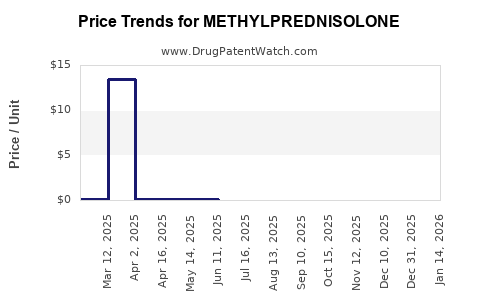
Pricing Trends & Projected Prices
Current Pricing
- Brand-name formulations: USD 15–30 per vial (100 mg/2 mL, injectable forms).
- Generic formulations: USD 5–12 per vial, depending on manufacturer and volume.
Price decline forecast
Post patent expiry, generic competition has driven prices down. For injectable formulations, prices declined by 20–30% between 2018 and 2022 [2].
Next 5 Years Price Projections
Regulatory & Market Dynamics Impacting Pricing
- Increased regulatory scrutiny and approval of biosimilar or alternative corticosteroids could further pressure prices.
- Potential formulary restrictions or clinical guideline updates favoring newer, possibly costlier alternatives may impact demand.
- Healthcare payers’ focus on cost-effectiveness may promote use of low-cost generics, stabilizing or decreasing prices.
Market Entry & R&D Trends
No new formulations or patent protections are expected soon; most innovations focus on delivery mechanisms rather than new molecular entities. Market entry of biosimilars or biobetters for corticosteroids remains limited due to complex development processes.
Key Sales Regions
- North America: Largest market, annual sales exceeding USD 1.2 billion, significant generic penetration.
- Europe: Similar dynamics, with prices slightly lower due to regulatory differences.
- Asia-Pacific: Rapid growth, driven by increasing healthcare infrastructure and disease prevalence; prices remain competitive.
Key Takeaways
- Methylprednisolone remains a high-volume corticosteroid with an established market largely driven by generics.
- Prices are declining due to competition, with injectable forms dropping from approximately USD 15–30 in 2022 to an expected USD 2.50–6 per vial by 2028.
- Demand growth correlates with autoimmune disease prevalence and hospital use.
- Market trends favor cost containment, influencing pricing strategies and market accessibility.
FAQs
1. What factors influence methylprednisolone price fluctuations?
Prices are affected by generic competition, raw material costs, regulatory policies, supply chain stability, and demand shifts across regions.
2. Will new formulations or delivery technologies impact methylprednisolone prices soon?
Current innovation efforts focus on alternative delivery methods or formulations; however, significant price impacts are unlikely unless new patents or therapies emerge.
3. How does methylprednisolone compare cost-wise to similar corticosteroids?
Prices for methylprednisolone are generally comparable within the corticosteroid class, with slight variations depending on formulation, region, and manufacturer.
4. Are there specific regional factors affecting methylprednisolone pricing?
Yes; less regulated markets or regions with higher healthcare costs tend to have higher prices, whereas economies with greater generic penetration or price controls see lower prices.
5. What is the outlook for methylprednisolone market growth?
The market is expected to grow modestly at a CAGR of around 4.8%, driven by demand for anti-inflammatory therapies and increased healthcare access globally.
References
[1] Research and Markets. "Global Corticosteroids Market Analysis, Trends & Forecasts 2023–2030."
[2] IQVIA. "Prescription Data and Price Trends," 2018–2022.