Last updated: September 7, 2026
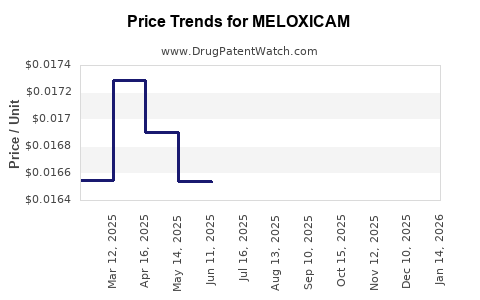
Meloxicam is a mature, mostly generic nonsteroidal anti-inflammatory drug (NSAID) used for osteoarthritis and rheumatoid arthritis. Its commercial trajectory is defined by high prescription volume, low unit pricing, fragmented generic supply, and limited ability to sustain branded pricing. Revenue has shifted from the original Mobic franchise toward generic tablets, low-dose specialty capsules such as Vivlodex, orally disintegrating tablets, and injectable hospital products. No reliable public source reports a consolidated global meloxicam market revenue figure because manufacturers disclose sales by company or product portfolio rather than by active ingredient.
How large is the meloxicam market?
Meloxicam is a high-volume, low-value pharmaceutical market. The largest demand segment is oral generic meloxicam, particularly 7.5 mg and 15 mg tablets.
| Market segment |
Main products |
Commercial position |
| Standard oral tablets |
Generic meloxicam, Mobic legacy brand |
Largest volume segment; intense price competition |
| Oral suspension |
Meloxicam suspension |
Pediatric and swallowing-difficulty niche |
| Low-dose capsules |
Vivlodex |
Specialty branded segment for osteoarthritis |
| Orally disintegrating tablets |
QMIIZ ODT |
Differentiated formulation with limited price premium |
| Intravenous injection |
Anjeso |
Hospital and postoperative pain niche |
| Veterinary products |
Generic and branded veterinary meloxicam |
Separate regulatory and purchasing channel |
The United States is commercially important because it has broad generic substitution and multiple dosage-form suppliers. Europe and other developed markets also have extensive generic use, while emerging markets are more exposed to local manufacturing, tender pricing, and over-the-counter or pharmacy-dispensed NSAID channels.
The market is demand-stable rather than growth-oriented. Aging populations, osteoarthritis prevalence, and chronic musculoskeletal disease support prescription volume. Revenue growth is constrained by generic substitution and the availability of competing NSAIDs, including ibuprofen, naproxen, diclofenac, celecoxib, and etodolac.
When did meloxicam lose exclusivity?
The original Mobic exclusivity period ended years ago, allowing generic manufacturers to enter the U.S. market. The U.S. Food and Drug Administration approved Mobic, the branded meloxicam product, in 2000 for osteoarthritis and rheumatoid arthritis.[1]
The principal commercial loss of exclusivity occurred when abbreviated new drug application manufacturers entered the market in the mid-2000s. Generic meloxicam tablets are now supplied by multiple companies, including large generic manufacturers and contract suppliers. The original Mobic brand no longer controls the market.
| Milestone |
Approximate timing |
Commercial effect |
| FDA approval of Mobic tablets |
2000 |
Originator launch |
| Generic tablet approvals and market entry |
Mid-2000s |
Rapid price erosion |
| Vivlodex approval |
2015 |
New low-dose branded segment |
| QMIIZ ODT approval |
2020 |
New orally disintegrating formulation |
| Anjeso approval |
2020 |
New injectable hospital segment |
The specific timing of individual generic launches varied by applicant, dosage strength, settlement terms, and FDA approval date. The central market fact is that standard oral meloxicam is no longer protected by originator exclusivity.
What patents protect meloxicam products?
The basic active-ingredient patent estate for meloxicam is commercially exhausted in the United States. Current protection is concentrated in formulation, dosage, delivery, and product-specific patents rather than in the core molecule.
Standard tablets and capsules
Generic meloxicam tablets compete primarily on:
- FDA approval status
- manufacturing cost
- supply reliability
- wholesaler and group purchasing organization access
- pharmacopoeial compliance
- ability to maintain uninterrupted supply
The standard tablet market has limited patent-based differentiation. Most generic applicants rely on ANDAs demonstrating bioequivalence rather than conducting full clinical development.
Vivlodex
Vivlodex is a low-dose meloxicam capsule approved for osteoarthritis pain. It was developed by Iroko Pharmaceuticals and uses a lower-dose formulation than standard meloxicam products.[2] Its commercial strategy depends on formulation and dosing differentiation, not a new active ingredient.
Product-specific patents and regulatory exclusivity associated with Vivlodex must be evaluated through the current FDA Orange Book and patent records. The economic value of those rights depends on whether the claims cover the marketed dosage form, whether generic applicants can design around them, and whether listed patents remain enforceable.
QMIIZ ODT
QMIIZ ODT is an orally disintegrating meloxicam tablet approved in 2020. The dosage form addresses patients who have difficulty swallowing conventional tablets.[3] Its protection is based on formulation and delivery technology. The product competes in a smaller market than conventional meloxicam and may support a higher net price if prescribers and payers recognize a clinical or adherence benefit.
Anjeso
Anjeso is an intravenous meloxicam product approved for the management of moderate-to-severe pain in adults when treatment is appropriate.[4] It entered a hospital market where injectable NSAIDs compete with ketorolac, intravenous acetaminophen, and opioid-sparing protocols.
Injectable meloxicam creates manufacturing and regulatory barriers that do not apply to tablets. These include sterile manufacturing, container-closure integrity, particulate control, stability, and hospital formulary adoption. Those barriers can delay practical competition even when broad chemical patent protection is absent.
What is the Orange Book status of meloxicam?
The Orange Book distinguishes between the original Mobic product and later branded meloxicam formulations. Standard generic meloxicam tablets are generally approved under ANDAs and are not dependent on a continuing Mobic patent monopoly.
Product-specific listings may remain relevant for branded formulations such as Vivlodex, QMIIZ ODT, and Anjeso. The commercial impact of an Orange Book-listed patent depends on:
- The patent’s expiration date.
- Whether the patent is listed against the exact strength and dosage form.
- Whether an ANDA applicant files a Paragraph IV certification.
- Whether the patent owner brings infringement litigation within the statutory period.
- Whether the FDA approval is delayed by a 30-month stay or other applicable regulatory mechanism.
The Orange Book is the controlling source for current U.S. listed patents and exclusivity data.[5] Patent status should be assessed separately for each dosage form because a patent protecting an orally disintegrating tablet does not necessarily block a conventional tablet or capsule.
Which companies compete in meloxicam?
The competitive landscape has two tiers.
Generic manufacturers
The standard oral market includes a large number of ANDA holders and contract manufacturers. Competition is strongest in 7.5 mg and 15 mg tablets, where products are interchangeable under state substitution laws and payer formularies.
Large generic companies can compete through scale, procurement, and distribution. Smaller suppliers may win business through low manufacturing overhead or contract supply arrangements but face greater exposure to shortages and raw-material disruptions.
Branded and specialty manufacturers
The branded segment includes companies associated with:
- Mobic and its legacy originator franchise
- Vivlodex
- QMIIZ ODT
- Anjeso
Branded products must justify price through dosage convenience, route of administration, specialty distribution, hospital economics, or payer positioning. A reformulation without a clear clinical or operational advantage is vulnerable to rapid formulary resistance.
What is the financial trajectory for meloxicam?
Meloxicam’s financial trajectory has four phases.
Phase 1: Originator growth
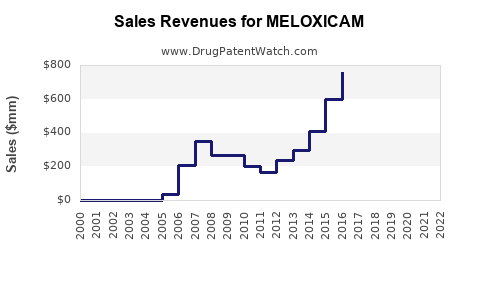
Mobic generated branded revenue after its 2000 approval as physicians adopted meloxicam for chronic arthritis treatment. Revenue benefited from prescription volume and brand recognition.
Phase 2: Generic erosion
Generic entry produced the largest structural decline in branded revenue. Unit volume remained substantial, but average selling prices fell sharply. This is the normal pattern for a widely substitutable oral NSAID.
Phase 3: Specialty reformulation
Vivlodex, QMIIZ ODT, and Anjeso attempted to create new revenue pools through differentiated dosage forms and routes of administration. These products have smaller eligible markets and higher development and manufacturing costs.
Phase 4: Mature portfolio economics
The current market is mature. Generic tablets generate recurring volume but limited revenue per prescription. Specialty formulations can produce higher revenue per unit, but they face narrower patient populations, payer scrutiny, and competition from established NSAIDs.
| Revenue driver |
Direction |
Impact |
| Chronic osteoarthritis prevalence |
Positive |
Supports prescription demand |
| Generic substitution |
Negative for brands |
Reduces net price |
| Multiple tablet suppliers |
Negative |
Increases price pressure |
| Specialty dosage forms |
Positive for selected products |
Creates pricing differentiation |
| Hospital injectable demand |
Mixed |
Depends on formulary adoption |
| Raw-material and manufacturing costs |
Negative when elevated |
Compresses generic margins |
| NSAID safety concerns |
Negative |
Limits long-term use and labeling flexibility |
No standalone Mobic or meloxicam revenue figure can be used as a reliable proxy for the full market. Originator companies typically report such products within broader portfolios, while generic companies aggregate revenue across numerous molecules.
What generic entry risks exist for branded meloxicam products?
The greatest generic risk affects branded reformulations rather than standard tablets.
Vivlodex
Vivlodex faces substitution risk if an applicant obtains approval for a therapeutically equivalent or sufficiently substitutable low-dose meloxicam product. A generic may also compete indirectly through standard meloxicam tablets if prescribers use lower doses outside the branded product’s commercial positioning.
QMIIZ ODT
QMIIZ ODT has formulation-specific protection, but its market is vulnerable to alternative administration formats. Patients who need an orally disintegrating product represent a narrower segment than the total meloxicam market. A competitor could challenge the product through an equivalent ODT or compete with liquid, capsule, or tablet alternatives.
Anjeso
Anjeso faces a different risk profile. Sterile injectable manufacturing limits the number of immediate competitors, but hospital buyers can substitute toward ketorolac, acetaminophen, or other nonopioid analgesics. The primary threat is therefore therapeutic and formulary substitution, not only a direct generic equivalent.
Are there Paragraph IV challenges to meloxicam?
Paragraph IV exposure is product-specific. Generic applicants can challenge listed patents by asserting that a patent is invalid, unenforceable, or not infringed. The risk is most relevant to newer branded formulations with Orange Book-listed patents.
For standard meloxicam tablets, the key Paragraph IV period has passed because generic competition is established. For Vivlodex, QMIIZ ODT, and Anjeso, the relevant question is whether current listed patents remain active and whether ANDA applicants have filed certifications or initiated litigation.
A Paragraph IV case can produce:
- A 30-month FDA approval stay under applicable conditions.
- Patent litigation costs for the branded company.
- A potential 180-day generic exclusivity period for a first successful Paragraph IV applicant.
- Settlement agreements that establish an authorized or licensed entry date.
- Earlier entry through a negotiated license.
What patent litigation and settlements affect meloxicam?
Meloxicam’s major commercial litigation history is associated with generic entry against older branded products and with later formulation-specific patents. The standard Mobic tablet franchise is no longer a meaningful patent-exclusion platform.
For newer products, litigation risk turns on claim scope. Formulation patents are often narrower than composition-of-matter patents. A competitor may avoid infringement by changing excipients, particle size, dosage form, release profile, or manufacturing process.
Settlement agreements can materially alter the launch date of a generic product. They may permit entry before patent expiration, provide a license to the branded company’s intellectual property, or restrict the applicant’s commercial launch until a specified date. Settlement terms are often confidential, so public records may show the litigation outcome without disclosing the full economic arrangement.
How does meloxicam compare with competing NSAIDs?
| Drug |
Main competitive advantage |
Main commercial weakness |
| Meloxicam |
Once-daily dosing; broad generic availability |
Low pricing and NSAID class risks |
| Naproxen |
Long clinical history; broad OTC and prescription use |
Frequent dosing and gastrointestinal concerns |
| Ibuprofen |
Low cost; strong consumer familiarity |
Shorter duration and frequent dosing |
| Diclofenac |
Strong anti-inflammatory effect; topical options |
Cardiovascular and regulatory concerns |
| Celecoxib |
COX-2 selectivity and branded clinical positioning |
Higher price than many generic NSAIDs |
| Ketorolac |
Potent short-term analgesia; injectable use |
Restricted duration because of safety risks |
Meloxicam’s commercial strength is convenience combined with generic affordability. Its weakness is the absence of durable product differentiation in the main tablet market.
What is the FDA regulatory status of meloxicam?
FDA-approved meloxicam products include oral tablets, oral suspension, capsules, orally disintegrating tablets, and intravenous injection products. FDA labeling identifies indications, age restrictions, dosing, contraindications, cardiovascular warnings, gastrointestinal warnings, renal risks, and pregnancy-related restrictions.[1,2,3,4]
Meloxicam is a small-molecule drug. Biosimilar competition does not apply. Competitive entry occurs through ANDAs, product-specific 505(b)(2) applications, or new drug applications for differentiated dosage forms and routes of administration.
The most important regulatory barrier for generic tablets is bioequivalence. For sterile injections, the barrier is higher because the applicant must demonstrate product quality and manufacturing control in addition to pharmaceutical equivalence.
How strong is the meloxicam patent estate?
The estate is strong for the original molecule only in historical terms. It is weak for standard tablets because generic competition is established and the core patent period has expired.
The estate is stronger for selected reformulations where:
- The formulation solves a practical administration problem.
- The patent claims are difficult to design around.
- The product has a distinct FDA approval.
- Prescribers and payers recognize a meaningful advantage.
- Manufacturing complexity limits rapid generic replication.
The commercial strength of meloxicam intellectual property is therefore segmented. It is weak for commodity tablets, moderate for differentiated oral products, and potentially stronger for sterile injectable products with manufacturing barriers.
What licensing and partnership economics apply to meloxicam?
Meloxicam licensing is more likely to involve product development, formulation technology, regional commercialization, or manufacturing supply than a license to the core molecule. The originator molecule is mature, and the greatest economic value lies in differentiated products and distribution rights.
A licensing deal for a meloxicam reformulation would typically be evaluated against:
- Remaining patent life.
- Net price after rebates.
- Payer coverage.
- Development and manufacturing costs.
- Generic entry probability.
- Hospital or specialty-pharmacy access.
- Geographic rights.
- Minimum purchase commitments.
Regional licensing can remain commercially useful because regulatory approvals, reimbursement, and supply chains differ across the United States, Europe, Japan, and emerging markets.
What are the main geographic market differences?
The United States has the most visible patent and generic litigation environment. Europe has broad generic availability but stronger national reimbursement and tender effects. In many emerging markets, pricing is driven by local registration, domestic production, government procurement, and pharmacy distribution.
Manufacturing location affects supply security. Meloxicam API and finished-dose production are globally distributed, exposing the market to:
- API concentration.
- Shipping disruption.
- Quality-related import restrictions.
- Currency fluctuations.
- Government price controls.
- Contract-manufacturing changes.
Key Takeaways
- Meloxicam is a mature, high-volume generic NSAID with low average selling prices.
- Mobic lost its commercial exclusivity years ago, and standard tablets are heavily commoditized.
- Current value is concentrated in specialty formulations such as Vivlodex, QMIIZ ODT, and Anjeso.
- Formulation patents and sterile manufacturing barriers matter more than the expired core-molecule estate.
- Meloxicam has no biosimilar risk because it is a small-molecule drug.
- Generic competition is strongest in 7.5 mg and 15 mg oral tablets.
- Specialty products face both direct generic risk and therapeutic substitution from other NSAIDs.
- Standalone global meloxicam revenue is not publicly reported in a consistent manner.
- Long-term financial growth is limited unless a product achieves durable differentiation in dosage form, route, adherence, or hospital economics.
FAQs
Is meloxicam still profitable for pharmaceutical companies?
Generic meloxicam can remain profitable through scale, efficient manufacturing, and supply contracts, but tablet margins are substantially lower than branded margins. Specialty formulations have higher revenue potential but also higher commercial and regulatory costs.
Does meloxicam have patent protection in 2025?
The original meloxicam molecule is no longer a meaningful exclusivity barrier in the United States. Product-specific formulation or dosage-form patents may remain relevant for certain branded products and must be assessed separately in the Orange Book.
Can a generic company launch meloxicam without clinical trials?
A conventional generic tablet generally uses an ANDA and must demonstrate pharmaceutical equivalence and bioequivalence. A new dosage form, injectable product, or reformulation may require a 505(b)(2) application or another regulatory pathway with additional evidence.
Is Vivlodex protected from generic competition?
Vivlodex may have formulation- and product-specific patent protection, but that protection does not prevent all meloxicam competition. Standard tablets and other dosage forms can compete therapeutically even when direct capsule substitution is limited.
What is the largest commercial threat to meloxicam?
For standard tablets, the largest threat is sustained generic price erosion. For branded reformulations, the largest risks are direct formulation-specific generic entry, payer rejection, and substitution by lower-cost NSAIDs.
References
-
U.S. Food and Drug Administration. (2000). Mobic (meloxicam) prescribing information. FDA.
-
U.S. Food and Drug Administration. (2015). Vivlodex (meloxicam) prescribing information. FDA.
-
U.S. Food and Drug Administration. (2020). QMIIZ ODT (meloxicam) prescribing information. FDA.
-
U.S. Food and Drug Administration. (2020). Anjeso (meloxicam injection) prescribing information. FDA.
-
U.S. Food and Drug Administration. (2024). Approved drug products with therapeutic equivalence evaluations: Orange Book. FDA.