Last updated: June 27, 2026
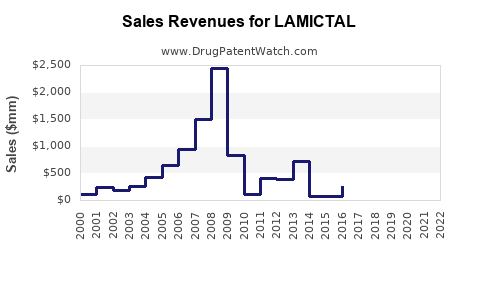
LAMICTAL’s financial trajectory is shaped by late-cycle patent/exclusivity erosion in core markets, steady generic volume ramp in the U.S. and EU, and incremental share gains driven by brand switching for epilepsy and bipolar indications rather than new chemistry. The brand remains a high-volume, lower-growth franchise as competition consolidates around multiple generic entrants and payer formularies.
What is LAMICTAL (lamotrigine) used for and how do those indications shape demand?
LAMICTAL is prescribed for:
- Epilepsy
- Adjunctive therapy for partial-onset seizures
- Monotherapy for primary generalized tonic-clonic seizures
- Adjunctive therapy for Lennox-Gastaut syndrome
- Bipolar disorder
- Maintenance treatment to delay the time to occurrence of mood episodes in patients with bipolar I disorder
Demand implication
- Epilepsy care is chronic and treatment-switch resistant after stabilization, which supports a “sticky” patient base even as generics expand.
- Bipolar maintenance is also long-duration, but prescribers and payers tend to treat lamotrigine as a commodity after multiple generics establish.
How does the dosing schedule and titration burden affect switch rates to generics?
Lamotrigine requires careful dose titration to reduce rash risk. That clinical friction tends to slow switching for established patients, but it does not prevent new starts where generics are the lowest net-cost option under formulary pressure.
How has LAMICTAL’s market share changed as generics expanded?
LAMICTAL has experienced the classic late-life pattern:
- Pre-generic phase: brand captures most commercial prescriptions.
- Generic introduction phase: rapid share loss driven by price competition.
- Post-introduction phase: brand persists through select payer coverage, clinician preference, and patient adherence dynamics.
Key dynamic
- After generic entry stabilizes, the remaining branded share is mostly explained by coverage nuances (tiering, prior authorization rules), patient history, and continuity of therapy.
What generic landscape dominates lamotrigine in the U.S. and EU?
- U.S.: multiple ANDA sponsors for generic lamotrigine tablets and ODT typically compete on price and supply reliability once launched.
- EU/UK: multiple national generic launches and pharmacy substitution policies drive persistent price compression.
When does LAMICTAL lose exclusivity and what parts typically drive the sell-through?
Exclusivity timing for a legacy small molecule usually breaks into:
- Patent protection on the active itself (if any late filings exist)
- Patent protection on formulations (immediate release vs extended formulations, ODT, XR variants if applicable)
- Patent protection on methods of use (indications, dosing regimens)
- Regulatory exclusivity for specific drug products (where applicable)
LAMICTAL’s practical sell-through
- In a branded commodity, revenue typically declines as:
- patent-driven brand exclusivity ends
- generic competition triggers step-downs in net price through rebates and payer negotiation
- brand share erodes faster than wholesale volume as formularies tighten
What is the typical revenue math in a late-cycle small molecule like lamotrigine?
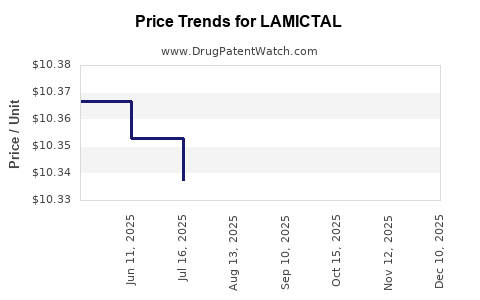
- Wholesale-to-net erosion: increases as payer rebates intensify and generic reference pricing expands.
- Volume decline: is often less severe than unit price deterioration, because many patients remain on therapy but switch to generics.
- Channel behavior: pharmacy substitution and mail order accelerate brand share loss once generics are tiered as preferred.
What is the Orange Book status of LAMICTAL and how does it affect generic entry risk?
LAMICTAL’s U.S. regulatory landscape is governed by the FDA Orange Book listing of patents tied to specific dosage forms and strengths. For any given generic product, ANDA approval and launch depend on:
- listed patent status (expired vs active)
- whether the ANDA includes Paragraph IV certifications
- settlement agreements that may delay launch under the Hatch-Waxman framework
Market impact
- Every active Orange Book listing that is not cleared for generic use raises launch risk and can extend the window for branded pricing power.
How many patents typically cover LAMICTAL dosage forms and indications?
Legacy brands frequently carry:
- multiple formulation patents (compositions, stability, manufacturing)
- method-of-use patents per indication
- packaging/polymorph or process-related patents
The number of active listings at any time is what determines how many ANDA “certification paths” generics must navigate.
Which companies are competing with LAMICTAL generics and what is the competitive pressure profile?
Lamotrigine competition is generally characterized by:
- numerous generic manufacturers producing equivalent strengths and dosage forms
- price-led competition after launch
- payer consolidation around the lowest net-cost option
What matters commercially
- ability to supply consistently
- timely product equivalence
- contract tier position with major pharmacy benefit managers
What is the usual impact of multi-generic supply on brand net revenue?
- net revenue for the brand declines due to:
- increased generic share
- rebate renegotiations to retain tier placement
- reduced script share in switching-prone segments (new patients, dose adjustments)
How strong is the patent estate for LAMICTAL and what does “strength” mean for litigation and settlements?
For a mature small molecule, “strength” is less about a single blockbuster patent and more about:
- whether any remaining composition/formulation or method-of-use patents block ANDA launches for key dosage forms
- whether Paragraph IV litigations lead to:
- early dismissal
- sustained injunctions
- settlements that impose launch delays
Commercial translation
- If multiple Orange Book patents remain enforceable for core strengths and dosage forms, generic entry is staggered.
- If most patents are expired or found not infringed, the market moves quickly to price-led equilibrium.
What patent litigation affects LAMICTAL generics, including Paragraph IV challenges?
In the Hatch-Waxman model:
- Paragraph IV filings are typically made against specific listed Orange Book patents for the referenced brand product.
- Litigation outcomes determine:
- which patents are invalidated or not infringed
- whether a 30-month stay applies
- settlement terms that can delay generic launch
Market dynamic
- Even when patents expire, litigation and settlements can delay generic utilization, creating temporary net revenue stabilization for the brand.
How do settlements usually change the launch timeline for generics?
Common outcomes include:
- settlement allowing launch at a defined time or after partial entry
- carve-outs for certain strengths/dosage forms
- agreement terms that reduce the probability of further litigation for specified products
How do LAMICTAL formulation choices (IR vs ODT) impact payer acceptance and price erosion?
LAMICTAL’s commercial resilience depends on the breadth of covered dosage forms:
- if branded product coverage includes high-need forms (for adherence and tolerability), brand share can hold longer even when IR equivalent generics are available.
- if formularies restrict brand to fewer tier positions, generic competition becomes dominant.
What role does ODT (and similar patient-friendly formats) play in maintaining branded prescriptions?
ODT and other ease-of-use formats can:
- reduce barriers to adherence
- keep a subset of patients on brand longer
- support prior authorization pathways where payers enforce cost-control but accommodate clinical need
How does FDA regulatory status influence LAMICTAL competitive lifecycle?
For small molecules, FDA status influences:
- whether generics can be approved without waiting for new clinical exclusivity
- whether new dosage forms receive distinct patent/Orange Book listings
Net effect
- once generics are approved, market dynamics are dominated by reimbursement, contracts, and supply, not FDA review timelines.
What is the financial trajectory of LAMICTAL: revenue drivers and risk factors?
LAMICTAL’s financial trajectory is best explained through three linked levers:
- Net pricing: declines as generic reference pricing tightens and rebates rise.
- Unit share: declines as formularies prefer low-cost generics, but stabilizes for patients who remain on therapy.
- Mix: branded persistence can be supported by dosage-form mix where generics are slower to substitute or carry different coverage constraints.
Key downside risks
- faster-than-expected generic substitution in newly treated patients
- unfavorable payer contracting that removes branded tier placement
- supply disruptions among preferred generics that force switches, which can temporarily benefit brand but rarely sustains longer-term economics
- any remapping of coverage that classifies branded lamotrigine as non-preferred for most plans
Key upside supports
- continuity of patient therapy and reduced switching in stable epilepsy cases
- payer exceptions where clinical need supports branded coverage
- potential incremental demand from updated guideline adherence or patient retention programs
How does LAMICTAL compare with other major antiseizure and bipolar maintenance brands on late-cycle economics?
Late-cycle economics for antiseizure drugs with generic competition typically converge on:
- slower decline in volume than revenue
- persistent share among patients stable on brand
- major dependence on payer contracting and formulary tiering
LAMICTAL positioning
- LAMICTAL sits in a mature category with multiple generic alternatives.
- Its brand survival is driven more by formulary management and patient continuity than by differentiated innovation.
What generic entry scenarios exist for LAMICTAL and what would they do to revenue?
Generic entry scenarios generally fall into:
- Full early entry across key dosage forms: accelerates share loss and net pricing decline.
- Staggered entry by strength/dosage form: creates uneven erosion and can slow revenue decline temporarily.
- Partial entry with continued brand coverage in select strengths: preserves a higher branded net price on remaining covered formats.
Revenue sensitivity
- brands often see the largest step-down around:
- first meaningful generic breadth across high-prescribing strengths
- formulary reclassification to preferred generic tiers
Which jurisdictions matter most for LAMICTAL’s global revenue exposure?
Revenue exposure is typically concentrated in:
- U.S. (largest commercial market with fast generic uptake)
- EU core countries with strong generic penetration
- other major markets where reimbursement policies dictate the pace of substitution
Global dynamic
- Even if one region maintains brand, multi-country generic approvals can pressure global pricing strategies through reference pricing and corporate contracting norms.
How should R&D and licensing teams use LAMICTAL’s dynamics when evaluating adjacent programs?
LAMICTAL illustrates:
- mature small molecule brands have diminishing incremental upside without lifecycle extensions that materially change:
- formulation
- dosing experience
- payer coverage economics
- patent estates that are method-of-use heavy can be less reliable in blocking broad generic entry once patents expire and equivalence is accepted.
Key operational implications:
- lifecycle-extension R&D is most valuable when it targets payer-relevant differentiation (tolerability, adherence, dosing convenience) and is paired with defensible, Orange Book-listed patents.
- licensing strategy should prioritize assets that provide durable exclusivity and strong, litigation-resistant claims.
Key Takeaways
- LAMICTAL’s market dynamics are dominated by late-cycle generic competition, with branded revenue erosion driven primarily by net price compression and payer tiering rather than abrupt volume collapse.
- Exclusivity and Orange Book listings determine how quickly generics can launch across dosage forms, producing temporary stabilization around litigation and settlement milestones.
- Demand is relatively “sticky” in epilepsy due to stabilization and titration switching friction, which helps the brand persist but does not prevent long-term share erosion.
- Financial trajectory aligns with typical mature CNS small-molecule behavior: volume declines more slowly than revenue, with mix and coverage rules determining the slope.
FAQs
-
What drives LAMICTAL net revenue erosion after generic launch?
Rebates, payer contracting, and reference pricing typically compress net price faster than unit volume.
-
Do Orange Book formulation patents delay generic entry for LAMICTAL?
Yes, when active patents are tied to specific strengths/dosage forms and are certified in ANDA Paragraph IV challenges.
-
How does patient switching behavior differ between newly diagnosed and stable epilepsy patients on LAMICTAL?
New starts shift quickly to preferred generics; stable patients switch more slowly due to clinical stabilization.
-
What settlement terms most often impact the timing of generic availability for LAMICTAL?
Defined launch dates, strength/dosage-form carve-outs, and agreements that limit subsequent litigation for specified products.
-
How do payer formulary tier changes typically affect LAMICTAL prescriptions after exclusivity ends?
Tier downshifts for brand accelerate share loss, while prior authorization criteria can create pockets of remaining branded demand.
References
- FDA. Orange Book: Approved Drug Products with Therapeutic Equivalence Evaluations. U.S. Food and Drug Administration.
- FDA. ANDA and Hatch-Waxman framework materials (Paragraph IV, 30-month stay overview). U.S. Food and Drug Administration.
- FDA. LAMICTAL (lamotrigine) prescribing information and label history. U.S. Food and Drug Administration.