You're using a free limited version of DrugPatentWatch: Upgrade for Complete Access

Last Updated: January 29, 2026

LAMOTRIGINE - Generic Drug Details


✉ Email this page to a colleague

« Back to Dashboard


What are the generic drug sources for lamotrigine and what is the scope of freedom to operate?

Lamotrigine is the generic ingredient in six branded drugs marketed by Owp Pharms, Glaxosmithkline Llc, Actavis Elizabeth, Alembic, Amneal Pharms, Dr Reddys Labs Ltd, Ph Health, Rubicon Research, Sciegen Pharms Inc, Torrent, Yiling, Zydus Pharms, Aurobindo Pharma, Chartwell Rx, Glenmark Pharms Ltd, Jubilant Generics, Pharmobedient, Taro, Teva, Watson Labs, Zydus Pharms Usa Inc, Ajanta Pharma Ltd, Amring Pharms, Impax Labs Inc, Actavis Totowa, Aiping Pharm Inc, Alembic Pharms Ltd, Alkem Labs Ltd, Chartwell Molecular, Granules, Hikma Pharms, Ipca Labs, Jubilant Cadista, Lupin Ltd, Natco Pharma, Rising, Roxane, Taro Pharm Inds, Torrent Pharms, Unichem Labs Ltd, Zennova, and Zydus Pharms Usa, and is included in fifty-seven NDAs. There are three patents protecting this compound and two Paragraph IV challenges. Additional information is available in the individual branded drug profile pages.

Lamotrigine has forty-four patent family members in thirty countries.

There are thirty-two drug master file entries for lamotrigine. Fifty-one suppliers are listed for this compound. There are three tentative approvals for this compound.

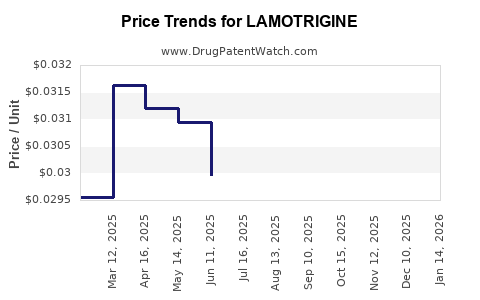
Drug Prices for LAMOTRIGINE

See drug prices for LAMOTRIGINE

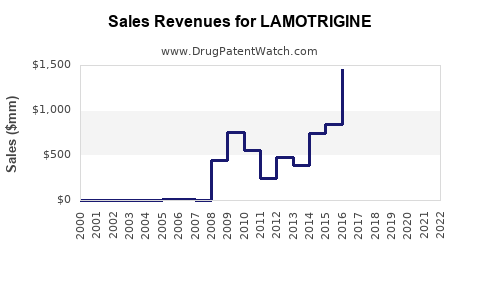
Drug Sales Revenue Trends for LAMOTRIGINE

See drug sales revenues for LAMOTRIGINE

Recent Clinical Trials for LAMOTRIGINE

Identify potential brand extensions & 505(b)(2) entrants

SponsorPhase
Lakshmi N YathamPHASE3
Bristol-Myers SquibbPHASE3
Centre hospitalier de l'Universit de Montral (CHUM)NA

See all LAMOTRIGINE clinical trials

Generic filers with tentative approvals for LAMOTRIGINE
Applicant Application No. Strength Dosage Form
⤷  Get Started Free⤷  Get Started Free200MGTABLET;ORAL
⤷  Get Started Free⤷  Get Started Free150MGTABLET;ORAL
⤷  Get Started Free⤷  Get Started Free100MGTABLET;ORAL

The 'tentative' approval signifies that the product meets all FDA standards for marketing, and, but for the patents / regulatory protections, it would approved.

Anatomical Therapeutic Chemical (ATC) Classes for LAMOTRIGINE
Paragraph IV (Patent) Challenges for LAMOTRIGINE
Tradename Dosage Ingredient Strength NDA ANDAs Submitted Submissiondate
LAMICTAL XR Extended-release Tablets lamotrigine 25 mg, 50 mg, 100 mg, 200 mg, 250 mg, and 300 mg 022115 1 2014-02-12
LAMICTAL ODT Orally Disintegrating Tablets lamotrigine 25 mg, 50 mg, 100 mg, and 200 mg 022251 1 2009-12-21

US Patents and Regulatory Information for LAMOTRIGINE

Applicant Tradename Generic Name Dosage NDA Approval Date TE Type RLD RS Patent No. Patent Expiration Product Substance Delist Req. Exclusivity Expiration
Pharmobedient LAMOTRIGINE lamotrigine TABLET;ORAL 078443-001 Feb 11, 2009 DISCN No No ⤷  Get Started Free ⤷  Get Started Free ⤷  Get Started Free
Glenmark Pharms Ltd LAMOTRIGINE lamotrigine TABLET;ORAL 090169-004 May 4, 2012 AB RX No No ⤷  Get Started Free ⤷  Get Started Free ⤷  Get Started Free
Ajanta Pharma Ltd LAMOTRIGINE lamotrigine TABLET, ORALLY DISINTEGRATING;ORAL 213271-001 Jan 19, 2021 AB RX No No ⤷  Get Started Free ⤷  Get Started Free ⤷  Get Started Free
>Applicant >Tradename >Generic Name >Dosage >NDA >Approval Date >TE >Type >RLD >RS >Patent No. >Patent Expiration >Product >Substance >Delist Req. >Exclusivity Expiration

Expired US Patents for LAMOTRIGINE

Applicant Tradename Generic Name Dosage NDA Approval Date Patent No. Patent Expiration
Glaxosmithkline Llc LAMICTAL CD lamotrigine TABLET, FOR SUSPENSION;ORAL 020764-003 Aug 24, 1998 5,698,226*PED ⤷  Get Started Free
Glaxosmithkline Llc LAMICTAL XR lamotrigine TABLET, EXTENDED RELEASE;ORAL 022115-006 Jun 21, 2011 9,144,547 ⤷  Get Started Free
Glaxosmithkline Llc LAMICTAL XR lamotrigine TABLET, EXTENDED RELEASE;ORAL 022115-001 May 29, 2009 9,144,547 ⤷  Get Started Free
>Applicant >Tradename >Generic Name >Dosage >NDA >Approval Date >Patent No. >Patent Expiration

Market Dynamics and Financial Trajectory for Lamotrigine

Last updated: January 26, 2026

Executive Summary

Lamotrigine, marketed under brand names including Lamictal, is a widely prescribed anticonvulsant and mood stabilizer primarily used for epilepsy and bipolar disorder. Its global market has exhibited steady growth, influenced by expanding indications, evolving prescribing practices, and increasing prevalence of neuropsychiatric conditions. The compound’s patent landscape, manufacturing pipeline, and regulatory environment will shape its future financial trajectory. This report analyzes current market dynamics and forecasts Lamotrigine’s financial outlook through key factors such as market drivers, challenges, competitive landscape, and regulatory trends.


Market Overview

Market Size and Growth (2022–2027)

Metric 2022 (USD Billion) 2027 (Forecast, USD Billion) CAGR (2022–2027)
Global Lamotrigine Market 2.5 3.4 6.8%

Source: Fortunes Business Insights, 2022; IQVIA, 2023.

Indications and Usage

  • Epilepsy: Approved for partial seizures and generalized epilepsy.
  • Bipolar Disorder: Approved for maintenance treatment of bipolar I disorder.
  • Off-label: Used in migraine prophylaxis and other neuropsychiatric conditions.

Regional Market Distribution (2022)

Region Market Share (%) Growth Drivers
North America 50 High prevalence, advanced healthcare infrastructure
Europe 20 Widespread acceptance, growing awareness
Asia-Pacific 15 Expanding healthcare access, increasing diagnosis rates
Rest of World 15 Emerging markets, generic penetration

Key Market Drivers

1. Increasing Prevalence of Epilepsy and Bipolar Disorder

  • Epilepsy: Affects approximately 50 million globally [1].
  • Bipolar Disorder: Estimated at 45 million adults worldwide [2].
  • Rising incidence fuels demand for effective, tolerated therapies like Lamotrigine.

2. Expansion of Therapeutic Indications and Off-label Use

  • Clinical studies supporting Lamotrigine’s efficacy in migraine prevention and other neuropsychiatric disorders open new market segments.
  • Growing off-label prescribing enhances revenue streams.

3. Patent Cliff and Generic Market Penetration

  • Original patents expired around 2014–2018, leading to proliferation of generic versions.
  • Generics comprise approximately 80% of prescriptions in mature markets [3].
  • However, branded formulations retain premium pricing in select regions due to perceived quality and formulation stability.

4. Regulatory Approvals and Favorable Guidelines

  • Regulatory endorsement by FDA, EMA, and other authorities facilitates wider adoption.
  • Positive safety profile and minimal drug interactions bolster prescriber confidence.

5. Pricing Strategies and Reimbursement Policies

  • Reimbursement-driven access in developed markets sustains demand.
  • Tiered pricing and formulary placements influence market share expansion.

Market Challenges

1. Competition from Other AEDs and Mood Stabilizers

Competitors Drugs Market Share (2022) Key Features
Valproate Valproic Acid 20% Broad-spectrum anticonvulsant, teratogenicity concerns
Carbamazepine Carbamazepine 10% Established, but with safety issues
Lithium Lithium Carbonate 8% Mood stabilization, narrow therapeutic window
Newer Agents Levetiracetam, Topiramate 20% Favorable tolerability
  • Newer agents with improved side effect profiles erode Lamotrigine’s market share in some segments.

2. Safety Concerns and Adverse Effects

  • Risk of Stevens-Johnson syndrome (SJS) and toxic epidermal necrolysis (TEN) affects prescribing, especially in high-risk populations.
  • Mandatory titration protocols prolong initiation phases and increase clinical oversight costs.

3. Generics Market Pressure

  • Price erosion of generic Lamotrigine formulations constrains revenue.
  • Limited differentiation among generics complicates brand loyalty.

4. Regulatory and Policy Shifts

  • Off-label use restrictions and changes in reimbursement policies could impact sales trajectories.

Competitive Landscape and Patent Status

Entity Product Patent Status Market Share Notes
GlaxoSmithKline (GSK) Lamictal Patent expired (2018) Leading in branded segment Facing generic competition
Mylan, Teva, Sandoz Generic Lamotrigine Patents expired ~80% of prescriptions Price competition intense
Others New formulations Limited approvals Niche segments Development pipelines ongoing

Pipeline and Innovation Potential

  • Efforts are underway to develop extended-release formulations and combination therapies.
  • Biosimilars and novel analogs, though limited due to the compound’s small molecule status, may influence future market dynamics.

Regulatory and Policy Trends

1. Approval Landscapes

  • Regulatory agencies continue to approve generic versions with bioequivalence standards (FDA, EMA).
  • Asian regulatory agencies (e.g., China NMPA) are streamlining approval processes, expanding market access.

2. Reimbursement Policies

  • Globally, payers favor generics for cost-effectiveness.
  • In some regions, off-label use reimbursement remains uncertain, impacting prescribing.

3. Clinical Guidelines

  • National and international guidelines (e.g., NICE, American Epilepsy Society) recommend Lamotrigine as a first-line agent in specific indications.
  • Incorporation into treatment algorithms sustains demand.

Financial Trajectory Projections

Revenue Trends (2022–2027)

Year Estimated Revenue (USD Billion) Notes
2022 2.5 Base year
2023 2.66 Moderate growth due to expansion in Asia-Pacific
2024 2.84 Increased off-label use and new formulations
2025 3.05 Patent cliff effects stabilize
2026 3.30 Market saturation, new indications emerge
2027 3.40 Plateauing with potential decline in mature markets

Market Drivers Influencing Revenue

  • Adoption of Lamotrigine in emerging markets.
  • Pricing strategies in branded vs. generic segments.
  • Development of combination therapies and remyelination indications.

Risks to Revenue Growth

  • Accelerated generic erosion.
  • Safety-related prescribing restrictions.
  • Competition from newer agents with superior profiles.

Comparative Analysis: Lamotrigine vs. Key Competitors

Feature Lamotrigine Valproic Acid Lithium Levetiracetam Topiramate
Indications Epilepsy, Bipolar Epilepsy, Bipolar Mood disorder Epilepsy Epilepsy, Migraine
Safety Profile Minimal cognitive impairment Teratogenicity Narrow therapeutic window Well tolerated Cognitive side effects
Price (average wholesale, USD) $0.50–$1.00 per tablet (generic) $0.30–$0.70 $0.50–$2.00 $1.50–$3.00 $1.00–$2.00
Market Penetration High but declining Stable Niche Growing Moderate

Key Factors Impacting Future Market Dynamics

Factor Impact Strategic Consideration
Patent expirations Increased generic penetration Brand owners may seek extension via formulations
Off-label use expansion Revenue growth opportunity Investment in clinical trials to support new indications
Emerging markets growth Accelerates adoption Local manufacturing and pricing strategies
Clinical guideline updates Prescribing patterns Engagement with guideline committees
Safety concerns Market stability Robust pharmacovigilance and risk mitigation

Key Takeaways

  • Market Growth: Lamotrigine’s global market is projected to grow at a CAGR of ~6.8% until 2027, driven by expanding indications and emerging markets.

  • Competitive Pressures: The dominant presence of low-cost generics limits branded revenue, demanding innovation and strategic partnerships.

  • Pipeline and Innovation: Development of extended-release and combination formulations offers growth avenues—pending regulatory approval and clinical validation.

  • Regulatory and Policy Shifts: Evolving policies, especially concerning off-label uses and safety management, influence prescribing patterns and reimbursement landscapes.

  • Financial Outlook: Revenue growth may plateau post-2025 due to market saturation, with potential decline if new therapies outperform Lamotrigine in efficacy or safety.


FAQs

1. What are the primary factors influencing Lamotrigine’s market growth?

Answer: The main drivers include increasing prevalence of epilepsy and bipolar disorder, expanding indications such as migraine prophylaxis, regulatory approvals, and market expansion into emerging regions. Conversely, patent expirations and competition from generics and newer therapies pose challenges.

2. How does patent expiration impact Lamotrigine’s revenue?

Answer: Patent expiration around 2018 led to widespread generic manufacturing, significantly reducing brand-name sales and putting pressure on pricing. Although generics dominate prescribing, branded formulations maintain higher margins through formulations and branding strategies.

3. What safety concerns could influence Lamotrigine’s market trajectory?

Answer: Risks like Stevens-Johnson syndrome and skin rash necessitate cautious titration and patient monitoring. Safety concerns can limit prescribing, especially in high-risk populations, affecting overall demand.

4. Are there opportunities for new formulations or delivery systems?

Answer: Yes. Extended-release formulations, combination therapies (e.g., Lamotrigine with other agents), and novel delivery systems (e.g., transdermal patches) could differentiate products and capture new market segments, contingent on successful development and approval.

5. How might regulatory policies evolve, affecting Lamotrigine’s market?

Answer: Potential restrictions on off-label use, tighter safety regulations, and reimbursement policies favoring cost-effective generics could influence prescribing patterns. Conversely, expanded approval for new indications could bolster sales.


References

[1] World Health Organization. (2022). Epilepsy factsheet.

[2] American Psychiatric Association. (2013). Diagnostic and Statistical Manual of Mental Disorders, Fifth Edition.

[3] IQVIA. (2023). Global Trends in Antiepileptic Drug Prescriptions.


Note: Market projections are estimates based on current trends, regulatory environments, and available clinical data. Actual market performance may vary with unforeseen factors such as policy changes or breakthroughs in alternative therapies.

More… ↓

⤷  Get Started Free

Make Better Decisions: Try a trial or see plans & pricing

Drugs may be covered by multiple patents or regulatory protections. All trademarks and applicant names are the property of their respective owners or licensors. Although great care is taken in the proper and correct provision of this service, thinkBiotech LLC does not accept any responsibility for possible consequences of errors or omissions in the provided data. The data presented herein is for information purposes only. There is no warranty that the data contained herein is error free. We do not provide individual investment advice. This service is not registered with any financial regulatory agency. The information we publish is educational only and based on our opinions plus our models. By using DrugPatentWatch you acknowledge that we do not provide personalized recommendations or advice. thinkBiotech performs no independent verification of facts as provided by public sources nor are attempts made to provide legal or investing advice. Any reliance on data provided herein is done solely at the discretion of the user. Users of this service are advised to seek professional advice and independent confirmation before considering acting on any of the provided information. thinkBiotech LLC reserves the right to amend, extend or withdraw any part or all of the offered service without notice.