Last Updated: September 24, 2026

KORSUVA Drug Patent Profile


✉ Email this page to a colleague

« Back to Dashboard


When do Korsuva patents expire, and what generic alternatives are available?

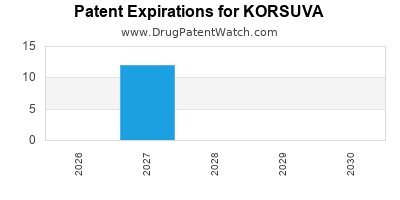
Korsuva is a drug marketed by Vifor Intl and is included in one NDA. There are twelve patents protecting this drug and one Paragraph IV challenge.

The generic ingredient in KORSUVA is difelikefalin acetate. There is one drug master file entry for this compound. One supplier is listed for this compound. Additional details are available on the difelikefalin acetate profile page.

DrugPatentWatch® Generic Entry Outlook for Korsuva

Korsuva was eligible for patent challenges on August 23, 2025.

There have been five patent litigation cases involving the patents protecting this drug, indicating strong interest in generic launch. Recent data indicate that 63% of patent challenges are decided in favor of the generic patent challenger and that 54% of successful patent challengers promptly launch generic drugs.

Indicators of Generic Entry

< Available with Subscription >

  Start Trial

AI Deep Research
Questions you can ask:
  • What is the 5 year forecast for KORSUVA?
  • What are the global sales for KORSUVA?
  • What is Average Wholesale Price for KORSUVA?
Pharmacology for KORSUVA
Paragraph IV (Patent) Challenges for KORSUVA
Tradename Dosage Ingredient Strength NDA ANDAs Submitted Submissiondate
KORSUVA Intravenous Solution difelikefalin acetate 0.065 mg/1.3 mL 214916 5 2025-08-25

US Patents and Regulatory Information for KORSUVA

KORSUVA is protected by twelve US patents and one FDA Regulatory Exclusivity.

Applicant Tradename Generic Name Dosage NDA Approval Date TE Type RLD RS Patent No. Patent Expiration Product Substance Delist Req. Exclusivity Expiration
Vifor Intl KORSUVA difelikefalin acetate SOLUTION;INTRAVENOUS 214916-001 Aug 23, 2021 RX Yes Yes ⤷  Start Trial ⤷  Start Trial Y Y ⤷  Start Trial
Vifor Intl KORSUVA difelikefalin acetate SOLUTION;INTRAVENOUS 214916-001 Aug 23, 2021 RX Yes Yes ⤷  Start Trial ⤷  Start Trial ⤷  Start Trial
Vifor Intl KORSUVA difelikefalin acetate SOLUTION;INTRAVENOUS 214916-001 Aug 23, 2021 RX Yes Yes ⤷  Start Trial ⤷  Start Trial Y Y ⤷  Start Trial
Vifor Intl KORSUVA difelikefalin acetate SOLUTION;INTRAVENOUS 214916-001 Aug 23, 2021 RX Yes Yes ⤷  Start Trial ⤷  Start Trial ⤷  Start Trial
Vifor Intl KORSUVA difelikefalin acetate SOLUTION;INTRAVENOUS 214916-001 Aug 23, 2021 RX Yes Yes ⤷  Start Trial ⤷  Start Trial Y ⤷  Start Trial
>Applicant >Tradename >Generic Name >Dosage >NDA >Approval Date >TE >Type >RLD >RS >Patent No. >Patent Expiration >Product >Substance >Delist Req. >Exclusivity Expiration

International Patents for KORSUVA

When does loss-of-exclusivity occur for KORSUVA?

Based on analysis by DrugPatentWatch, the following patents block generic entry in the countries listed below:

Australia

Patent: 07317817
Estimated Expiration: ⤷  Start Trial

Patent: 07319831
Estimated Expiration: ⤷  Start Trial

Brazil

Patent: 0718651
Estimated Expiration: ⤷  Start Trial

Canada

Patent: 67155
Estimated Expiration: ⤷  Start Trial

Patent: 67460
Estimated Expiration: ⤷  Start Trial

Patent: 98514
Estimated Expiration: ⤷  Start Trial

China

Patent: 1535336
Estimated Expiration: ⤷  Start Trial

Patent: 1627049
Estimated Expiration: ⤷  Start Trial

Cyprus

Patent: 16760
Estimated Expiration: ⤷  Start Trial

Patent: 22032
Estimated Expiration: ⤷  Start Trial

Denmark

Patent: 64228
Estimated Expiration: ⤷  Start Trial

European Patent Office

Patent: 64228
Estimated Expiration: ⤷  Start Trial

Patent: 79756
Estimated Expiration: ⤷  Start Trial

Finland

Patent: 0220043
Estimated Expiration: ⤷  Start Trial

France

Patent: C1054
Estimated Expiration: ⤷  Start Trial

Hong Kong

Patent: 30814
Estimated Expiration: ⤷  Start Trial

Hungary

Patent: 200045
Estimated Expiration: ⤷  Start Trial

Israel

Patent: 7923
Estimated Expiration: ⤷  Start Trial

Patent: 7924
Estimated Expiration: ⤷  Start Trial

Japan

Patent: 44810
Estimated Expiration: ⤷  Start Trial

Patent: 64583
Estimated Expiration: ⤷  Start Trial

Patent: 20180
Estimated Expiration: ⤷  Start Trial

Patent: 10509343
Estimated Expiration: ⤷  Start Trial

Patent: 10510966
Estimated Expiration: ⤷  Start Trial

Patent: 13241447
Estimated Expiration: ⤷  Start Trial

Lithuania

Patent: 064228
Estimated Expiration: ⤷  Start Trial

Patent: 2022522
Estimated Expiration: ⤷  Start Trial

Luxembourg

Patent: 0282
Estimated Expiration: ⤷  Start Trial

Malaysia

Patent: 8144
Patent: SYNTHETIC PEPTIDE AMIDES
Estimated Expiration: ⤷  Start Trial

Patent: 3678
Patent: SYNTHETIC PEPTIDE AMIDES AND DIMERS THEREOF
Estimated Expiration: ⤷  Start Trial

Mexico

Patent: 09004999
Patent: AMIDAS DE PEPTIDOS SINTETICOS Y DIMEROS DE LAS MISMAS. (SYNTHETIC PEPTIDE AMIDES AND DIMERS THEREOF.)
Estimated Expiration: ⤷  Start Trial

Patent: 09005000
Patent: AMIDAS DE PEPTIDOS SINTETICOS. (SYNTHETIC PEPTIDE AMIDES.)
Estimated Expiration: ⤷  Start Trial

Netherlands

Patent: 1199
Estimated Expiration: ⤷  Start Trial

New Zealand

Patent: 7107
Patent: Synthetic peptide amide ligands of the kappa opiod receptor
Estimated Expiration: ⤷  Start Trial

Patent: 7108
Patent: Synthetic peptide amides and dimers thereof of the kappa opioid receptor
Estimated Expiration: ⤷  Start Trial

Poland

Patent: 64228
Estimated Expiration: ⤷  Start Trial

Portugal

Patent: 64228
Estimated Expiration: ⤷  Start Trial

Russian Federation

Patent: 00685
Patent: СИНТЕТИЧЕСКИЕ ПЕПТИДНЫЕ АМИДЫ (SYNTHETIC PEPTIDE AMIDES)
Estimated Expiration: ⤷  Start Trial

Patent: 10399
Patent: СИНТЕТИЧЕСКИЕ ПЕПТИДНЫЕ АМИДЫ И ИХ ДИМЕРЫ (SYNTHETIC PEPTIDE AMIDES AND THEIR DIMERS)
Estimated Expiration: ⤷  Start Trial

Patent: 09121297
Patent: СИНТЕТИЧЕСКИЕ ПЕПТИДНЫЕ АМИДЫ (SYNTHETIC PEPTIDE AMIDES)
Estimated Expiration: ⤷  Start Trial

Patent: 09121298
Patent: СИНТЕТИЧЕСКИЕ ПЕПТИДНЫЕ АМИДЫ И ИХ ДИМЕРЫ (SYNTHETIC PEPTIDE AMIDES AND THEIR DIMERS)
Estimated Expiration: ⤷  Start Trial

Slovenia

Patent: 64228
Estimated Expiration: ⤷  Start Trial

South Africa

Patent: 0903053
Patent: SYNTHETIC PEPTIDE AMIDES AND DIMERS THEREOF
Estimated Expiration: ⤷  Start Trial

Patent: 0903054
Patent: SYNTHETIC PEPTIDE AMIDES
Estimated Expiration: ⤷  Start Trial

South Korea

Patent: 1513736
Estimated Expiration: ⤷  Start Trial

Patent: 1513737
Estimated Expiration: ⤷  Start Trial

Patent: 1513842
Estimated Expiration: ⤷  Start Trial

Patent: 090085096
Patent: 합성 펩타이드 아마이드 (SYNTHETIC PEPTIDE AMIDES)
Estimated Expiration: ⤷  Start Trial

Patent: 090085097
Patent: 합성 펩타이드 아마이드와 그의 다이머 (SYNTHETIC PEPTIDE AMIDES AND DIMERS THEREOF)
Estimated Expiration: ⤷  Start Trial

Patent: 140056396
Patent: 합성 펩타이드 아마이드와 그의 다이머 (SYNTHETIC PEPTIDE AMIDES AND DIMERS THEREOF)
Estimated Expiration: ⤷  Start Trial

Spain

Patent: 94377
Estimated Expiration: ⤷  Start Trial

Generics may enter earlier, or later, based on new patent filings, patent extensions, patent invalidation, early generic licensing, generic entry preferences, and other factors.

See the table below for additional patents covering KORSUVA around the world.

Country Patent Number Title Estimated Expiration
Australia 2007317817 ⤷  Start Trial
Australia 2007319831 ⤷  Start Trial
Brazil PI0718651 ⤷  Start Trial
Canada 2667155 ⤷  Start Trial
Canada 2667460 ⤷  Start Trial
Canada 2898514 ⤷  Start Trial
China 101535336 ⤷  Start Trial
>Country >Patent Number >Title >Estimated Expiration

Supplementary Protection Certificates for KORSUVA

Patent Number Supplementary Protection Certificate SPC Country SPC Expiration SPC Description
2064228 301199 Netherlands ⤷  Start Trial DETAILS ASSIGNMENT: CHANGE OF OWNER(S), ASSIGNMENT
2064228 CA 2022 00045 Denmark ⤷  Start Trial PRODUCT NAME: DIFELIKEFALIN IN ALL FORMS COVERED BY THE BASIC PATENT; REG. NO/DATE: EU/1/22/1643 20220427
2064228 PA2022522 Lithuania ⤷  Start Trial PRODUCT NAME: DIFELIKEFALINAS, BET KOKIA FORMA, KURIAI TAIKOMA PAGRINDINIO PATENTO APSAUGA ; REGISTRATION NO/DATE: EU/1/22/1643 20220425
2064228 LUC00282 Luxembourg ⤷  Start Trial PRODUCT NAME: DIFELIKEFALIN IN ALL FORMS COVERED BY THE BASIC PATENT; AUTHORISATION NUMBER AND DATE: EU/1/22/1643 20220427
2064228 2022C/546 Belgium ⤷  Start Trial DETAILS ASSIGNMENT: CHANGE OF OWNER(S), ASSIGNMENT
2064228 C20220035 00379 Estonia ⤷  Start Trial PRODUCT NAME: DIFELIKEFALIIN;REG NO/DATE: EU/1/22/1643 27.04.2022
2064228 122022000071 Germany ⤷  Start Trial PRODUCT NAME: DIFELIKEFALIN IN ALLEN DURCH DAS GRUNDPATENT GESCHUETZTEN FORMEN; AUTHORISATION NO/DATE: EU/1/22/1643 20220425
>Patent Number >Supplementary Protection Certificate >SPC Country >SPC Expiration >SPC Description

KORSUVA Market Dynamics and Financial Trajectory

Last updated: August 24, 2026

KORSUVA, or difelikefalin injection, has secured a differentiated regulatory position as the first FDA-approved treatment for moderate-to-severe pruritus associated with chronic kidney disease in adults receiving hemodialysis. Commercial performance has remained below the initial opportunity implied by that label. U.S. uptake has been gradual, dialysis-center adoption has constrained demand, and Cara Therapeutics has reduced investment after discontinuing oral difelikefalin development. The product remains commercially viable, but its trajectory depends on execution in dialysis centers, payer coverage, and the ability to expand use outside the original hemodialysis segment.

What is KORSUVA and which patients does it treat?

KORSUVA is an injectable formulation of difelikefalin, a selective peripheral kappa-opioid receptor agonist. The FDA approved it in August 2021 for moderate-to-severe pruritus associated with chronic kidney disease in adults undergoing hemodialysis. The drug is administered intravenously at the end of each hemodialysis session, three times per week in most patients. [1]

The commercial product is marketed in the United States as KORSUVA. In Europe and certain other territories, difelikefalin injection is marketed as Kapruvia. CSL Vifor holds commercialization rights in markets outside the United States under its collaboration with Cara Therapeutics. [2]

Attribute KORSUVA
Active ingredient Difelikefalin
Dosage form Intravenous injection
FDA indication CKD-associated pruritus in adults receiving hemodialysis
FDA approval August 2021
Primary channel Dialysis centers and nephrology providers
U.S. commercialization Cara Therapeutics
Ex-U.S. commercialization CSL Vifor
Administration At the end of hemodialysis sessions
Direct FDA-approved competitor None with the same indication and mechanism

KORSUVA’s clinical differentiation comes from its peripheral restriction. Unlike centrally acting opioids, difelikefalin was designed to limit central nervous system exposure, an important consideration in patients with renal impairment and high polypharmacy burdens. The product competes in practice with off-label gabapentin, pregabalin, antihistamines, topical agents and intensified dialysis management.

How large is the KORSUVA addressable market?

The immediate U.S. market is concentrated among adults receiving maintenance hemodialysis, a population of approximately 450,000 to 500,000 patients. Published studies have estimated that clinically significant pruritus affects a substantial share of this population, although prevalence varies by definition and study design. [3]

The commercial market is smaller than the epidemiological market because:

  • not every patient reports pruritus to a provider;
  • many patients receive inexpensive off-label treatments;
  • nephrologists may manage symptoms without adding a new administered drug;
  • dialysis-center protocols can delay formulary adoption;
  • treatment persistence varies with symptom severity and perceived benefit.

KORSUVA has a structurally attractive administration model because dialysis-center staff can administer the drug during a scheduled treatment. That model also creates a commercial bottleneck. The product must be incorporated into center protocols, billing workflows, inventory systems and nephrologist prescribing habits.

What drives KORSUVA demand?

The principal demand drivers are:

  1. Recognition of CKD-associated pruritus as a treatable condition.
  2. Dialysis-center formulary and protocol adoption.
  3. Reimbursement economics for dialysis providers.
  4. Patient-reported symptom improvement.
  5. Failure or intolerance of gabapentin and other off-label therapies.
  6. Support from nephrology education and care-management programs.

The principal constraints are low diagnostic intensity, budget sensitivity at dialysis providers, provider inertia and competition from low-cost generic therapies.

What were KORSUVA sales and Cara Therapeutics’ financial results?

KORSUVA generated commercial revenue for Cara Therapeutics beginning after the 2021 U.S. launch. The product’s revenue ramp was positive but modest relative to the size of the dialysis population and the company’s development spending.

Cara reported total revenue of approximately $31 million in 2022 and approximately $36 million in 2023, with KORSUVA product sales and related collaboration revenue representing the main commercial sources. [4] Revenue growth reflected broader dialysis-center adoption, but the company continued to report substantial operating losses.

Period Cara revenue profile Financial interpretation
2021 Initial launch period Limited commercial contribution
2022 Approximately $31 million total revenue Early dialysis-center adoption
2023 Approximately $36 million total revenue Growth continued, but below scale needed for profitability
2024 Strategic cost reductions and lower development spending Company prioritized liquidity and commercial discipline

Reported revenue figures include product-related revenue and may not equal gross KORSUVA sales. Contractual arrangements, gross-to-net deductions, collaboration revenue and accounting treatment affect comparisons between periods.

Cara’s financial trajectory was shaped by a mismatch between commercial scale and fixed costs. The company funded:

  • U.S. sales and medical-affairs infrastructure;
  • manufacturing and supply activities;
  • post-approval regulatory obligations;
  • late-stage oral difelikefalin trials;
  • corporate overhead and public-company costs.

In 2023, the failure of the oral difelikefalin program materially changed the investment case. Cara discontinued the oral program after topline results from the KALM-1 and KALM-2 studies did not support the planned development path. [5] The company then reduced its workforce and narrowed its strategic focus.

Why has KORSUVA adoption been slower than expected?

KORSUVA entered a market with a clear unmet need but a difficult commercialization structure. The product is not dispensed through a conventional retail pharmacy in most cases. It is administered in dialysis facilities, where prescribing authority, purchasing responsibility and reimbursement incentives can be distributed across different stakeholders.

Dialysis-center economics

Large dialysis organizations can influence adoption across hundreds of facilities, but they often require evidence that a new product improves care without creating operational or financial friction. KORSUVA must compete with:

  • generic gabapentin;
  • pregabalin;
  • topical therapies;
  • antihistamines;
  • informal symptom management;
  • no pharmacologic treatment.

A dialysis center may also require a protocol change before regular use. That process can be slower than a traditional specialty-pharmacy launch.

Patient identification

Pruritus is underreported. Patients may not identify itching as a distinct medical condition, and nephrologists may focus visits on anemia, mineral-bone disease, fluid management and dialysis adequacy. Commercial growth therefore depends on screening and documentation, not simply on product availability.

Reimbursement and purchasing

KORSUVA’s economic value depends on how dialysis providers are reimbursed and whether use generates adequate margin after acquisition and administration costs. The product’s administered setting can simplify adherence but makes reimbursement negotiations more important than in a retail prescription market.

What is the competitive landscape for KORSUVA?

KORSUVA has no direct FDA-approved branded competitor for the same U.S. indication. Its practical competition is broad and largely generic.

Competitor category Examples Competitive effect
Gabapentinoids Gabapentin, pregabalin Low-cost, established off-label alternatives
Antihistamines Hydroxyzine and others Often used despite limited disease-specific evidence
Topical products Emollients, corticosteroids, counterirritants Useful for localized or mild symptoms
Dialysis management Adequacy optimization, phosphate control Addresses contributing factors rather than directly treating itch
Opioid-pathway agents Naltrexone and other off-label agents Variable use and evidence
Emerging oral difelikefalin Development discontinued by Cara Removed a potential expansion route

KORSUVA’s main commercial argument is not simply efficacy. It is the combination of disease-specific approval, peripheral kappa-opioid activity, dialysis-session administration and a safety profile designed for patients with advanced kidney disease.

What happened to oral difelikefalin?

Cara developed oral difelikefalin to address patients with CKD-associated pruritus who were not receiving hemodialysis, including patients with earlier-stage CKD and potentially peritoneal dialysis patients. That strategy would have expanded the addressable market substantially beyond the injectable product.

The oral program encountered a major setback when phase 3 studies failed to provide the required efficacy outcome. Cara discontinued development in 2023. [5] This decision removed the most important near-term growth option for the difelikefalin franchise.

The consequence is strategic:

  • KORSUVA remains concentrated in the hemodialysis population.
  • The company lost a pathway to a broader nephrology market.
  • Development spending declined, but so did the potential long-term revenue ceiling.
  • Commercial success now depends primarily on deeper penetration of existing dialysis centers.

What is the FDA regulatory status of KORSUVA?

KORSUVA is FDA-approved and commercially available in the United States. Its approved indication is limited to adults with moderate-to-severe CKD-associated pruritus who are receiving hemodialysis. [1]

The FDA approval was based on the KALM-1 and KALM-2 development program, which evaluated reductions in itch severity using patient-reported outcomes. The label does not cover patients with non-dialysis CKD or all forms of chronic pruritus.

The regulatory position is therefore strong within a narrow population but does not provide a broad dermatology or general-pruritus label.

What patents protect KORSUVA and when could generic entry occur?

KORSUVA is a small-molecule drug, not a biologic. Biosimilar risk is therefore not the relevant challenge. Any future competitor would generally pursue an abbreviated new drug application, or ANDA, and could challenge listed patents through Paragraph IV certification.

The relevant protection can include:

  • compound patents covering difelikefalin;
  • salt or stereochemical-form patents;
  • formulation patents;
  • injectable composition patents;
  • method-of-use patents covering CKD-associated pruritus;
  • manufacturing or purification patents.

The operative generic-entry date depends on the current Orange Book listing, patent-term adjustment, pediatric exclusivity, any applicable regulatory exclusivity and the outcome of patent litigation. FDA’s Orange Book should be used as the controlling source for listed patents and expiration data. [6]

KORSUVA’s commercial exposure is reduced by the limited size of the labeled population, but the product also has fewer obvious lifecycle extensions after the oral program failure. A narrow method-of-use estate could delay an identical labeled generic while leaving room for off-label substitution with existing drugs.

Does KORSUVA have biosimilar risk?

No. Difelikefalin is a chemically synthesized small molecule. The relevant threat is generic substitution, not biosimilar competition. Generic applicants may challenge composition, formulation or method-of-use patents through the ANDA Paragraph IV process.

Which companies are challenging KORSUVA?

No major commercial generic challenger had established a material U.S. market position through the company disclosures and public regulatory information available for the period reviewed. The likely future challengers are generic-drug manufacturers with nephrology or injectable portfolios.

The principal competitive pressure has come from existing therapies rather than a launched generic difelikefalin product. That distinction matters. KORSUVA can lose volume without losing patent protection if providers substitute gabapentin, pregabalin or other low-cost treatments.

What patent litigation and settlement agreements affect KORSUVA?

Publicly disclosed commercial litigation has not been the central driver of KORSUVA’s financial trajectory. The more immediate issues have been adoption, the economics of dialysis-center purchasing and the failure of oral difelikefalin development.

No material public settlement establishing an early generic launch date was identified in the cited company and FDA materials. Any later ANDA litigation or settlement would need to be assessed against the current Orange Book listing and the specific Paragraph IV certifications filed by each applicant.

What licensing deals support KORSUVA?

Cara and Vifor entered a strategic collaboration under which Vifor obtained commercial rights to difelikefalin outside the United States. The agreement included upfront and milestone economics, as well as commercial participation tied to the product’s development and launch. [2]

The arrangement gave Cara access to Vifor’s nephrology commercial infrastructure and dialysis relationships outside the United States. It also reduced the need for Cara to build a global commercial organization. The tradeoff was shared economics and reliance on a partner whose portfolio priorities could change.

CSL’s acquisition of Vifor created a larger commercial owner with an established renal-care franchise. That structure supports international distribution but does not solve the U.S. dialysis-center adoption problem, which remains primarily Cara’s commercial responsibility.

How strong is the KORSUVA patent and commercial estate?

KORSUVA has a differentiated regulatory position, but its overall franchise strength is moderate rather than broad.

Estate component Assessment
Regulatory differentiation Strong within hemodialysis-associated pruritus
Clinical differentiation Meaningful against off-label therapies, but dependent on symptom response
Patient population Clearly defined but limited
Formulation breadth Narrow injectable use limits expansion
Lifecycle management Weakened by discontinuation of oral development
Generic risk Delayed by valid enforceable patents, but eventual ANDA risk remains
Commercial infrastructure More established than at launch, but adoption remains uneven
International reach Supported by CSL Vifor collaboration

The strongest asset is the combination of FDA approval and an administration model aligned with dialysis care. The main weakness is concentration in a single, operationally complex market.

What generic launch scenarios exist for KORSUVA?

Three scenarios are commercially relevant:

Scenario 1: Continued branded growth before generic entry

Cara and its partners increase screening, secure more dialysis-center protocols and expand payer coverage. KORSUVA revenue rises gradually without a major label expansion.

Scenario 2: Early Paragraph IV challenge

A generic company challenges Orange Book patents before their nominal expiration. The result could be litigation, a settlement with a delayed entry date or an at-risk launch. The commercial impact would depend on whether the generic product can obtain dialysis-center formulary access.

Scenario 3: Off-label erosion without generic difelikefalin

KORSUVA remains patent-protected, but providers increasingly use generic alternatives. This scenario is plausible because the principal substitutes are already available and inexpensive.

What is the investment outlook for KORSUVA?

KORSUVA is a focused commercial asset with a credible but limited revenue base. Its upside depends more on execution than on new clinical innovation. The discontinued oral program removed a major expansion catalyst and increased the importance of dialysis-center penetration.

The financial trajectory has four defining characteristics:

  • revenue growth from a low base;
  • persistent operating losses;
  • declining research spending after oral-program termination;
  • high sensitivity to commercial adoption and liquidity management.

KORSUVA can support a specialized renal franchise if adoption improves, but the product alone has limited capacity to support a large public-company cost structure. The value proposition is stronger for a strategic buyer with an existing dialysis, nephrology or hospital portfolio than for a standalone company carrying substantial development and corporate expenses.

Key Takeaways

  • KORSUVA is the first FDA-approved therapy specifically indicated for CKD-associated pruritus in adult hemodialysis patients.
  • U.S. commercial uptake has been gradual because dialysis-center adoption and reimbursement are more important than conventional retail prescribing.
  • Cara Therapeutics reported approximately $31 million of total revenue in 2022 and approximately $36 million in 2023, while remaining unprofitable.
  • The discontinuation of oral difelikefalin eliminated the principal pathway to a broader CKD-pruritus market.
  • KORSUVA faces generic, not biosimilar, risk.
  • Existing generic therapies are a major source of commercial erosion even before a difelikefalin ANDA reaches the market.
  • The asset has strong regulatory differentiation but a narrow patient population and limited lifecycle breadth.
  • International commercialization benefits from the CSL Vifor relationship.
  • The most likely value-creation path is deeper dialysis-center penetration, lower operating costs and strategic ownership by a renal-focused company.

FAQs About KORSUVA Market Dynamics

Is KORSUVA a blockbuster drug?

No. KORSUVA has generated commercial revenue but has not approached blockbuster scale. Its target population and dialysis-center distribution model constrain peak sales potential.

Is KORSUVA covered by Medicare?

Coverage depends on the applicable Medicare benefit, dialysis-provider reimbursement structure and payer policy. Coverage decisions can differ by facility and jurisdiction.

Can KORSUVA be used in patients who are not on dialysis?

The FDA-approved U.S. indication is limited to adults receiving hemodialysis. Use in non-dialysis CKD would be outside the approved label.

What is the main alternative to KORSUVA?

Gabapentin is one of the most common practical alternatives because it is inexpensive and familiar to nephrologists. Pregabalin, topical agents and antihistamines are also used.

Could a generic KORSUVA launch before all patents expire?

Potentially. An ANDA applicant could file a Paragraph IV certification and challenge listed patents. Commercial entry would then depend on litigation, settlement terms, court decisions and regulatory exclusivity.

References

  1. U.S. Food and Drug Administration. (2021). KORSUVA (difelikefalin) injection prescribing information. FDA.

  2. Cara Therapeutics, Inc. (2018). Cara Therapeutics and Vifor Pharma enter global collaboration for difelikefalin. Company announcement.

  3. Narita, I., Iguchi, S., Omori, K., & Gejyo, F. (2006). Uremic pruritus in chronic hemodialysis patients. Journal of Nephrology, 19(3), 360-367.

  4. Cara Therapeutics, Inc. (2024). Annual report on Form 10-K for the fiscal year ended December 31, 2023. U.S. Securities and Exchange Commission.

  5. Cara Therapeutics, Inc. (2023). Cara Therapeutics announces topline results from phase 3 KALM-1 and KALM-2 oral difelikefalin studies. Company announcement.

  6. U.S. Food and Drug Administration. (2024). Approved drug products with therapeutic equivalence evaluations: Orange Book. FDA.

More… ↓

⤷  Start Trial

Make Better Decisions: Try a trial or see plans & pricing

Drugs may be covered by multiple patents or regulatory protections. All trademarks and applicant names are the property of their respective owners or licensors. Although great care is taken in the proper and correct provision of this service, thinkBiotech LLC does not accept any responsibility for possible consequences of errors or omissions in the provided data. The data presented herein is for information purposes only. There is no warranty that the data contained herein is error free. We do not provide individual investment advice. This service is not registered with any financial regulatory agency. The information we publish is educational only and based on our opinions plus our models. By using DrugPatentWatch you acknowledge that we do not provide personalized recommendations or advice. thinkBiotech performs no independent verification of facts as provided by public sources nor are attempts made to provide legal or investing advice. Any reliance on data provided herein is done solely at the discretion of the user. Users of this service are advised to seek professional advice and independent confirmation before considering acting on any of the provided information. thinkBiotech LLC reserves the right to amend, extend or withdraw any part or all of the offered service without notice.