Last updated: August 14, 2026
Ketoconazole is a mature, largely generic antifungal with declining systemic use and stable niche demand in topical dermatology. The oral tablet market contracted sharply after FDA and European safety actions linked the drug to serious hepatotoxicity, adrenal suppression, and drug interactions. Commercial activity now centers on generic creams, shampoos, foams, gels, and other topical formulations for seborrheic dermatitis, dandruff, tinea infections, cutaneous candidiasis, and related conditions.
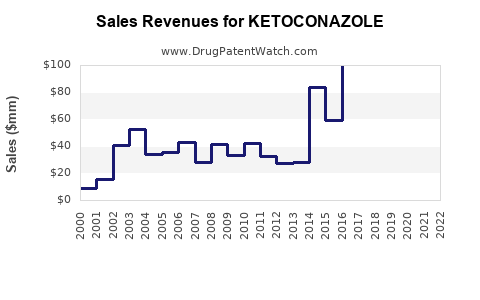
Standalone revenue is not publicly disclosed by most manufacturers. Ketoconazole has no current branded revenue base comparable with protected specialty drugs. Its financial profile is driven by high-volume, low-price generic competition, over-the-counter shampoo sales, product availability, formulation differentiation, and retailer or pharmacy-channel placement.
What is the current FDA status of ketoconazole?
FDA status differs materially by dosage form.
| Dosage form |
Principal U.S. status |
Current commercial position |
| Oral tablets |
FDA-approved but heavily restricted in use |
Limited systemic use because of hepatotoxicity and drug-interaction risks |
| 2% cream |
Approved generic and branded products |
Established prescription topical market |
| 2% shampoo |
Prescription and OTC products |
Durable consumer and dermatology demand |
| 2% foam |
Prescription product |
Premium topical niche with formulation differentiation |
| 2% gel |
Prescription generic and branded products |
Smaller dermatology segment |
| Other topical products |
Product-specific approvals |
Fragmented market |
FDA advised that oral ketoconazole should not be used as first-line therapy for fungal infections and should generally be reserved for serious systemic infections when alternative treatments are unavailable or not tolerated. The agency cited potentially fatal liver injury, adrenal insufficiency, and clinically significant drug interactions involving CYP3A4 inhibition.[1]
The oral formulation remains listed in FDA drug databases, but its clinical and commercial role is substantially narrower than before the 2013 safety communication. Topical ketoconazole products were not subject to the same systemic safety restrictions because systemic exposure is much lower when used as directed.
When did ketoconazole lose exclusivity?
Ketoconazole lost meaningful compound-level exclusivity decades ago. The active ingredient was introduced in the United States in the early 1980s, and generic versions have been available for many years.
| Event |
Approximate timing |
Commercial effect |
| U.S. approval of oral Nizoral |
1981 |
Established the systemic ketoconazole market |
| Generic entry |
1990s and later |
Removed compound-level pricing power |
| Topical generic expansion |
2000s onward |
Increased price competition |
| FDA oral-use safety restrictions |
2013 |
Reduced systemic demand |
| EU suspension of oral ketoconazole for fungal infections |
2013 |
Accelerated global decline in oral use |
| Continuing topical sales |
2010s to present |
Preserved a low-cost, durable market |
The original active-ingredient patent estate is no longer commercially relevant. Current differentiation depends on formulation, delivery system, brand recognition, manufacturing cost, channel access, and regulatory status rather than on exclusivity for ketoconazole itself.
What patents protect ketoconazole products?
The core ketoconazole molecule is off patent. Current patent value, where it exists, is concentrated in formulation and delivery technology.
Formulation patents
Historical and more recent patent activity has addressed:
- Topical creams and gels
- Foams and aerosol delivery systems
- Solubilized ketoconazole compositions
- Shampoos and suspension systems
- Combinations with corticosteroids or other dermatologic agents
- Vehicles designed to improve skin penetration or cosmetic acceptability
- Manufacturing processes that improve uniformity, stability, or particle size
These patents generally have narrower commercial reach than a compound patent. A generic manufacturer can often avoid infringement by using a different vehicle, excipient system, particle-size distribution, packaging configuration, or manufacturing process.
The commercially relevant question is whether a patent is listed in the FDA Orange Book for the specific reference product and whether it covers the approved product rather than a broader research formulation. Patent claims covering unapproved or noncommercial formulations may have little practical value.
Orange Book listings
FDA’s Orange Book should be reviewed by product and dosage form because ketoconazole is not governed by one unified patent estate. Oral tablets, creams, shampoos, foams, and gels can have different reference products, sponsors, and listing histories.[2]
For mature generic ketoconazole products, the principal competitive barriers are usually regulatory filing requirements, manufacturing economics, product availability, and distribution rather than active Orange Book exclusivity. An Orange Book patent listing does not automatically prevent an alternative generic or a noninfringing formulation from entering the market.
Method-of-use patents
Method-of-use claims may cover treatment of specific fungal or dermatologic conditions, but their practical value is limited when:
- The active ingredient is already available in generic form.
- The product label contains multiple uses.
- Generic applicants can use a section viii carve-out for a patented indication where permitted.
- Physicians prescribe the drug for nonprotected indications.
Method-of-use patents can still support litigation or a targeted licensing strategy, but they rarely restore broad pricing power to ketoconazole.
How strong is the ketoconazole patent estate?
The ketoconazole patent estate is weak at the molecule level and moderate only in selected formulation niches.
| Patent layer |
Strength |
Commercial significance |
| Compound patent |
Expired |
No remaining broad exclusivity |
| Oral tablet formulation |
Weak to limited |
Safety restrictions reduce value |
| Standard 2% cream |
Weak |
Multiple generic alternatives |
| Shampoo formulation |
Low to moderate |
Brand and OTC positioning matter more than patents |
| Foam and advanced vehicles |
Moderate in individual products |
May support premium pricing if claims remain enforceable |
| Manufacturing patents |
Product-specific |
Can raise switching costs but rarely block the market |
| Method-of-use patents |
Limited |
Narrow indication coverage and carve-out potential |
The strongest commercial positions are likely to arise from products with distinctive dosage forms, packaging, consumer branding, or proprietary delivery systems. Those positions are vulnerable to substitution by conventional cream, shampoo, or gel products when physicians and consumers prioritize price.
What is the ketoconazole market size and financial trajectory?
A precise global ketoconazole market value is difficult to isolate because the drug is sold through several channels:
- Prescription topical dermatology
- OTC dandruff and seborrheic dermatitis products
- Hospital and specialist use
- Generic pharmacy products
- Combination dermatology products
- Regional products not reported under a global brand
Public manufacturers generally do not report ketoconazole revenue separately. As a result, company-level financial analysis must rely on product-specific disclosures, prescription data, retail audit data, tender data, and distributor information rather than annual reports alone.
Revenue trajectory by segment
| Segment |
Historical trajectory |
Current outlook |
| Oral tablets |
Sharp decline after 2013 safety actions |
Structurally depressed and limited |
| Prescription cream |
Declined from branded peak |
Stable generic demand with price pressure |
| Prescription shampoo |
Mature |
Stable to modestly declining |
| OTC shampoo |
More resilient |
Supported by recurring consumer use |
| Foam and specialized vehicles |
Niche growth potential |
Dependent on reimbursement and differentiation |
| Combination products |
Fragmented |
Vulnerable to substitution and regulatory scrutiny |
The market has shifted from a high-margin branded antifungal to a low-margin, recurring-use topical product category. Volume can remain substantial even as revenue declines because generic prices fall faster than demand.
Which companies compete in ketoconazole?
Competition is fragmented across branded, generic, specialty, and consumer-health manufacturers.
Branded and consumer products
Nizoral is the best-known historical ketoconazole brand. Brand ownership and regional commercialization have changed over time, and the relevant marketing company depends on the country and dosage form. Nizoral-branded shampoo competes against generic ketoconazole shampoo, selenium sulfide products, zinc pyrithione products, ciclopirox products, and nonprescription anti-dandruff formulations.
Prescription topical products have included branded creams, foams, gels, and combination products marketed by specialty dermatology companies. Their commercial durability depends on payer coverage, physician familiarity, and whether the formulation provides a meaningful convenience or tolerability benefit.
Generic manufacturers
Generic ketoconazole products are supplied by multiple manufacturers and labelers. The competitive environment is characterized by:
- Low barriers to substitution after ANDA approval
- Periodic shortages or supplier exits
- Price erosion during multi-source competition
- Retailer and wholesaler concentration
- Limited physician loyalty to a specific manufacturer
- Exposure to active pharmaceutical ingredient availability and quality controls
The number of approved products can exceed the number of actively marketed products. FDA approval alone does not establish material market share.
What generic entry risks exist for ketoconazole?
Generic entry risk is high for conventional ketoconazole products because the active ingredient is long off patent and the main dosage forms are established.
Generic risk by product type
| Product type |
Generic entry risk |
Main barrier |
| Oral tablet |
High, but demand is limited |
Safety, restricted use, manufacturing economics |
| 2% cream |
Very high |
Minimal formulation differentiation |
| 2% shampoo |
High |
Brand recognition and OTC shelf placement |
| 2% gel |
High |
Limited clinical differentiation |
| Foam |
Moderate to high |
Device, vehicle, and formulation complexity |
| Combination product |
Moderate |
Separate active ingredients and labeling requirements |
A generic applicant may submit an ANDA where the reference product is eligible for abbreviated approval. Patent certifications can include Paragraph IV assertions that listed patents are invalid, unenforceable, or not infringed. For an old generic such as ketoconazole, the commercial impact of a Paragraph IV challenge depends less on the active ingredient and more on whether a specific branded formulation has an unexpired Orange Book patent.
Which companies are challenging ketoconazole patents?
No single, broadly dominant patent challenge defines the current ketoconazole market. Historical ANDA activity has involved multiple generic manufacturers seeking approval for oral and topical products. The more important commercial issue is whether a current branded product has a live, enforceable formulation patent and whether an ANDA applicant has filed a Paragraph IV certification against it.
For standard ketoconazole cream, shampoo, gel, and tablet products, generic competition is already established. Litigation risk is more relevant to specialized vehicles, combination products, and branded dermatology products than to the conventional molecule.
What patent litigation affects ketoconazole?
Ketoconazole litigation has generally been product-specific rather than molecule-wide. Relevant disputes can involve:
- ANDA infringement claims
- Formulation patent validity
- Hatch-Waxman litigation
- Trade dress and trademark disputes involving branded shampoo
- Patent disputes over foam, gel, or delivery systems
- Contract disputes involving licensing and authorized generic supply
The commercial impact of litigation depends on whether the asserted patent covers the product as sold, whether a court grants an injunction, whether the generic can launch an alternative formulation, and whether the parties reach a settlement.
Settlements may include:
- An agreed generic entry date
- A license with royalties
- Authorized generic supply
- Product-specific commercialization rights
- Restrictions on formulation or indication labeling
Because conventional ketoconazole products are mature and heavily substituted, settlements involving a narrow formulation patent generally have limited impact on the overall ketoconazole market.
What is the regulatory status of oral ketoconazole in Europe?
The European Medicines Agency recommended suspension of oral ketoconazole medicines for fungal infections in 2013 after concluding that liver injury risk outweighed benefits relative to alternative antifungal treatments.[3]
The European action reinforced a global shift toward safer alternatives, including terbinafine, itraconazole, fluconazole, and topical agents. Oral ketoconazole may remain available in some jurisdictions for restricted indications or under local regulatory conditions, but its use is no longer a mainstream systemic antifungal strategy.
Topical ketoconazole remains commercially relevant in Europe and other markets for dandruff, seborrheic dermatitis, and superficial fungal infections.
How does ketoconazole compare with competing antifungals?
| Drug |
Main use |
Competitive position versus ketoconazole |
| Terbinafine |
Dermatophyte infections |
Stronger systemic and topical alternative for many dermatophyte conditions |
| Itraconazole |
Systemic fungal infections |
Broader systemic role, but interaction and monitoring issues remain |
| Fluconazole |
Systemic and mucosal infections |
Broad generic availability and established clinical use |
| Ciclopirox |
Topical dermatology |
Alternative for superficial fungal disease |
| Selenium sulfide |
Dandruff and seborrheic dermatitis |
Low-cost OTC competitor in shampoo |
| Zinc pyrithione |
Dandruff |
Consumer-health substitute, subject to regional regulatory treatment |
| Clotrimazole |
Topical fungal infections |
Widely available generic and OTC competitor |
Ketoconazole retains value where clinicians prefer its activity against Malassezia and dermatophytes, particularly in seborrheic dermatitis and dandruff. Its commercial position is weaker where competing products offer better systemic safety, shorter treatment courses, or more convenient OTC access.
What manufacturing and intellectual-property barriers affect ketoconazole?
Manufacturing barriers are modest for standard products but higher for specialized formulations.
Standard products
Generic manufacturers generally face conventional requirements for:
- API sourcing
- Impurity control
- Content uniformity
- Microbial limits
- Stability
- Packaging compatibility
- Bioequivalence or product-specific equivalence testing
- cGMP compliance
Topical products can present more complex equivalence issues than oral tablets because FDA may evaluate formulation, viscosity, particle size, rheology, emulsion structure, and performance characteristics in addition to chemical composition.[4]
Specialized products
Foams, gels, suspensions, and combination products can require greater development investment. Manufacturing know-how may create practical advantages even when patent protection is weak. These advantages are usually temporary because competitors can develop alternative vehicles and outsource production to contract manufacturers.
What is the outlook for ketoconazole revenue?
The base case is continued low-single-digit or negative revenue growth for conventional products, offset by stable volume in recurring-use topical and OTC segments.
Revenue drivers
- Persistent dandruff and seborrheic dermatitis prevalence
- Low-cost generic access
- OTC consumer demand
- Periodic supply shortages
- Retail distribution
- Demand in emerging markets
- Specialty formulations with better cosmetic properties
Revenue pressures
- Generic price erosion
- Substitution by terbinafine, ciclopirox, selenium sulfide, and clotrimazole
- Reduced oral use
- Payer preference for low-cost alternatives
- Limited patent protection
- Manufacturer exits and channel consolidation
- Regulatory scrutiny of combination products
The strongest financial opportunities are not in the ketoconazole molecule itself. They are in manufacturing scale, dependable supply, consumer branding, formulation improvements, and bundled dermatology portfolios. A company holding only a conventional ketoconazole generic should expect limited pricing power and high substitution risk.
Key Takeaways
- Ketoconazole is a mature generic antifungal with no meaningful remaining compound-level exclusivity.
- Oral ketoconazole has suffered a structural demand decline after FDA and European safety actions.
- Topical creams, shampoos, gels, and foams remain commercially active.
- The strongest remaining intellectual-property positions are formulation-specific and generally narrow.
- Orange Book and Paragraph IV risk is product-specific, not molecule-wide.
- Biosimilar risk is irrelevant because ketoconazole is a small-molecule drug; generic substitution is the relevant threat.
- Conventional products face high generic-entry and price-erosion risk.
- OTC shampoo and recurring dermatology use provide the most durable volume.
- Public companies generally do not disclose standalone ketoconazole revenue.
- Long-term value depends on supply reliability, distribution, formulation differentiation, and brand strength rather than patent duration.
FAQs
Is ketoconazole still a profitable pharmaceutical product?
It can generate dependable volume, but conventional generic ketoconazole is usually a low-margin product. Profitability depends on manufacturing scale, supply reliability, channel access, and whether the product has branded or formulation differentiation.
Does ketoconazole have biosimilar competition?
No. Ketoconazole is a small-molecule drug, so its relevant competitors are generic versions and alternative antifungal products, not biosimilars.
Can a company obtain a new patent on ketoconazole?
A company may obtain patents on a novel formulation, delivery system, combination, manufacturing method, or new therapeutic use if statutory requirements are met. A new patent would not restore exclusivity to the underlying molecule.
Is oral ketoconazole commercially viable for new drug development?
The risk-adjusted outlook is poor for broad systemic antifungal use because of established hepatotoxicity and interaction concerns. A development program would require a narrowly defined clinical need and a clear benefit over safer alternatives.
Which ketoconazole formulation has the best commercial outlook?
Topical shampoo has the broadest consumer recognition, while specialized foams and cosmetically improved vehicles have greater potential for premium pricing. Standard 2% cream has the lowest differentiation and the highest generic price pressure.
References
-
U.S. Food and Drug Administration. (2013, July 26). FDA limits usage of Nizoral oral tablets due to potentially fatal liver injury and risk of drug interactions and adrenal gland problems. https://www.fda.gov/drugs/drug-safety-and-availability/fda-drug-safety-communication-fda-limits-usage-nizoral-ketoconazole-oral-tablets-due
-
U.S. Food and Drug Administration. (n.d.). Approved drug products with therapeutic equivalence evaluations: Orange Book. https://www.accessdata.fda.gov/scripts/cder/ob/
-
European Medicines Agency. (2013, July 26). European Medicines Agency recommends suspension of marketing authorisations for oral ketoconazole. https://www.ema.europa.eu/en/news/european-medicines-agency-recommends-suspension-marketing-authorisations-oral-ketoconazole
-
U.S. Food and Drug Administration. (2022). Product-specific guidance on ketoconazole topical cream. Center for Drug Evaluation and Research. https://www.fda.gov/drugs/drug-development-guidance/product-specific-guidances-generic-drug-development