Last updated: February 13, 2026
Overview
Ketoconazole is a broad-spectrum antifungal agent primarily used to treat fungal infections. It is available in topical, oral, and shampoo formulations. The drug faces competition from newer antifungals with better safety profiles, like itraconazole and fluconazole. Its market viability depends on evolving regulatory policies, formulary shifts, and resistance management.
Market Size and Trends
The global antifungal market was valued at approximately USD 13.8 billion in 2022 and is projected to reach USD 19.2 billion by 2030, with a compound annual growth rate (CAGR) of 4.4% (CAGR from 2023 to 2030). Ketoconazole accounts for an estimated 10-12% of the topical antifungal segment, roughly USD 350–450 million in 2022.
Factors driving growth include increased prevalence of fungal infections, such as dermatophytes, candidiasis, and pityriasis versicolor. The rising incidence correlates with global increases in immunocompromised populations and climate factors promoting fungal proliferation.
Regulatory Status
- United States: FDA withdrew approval for oral ketoconazole in 2013 due to hepatotoxicity risks. It remains approved for topical use, including shampoo for dandruff and fungal skin infections.
- Europe: EMA restricts oral ketoconazole to cases where other antifungals are unsuitable, citing similar safety concerns.
- Other regions: Availability varies; some markets restrict or phase out oral formulations, emphasizing topical applications.
Competitive Landscape
- Topical formulations: Over-the-counter (OTC) and prescription creams and shampoos. The dominance of ketoconazole shampoos persists in OTC markets, especially for dandruff, with brands like Nizoral.
- Oral formulations: Limited to specific indications; alternative antifungals largely replace ketoconazole due to safety issues.
- Emerging competitors: New azoles, including isavuconazole and voriconazole, target systemic infections with better safety profiles but have limited use for topical indications.
Pricing Dynamics
- Topical ketoconazole: Retail prices range from USD 10–20 per 30g tube or bottle (e.g., Nizoral shampoo). Over-the-counter prices are competitive and often dictated by generic availability.
- Prescription formulations: Cost varies by insurance coverage and regional pricing policies but generally falls between USD 50–150 per treatment course.
- Generic penetration: Dominates the OTC segment, maintaining low prices and high market volume.
Price Projections
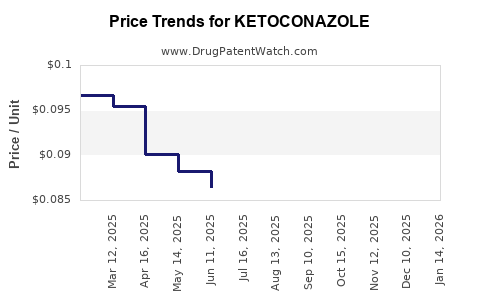
- Short-term (2023–2025): Due to safety concerns limiting oral use, overall market volume for ketoconazole is expected to stabilize or decline marginally. Topical prices will remain stable, especially in generics, with minor upward pressure from inflation and supply chain factors.
- Medium-term (2026–2030): The absence of new formulations or indications limits significant price increases. Market contraction may occur in oral products, but topical sales could sustain moderate growth driven by dermatological needs.
| Year |
Estimated Market Size (USD millions) |
Notes |
| 2023 |
400 |
Stabilized, mainly topical formulations |
| 2025 |
390–410 |
Slight decline in oral segment; stable topical sales |
| 2030 |
370–420 |
Market contraction in oral use; topical remains stable |
Key Drivers and Risks
- Drivers: Increased dermatological use, OTC availability, persistent demand for antifungal shampoos.
- Risks: Regulatory restrictions, safety concerns affecting oral formulations, competitive pressure from newer azoles, generics eroding margins.
Conclusion
The ketoconazole market remains primarily driven by topical formulations, especially shampoos for dandruff and fungal skin infections. Oral formulations are highly restricted and declining. Price levels are expected to stay stable over the next few years, with limited upside potential, mainly supported by inflation and supply chain trends rather than innovation or increased demand.
Key Takeaways
- The global antifungal market is projected to grow at 4.4% CAGR, reaching USD 19.2 billion by 2030.
- Ketoconazole holds a significant position in OTC topical antifungal products, especially shampoos.
- Regulatory restrictions on oral ketoconazole mitigate its market size; topical prices remain stable.
- Short-term (2023–2025) outlook shows stabilization; medium-term (2026–2030) forecasts suggest slight decline in overall market value.
- Generic availability maintains low retail prices, limiting profit margins.
FAQs
1. What are the main clinical uses of ketoconazole today?
It is primarily used in topical forms (creams, shampoos) for fungal skin infections and dandruff. Oral use is restricted due to safety concerns.
2. How does regulatory scrutiny affect ketoconazole’s market?
Regulations restrict oral formulations, especially in the US and Europe, shifting focus to topical products and limiting market growth.
3. Are there any upcoming formulations or indications for ketoconazole?
No; current trends favor newer antifungals with better safety profiles, diminishing prospects for innovation in ketoconazole.
4. What are the key competitive products against ketoconazole?
Topical antifungals like clotrimazole, miconazole, sertaconazole, and newer azoles such as econazole compete in the same dermatological space.
5. How will supply chain issues influence prices?
Global disruptions may increase raw material costs modestly, supporting slight price increases, particularly in generic markets.
References
- MarketsandMarkets. (2022). Antifungal drugs market size, share, and forecast.
- FDA. (2013). FDA updates on ketoconazole safety.
- EMA. (2017). EMA recommendations on systemic antifungal agents.
- IQVIA. (2022). Global dermatology and antifungal market data.