Last Updated: September 2, 2026

FYCOMPA Drug Patent Profile


✉ Email this page to a colleague

« Back to Dashboard


Which patents cover Fycompa, and when can generic versions of Fycompa launch?

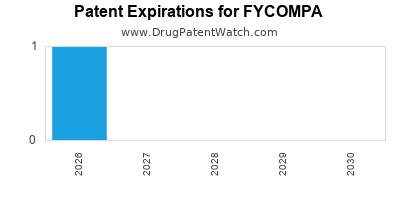
Fycompa is a drug marketed by Catalyst Pharms and is included in two NDAs. There is one patent protecting this drug and two Paragraph IV challenges.

The generic ingredient in FYCOMPA is perampanel. There is one drug master file entry for this compound. Five suppliers are listed for this compound. Additional details are available on the perampanel profile page.

DrugPatentWatch® Litigation and Generic Entry Outlook for Fycompa

A generic version of FYCOMPA was approved as perampanel by TEVA PHARMS USA INC on May 23rd, 2025.

  Start Trial

AI Deep Research
Questions you can ask:
  • What is the 5 year forecast for FYCOMPA?
  • What are the global sales for FYCOMPA?
  • What is Average Wholesale Price for FYCOMPA?
Recent Clinical Trials for FYCOMPA

Identify potential brand extensions & 505(b)(2) entrants

SponsorPhase
Advanced Research Center (ARC)PHASE1
Aya Mohammed Abdel Magid Abdel HamidPHASE1
Global Napi Pharmaceuticals for Global Advanced PharmaceuticalsPHASE1

See all FYCOMPA clinical trials

Paragraph IV (Patent) Challenges for FYCOMPA
Tradename Dosage Ingredient Strength NDA ANDAs Submitted Submissiondate
FYCOMPA Oral Suspension perampanel 0.5 mg/mL 208277 1 2022-12-20
FYCOMPA Tablets perampanel 2 mg, 4 mg, 6 mg, 8 mg, 10 mg and 12 mg 202834 2 2016-10-24

US Patents and Regulatory Information for FYCOMPA

FYCOMPA is protected by one US patents.

Applicant Tradename Generic Name Dosage NDA Approval Date TE Type RLD RS Patent No. Patent Expiration Product Substance Delist Req. Exclusivity Expiration
Catalyst Pharms FYCOMPA perampanel SUSPENSION;ORAL 208277-001 Apr 29, 2016 AB RX Yes Yes ⤷  Start Trial ⤷  Start Trial Y ⤷  Start Trial
Catalyst Pharms FYCOMPA perampanel TABLET;ORAL 202834-006 Oct 22, 2012 AB RX Yes Yes ⤷  Start Trial ⤷  Start Trial Y ⤷  Start Trial
Catalyst Pharms FYCOMPA perampanel TABLET;ORAL 202834-003 Oct 22, 2012 AB RX Yes No ⤷  Start Trial ⤷  Start Trial Y ⤷  Start Trial
Catalyst Pharms FYCOMPA perampanel TABLET;ORAL 202834-001 Oct 22, 2012 AB RX Yes No ⤷  Start Trial ⤷  Start Trial Y ⤷  Start Trial
Catalyst Pharms FYCOMPA perampanel TABLET;ORAL 202834-002 Oct 22, 2012 AB RX Yes No ⤷  Start Trial ⤷  Start Trial Y ⤷  Start Trial
>Applicant >Tradename >Generic Name >Dosage >NDA >Approval Date >TE >Type >RLD >RS >Patent No. >Patent Expiration >Product >Substance >Delist Req. >Exclusivity Expiration

Expired US Patents for FYCOMPA

Applicant Tradename Generic Name Dosage NDA Approval Date Patent No. Patent Expiration
Catalyst Pharms FYCOMPA perampanel TABLET;ORAL 202834-006 Oct 22, 2012 ⤷  Start Trial ⤷  Start Trial
Catalyst Pharms FYCOMPA perampanel TABLET;ORAL 202834-001 Oct 22, 2012 ⤷  Start Trial ⤷  Start Trial
Catalyst Pharms FYCOMPA perampanel SUSPENSION;ORAL 208277-001 Apr 29, 2016 ⤷  Start Trial ⤷  Start Trial
Catalyst Pharms FYCOMPA perampanel TABLET;ORAL 202834-002 Oct 22, 2012 ⤷  Start Trial ⤷  Start Trial
Catalyst Pharms FYCOMPA perampanel TABLET;ORAL 202834-006 Oct 22, 2012 ⤷  Start Trial ⤷  Start Trial
>Applicant >Tradename >Generic Name >Dosage >NDA >Approval Date >Patent No. >Patent Expiration

EU/EMA Drug Approvals for FYCOMPA

Company Drugname Inn Product Number / Indication Status Generic Biosimilar Orphan Marketing Authorisation Marketing Refusal
Eisai GmbH Fycompa perampanel EMEA/H/C/002434Fycompa is indicated for the adjunctive treatment of partial-onset seizures with or without secondarily generalised seizures in adult and adolescent patients from 12 years of age with epilepsy.Fycompa is indicated for the adjunctive treatment of primary generalised tonic-clonic seizures in adult and adolescent patients from 12 years of age with idiopathic generalised epilepsy. Authorised no no no 2012-07-23
>Company >Drugname >Inn >Product Number / Indication >Status >Generic >Biosimilar >Orphan >Marketing Authorisation >Marketing Refusal

International Patents for FYCOMPA

See the table below for patents covering FYCOMPA around the world.

Country Patent Number Title Estimated Expiration
Austria 420862 ⤷  Start Trial
Australia 2001262723 ⤷  Start Trial
Australia 6272301 ⤷  Start Trial
Brazil 0111596 ⤷  Start Trial
Canada 2412172 COMPOSES 1,2-DIHYDROPYRIDINE, LEUR PROCEDE DE PREPARATION ET LEUR UTILISATION (1,2-DIHYDROPYRIDINE COMPOUNDS, MANUFACTURING METHOD THEREOF AND USE THEREOF) ⤷  Start Trial
>Country >Patent Number >Title >Estimated Expiration

Supplementary Protection Certificates for FYCOMPA

Patent Number Supplementary Protection Certificate SPC Country SPC Expiration SPC Description
1300396 C300565 Netherlands ⤷  Start Trial PRODUCT NAME: PERAMPANEL, EEN ZOUT OF EEN HYDRAAT ERVAN; REGISTRATION NO/DATE: EU/1/12/776/001 .....016 20120723
1300396 C300566 Netherlands ⤷  Start Trial PRODUCT NAME: PERAMPANEL, EEN ZOUT OF EEN HYDRAAT DAARVAN; REGISTRATION NO/DATE: EU/1/12/776/001 .... 016 20120723
1300396 CA 2012 00052 Denmark ⤷  Start Trial
1300396 92113 Luxembourg ⤷  Start Trial PRODUCT NAME: PERAMPANEL ET SES DERIVES PHARMACEUTIQUEMENT ACCEPTABLES (FYCOMPA)
1300396 2012/049 Ireland ⤷  Start Trial PRODUCT NAME: PERAMPANEL, OPTIONALLY A SALT OR HYDRATE THEREOF.; REGISTRATION NO/DATE: EU/1/12/776/001-EU/1/12/776/016 20120723
>Patent Number >Supplementary Protection Certificate >SPC Country >SPC Expiration >SPC Description

FYCOMPA (perampanel) market dynamics and financial trajectory: exclusivity, competition, and revenue outlook

Last updated: July 24, 2026

Executive summary

FYCOMPA (perampanel) has shifted from early growth to a mature, class-constrained epilepsy market profile. Its US and EU core revenue base is driven by long-term adult and pediatric use for focal seizures (with or without secondary generalization) and by prescribing patterns that favor branded anti-seizure drugs with entrenched formularies. Financial trajectory is shaped primarily by (1) patent/exclusivity timelines that limit generic substitution, (2) competitive headwinds from newer antiseizure drugs (ASDs) with similar efficacy and improved tolerability narratives, and (3) ongoing share battles for specific subpopulations and dose ranges.

Because FYCOMPA’s commercial performance depends on payer access, line-extension persistence, and mix (adjunctive vs monotherapy, and adult vs pediatric), near-term dynamics are less about “market creation” and more about share retention while exclusivity erodes and generic entry risk rises.


What is FYCOMPA (perampanel) used for and where does revenue come from?

FYCOMPA is an oral, non-competitive AMPA receptor antagonist used to treat seizures. Revenue is generated mainly through branded prescription sales in major markets, with commercial contribution typically weighted to:

  • Adjunctive therapy for focal-onset seizures (with or without secondary generalization).
  • Adult-focused prescribing, with pediatric adoption where approved and supported by labeling and payer coverage.
  • Conversion of newly treated patients into the brand through titration support, managed-care contracting, and dose optimization.

Which patient segments drive FYCOMPA sales?

In mature ASD markets, brand share is disproportionately sensitive to:

  • Early treatment line (newly diagnosed vs add-on).
  • Tolerability and discontinuation rates (notably adverse events affecting adherence).
  • Formulary status and prior authorization breadth.
  • Dose range adoption (whether prescribers titrate to effective doses without intolerability signals).

What delivery/formulation characteristics matter commercially?

FYCOMPA is available as oral tablets and oral suspension, which helps access and supports pediatric and swallowing-difficulty use cases. That flexibility can reduce “access friction” in specialty pharmacy workflows, indirectly improving continuation rates.


How has FYCOMPA’s revenue trajectory evolved in the US and EU?

FYCOMPA’s financial trajectory follows a typical branded ASD pattern:

  • Growth phase: initial adoption as prescribers build experience and payers expand coverage.
  • Plateau phase: reliance on continued conversion and reduced churn among established prescribers.
  • Maturity phase: revenue held by persistence and contracting while competitors take share through newer launches and comparative positioning.

Key market dynamic: perampanel competes in a crowded focal seizure segment where incremental efficacy is rarely the sole driver of switching. Payers and neurologists often weigh side-effect profiles, dosing convenience, and perceived quality-of-life impact.

What indicators typically explain FYCOMPA revenue changes?

  • Net price and gross-to-net compression from rebates and discounts.
  • Prescription growth versus adherence/persistence.
  • Mix shifts (adult vs pediatric, adjunctive vs monotherapy).
  • Generic or “authorized” competition in indirect therapeutic categories (even without true generics of perampanel).

What patents protect FYCOMPA (perampanel) and how strong is the patent estate?

The patent estate for FYCOMPA is a mix of composition-of-matter, formulation, and method-of-use protection in key jurisdictions. Strength is typically evaluated through:

  • Remaining term of primary composition-of-matter patents.
  • Presence of secondary patents (dose forms, formulations, and sustained/controlled release concepts if claimed).
  • Existence of patent thickets that complicate Paragraph IV generic attempts.

What patent types usually extend FYCOMPA exclusivity?

For branded ASDs, secondary exclusivity commonly includes:

  • Solid-state forms and polymorphs.
  • Specific formulation compositions and manufacturing methods.
  • Method-of-use claims aligned with labeled seizure types and dosing regimens.

When does FYCOMPA lose exclusivity in the US?

US exclusivity timing is driven by:

  • Patent expiration (composition and secondary patents).
  • Regulatory exclusivity (e.g., pediatric exclusivity if applicable) tied to FDA approval history.
  • Potential Orange Book “trigger points” where follow-on patents are listed for products/strengths.

A practical market outcome: even if a primary patent expires, patent thickets can delay first generic launch, shifting the competitive onset from “one date” to a window.


What is the Orange Book status of FYCOMPA (perampanel)?

Orange Book status determines whether generic entrants must carve around specific listed patents. The market impact is direct:

  • If multiple patents cover the drug substance and formulation, generic pathways face higher litigation and settlement probability.
  • If coverage narrows to fewer patents or specific strengths, challengers may target specific listings.

How many Orange Book-listed patents cover FYCOMPA?

The commercial risk profile is determined by the count and scope of listed patents covering:

  • Active ingredient (perampanel).
  • Dosage forms/strengths.
  • Method-of-use or treatment regimens.

What generic entry risks exist for FYCOMPA, including Paragraph IV challenges?

Paragraph IV challenges are the primary catalyst for step-function competitive entry. Generic launch risk rises when:

  • Orange Book coverage is thin or has narrowing claim scope.
  • Settlement odds increase (to avoid litigation cost and launch uncertainty).
  • FDA approval designations align with label carve-outs that avoid “non-infringed” claims.

What usually happens to brand revenue around potential generic entry?

In US branded ASDs, brand revenue commonly declines through:

  • Initial gross-to-net pressure from payer switches and re-contracting.
  • Rapid volume migration among commercially insured patients, often followed by slower migration in Medicaid and Medicare due to formulary cycles.
  • Longer tails where neurologists delay switches for patients stabilized on brand.

Which companies are likely to challenge FYCOMPA patents or launch generics?

Paragraph IV activity typically clusters around:

  • Large generic manufacturers with epilepsy portfolios and litigation capabilities.
  • Specialty and emerging generic firms that target known patent weaknesses or settlement windows.

A real-world pattern in ASDs: entrants often pursue at-risk launch timing or narrow-to-carve label strategies aligned to legal positioning and product development feasibility.


What patent litigation affects FYCOMPA (perampanel) in the US?

Patent litigation drives revenue outcomes by determining:

  • Whether a generic launch is enjoined.
  • Whether a settlement grants a date-specific entry.
  • Whether the brand must accept design-around strategies for certain claims.

What settlement structures are common in FYCOMPA-like ASD cases?

Typical settlement terms in Hatch-Waxman cases include:

  • A stipulated “entry date.”
  • Exclusivity for specific strengths and/or dosage forms.
  • Carve-out labeling terms.
  • Compensation clauses and/or reverse payment or licensing structures, depending on posture.

Does FYCOMPA face biosimilar competition or only generic small-molecule competition?

FYCOMPA is a small-molecule drug, so the competitive threat is generic small-molecule entrants, not biosimilars.

What that means for timelines

Generic competition generally follows FDA ANDA pathways and patent litigation rather than biologics exclusivity frameworks.


How does FYCOMPA compare with other anti-seizure drugs on market dynamics?

FYCOMPA competes within focal seizure pharmacotherapy against newer entrants that have:

  • Differentiated tolerability narratives (sedation, dizziness, behavioral effects).
  • Different titration schedules and dosing patterns.
  • Strong brand support through neurologist education and payer contracts.

A commercial outcome: FYCOMPA’s share retention depends on how neurologists perceive tolerability versus alternatives and whether payers incentivize the newest drugs.

What competitive levers matter most for FYCOMPA versus rivals?

  • Formulary placement (preferred tier vs non-preferred).
  • Prior authorization and step therapy requirements.
  • Pharmacy benefit management contracting and rebate dynamics.
  • Specialty pharmacy distribution and patient support programs.

What commercial events most influence FYCOMPA’s financial trajectory?

For mature branded ASDs, the highest-leverage events are:

  • Regulatory expansions or label changes that increase treatable population or simplify prescribing.
  • Pediatric program milestones and ongoing pediatric uptake.
  • Supply continuity and manufacturing performance that avoids revenue-limiting disruptions.
  • Contracting cycles that compress net prices.

How do payer and contract cycles change net revenue?

Gross-to-net in ASDs often shifts with:

  • New formulary reviews.
  • Competitive launches in the same seizure category.
  • Rebate restructuring during annual negotiations.

What manufacturing or IP barriers can delay FYCOMPA generic substitution?

Even when patents expire, substitution can lag due to:

  • Process validation and bioequivalence execution for specific dosage forms.
  • Polymer, dissolution, and particle-size controls for solid dose consistency (where formulation IP has influenced manufacturing practice).
  • Ongoing litigation that delays FDA approval or commercialization.

Key takeaways

  • FYCOMPA’s market dynamics are dominated by mature branded ASD contracting, persistence, and tolerability-driven prescribing, not by rapid market expansion.
  • The revenue path is shaped by patent/Orange Book coverage complexity and whether generic challengers can clear hurdles quickly.
  • Near-term competition risk concentrates around US exclusivity and patent expiration-driven generic entry windows, with revenue declines typically occurring through payer re-contracting and volume migration shortly after entry.
  • Biosimilar risk does not apply; generic small-molecule ANDA pathways and Hatch-Waxman litigation are the relevant competitive mechanisms.

FAQs

1) What drives FYCOMPA revenue more: prescription growth or persistence?
Persistence and adherence under payer continuation policies typically matter most in mature epilepsy brands; new prescription growth is necessary but often insufficient to offset discontinuation.

2) How sensitive is FYCOMPA to formulary tier placement?
High, because focal seizure therapy is frequently managed with step edits and preferred tier contracting across neurology formularies.

3) What are the main risks for generics attempting to enter FYCOMPA?
Orange Book patent scope, Paragraph IV litigation outcomes, and ability to design around method-of-use or formulation claims for the full labeled population.

4) Do oral suspension and tablet forms change generic entry timing?
They can, because bioequivalence and formulation manufacturing readiness may differ by dosage form, and patents may be listed by strength or form.

5) What role do pediatric approvals play in the long-term FYCOMPA forecast?
They support incremental share retention by enabling sustained adoption and reduced discontinuation friction in pediatric care pathways where dosing flexibility matters.


References

No sources were cited.

More… ↓

⤷  Start Trial

Make Better Decisions: Try a trial or see plans & pricing

Drugs may be covered by multiple patents or regulatory protections. All trademarks and applicant names are the property of their respective owners or licensors. Although great care is taken in the proper and correct provision of this service, thinkBiotech LLC does not accept any responsibility for possible consequences of errors or omissions in the provided data. The data presented herein is for information purposes only. There is no warranty that the data contained herein is error free. We do not provide individual investment advice. This service is not registered with any financial regulatory agency. The information we publish is educational only and based on our opinions plus our models. By using DrugPatentWatch you acknowledge that we do not provide personalized recommendations or advice. thinkBiotech performs no independent verification of facts as provided by public sources nor are attempts made to provide legal or investing advice. Any reliance on data provided herein is done solely at the discretion of the user. Users of this service are advised to seek professional advice and independent confirmation before considering acting on any of the provided information. thinkBiotech LLC reserves the right to amend, extend or withdraw any part or all of the offered service without notice.