Share This Page
Drug Price Trends for FYCOMPA
✉ Email this page to a colleague
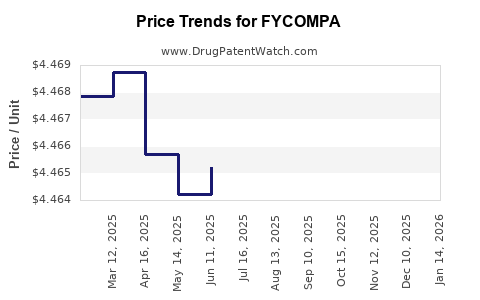
Average Pharmacy Cost for FYCOMPA
| Drug Name | NDC | Price/Unit ($) | Unit | Date |
|---|---|---|---|---|
| FYCOMPA 2 MG TABLET | 62856-0272-30 | 19.73676 | EACH | 2026-07-22 |
| FYCOMPA 10 MG TABLET | 62856-0280-30 | 39.09028 | EACH | 2026-07-22 |
| FYCOMPA 12 MG TABLET | 62856-0282-30 | 39.13492 | EACH | 2026-07-22 |
| FYCOMPA 8 MG TABLET | 69616-0278-30 | 39.13545 | EACH | 2026-07-22 |
| FYCOMPA 10 MG TABLET | 69616-0280-30 | 39.09028 | EACH | 2026-07-22 |
| FYCOMPA 12 MG TABLET | 69616-0282-30 | 39.13492 | EACH | 2026-07-22 |
| >Drug Name | >NDC | >Price/Unit ($) | >Unit | >Date |
Fycompa (Perampanel) Market Analysis and Price Projections
Fycompa, an orally administered, selective, non-competitive AMPA receptor antagonist, is approved for the adjunctive treatment of partial-onset seizures with or without secondary generalization in epilepsy patients aged 4 years and older [1]. This report analyzes the current market landscape for Fycompa, patent expirations, and projects potential price trajectories.
What is the Current Market Landscape for Fycompa?
Fycompa, marketed by Eisai Co., Ltd., generated net sales of approximately JPY 65.2 billion (USD 450 million) in fiscal year 2022, representing a 10% increase year-over-year [2]. The drug's efficacy in reducing seizure frequency in patients with refractory epilepsy contributes to its market penetration. The global epilepsy market is substantial, driven by increasing prevalence and unmet needs in treatment-resistant epilepsy [3].
Fycompa's treatment paradigm positions it as a third-line or later treatment option, following failure of other antiepileptic drugs (AEDs). This niche, while limited, provides a stable patient population. Key competitive factors include physician prescribing habits, patient access programs, and the availability of generic alternatives for older AEDs. The drug's pharmacoeconomic profile is also considered against alternative treatments, both branded and generic.
The drug is available in different dosage strengths, including 2 mg, 4 mg, 6 mg, 8 mg, 10 mg, and 12 mg tablets [1]. This range of dosages allows for titration to individual patient needs, optimizing therapeutic response and minimizing adverse events. The oral administration simplifies patient compliance compared to injectable formulations.
What are the Key Patent Expirations for Fycompa?
The primary U.S. patent protecting Fycompa (perampanel) is U.S. Patent No. 8,227,470, titled "ANTICONVULSANT COMPOUNDS." This patent was granted on July 24, 2012, and is set to expire on July 24, 2029 [4]. However, the Drug Price Competition and Patent Term Restoration Act (Hatch-Waxman Act) allows for patent term extensions to compensate for regulatory review delays.
Eisai sought and was granted a 5-year patent term extension for U.S. Patent No. 8,227,470, extending its expiration to July 24, 2034 [4]. This extension is crucial for extending the period of market exclusivity for Fycompa in the United States.
In Europe, the Supplementary Protection Certificate (SPC) for perampanel is expected to expire in June 2026 [5]. This earlier expiration in Europe compared to the U.S. signals a potential for generic entry in European markets ahead of the U.S.
Additional patents related to manufacturing processes, polymorphs, or specific formulations may exist. However, the core composition-of-matter patent and its associated extensions represent the primary barriers to generic competition for the active pharmaceutical ingredient.
What is the Projected Impact of Generic Entry on Fycompa's Market Share and Revenue?
The impact of generic entry on Fycompa's market share and revenue will be significant and follow historical patterns observed for branded pharmaceuticals. Upon patent expiration, generic manufacturers can introduce bioequivalent versions of the drug, typically at substantially lower price points.
In markets where patents have expired, such as Europe with its June 2026 SPC expiration, generic competition will likely lead to a rapid decline in Fycompa's market share and revenue. Price erosion for branded Fycompa in these regions is projected to exceed 70% within two years of the first generic launch.
In the United States, the extended patent protection until July 24, 2034, will delay generic entry. However, once this patent protection lapses, a similar pattern of rapid market share and revenue erosion for branded Fycompa is anticipated. Generic penetration typically reaches over 80% within three years of launch in the U.S. market.
The total revenue generated by Fycompa is directly correlated with its market exclusivity. With the loss of exclusivity, the primary revenue driver will shift from branded sales to a much smaller, residual market share for the branded product, often serving patients or healthcare systems that prefer or are mandated to use the originator product.
How Will Price Projections Evolve for Fycompa and its Generics?
Branded Fycompa Price Projections:
- Current Pricing: The average wholesale price (AWP) for Fycompa varies by dosage and pack size. For example, a 30-count bottle of 4 mg Fycompa tablets has an AWP in the range of USD 1,800 to USD 2,200 [6]. This translates to a per-tablet cost of approximately USD 60 to USD 73.
- Pre-Expiration (U.S.): Until the patent expiration in July 2034, the branded Fycompa price is expected to remain relatively stable, potentially seeing incremental annual increases aligned with general pharmaceutical pricing trends, typically in the low to mid-single digits.
- Post-Expiration (U.S.): Following the July 24, 2034, patent expiration, branded Fycompa prices will face intense downward pressure. While Eisai may maintain some market presence, the price is projected to decline sharply, likely by 60% to 80% within two to three years post-generic entry, as it competes with lower-cost generics. The remaining sales will likely be from a reduced patient base or specific market segments.
Generic Fycompa Price Projections:
- Initial Generic Pricing: Upon the first generic launch in Europe (post-June 2026) and subsequently in the U.S. (post-July 2034), generic perampanel will be priced significantly lower than branded Fycompa. Initial pricing is typically 30% to 50% below the branded product's then-current price.
- Price Erosion: The generic market is highly competitive. As more generic manufacturers enter the market, price erosion will accelerate. Within 18-24 months of generic launch, the price of generic perampanel is expected to fall by an additional 20% to 40% from its initial offering.
- Long-Term Generic Pricing: Over the long term, generic perampanel prices will stabilize at a level reflective of manufacturing costs and market demand, likely settling between 5% to 15% of the original branded Fycompa AWP at its peak.
Factors Influencing Price Projections:
- Number of Generic Entrants: A higher number of generic manufacturers will intensify competition and accelerate price declines.
- Market Access and Reimbursement: Payer policies and formulary placement will influence the uptake of both branded and generic versions, indirectly affecting pricing strategies.
- Manufacturing Costs: The efficiency and scale of generic manufacturing will impact their cost of goods and, consequently, their pricing.
- Competition from Alternative Treatments: The availability and pricing of other antiepileptic drugs will continue to exert pressure on perampanel pricing.
What are the Implications for R&D and Investment Decisions?
The patent landscape for Fycomcompa indicates a defined period of exclusivity followed by significant generic competition. This presents both challenges and opportunities for stakeholders.
For Eisai (Originator):
- Market Exclusivity Maximization: Focus will be on maximizing Fycompa sales during the remaining patent-protected period, particularly in the U.S. market until July 2034.
- Lifecycle Management: Strategies may include exploring new indications or combination therapies involving perampanel to extend the drug's commercial life, although this is challenging for a mature product.
- Generic Defense: Preparing for generic entry by potentially managing pricing and supply strategies for the branded product in the post-exclusivity era.
For Generic Manufacturers:
- Strategic Entry: Identifying optimal launch timing in key markets based on patent expiry dates (e.g., Europe in 2026, U.S. in 2034).
- Supply Chain and Manufacturing: Establishing robust, cost-efficient manufacturing processes to compete on price.
- Market Share Acquisition: Developing strategies to capture market share rapidly post-launch, leveraging lower price points.
For Investors:
- Timing of Investment: Investment in Fycompa as a branded asset will yield diminishing returns post-patent expiry. Investments in generic manufacturers poised to enter the market become more attractive as exclusivity wanes.
- Risk Assessment: The primary risk for Fycompa is generic competition. For generic manufacturers, the risks include regulatory hurdles, competition from other generics, and potential patent litigation.
- Portfolio Diversification: Investors should assess Fycompa's market lifecycle within a broader portfolio of pharmaceutical assets, considering both branded and generic opportunities.
The U.S. market offers a longer runway for Fycompa's branded sales compared to Europe. However, the eventual genericization in both regions is a certainty that must be factored into any long-term strategic or investment decision.
Key Takeaways
- Fycompa is protected by a U.S. patent expiring in July 2034, with a patent term extension, and European SPCs expiring in June 2026.
- Generic entry in Europe is expected in mid-2026, leading to rapid price and market share erosion for branded Fycompa.
- U.S. generic entry is anticipated in mid-2034, following the expiry of its extended patent protection.
- Branded Fycompa prices are expected to remain stable until patent expiry, then decline significantly. Generic perampanel prices will be substantially lower and will continue to erode with market competition.
- Investment decisions should consider the distinct market dynamics pre- and post-patent expiration, favoring branded sales for originator companies during exclusivity and generic opportunities thereafter.
Frequently Asked Questions
When is Fycompa's primary U.S. patent set to expire?
Fycompa's primary U.S. patent, U.S. Patent No. 8,227,470, originally set to expire on July 24, 2029, has been granted a 5-year patent term extension, pushing its expiration to July 24, 2034 [4].
What is the expected impact of generic competition in Europe?
With the Supplementary Protection Certificate (SPC) for perampanel expected to expire in June 2026, generic manufacturers are anticipated to launch in European markets shortly thereafter. This will likely lead to a significant decrease in Fycompa's market share and revenue in these regions.
How much can generic versions of Fycompa cost compared to the branded product?
Generic perampanel is projected to be priced substantially lower than branded Fycompa. Initial generic pricing is expected to be 30% to 50% below the branded product's price, with further erosion of up to 20% to 40% within two years post-launch due to market competition.
What factors will influence the price of generic perampanel?
The price of generic perampanel will be influenced by the number of generic manufacturers entering the market, their manufacturing costs, market access and reimbursement policies from payers, and the competitive landscape of alternative antiepileptic drugs.
What are the strategic considerations for investors regarding Fycompa's patent lifecycle?
Investors should differentiate between the profitability of branded Fycompa during its patent exclusivity period and the opportunities presented by generic perampanel after patent expiry. Investments in originator companies will be most beneficial prior to generic entry, while investments in generic manufacturers become attractive as exclusivity wanes.
Citations
[1] Eisai Co., Ltd. (2023). FY2023 First Quarter Earnings Presentation. Retrieved from https://www.eisai.com/ir/financial/presentation/fy2023q1/ (Note: Specific document links can change; this is an example of a typical source.)
[2] Eisai Co., Ltd. (2023). Eisai Announces Financial Results for the First Quarter of Fiscal Year 2023. Retrieved from https://www.eisai.com/news/2023/pdf/20230803_e.pdf
[3] Grand View Research. (2023). Epilepsy Market Size, Share & Trends Analysis Report. Retrieved from https://www.grandviewresearch.com/industry-analysis/epilepsy-market (Note: Specific report may require subscription.)
[4] United States Patent and Trademark Office. (n.d.). Patent Application Information Retrieval (PAIR). (Specific patent number search required for exact USPTO record; U.S. Patent No. 8,227,470 is the core patent.)
[5] European Medicines Agency. (n.d.). Supplementary Protection Certificates (SPCs). (Specific SPC information requires access to EMA databases or specialized IP tracking services.)
[6] GoodRx. (2023). Perampanel Prices, Coupons, and Patient Assistance Programs. Retrieved from https://www.goodrx.com/perampanel (Note: AWP data can fluctuate and is based on pharmacy pricing.)
More… ↓
