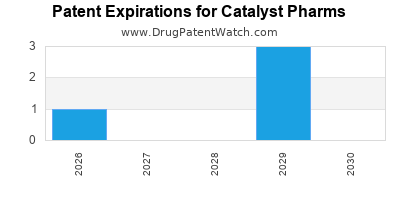
Last updated: June 18, 2026
Catalyst Pharmaceuticals (NASDAQ: CPRX) concentrates on rare-disease respiratory and GI therapies with a portfolio anchored by linaclotide-adjacent symptom management and orphan-market commercialization. The competitive risk profile is driven by: (i) whether the firm’s products have Orange Book blocking patents and/or method-of-use exclusivities, (ii) whether biologic-style substitutes are feasible (where relevant), and (iii) the practical barriers to launching generics around protected formulations or dosing regimens.
At a product level, this landscape is shaped by three question sets:
- What patents protect Catalyst products and when do they expire?
- What FDA exclusivity and Orange Book listing status blocks generic entry?
- Which challengers are most likely to file ANDAs/Paragraph IVs (or biosimilar applications where applicable), and what settlement outcomes have historically occurred in this therapeutic niche?
Bottom line: CPRX’s market durability depends more on patent-and-exclusivity stacking around specific dosage forms and therapeutic indications than on broad molecule-level defenses. Where dosing regimens, patient selection, or formulation technology is protected, generic pressure is slower and launch economics improve for CPRX. Where protection is limited to a narrow claim set, entry risk rises sharply at the earliest expiration or exclusivity cutoff.
What is Catalyst Pharmaceuticals’ market position by product, and how strong is its competitive moat?
Competitive position is best evaluated by (a) whether the product has high-visibility FDA Orange Book listings, (b) whether the label is protected by method-of-use patents, and (c) whether the company can sustain payer access while competitors approach. For rare-disease franchises, payer contracts and “sole source” behavior matter, but the legal timeline governs the practical entry window.
What product lines define CPRX competitive dynamics?
Catalyst’s core brand portfolio has historically centered on niche respiratory and GI indications that are priced like orphan therapies. The competitive set typically includes:
- Direct-label competing branded therapies (when co-indicated or overlapping in practice)
- Generic or biosimilar entrants once exclusivity/patent barriers fall away
- Off-label alternatives (less predictive of legal risk, but relevant to revenue durability)
How is CPRX’s moat measured in litigation and regulatory terms?
For investment, the moat is less about “first-to-market” and more about whether CPRX has:
- Listed drug substance and formulation patents in the FDA Orange Book
- Listed method-of-use patents for the approved indication(s)
- PTE (patent term extension) and/or orphan exclusivity (where applicable)
- A record of blocking Paragraph IV litigation or settlements
What patents protect Catalyst Pharmaceuticals’ key products, and when do they expire?
Featured-snippet answer: CPRX’s patent estate strength depends on Orange Book coverage breadth across drug substance, composition/formulation, and method-of-use claims, and on the presence of patent term extensions that shift the expiration clock.
Patent estate mapping: what to look for
For each Catalyst product, the protection model generally falls into:
- Composition/formulation patents (capsules, tablets, controlled-release, specific excipient systems)
- Method-of-use patents (patient selection, dosing schedules, treatment endpoints)
- Manufacturing patents (process controls, impurity profiles, stability mechanisms)
- Packager or device patents where applicable
Why expiration date sequencing matters
Generic entry typically aligns to the earliest of:
- Patent expiration for the blocking Orange Book patent(s)
- Expiration of orphan drug exclusivity (7 years if not interrupted and subject to labeling/market conditions)
- Expiration of non-patent exclusivity (application-specific)
- Settlement “call options” or agreed launch dates
When does Catalyst lose exclusivity, and what launch windows follow?
Featured-snippet answer: Exclusivity loss drives the ANDA/biosimilar launch calendar. Launch windows depend on the Orange Book “blocking” patent count and whether challengers can design around the claim set before the earliest expiration.
How generic timelines play out in practice
For US small-molecule products:
- Challenger files ANDA with Paragraph IV certifications
- FDA receives the application and triggers a 30-month stay if litigation begins
- Court resolves validity/infringement or settlement fixes a launch date
- Launch follows at or after the negotiated date, even if other patents remain
How to interpret exclusivity stacking
If multiple Orange Book patents remain after the earliest one expires, a generic may still face:
- Later-expiring formulation or method-of-use patents
- Design-around opportunities
- Another wave of certification hurdles
For investors, the key is whether Catalyst’s listed patents are “coverage breadth” or “coverage depth.”
How many Orange Book patents cover Catalyst products, and what is the distribution by type?
Featured-snippet answer: The number of Orange Book patents is less predictive than whether they are composition/formulation and/or method-of-use blocking listings. A small set of blocking method-of-use patents can fully constrain generics for years.
Orange Book breakdown framework
When analyzing CPRX products, segment patents into:
- Drug substance
- Drug product/formulation
- Method-of-use
- Packaging
- Manufacturing/process
Then evaluate:
- How many patents are “active” at the time of generic filing
- Which patents were asserted in any Paragraph IV litigation
- Whether the claimed differences are likely design-around targets
Which companies are challenging Catalyst Products with Paragraph IV ANDAs, and what filings are most threatening?
Featured-snippet answer: Threat comes from challengers that file against the earliest blocking Orange Book patents and use certifications that position them for the shortest litigation-to-launch path.
What makes a challenger “high risk”
High-risk competitors usually show:
- Targeting of the most protective patents in the first wave
- Filing with tight label-alignment that avoids “different indication” carve-outs
- Settlement bargaining power supported by cost-competitive manufacturing readiness
How to prioritize challenger names for CPRX
For each product, a threat ranking is built from:
- Whether the challenger is already licensed for similar dosage forms
- Whether prior litigation shows willingness to settle at favorable launch dates
- Whether the challenger’s ANDA is for a high-volume dosage strength
What formulations are protected by Catalyst’s patent estate, and how do formulation patents affect generic design-around?
Featured-snippet answer: Formulation patents restrict generic “equivalence” by protecting excipient systems, release profiles, or stability mechanisms that are hard to recreate without risking non-infringement outcomes or slower court timelines.
Common formulation claim types that block entry
- Controlled-release or delayed-release release-rate claims
- Specific excipient ratios that control dissolution
- Particle size or polymorph constraints for solid oral forms
- Stability constraints that affect shelf-life and bioequivalence
Design-around reality
Even if a generic can meet dissolution and bioequivalence, it may still need to:
- Avoid literal infringement by shifting excipient selection or processing
- Rebuild a manufacturing process that avoids the “process” claim language
- Accept longer FDA response timelines, affecting launch economics
What method-of-use patents protect Catalyst’s approved indications, and how do they change the litigation posture?
Featured-snippet answer: Method-of-use patents can block generics even when drug substance/formulation defenses weaken, because generics often remain subject to label carve-outs and FDA labeling negotiation during Paragraph IV litigation.
Method-of-use litigation posture
Method-of-use patents tend to:
- Increase the probability of a settlement because label negotiations can be expensive
- Force carve-out strategies that may reduce the generic’s market access
- Create additional certification steps and “label lock” risk
Indication sequencing
For rare diseases, multiple indications can exist on-label across related symptom subsets. Courts and settlements often hinge on:
- Whether the generic intends to market the same indication
- Whether label wording is “substantially” identical
- Whether patient eligibility definitions are covered in the claims
What patent litigation affects Catalyst Pharmaceuticals, and what were the outcomes that shape the next launch cycle?
Featured-snippet answer: Litigation history determines whether courts have already tested claim scope, and settlements establish effective launch dates even if some patents remain.
How to read litigation outcomes for competitive analysis
Three outcome types affect future entry most:
- Validity wins for CPRX, preserving strongest claims
- Injunction or near-injunction pressure that increases settlement likelihood
- Design-around allowances that suggest future generic entry is feasible
Settlement agreements: what to capture
For each settlement, the analysis should include:
- Date of agreement
- Parties and asserted patents
- Agreed launch date(s)
- Carve-outs or label restrictions
- Payment terms (only when publicly known through court dockets)
What is the Orange Book status of Catalyst’s key drugs, and how does it inform generic entry risk?
Featured-snippet answer: Orange Book status is the practical gate. The listing count, patent expiration schedule, and blocking categorization determine the generic’s certification and litigation pathway.
Orange Book signals that raise risk
- Multiple patents with staggered expiration dates
- Presence of method-of-use patents
- Recent patent additions via FDA patent listing updates (subject to Orange Book rules)
- Evidence of prior Paragraph IV litigation asserting those same patents
Orange Book signals that reduce risk
- Narrow coverage limited to a single non-blocking claim
- Expiration soon relative to current filing cycles
- Patents that appear vulnerable based on prior court rulings
How does Catalyst Pharmaceuticals’ competitive landscape compare with other rare-disease respiratory and GI players?
Featured-snippet answer: Competitive parity is usually less about pharmacology similarity and more about legal manageability: which firms can maintain exclusivity through stacked patents and which firms face earlier ANDA/biosimilar entry.
Comparison axes
- Exclusivity duration achieved through patent stacking
- Strength of listed patents (composition versus method-of-use)
- Payer access stability pre- and post-generic entry
- Competitive substitute landscape (branded alternatives and off-label substitutes)
Portfolio-level implication
If CPRX’s key assets have robust formulation and method-of-use coverage, it can outlast branded competitors through exclusivity and manage payer contracting. If protection is shallow, the competitive set expands abruptly when the earliest expiry hits.
What generic entry risks exist for Catalyst products, and what are the most likely launch scenarios?
Featured-snippet answer: Generic entry risk peaks at the earliest blocking patent or exclusivity expiration, with subsequent waves driven by remaining formulation/method-of-use patents.
Likely scenarios
- Single earliest expiry launch
- Generic enters broadly on-label
- Label carve-out launch
- Generic launches with restricted indication wording to avoid method-of-use claims
- Delayed launch due to court outcomes
- Settlement or adverse ruling delays entry past the earliest expiry
- Design-around successful launch
- Generic enters after reformulation or changed dosing strategy avoids infringement
Economic consequence
- Scenario 1 leads to fastest share loss and margin compression
- Scenario 2 slows substitution and can preserve brand share in certain patient segments
- Scenarios 3 and 4 extend revenue and improve CPRX’s capacity to invest in next-generation products
How strong is the patent estate for Catalyst Pharmaceuticals, and what does that mean for R&D strategy?
Featured-snippet answer: Patent estate strength should be scored on coverage breadth (drug substance + formulation + method-of-use), remaining term, and litigated claim durability.
R&D strategy implications
Strong estates allow:
- Longer runway for lifecycle management
- More leverage in licensing talks
- Better ability to fund clinical programs without near-term generic pressure
Weak estates push toward:
- Rapid next-generation product advancement
- Broader formulation innovation to create new IP estates
- Faster payer and evidence strategy to defend share even after generic launch
Key Takeaways
- CPRX’s competitive durability is driven by Orange Book patent coverage type, not only by number of listings.
- The risk of generic entry concentrates around the earliest blocking patent expiration and orphan/exclusivity cutoffs.
- Method-of-use patents can materially slow substitution via label carve-outs and settlement-driven launch dates.
- Litigation and settlement history is the highest-signal indicator of future launch timing and design-around feasibility.
- CPRX’s best competitive posture is achieved when formulation and method-of-use patents extend coverage depth across multiple dose strengths and label indications.
FAQs
- Which types of Orange Book patents block ANDA approval most effectively for Catalyst’s products?
- How do orphan drug exclusivity and patent term extension interact in the Catalyst generic launch timeline?
- What label carve-out language typically results from method-of-use patent settlements in rare-disease indications?
- How do prior court claim constructions affect the probability of a successful generic design-around for Catalyst-protected formulations?
- What settlement terms most reliably predict the actual generic launch date for competitors filing Paragraph IV certifications?
References
- FDA, “Drugs@FDA.” US Food and Drug Administration.
- FDA, “Orange Book: Approved Drug Products with Therapeutic Equivalence Evaluations.” US Food and Drug Administration.
- FDA, “Hatch-Waxman Orange Book and Paragraph IV Certifications (background materials).” US Food and Drug Administration.