Last updated: September 28, 2026
ESTRING is a low-dose estradiol vaginal ring for postmenopausal atrophic vaginitis. Its market position rests on a differentiated 90-day delivery system, limited direct competition, and persistent manufacturing and reimbursement constraints. The product’s original pharmaceutical patent estate is mature, and the principal commercial barriers are now device complexity, limited market size, manufacturing capacity, and payer substitution rather than long-dated composition-of-matter exclusivity.
Pfizer does not report ESTRING revenue separately. Public financial filings therefore do not support a product-level revenue series or a reliable standalone valuation. ESTRING remains commercially relevant within the local estrogen market, but it is a small product relative to Pfizer’s major oncology, immunology, vaccine, and cardiovascular franchises.
What is ESTRING and how does the product generate revenue?
ESTRING contains 2 mg of estradiol in a silicone vaginal ring that releases approximately 7.5 micrograms of estradiol per day for 90 days. It is inserted vaginally and replaced quarterly. The FDA-approved indication is treatment of moderate-to-severe symptoms of vulvar and vaginal atrophy caused by menopause, including vaginal dryness and irritation.[1]
| Product attribute |
ESTRING detail |
| Active ingredient |
Estradiol |
| Dosage form |
Vaginal ring |
| Strength |
2 mg ring |
| Release rate |
Approximately 7.5 mcg/day |
| Replacement interval |
90 days |
| FDA application |
NDA 020472 |
| Route |
Vaginal |
| Primary indication |
Postmenopausal vulvar and vaginal atrophy |
| Regulatory status |
FDA-approved prescription product |
| Manufacturer/label holder |
Pfizer-associated U.S. product labeling |
| Biosimilar exposure |
None |
| Direct generic exposure |
Limited by ring-device and manufacturing requirements |
The annual treatment pattern is approximately four rings per patient. Revenue is therefore driven by the number of treated patients, refill persistence, list price, net payer reimbursement, and the proportion of prescriptions retained against estradiol creams and tablets.
What is the FDA and Orange Book status of ESTRING?
ESTRING is an FDA-approved new drug application product listed in the Orange Book under estradiol vaginal ring technology.[2] It is a drug-device combination in practical commercial terms because the active ingredient is incorporated into a polymeric delivery system.
The product has long passed the period of ordinary new chemical entity exclusivity. Any current commercial protection must therefore come from listed patents, regulatory exclusivity, manufacturing know-how, trademarks, or market-specific execution.
The FDA labeling includes the standard boxed-warning framework applicable to systemic estrogen products, including risks related to endometrial cancer, cardiovascular events, breast cancer, and probable dementia in certain systemic hormone-therapy settings. The label also recognizes that systemic exposure from low-dose vaginal estrogen is low, although the prescribing information retains class warnings.[1]
Does ESTRING have FDA exclusivity remaining?
No meaningful FDA exclusivity period remains from the original approval. ESTRING was approved decades ago, and any original five-year new chemical entity exclusivity and three-year clinical-investigation exclusivity have expired.
The commercial question is therefore generic availability, not the survival of FDA exclusivity.
What patents protect ESTRING?
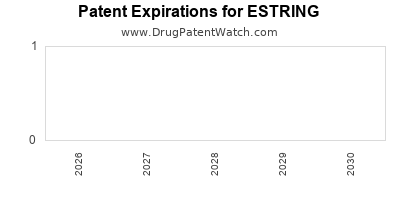
The core patent estate associated with ESTRING is mature. Historical patents covering estradiol vaginal rings, silicone drug-delivery systems, and related release technologies would generally have expiration dates well before 2024. No long-dated composition-of-matter patent should be assumed to protect current ESTRING sales.
| Protection category |
Current commercial assessment |
| Estradiol active ingredient |
Long expired |
| Original vaginal-ring technology |
Mature or expired |
| 90-day release profile |
Potentially relevant as formulation and device know-how, but not presumed to have live blocking patents |
| Manufacturing process |
Could remain protected as trade secret or process know-how |
| Trademark |
ESTRING brand remains commercially relevant |
| FDA exclusivity |
Expired |
| Device-related barriers |
Material even without patent exclusivity |
A definitive litigation or launch analysis should distinguish between patents listed in the Orange Book, patents outside the Orange Book, device patents, process patents, and trade secrets. Only Orange Book-listed patents create the standard statutory framework for a Paragraph IV certification against an ANDA applicant.
Publicly available product materials do not establish a current, long-duration patent moat comparable with newer branded pharmaceuticals. The principal risk is that a technically capable generic manufacturer could reproduce the ring and demonstrate pharmaceutical equivalence.
When does ESTRING lose exclusivity?
ESTRING’s conventional exclusivity has already expired. There is no expected future cliff comparable with a product that still has active composition-of-matter protection.
The relevant timeline is:
| Event |
Timing |
| Original FDA approval |
1990s |
| NCE exclusivity |
Expired |
| Original formulation and delivery patents |
Generally mature or expired |
| Current commercial period |
Post-exclusivity |
| Generic entry trigger |
ANDA approval, manufacturing readiness, and commercial launch |
| Current principal risk |
Generic or authorized-generic substitution |
The absence of a current patent cliff does not mean immediate generic erosion. Generic entry depends on FDA approval, production capacity, bioequivalence or pharmaceutical-equivalence requirements, device reproducibility, reimbursement access, and commercial economics.
Which companies are challenging ESTRING with generics?
The competitive threat is primarily from manufacturers of generic estradiol products rather than from biosimilar developers. ESTRING is a small-molecule product and is not eligible for a biosimilar pathway.
Potential competitors fall into four groups:
- Generic manufacturers developing an equivalent estradiol vaginal ring.
- Manufacturers selling estradiol vaginal tablets or inserts.
- Manufacturers selling estradiol vaginal creams.
- Branded manufacturers selling alternative vaginal estrogen or selective estrogen receptor products.
The absence of a widely established, broadly marketed generic ESTRING equivalent through the latest publicly available information reflects the product’s technical and economic profile. A ring must provide consistent estradiol release over approximately 90 days, maintain mechanical integrity, meet sterility and biocompatibility requirements, and satisfy FDA requirements for pharmaceutical equivalence and device performance.
An ANDA applicant could challenge any Orange Book-listed patent through Paragraph IV certification. A public Paragraph IV challenge should not be inferred merely from the age of the product. A product can remain generic-free because the market is small, development costs are high, or the reference product is difficult to reproduce.
What formulations are protected by ESTRING technology?
The principal technical value is the sustained-release vaginal ring rather than estradiol itself.
Vaginal ring
The ring provides quarterly administration and avoids the daily or twice-weekly dosing associated with many vaginal estrogen products. This reduces administration burden and may improve persistence for patients who prefer a device-based treatment.
Vaginal creams
Estradiol and conjugated-estrogen creams are flexible in dosing and may have lower acquisition costs. Their disadvantages include mess, variable administration, and more frequent dosing.
Vaginal tablets and inserts
Products such as generic estradiol vaginal tablets generally offer lower-dose regimens and simpler dispensing. They compete directly with ESTRING for low-dose local estrogen treatment, particularly when formularies prefer generic tablets.
Systemic estrogen rings
Femring is a distinct product with a higher estradiol release profile and systemic indications. It should not be treated as a direct generic substitute for ESTRING. The products differ in dose, indication, and systemic exposure.
How does ESTRING compare with Vagifem, Imvexxy, creams, and Femring?
| Product or category |
Dosage form |
Typical use pattern |
Commercial position versus ESTRING |
| ESTRING |
90-day vaginal ring |
Quarterly replacement |
Convenience and persistence; higher device complexity |
| Generic estradiol vaginal tablets |
Vaginal tablet |
Daily initiation, then maintenance dosing |
Lower-cost substitution risk |
| Vaginal estrogen creams |
Cream |
Usually multiple administrations weekly |
Flexible dosing; mess and adherence burden |
| Imvexxy |
Softgel vaginal insert |
Maintenance dosing several times weekly |
Branded alternative with lower device complexity |
| Femring |
Systemic vaginal ring |
Ring replacement generally every 90 days |
Different dose and systemic indication |
| Osphena |
Oral ospemifene |
Daily oral treatment |
Non-estrogen local alternative with different risk profile |
ESTRING’s strongest advantage is convenience. Its main disadvantages are price, insertion and removal requirements, clinician or patient acceptance of a retained vaginal device, and limited pharmacy substitution.
The product is most exposed to generic estradiol tablets and creams when insurers apply step therapy or impose high patient cost sharing. It is less exposed when patients prioritize quarterly dosing and remain stable on the ring.
What is the market size and financial trajectory for ESTRING?
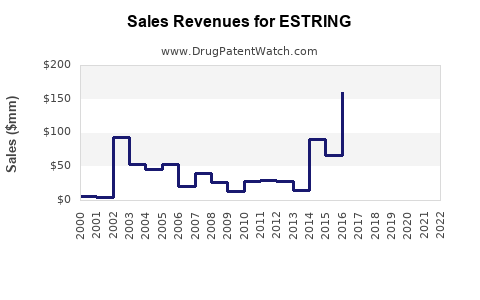
Pfizer’s SEC filings do not separately disclose ESTRING revenue, gross margin, patient volume, or geographic sales. Pfizer reports at segment and portfolio levels, so ESTRING financial performance cannot be isolated from public annual reports.[3]
The product’s financial trajectory is best characterized as mature and defensively stable rather than high growth:
| Financial driver |
Directional impact |
| Menopausal genitourinary symptoms |
Supports durable underlying demand |
| Aging female population |
Supports patient pool expansion |
| Generic estradiol tablets and creams |
Creates price and volume pressure |
| Lack of direct ring substitutes |
Supports retention among existing users |
| Quarterly dosing |
Supports persistence |
| Device manufacturing cost |
Limits margin compared with tablets |
| Reimbursement restrictions |
Reduces net price and access |
| Product shortages |
Can cause temporary volume loss and switching |
| Brand awareness |
Supports prescription continuity in established users |
Revenue is likely concentrated in the U.S. market, where the product has the strongest brand recognition and reimbursement infrastructure. International sales may be limited by local regulatory approvals, pricing controls, and differences in hormone-therapy prescribing.
Because Pfizer does not disclose ESTRING revenue, analysts should not use total Pfizer women’s-health or established-products revenue as a proxy without a product allocation methodology. Retail prescription data, payer claims, IQVIA data, and wholesaler information are required for a defensible revenue estimate.
What manufacturing and intellectual-property barriers affect ESTRING?
Manufacturing is a more important barrier than basic estradiol synthesis. The active ingredient is inexpensive and widely available. The technical challenge lies in producing a ring with reproducible drug loading, release kinetics, dimensional stability, sterilization compatibility, packaging integrity, and shelf life.
Key barriers include:
- Consistent estradiol distribution within the polymer matrix.
- Stable release over the full 90-day period.
- Reproducible ring dimensions and mechanical properties.
- Control of extractables and leachables.
- Validation of cleaning and sterilization processes.
- Scale-up without changing release performance.
- Reliable supply of pharmaceutical-grade elastomer and components.
- FDA demonstration of equivalence for the finished product.
These requirements can discourage entry even where patent protection is weak. They also create supply-chain exposure for the incumbent. A manufacturing disruption can produce temporary shortages, force patient switching, and accelerate prescriber adoption of tablets or creams.
What patent litigation and settlement agreements affect ESTRING?
No major, publicly established ESTRING patent litigation or settlement agreement is central to the product’s current commercial profile through the latest publicly available information.
That assessment does not eliminate litigation risk. A future ANDA applicant could bring a Paragraph IV challenge if an Orange Book-listed patent were identified. Potential disputes could concern:
- Ring composition.
- Drug-release kinetics.
- Polymer formulation.
- Manufacturing methods.
- Device dimensions or insertion characteristics.
- Labeling for the approved indication.
A settlement would be commercially significant only if it delayed generic launch or established an authorized-generic arrangement. No widely reported settlement has created a known future launch date for an ESTRING generic.
What regulatory risks affect ESTRING?
The principal regulatory risks are product quality, supply continuity, labeling, and generic substitution.
FDA scrutiny may focus on:
- Uniformity of estradiol release.
- Product degradation.
- Packaging and storage conditions.
- Device integrity after insertion and removal.
- Manufacturing-site compliance.
- Adverse-event monitoring associated with estrogen exposure.
The product also competes in a regulatory environment where FDA and professional societies increasingly distinguish low-dose local vaginal estrogen from higher-exposure systemic hormone therapy. This distinction can influence patient counseling, prescriber behavior, and market access, but it does not remove class labeling requirements from the approved label.[1]
What generic launch scenarios exist for ESTRING?
Scenario 1: No near-term direct generic
This is the most favorable scenario for the branded product. ESTRING retains a niche based on convenience, physician familiarity, and patient persistence. Erosion continues through tablets, creams, and other local therapies rather than direct ring substitution.
Scenario 2: One approved generic ring
A single generic could produce rapid price pressure but may initially have limited supply. The brand could retain patients with favorable coverage, loyalty, or physician preference. Net pricing would likely decline before total volume falls materially.
Scenario 3: Multiple generic entrants
Several suppliers would create the greatest erosion risk. Pharmacy benefit managers could impose automatic substitution, and ESTRING could lose both volume and price. The ring’s technical complexity may limit the number of durable entrants, but a successful first entrant could validate the market.
Scenario 4: Authorized generic
An authorized generic could preserve manufacturing utilization while reducing the branded list-price premium. This structure would allow the originator to participate in post-exclusivity volume while reducing the attractiveness of independent generic entry.
How strong is the ESTRING patent estate?
The patent estate is weak as a long-term exclusivity asset but the product has moderate commercial defensibility.
| Dimension |
Assessment |
| Active-ingredient protection |
Weak; expired |
| Regulatory exclusivity |
None remaining |
| Patent duration |
Mature |
| Device complexity |
Moderate to high |
| Manufacturing know-how |
Potentially meaningful |
| Brand retention |
Moderate among established users |
| Reimbursement protection |
Variable |
| Direct generic substitution risk |
Moderate |
| Alternative-product pressure |
High |
| Long-term growth potential |
Limited |
ESTRING is therefore better analyzed as a mature branded pharmaceutical with operational and market-retention value, not as a patent-protected growth asset.
What geographic coverage does ESTRING have?
The United States is the most commercially important market because of the product’s established FDA approval, brand recognition, and prescription reimbursement infrastructure. International performance depends on country-specific approvals and the availability of local estradiol rings.
Geographic risks include:
- Reference-pricing systems.
- Tender-based reimbursement.
- Local generic substitution rules.
- Different hormone-therapy guidelines.
- Currency movements.
- Country-specific manufacturing or supply requirements.
A generic entrant does not need global approval to affect U.S. economics. U.S. ANDA approval alone could materially change the product’s domestic price and volume profile.
Key Takeaways
- ESTRING is a 90-day, low-dose estradiol vaginal ring approved under NDA 020472.
- Its FDA exclusivity period has expired, and its original patent estate is mature.
- No biosimilar pathway applies because ESTRING contains a small-molecule active ingredient.
- The main competitive risks are generic estradiol tablets, creams, inserts, and a future direct generic vaginal ring.
- Device reproducibility, release kinetics, manufacturing validation, and limited market scale can delay direct generic entry.
- Pfizer does not disclose ESTRING revenue separately, so product-level financial estimates require prescription, claims, or commercial audit data.
- The product’s financial profile is mature, with durable demand but limited growth and meaningful reimbursement exposure.
- No major publicly established ESTRING Paragraph IV settlement or patent litigation defines the current market.
- An authorized generic would be the most credible strategy for preserving post-exclusivity volume while controlling price erosion.
FAQs
Is ESTRING still FDA approved?
Yes. ESTRING remains an FDA-approved estradiol vaginal ring for postmenopausal vulvar and vaginal atrophy under NDA 020472.[1]
Is there a generic version of ESTRING?
A broadly established, widely marketed direct generic equivalent was not evident in the latest publicly available information through June 2024. Generic estradiol tablets, inserts, and creams are available and compete with ESTRING clinically.
Does ESTRING have a patent that prevents generic entry?
The original patent protection is mature. Any current generic barrier would more likely arise from technical development, manufacturing requirements, device performance, or a specific live listed patent rather than basic estradiol protection.
How often is ESTRING replaced?
The ring is designed to remain in place for 90 days and is then replaced with a new ring.[1]
Is ESTRING more expensive than generic vaginal estradiol?
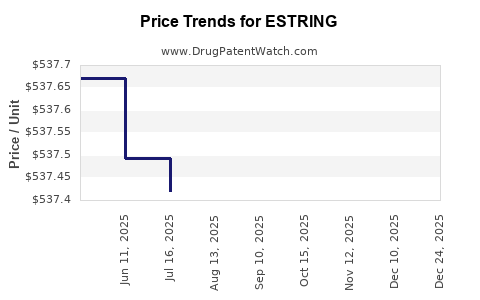
Usually, the ring has a higher acquisition cost than generic estradiol tablets or creams. Actual patient cost depends on insurance coverage, formulary placement, deductibles, and pharmacy benefit design.
References
-
U.S. Food and Drug Administration. (2023). ESTRING (estradiol) vaginal insert prescribing information. Pfizer Laboratories.
-
U.S. Food and Drug Administration. (2024). Approved drug products with therapeutic equivalence evaluations: Orange Book. FDA.
-
Pfizer Inc. (2024). Annual report pursuant to Section 13 or 15(d) of the Securities Exchange Act of 1934 for the fiscal year ended December 31, 2023. Pfizer Inc.
-
U.S. Food and Drug Administration. (2024). Drugs@FDA: ESTRING, NDA 020472. FDA.
-
The North American Menopause Society. (2022). The 2022 hormone therapy position statement of The North American Menopause Society. Menopause, 29(7), 767-794.