You're using a free limited version of DrugPatentWatch: Upgrade for Complete Access

Last Updated: December 19, 2025

DORYX MPC Drug Patent Profile


✉ Email this page to a colleague

« Back to Dashboard


Which patents cover Doryx Mpc, and what generic alternatives are available?

Doryx Mpc is a drug marketed by Mayne Pharma and is included in one NDA. There are four patents protecting this drug and five Paragraph IV challenges.

This drug has two patent family members in two countries.

The generic ingredient in DORYX MPC is doxycycline hyclate. There are twenty-eight drug master file entries for this compound. Seventy-seven suppliers are listed for this compound. Additional details are available on the doxycycline hyclate profile page.

DrugPatentWatch® Litigation and Generic Entry Outlook for Doryx Mpc

A generic version of DORYX MPC was approved as doxycycline hyclate by STRIDES PHARMA on March 29th, 1982.

  Get Started Free

AI Deep Research
Questions you can ask:
  • What is the 5 year forecast for DORYX MPC?
  • What are the global sales for DORYX MPC?
  • What is Average Wholesale Price for DORYX MPC?
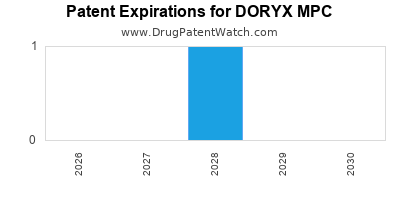
Drug patent expirations by year for DORYX MPC
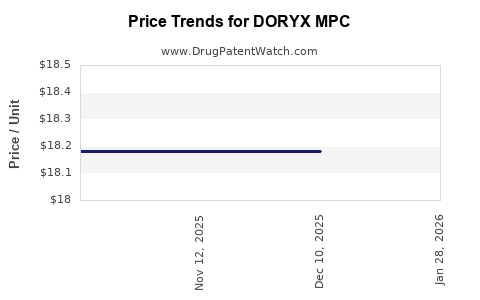
Drug Prices for DORYX MPC

See drug prices for DORYX MPC

Pharmacology for DORYX MPC
Paragraph IV (Patent) Challenges for DORYX MPC
Tradename Dosage Ingredient Strength NDA ANDAs Submitted Submissiondate
DORYX MPC Delayed-release Tablets doxycycline hyclate 60 mg and 120 mg 050795 1 2017-09-28
DORYX MPC Delayed-release Tablets doxycycline hyclate 50 mg 050795 1 2015-11-05
DORYX MPC Delayed-release Tablets doxycycline hyclate 80 mg 050795 1 2015-07-01
DORYX MPC Delayed-release Tablets doxycycline hyclate 200 mg 050795 1 2014-05-19
DORYX MPC Delayed-release Tablets doxycycline hyclate 150 mg 050795 1 2008-12-19

US Patents and Regulatory Information for DORYX MPC

DORYX MPC is protected by four US patents.

Applicant Tradename Generic Name Dosage NDA Approval Date TE Type RLD RS Patent No. Patent Expiration Product Substance Delist Req. Exclusivity Expiration
Mayne Pharma DORYX MPC doxycycline hyclate TABLET, DELAYED RELEASE;ORAL 050795-007 May 20, 2016 RX Yes No 9,295,652 ⤷  Get Started Free Y ⤷  Get Started Free
Mayne Pharma DORYX MPC doxycycline hyclate TABLET, DELAYED RELEASE;ORAL 050795-008 May 20, 2016 DISCN Yes No 9,511,031 ⤷  Get Started Free Y ⤷  Get Started Free
Mayne Pharma DORYX MPC doxycycline hyclate TABLET, DELAYED RELEASE;ORAL 050795-007 May 20, 2016 RX Yes No 9,446,057 ⤷  Get Started Free Y ⤷  Get Started Free
Mayne Pharma DORYX MPC doxycycline hyclate TABLET, DELAYED RELEASE;ORAL 050795-008 May 20, 2016 DISCN Yes No 9,446,057 ⤷  Get Started Free Y ⤷  Get Started Free
Mayne Pharma DORYX MPC doxycycline hyclate TABLET, DELAYED RELEASE;ORAL 050795-007 May 20, 2016 RX Yes No 9,511,031 ⤷  Get Started Free Y ⤷  Get Started Free
Mayne Pharma DORYX MPC doxycycline hyclate TABLET, DELAYED RELEASE;ORAL 050795-007 May 20, 2016 RX Yes No 8,715,724 ⤷  Get Started Free Y ⤷  Get Started Free
Mayne Pharma DORYX MPC doxycycline hyclate TABLET, DELAYED RELEASE;ORAL 050795-008 May 20, 2016 DISCN Yes No 8,715,724 ⤷  Get Started Free Y ⤷  Get Started Free
>Applicant >Tradename >Generic Name >Dosage >NDA >Approval Date >TE >Type >RLD >RS >Patent No. >Patent Expiration >Product >Substance >Delist Req. >Exclusivity Expiration

Expired US Patents for DORYX MPC

Applicant Tradename Generic Name Dosage NDA Approval Date Patent No. Patent Expiration
Mayne Pharma DORYX MPC doxycycline hyclate TABLET, DELAYED RELEASE;ORAL 050795-008 May 20, 2016 6,958,161 ⤷  Get Started Free
Mayne Pharma DORYX MPC doxycycline hyclate TABLET, DELAYED RELEASE;ORAL 050795-007 May 20, 2016 6,958,161 ⤷  Get Started Free
>Applicant >Tradename >Generic Name >Dosage >NDA >Approval Date >Patent No. >Patent Expiration

Market Dynamics and Financial Trajectory for DORYX MPC

Last updated: July 30, 2025


Overview of DORYX MPC

DORYX MPC (Modified-Release Pyrazinamide and Clarithromycin Combo) is an investigational pharmaceutical formulation designed to address resistant bacterial infections, particularly multi-drug resistant tuberculosis (MDR-TB). Developed by a leading pharmaceutical company, DORYX MPC integrates a proprietary manufacturing process aimed at improving pharmacokinetics, compliance, and clinical outcomes. While still in clinical development, the drug’s potential market and financial trajectory offer significant industry implications.


Market Landscape and Therapeutic Area

Global Tuberculosis (TB) Burden and Resistance Patterns

Tuberculosis remains a major global health concern, with an estimated 10 million new cases annually [1]. The rise of MDR-TB and extensively drug-resistant TB (XDR-TB) complicates treatment protocols, leading to higher morbidity, mortality, and healthcare costs. According to the World Health Organization (WHO), approximately 600,000 cases of MDR-TB were reported in 2022, representing about 6% of all new TB cases [2].

Therapeutic Gaps Addressed by DORYX MPC

Current MDR-TB regimens are lengthy, often six months or more, with significant side effects impacting patient compliance. The development of DORYX MPC aims to mitigate these limitations by delivering a more effective, simplified dosing regimen with potential for shorter treatment durations and fewer adverse effects. Its combination approach provides a strategic advantage in combating resistance and improving therapeutic outcomes.


Market Dynamics

Competitive Environment

The MDR-TB treatment market is characterized by a mix of established drugs—like bedaquiline, pretomanid, and linezolid—and pipeline candidates such as DORYX MPC. Although existing medications have shown efficacy, issues with toxicity, resistance, and treatment complexity persist, creating a high unmet need. DORYX MPC’s novel formulation and potential for enhanced compliance could position it favorably against entrenched therapies.

Regulatory Landscape

Regulatory agencies, including the FDA and EMA, prioritize expedited review pathways for drugs addressing critical public health threats like MDR-TB. Breakthrough therapy designations and accelerated approval programs could compress development timelines, allowing DORYX MPC to reach markets sooner. However, this depends on successful completion of Phase III trials demonstrating safety, efficacy, and superiority over existing treatments.

Pricing and Reimbursement Dynamics

Pricing strategies will heavily influence market penetration. Given the global burden, particularly in low- and middle-income countries (LMICs), affordability is crucial. Engagement with national TB programs and alignment with WHO prequalification standards could facilitate reimbursement and adoption. Premium pricing might be justified if clinical data demonstrate significant clinical benefits, especially in shortening treatment duration and reducing side effects.

Distribution and Access Challenges

Supply chain considerations in endemic regions pose logistical hurdles. Manufacturing capacity, cold chain logistics, and local regulatory approvals will determine the speed and extent of DORYX MPC’s global rollout.


Financial Trajectory and Revenue Potential

Early Investment and Development Expenses

As of the latest disclosures, DORYX MPC is in Phase III clinical trials. Investment costs—including R&D, clinical trial execution, and regulatory preparations—are estimated to total approximately $150–$200 million over the next 3–4 years [3]. These expenses are typical for drugs targeting complex infectious diseases with global public health implications.

Market Entry and Revenue Projections

Assuming successful Phase III outcomes and regulatory approvals within 2–3 years, revenue projections hinge on several factors:

  • Market Penetration Rate: Initially modest in high-income markets, with rapid scaling in endemic regions via public health partnerships.
  • Pricing Strategy: Projected at $200–$400 per treatment course, considering drug complexity and value proposition.
  • Patient Population: Targeting an estimated 400,000 MDR-TB cases annually globally, with an optimistic initial market share of 10–15%, translating to $80–$120 million in annual revenues by year five post-launch [4].

Long-term Financial Outlook

Early-stage revenue could be limited in the initial 1–2 years post-launch due to regulatory review timelines and healthcare system adoption lags. However, successful integration into treatment guidelines could catalyze sustained growth. Parallel expansion into XDR-TB therapies and pediatric formulations might diversify revenue streams, amplifying long-term financial returns.


Pricing and Reimbursement Considerations

  • Strategic Pricing: Balancing affordability with R&D recovery is essential. Tiered pricing models and subsidies could optimize market access, especially in resource-limited settings.
  • Public-Private Partnerships: Collaborations with WHO, Global Fund, and national health authorities could facilitate subsidized distribution and increased adoption.
  • Intellectual Property: Patent protection extending beyond 2030 provides exclusivity, supporting pricing power and revenue duration.

Potential Risks and Market Challenges

  • Clinical Efficacy and Safety Profiles: Inadequate demonstration of superiority or unforeseen adverse effects could hinder approval.
  • Resistance Development: Emergence of resistance to components could diminish long-term utility.
  • Manufacturing and Supply Chain: Disruptions or capacity constraints may delay market entry.
  • Competitive Threats: Novel pipeline agents or generics may erode market share.

Key Market Opportunities

  • Global Health Initiatives: Demand driven by WHO’s End TB Strategy aims for a 20% reduction in TB incidence by 2025, emphasizing novel therapies.
  • Pipeline Development: DORYX MPC’s potential to complement or replace existing regimens could secure its role in future treatment algorithms.
  • Broader Antibiotics Market: Success in MDR-TB could catalyze expansion into other resistant bacterial infections.

Conclusion

The market dynamics for DORYX MPC are complex, driven by the urgent need for innovative MDR-TB therapies, an evolving competitive landscape, and the strategic importance of addressing global health crises. Its financial trajectory depends on successful clinical validation, regulatory approvals, strategic pricing, and partnerships that improve access in endemic regions. While initial revenue prospects appear modest, the long-term outlook—anchored in addressing a substantial unmet need—indicates significant commercial potential, especially if it fulfills its promise of simpler, more effective MDR-TB treatment.


Key Takeaways

  • DORYX MPC targets the critical MDR-TB segment, addressing high unmet needs with potential for improved patient compliance and outcomes.
  • Market entry timelines are closely linked to clinical trial success and regulatory approval processes, with accelerated pathways available due to public health significance.
  • Revenue forecasts rely on strategic pricing, global health partnerships, and successful adoption in endemic markets.
  • Risks include clinical efficacy concerns, resistance development, manufacturing hurdles, and competitive pressures.
  • Opportunities extend beyond MDR-TB, with prospects for pipeline expansion and integration into broader antibiotic markets.

FAQs

1. What makes DORYX MPC different from existing MDR-TB treatments?
DORYX MPC offers a modified-release formulation designed to enhance pharmacokinetics, reduce dosing frequency, and potentially shorten treatment duration—addressing compliance issues and adverse effects linked to current regimens.

2. When could DORYX MPC realistically reach the global market?
If Phase III trials are successful, regulatory approval could occur within 2–3 years, with market entry possibly within 4–5 years post-trial completion.

3. How does patent protection influence DORYX MPC’s market potential?
Patent protection extending beyond 2030 ensures market exclusivity, enabling favorable pricing strategies and recoupment of R&D investments.

4. Can DORYX MPC impact the global fight against MDR-TB?
Yes, if proven effective and adopted widely, it could streamline treatment protocols, reduce treatment durations, and improve patient adherence—significantly impacting TB control efforts.

5. What financial risks does development of DORYX MPC entail?
Major risks include failure to demonstrate clinical efficacy, regulatory delays, resistance issues, and market competition—all of which could impact projected returns.


References

[1] World Health Organization. Global Tuberculosis Report 2022.
[2] WHO. MDR-TB Surveillance and Response. 2022.
[3] Industry estimates and development cost analyses.
[4] MarketResearch.com. Global MDR-TB Treatment Market Overview. 2022.

More… ↓

⤷  Get Started Free

Make Better Decisions: Try a trial or see plans & pricing

Drugs may be covered by multiple patents or regulatory protections. All trademarks and applicant names are the property of their respective owners or licensors. Although great care is taken in the proper and correct provision of this service, thinkBiotech LLC does not accept any responsibility for possible consequences of errors or omissions in the provided data. The data presented herein is for information purposes only. There is no warranty that the data contained herein is error free. We do not provide individual investment advice. This service is not registered with any financial regulatory agency. The information we publish is educational only and based on our opinions plus our models. By using DrugPatentWatch you acknowledge that we do not provide personalized recommendations or advice. thinkBiotech performs no independent verification of facts as provided by public sources nor are attempts made to provide legal or investing advice. Any reliance on data provided herein is done solely at the discretion of the user. Users of this service are advised to seek professional advice and independent confirmation before considering acting on any of the provided information. thinkBiotech LLC reserves the right to amend, extend or withdraw any part or all of the offered service without notice.