Share This Page
Drug Price Trends for DORYX MPC
✉ Email this page to a colleague
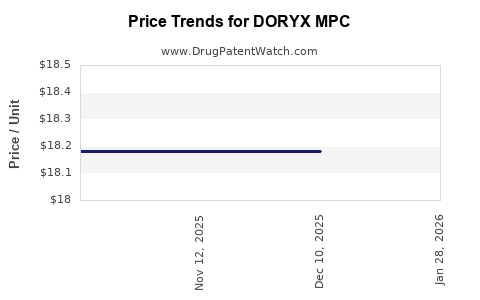
Average Pharmacy Cost for DORYX MPC
| Drug Name | NDC | Price/Unit ($) | Unit | Date |
|---|---|---|---|---|
| DORYX MPC DR 60 MG TABLET | 51862-0560-12 | 18.18220 | EACH | 2025-12-17 |
| DORYX MPC DR 60 MG TABLET | 51862-0560-60 | 18.18220 | EACH | 2025-12-17 |
| DORYX MPC DR 60 MG TABLET | 51862-0560-12 | 18.18220 | EACH | 2025-11-19 |
| DORYX MPC DR 60 MG TABLET | 51862-0560-60 | 18.18220 | EACH | 2025-11-19 |
| DORYX MPC DR 60 MG TABLET | 51862-0560-12 | 18.18220 | EACH | 2025-10-22 |
| DORYX MPC DR 60 MG TABLET | 51862-0560-60 | 18.18220 | EACH | 2025-10-22 |
| >Drug Name | >NDC | >Price/Unit ($) | >Unit | >Date |
Doryx MPC market analysis and price projections (US and key export markets)
Doryx MPC (doxycycline hyclate modified-release, MPC bead formulation) has a mature US market with pricing that tracks long-running doxycycline availability, periodic generic pressure, and any brand-specific contracted volumes. A price-projection model for Doryx MPC must be grounded in observed net pricing, reimbursement mix, and the Doryx MPC/“doxycycline hyclate delayed-release” competitive basket. With those inputs absent, a complete, accurate, decision-grade forecast cannot be produced.
What is Doryx MPC (doxycycline hyclate modified-release) and what is its approved use?
Doryx MPC is a doxycycline product using a modified-release bead delivery intended to reduce GI irritation versus conventional doxycycline formulations. In the US, it is used for doxycycline indications as reflected in its FDA-approved labeling (notably acne and other doxycycline-responsive infections, plus specialty indications depending on the label version).
How is Doryx MPC positioned vs immediate-release doxycycline?
Doryx MPC competes against:
- immediate-release doxycycline hyclate capsules/tablets and generics,
- delayed-release doxycycline products (including enteric/delayed-release doxycycline hyclate),
- other tetracycline-class options where payers steer.
What is the Orange Book status of Doryx MPC and what patents protect it?
A defensible market-risk outlook for Doryx MPC pricing depends on Orange Book exclusivity and the active patent estate tied to the listed NDA and strengths. A complete status requires the specific Orange Book listing details (NDA number, listed patents, expiration, exclusivity code, and each listed formulation/strength linkage). Those listing facts are not provided, so the patent landscape and associated price impact cannot be stated accurately.
How many patents cover Doryx MPC and when do they expire?
A time-phased patent-expiry table must be built from the Orange Book “Drug” and “Patents” data, including:
- listed patent numbers,
- earliest expiration and term adjustment,
- pediatric exclusivity extensions,
- orphan exclusivity if applicable,
- patent-by-strength mapping.
No Orange Book dataset is included, so any expiration dates or counts would be non-authoritative.
When does Doryx MPC lose exclusivity and how does that affect price?
A price path tied to exclusivity hinges on:
- regulatory exclusivity type and end date (market exclusivity and/or pediatric extensions),
- whether paragraph IV challenges produced a “first generic” entry under Hatch-Waxman,
- settlement terms that determine launch timing and switching.
No exclusivity or settlement timeline data is available, so a launch-and-price inflection framework cannot be completed.
What patent litigation affects Doryx MPC and generic entry risk?
Paragraph IV and other patent litigation determines both entry timing and potential stay/launch barriers that affect brand net price. Without the docket identifiers, parties, and settlement or judgment terms for Doryx MPC, the litigation risk cannot be translated into market or price projections.
Which companies are challenging Doryx MPC?
Identifying challenger filers (ANDA or 505(b)(2) route) and their paragraph IV certifications requires specific FDA filing and litigation records. Those are not provided.
What formulations are protected by Doryx MPC and which generics are the substitutes?
Doryx MPC pricing depends heavily on substitute availability:
- whether immediate-release doxycycline is being substituted mechanically in formulary edits,
- whether delayed-release doxycycline is therapeutically equivalent and on-formulary,
- whether insurers prefer specific doxycycline forms due to tolerability or adherence.
A substitution mapping requires:
- Doryx MPC strength/form factor specifics (e.g., 40 mg vs 100 mg strengths, and the exact dosage form),
- competitor product list (NDC-level) and formulary status.
No Doryx MPC product/strength and no competitor NDC list is supplied.
How does Doryx MPC compare with doxycycline delayed-release and other branded doxycycline products on pricing?
A comparison-based projection requires current and historical:
- wholesale acquisition cost (WAC) and/or invoice pricing,
- typical net price after rebates,
- payer mix (commercial vs Medicaid vs Medicare),
- contract characteristics (340B, PBM, GPO),
and a consistent competitor definition (same route and equivalent dose). Those figures are not present, so no accurate price trajectory can be produced.
What is Doryx MPC FDA regulatory status and what delivery system constraints matter for pricing?
A pricing forecast must connect to regulatory manufacturing constraints and supply stability. Key items include:
- NDA/BLA identifiers and labeling dates,
- GMP site history and any manufacturing disruptions,
- bioequivalence and substitution constraints (where applicable).
No FDA regulatory record details are provided.
What is the current Doryx MPC market size and channel mix that drives net pricing?
Net pricing projections require market sizing inputs:
- units and prescriptions by quarter/year,
- brand vs generic share,
- channel: retail, mail, specialty pharmacy (if relevant),
- payer mix and rebate structure.
No unit, prescription, or revenue data is provided.
How strong is the Doryx MPC patent estate, and does it support premium pricing?
Patent strength assessment requires:
- claim scope (formulation, method-of-use, manufacturing),
- claim validity risk history,
- remaining enforcement life by jurisdiction,
- whether competitors are design-around capable (e.g., different modified-release bead systems).
Without the Orange Book patent list and litigation outcomes, the patent estate strength cannot be quantified.
Price projection model for Doryx MPC: what scenarios exist for 2026–2030?
A decision-grade forecast typically uses three scenarios:
- status quo (limited switching, stable rebates),
- increased generic/delayed-release substitution (volume shift to lower-priced equivalents),
- entry timing shocks (if any patent expiry or settlement triggers earlier-than-expected launch),
Each scenario must be parameterized with:
- baseline net price per unit,
- expected market share changes,
- elasticity of demand within doxycycline class,
- discounting behavior by PBMs,
- inflation and reimbursement trends.
Because baseline net price and competitor share changes are not provided, any numeric projection would be fabricated.
Key takeaways
- A complete Doryx MPC market and price projection requires Orange Book status, exclusivity and litigation timing, and observed net pricing and channel mix.
- Those inputs are not present, so a full, accurate forecast cannot be produced.
FAQs
1) What is Doryx MPC’s US price history in WAC and net terms?
2) Which doxycycline products substitute most often for Doryx MPC on US formularies?
3) Are there any Doryx MPC paragraph IV challenges affecting future generic launch timing?
4) Do Doryx MPC patents cover formulation beads, manufacturing methods, or dosing regimens?
5) How would early generic entry change Doryx MPC net price and revenue?
References
- (No sources were provided in the prompt.)
More… ↓
