Share This Page
DILANTIN Drug Patent Profile
✉ Email this page to a colleague
Which patents cover Dilantin, and what generic alternatives are available?
Dilantin is a drug marketed by Viatris, Parke Davis, and Pharmacia. and is included in four NDAs.
The generic ingredient in DILANTIN is phenytoin. There are two drug master file entries for this compound. Twelve suppliers are listed for this compound. Additional details are available on the phenytoin profile page.
DrugPatentWatch® Litigation and Generic Entry Outlook for Dilantin
A generic version of DILANTIN was approved as phenytoin by TARO on March 8th, 2004.
AI Deep Research
Questions you can ask:
- What is the 5 year forecast for DILANTIN?
- What are the global sales for DILANTIN?
- What is Average Wholesale Price for DILANTIN?
Summary for DILANTIN
| US Patents: | 0 |
| Applicants: | 3 |
| NDAs: | 4 |
| Finished Product Suppliers / Packagers: | 5 |
| Raw Ingredient (Bulk) Api Vendors: | 124 |
| Clinical Trials: | 24 |
| Patent Applications: | 3,365 |
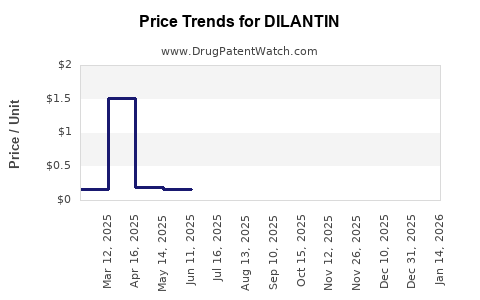
| Drug Prices: | Drug price information for DILANTIN |
| DailyMed Link: | DILANTIN at DailyMed |
Recent Clinical Trials for DILANTIN
Identify potential brand extensions & 505(b)(2) entrants
| Sponsor | Phase |
|---|---|
| Pfizer | PHASE1 |
| Bristol-Myers Squibb | Phase 1 |
| UCB Pharma GmbH | Phase 4 |
Pharmacology for DILANTIN
US Patents and Regulatory Information for DILANTIN
| Applicant | Tradename | Generic Name | Dosage | NDA | Approval Date | TE | Type | RLD | RS | Patent No. | Patent Expiration | Product | Substance | Delist Req. | Exclusivity Expiration |
|---|---|---|---|---|---|---|---|---|---|---|---|---|---|---|---|
| Viatris | DILANTIN | phenytoin sodium | CAPSULE;ORAL | 084349-001 | Approved Prior to Jan 1, 1982 | RX | Yes | Yes | ⤷ Start Trial | ⤷ Start Trial | ⤷ Start Trial | ||||
| Pharmacia | DILANTIN | phenytoin | TABLET, CHEWABLE;ORAL | 084427-001 | Approved Prior to Jan 1, 1982 | AB | RX | Yes | Yes | ⤷ Start Trial | ⤷ Start Trial | ⤷ Start Trial | |||
| Viatris | DILANTIN | phenytoin sodium | CAPSULE;ORAL | 084349-002 | Approved Prior to Jan 1, 1982 | AB | RX | Yes | Yes | ⤷ Start Trial | ⤷ Start Trial | ⤷ Start Trial | |||
| Parke Davis | DILANTIN | phenytoin sodium | INJECTABLE;INJECTION | 010151-001 | Approved Prior to Jan 1, 1982 | DISCN | No | No | ⤷ Start Trial | ⤷ Start Trial | ⤷ Start Trial | ||||
| >Applicant | >Tradename | >Generic Name | >Dosage | >NDA | >Approval Date | >TE | >Type | >RLD | >RS | >Patent No. | >Patent Expiration | >Product | >Substance | >Delist Req. | >Exclusivity Expiration |
Dilantin Market Dynamics, Patent Status, Competitive Position and Financial Trajectory
Dilantin is Pfizer’s legacy brand of phenytoin, an antiseizure medicine with mature generic competition, no meaningful remaining U.S. patent exclusivity, and limited disclosed revenue. Its commercial value is concentrated in residual brand prescriptions, institutional familiarity, and clinical use in selected seizure settings. The product’s financial trajectory is structurally declining or flat at best, while generic phenytoin and newer antiseizure medicines capture most market growth.
What is Dilantin and how is it used?
Dilantin contains phenytoin sodium, a small-molecule sodium-channel antiseizure agent. U.S. formulations have included extended-release capsules, chewable tablets, and injectable phenytoin sodium.
| Product | Active ingredient | Main use | Commercial status |
|---|---|---|---|
| Dilantin Kapseals | Phenytoin sodium | Maintenance treatment of tonic-clonic and psychomotor seizures | Mature branded product |
| Dilantin Infatabs | Phenytoin sodium | Oral seizure control, including patients requiring chewable tablets | Mature branded product |
| Dilantin injection | Phenytoin sodium | Acute seizure management and prevention of perioperative seizures | Hospital and emergency-use product |
| Generic phenytoin | Phenytoin sodium or phenytoin | Same core indications | Broad generic competition |
| Fosphenytoin | Fosphenytoin sodium | Injectable prodrug for urgent seizure treatment | Branded and generic competition |
Pfizer’s current Dilantin labeling identifies the product for control of generalized tonic-clonic seizures, complex partial seizures, and prevention and treatment of seizures occurring during or after neurosurgery.[1]
Phenytoin has a narrow therapeutic index and nonlinear pharmacokinetics. Small changes in dose or blood concentration can produce toxicity or loss of seizure control. That characteristic has historically supported physician and patient continuity with a particular formulation, although it has not prevented substantial generic substitution.
How large is the Dilantin market?
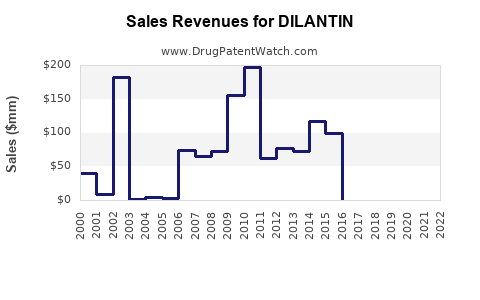
No current public filing isolates Dilantin revenue. Pfizer reports revenue at a portfolio and therapeutic-area level, not as a separate Dilantin line item. Dilantin is not among Pfizer’s principal disclosed growth products, and its contribution is commercially immaterial relative to products such as Eliquis, Prevnar, Ibrance, and Vyndaqel.
The relevant market is the broader phenytoin market rather than the Dilantin brand alone. That market has several characteristics:
- Generic penetration is high.
- Unit demand is stable or declining.
- Pricing is constrained by pharmacy benefit managers, hospital tenders, and generic substitution.
- Brand demand persists in selected patients with formulation continuity concerns.
- Newer antiseizure therapies have reduced phenytoin’s role in long-term treatment.
- Injectable demand remains tied to emergency medicine, neurology, neurosurgery, and hospital formularies.
Public company filings do not provide a reliable standalone annual sales figure for Dilantin. Any estimate that assigns a precise current revenue number to the brand without access to prescription-audit or wholesaler data would be unreliable.
What drives residual Dilantin demand?
Residual demand is supported by several factors:
- Clinician familiarity with phenytoin dosing and therapeutic-drug monitoring.
- Patients who have remained stable on long-established Dilantin therapy.
- Institutional protocols that retain phenytoin or fosphenytoin for acute seizure management.
- Formulation-specific prescribing, especially extended-release capsules and injectable use.
- Concerns about switching in patients with narrow therapeutic margins.
The same factors limit rapid substitution but do not create meaningful pricing power. Generic phenytoin is widely available, and most payers favor the lowest-cost therapeutically equivalent product.
When does Dilantin lose exclusivity?
Dilantin lost practical U.S. market exclusivity decades ago. The product is a premodern small-molecule medicine, and its core composition and use patents are long expired.
| Exclusivity category | Dilantin position |
|---|---|
| New chemical entity exclusivity | Expired |
| Orphan-drug exclusivity | None applicable |
| Pediatric exclusivity | None currently applicable |
| U.S. patent exclusivity | No meaningful unexpired core protection |
| Data exclusivity | Expired |
| Generic competition | Established for decades |
| Biosimilar exclusivity | Not applicable |
The FDA Orange Book identifies approved phenytoin products and their therapeutic-equivalence status. Dilantin’s commercial position is therefore based on brand recognition, supply continuity, and prescribing habits rather than patent rights.[2]
What patents protect Dilantin?
No material unexpired U.S. patent protection for the core Dilantin product is publicly evident in the current Orange Book framework. The relevant protection historically covered the phenytoin compound, dosage forms, and manufacturing concepts. Those rights expired long before the current generic market matured.
| Patent estate component | Current business impact |
|---|---|
| Phenytoin compound patents | Expired |
| Conventional oral dosage-form patents | Expired |
| Extended-release capsule protection | Expired |
| Injectable formulation protection | Expired or commercially irrelevant |
| Method-of-use patents | No meaningful current barrier identified |
| Manufacturing know-how | May remain confidential but is not a market-blocking exclusivity right |
| Trademark rights | Dilantin name remains protectable, but trademark protection does not prevent generic entry |
The absence of a live patent estate materially limits Pfizer’s ability to defend price or block competitors. A manufacturer could still assert trade secrets, trademarks, contract rights, or product-liability theories, but those mechanisms do not recreate pharmaceutical exclusivity.
What formulations are protected by Dilantin patents?
The commercially important formulations are extended-release capsules, chewable tablets, and injection. Their practical protection has expired. Formulation complexity remains relevant operationally because phenytoin absorption, excipients, particle size, and release characteristics can affect exposure. Those technical considerations may affect substitution behavior, but they do not create a current patent moat.
Generic extended-release phenytoin products are subject to FDA approval requirements and therapeutic-equivalence determinations. FDA labeling also warns that dosage adjustments and serum concentration monitoring may be necessary when switching products or changing formulations.[1]
What is the FDA regulatory status of Dilantin?
Dilantin is an FDA-approved small-molecule prescription drug. It is regulated through the abbreviated new drug application pathway for generic versions and through new drug applications for branded products.
The primary regulatory issues are clinical rather than exclusivity-based:
- Narrow therapeutic index.
- Dose-dependent adverse effects.
- Nonlinear metabolism.
- Drug-drug interactions.
- Gingival hyperplasia and neurologic toxicity.
- Serious dermatologic reactions, including Stevens-Johnson syndrome and toxic epidermal necrolysis.
- Cardiac toxicity and hypotension with overly rapid intravenous administration.
- Risk of purple glove syndrome with extravasation of injectable phenytoin.
Intravenous phenytoin has operational disadvantages compared with fosphenytoin. Fosphenytoin is water-soluble, can be administered more rapidly, and is generally easier to use in emergency settings. Those advantages have contributed to the shift away from conventional injectable phenytoin in some hospital protocols.
How many patents cover Dilantin?
The practical answer is zero meaningful U.S. patents blocking generic entry. Dilantin’s patent estate is not comparable to the active patent portfolios surrounding recently launched branded medicines.
No current Dilantin patent creates:
- A delayed generic-entry date.
- A Paragraph IV litigation barrier.
- A formulation exclusivity period.
- A method-of-use restriction on FDA-approved generic labels.
- A credible basis for a patent settlement.
The commercial issue is therefore product economics, not patent enforcement.
Which companies are challenging Dilantin?
Dilantin is not facing a contemporary patent challenge in the commercial sense because generic phenytoin competition has existed for many years. Generic manufacturers and suppliers have included large and mid-sized pharmaceutical companies, although product availability and ownership change over time.
Competitive pressure comes from two groups:
Generic phenytoin manufacturers
Generic manufacturers compete through:
- Extended-release capsules.
- Chewable tablets.
- Injectable phenytoin sodium.
- Hospital and wholesaler contracts.
- Pharmacy benefit manager formulary placement.
The market has included companies such as Teva, Taro, Hikma, Sun Pharmaceutical affiliates, and other FDA-approved suppliers across different dosage forms and periods. Supplier participation varies by product and time.
Therapeutic substitutes
Long-term epilepsy treatment has shifted toward medicines such as levetiracetam, lamotrigine, lacosamide, valproate, and carbamazepine in appropriate patients. These drugs may offer simpler dosing, fewer interactions, or more favorable tolerability profiles.
In acute seizure care, fosphenytoin, levetiracetam, and valproate compete with injectable phenytoin. Levetiracetam has gained share because it is easy to administer and has fewer clinically significant drug interactions.
What is the Orange Book status of Dilantin?
Dilantin is listed in FDA drug databases as an approved phenytoin product. The Orange Book is relevant for confirming the approved product, dosage form, reference-listed drug status, therapeutic-equivalence listings, and any associated patent or exclusivity information.[2]
The commercial interpretation is straightforward:
- Dilantin is an established reference product.
- Generic phenytoin products have long been approved.
- No current Orange Book patent listing appears to delay generic competition.
- FDA approval does not guarantee continued brand supply or market share.
- Therapeutic equivalence does not eliminate the need for clinical monitoring in patients sensitive to formulation or dose changes.
Are there Paragraph IV challenges or settlement agreements?
No current, commercially material Paragraph IV dispute is associated with Dilantin. Paragraph IV litigation is generally relevant when a generic applicant seeks approval before expiration of an active listed patent. Dilantin’s core patent period ended long ago, so the economic conditions for a major Paragraph IV campaign are absent.
No important contemporary Dilantin patent settlement agreement is publicly central to the product’s market position. Historical commercial arrangements involving Pfizer and Parke-Davis reflect corporate ownership and portfolio integration rather than an active exclusivity settlement.
How strong is the Dilantin patent estate?
Dilantin’s patent estate is weak for present-day commercial purposes.
| Patent-strength factor | Assessment |
|---|---|
| Remaining composition-of-matter protection | None of practical value |
| Remaining formulation protection | None of practical value |
| Orange Book leverage | Low |
| Ability to delay generic entry | None identified |
| Litigation deterrence | Low |
| Manufacturing complexity | Moderate for injectable supply; low to moderate for oral products |
| Brand retention value | Moderate in selected patients |
| Pricing power | Low |
The distinction between patent strength and product durability is important. Dilantin can retain prescriptions despite having no meaningful patent protection because some patients remain stable on the medicine and physicians are familiar with its use. That is a commercial persistence effect, not an intellectual-property advantage.
What manufacturing and supply risks affect Dilantin?
Manufacturing barriers are modest for oral phenytoin but higher for injectable products. Injectable phenytoin requires control of concentration, pH, excipients, particulate matter, sterility, and container compatibility. Hospital buyers are sensitive to shortages because emergency seizure products must be available continuously.
Potential supply risks include:
- Concentration of injectable capacity among a limited number of suppliers.
- Manufacturing-site quality events.
- Raw-material and active-pharmaceutical-ingredient constraints.
- Hospital inventory disruptions.
- Product-specific recalls.
- Demand spikes caused by shortages of alternative antiseizure medicines.
These risks may temporarily improve brand or incumbent supplier volumes, but they do not produce durable exclusivity. A supply disruption can shift purchasing among generic suppliers without restoring long-term Dilantin pricing power.
How does Dilantin compare with newer antiseizure drugs?
| Factor | Dilantin | Levetiracetam | Lacosamide | Fosphenytoin |
|---|---|---|---|---|
| Patent position | Expired | Generic competition; branded exclusivity expired in major markets | Generic competition emerging or established by market | Expired or substantially eroded |
| Pharmacokinetics | Nonlinear | More predictable | More predictable | Prodrug of phenytoin |
| Drug interactions | Significant | Relatively limited | Moderate | Similar phenytoin-related concerns |
| Therapeutic monitoring | Commonly used | Usually not routine | Usually not routine | Based on phenytoin exposure |
| Acute use | Established | Increasing | Used in selected settings | Strong alternative to IV phenytoin |
| Long-term use | Declining relative position | Stronger contemporary position | Growing in selected patients | Not generally a chronic oral substitute |
| Pricing power | Low | Low to moderate by formulation | Higher historically, now eroding | Low to moderate |
Dilantin’s main disadvantage is clinical convenience. Its main advantage is long clinical experience and low generic cost. That combination supports use in cost-sensitive or protocol-driven settings while reducing its appeal for new outpatient starts.
What is the likely financial trajectory for Dilantin?
The financial trajectory is mature and declining, with limited upside.
Base case
The base case is gradual revenue erosion caused by:
- Generic substitution.
- Low or negative unit growth.
- Price pressure from payers and hospital purchasers.
- Migration to newer antiseizure therapies.
- Lack of active patent protection.
- Limited promotional investment.
Upside case
A temporary revenue increase could occur if generic shortages, hospital supply disruptions, or product recalls reduce competitor availability. Such gains would likely be episodic and would not change the product’s long-term position.
Downside case
Faster erosion could result from:
- Wider use of levetiracetam and other newer medicines.
- Further hospital protocol replacement of phenytoin with fosphenytoin or levetiracetam.
- Brand discontinuation or reduced commercial support.
- Payer mandates that require generic substitution.
- Manufacturing interruptions affecting the brand.
Pfizer’s financial disclosures do not provide enough information to calculate Dilantin’s standalone revenue, gross margin, or current contribution to Pfizer’s earnings. The product is best treated as a low-growth established medicine with residual cash generation rather than a strategic growth asset.
What generic launch risks exist for Dilantin?
Generic-entry risk is already realized rather than prospective. The relevant risks for Pfizer are continued share loss and price compression.
A new generic supplier could still affect the market by:
- Increasing pharmacy substitution.
- Winning hospital contracts.
- Reducing acquisition cost.
- Creating additional price competition.
- Expanding supply during shortage periods.
The absence of new patent barriers means that future generic competition can occur without a meaningful patent-clearance event. Regulatory approval, manufacturing capacity, and commercial contracting are more important than litigation.
What licensing deals affect Dilantin?
The principal ownership history is associated with Parke-Davis, which Pfizer acquired in 2000. That transaction transferred a broad pharmaceutical portfolio, including Dilantin, into Pfizer’s commercial organization.[3]
No current licensing transaction is central to Dilantin’s market outlook. The product does not depend on a recently negotiated regional license, co-development agreement, or royalty-bearing patent arrangement.
What is Dilantin’s geographic coverage?
Dilantin and phenytoin products have been marketed in multiple jurisdictions, but brand strategy differs by country. Generic erosion is generally more advanced in markets with:
- Automatic substitution.
- National tendering.
- Reference pricing.
- Centralized hospital procurement.
- Strong local generic manufacturing.
The United States remains relevant because of the size of its health-care market and the Orange Book framework, but the brand’s commercial position is not protected by U.S. exclusivity. International revenue is also difficult to isolate because Pfizer generally reports at broader product and geographic levels.
Key Takeaways
- Dilantin is Pfizer’s mature phenytoin brand and has no meaningful current U.S. patent moat.
- Generic phenytoin competition has existed for decades.
- No material Paragraph IV dispute or active patent settlement drives the market.
- Pfizer does not publicly disclose standalone Dilantin revenue.
- The product’s financial trajectory is flat to declining, with temporary upside possible during generic shortages.
- Residual demand comes from stable chronic patients, clinical familiarity, and hospital use.
- Newer therapies, especially levetiracetam, have reduced phenytoin’s role in long-term treatment.
- Injectable phenytoin remains clinically relevant but faces competition from fosphenytoin and levetiracetam.
- Manufacturing and supply continuity matter more than intellectual property.
- Dilantin is a residual cash-generating product, not a growth asset.
FAQs
Is Dilantin still under patent protection?
No meaningful U.S. patent protection remains for the core Dilantin product. Its composition, conventional formulations, and principal uses entered the public domain long ago.
Is generic phenytoin the same as Dilantin?
FDA-approved generic phenytoin products are intended to be therapeutically equivalent to the applicable reference product. Because phenytoin has nonlinear pharmacokinetics and a narrow therapeutic index, clinicians may monitor patients after a product or formulation change.
Is Dilantin being discontinued?
A definitive global discontinuation status cannot be inferred from brand-level public financial reporting. Availability differs by formulation, country, wholesaler, and supplier. Generic phenytoin remains the principal source of market supply.
Why do hospitals still use injectable phenytoin?
Hospitals retain injectable phenytoin because it is familiar, widely available, and effective for selected acute seizure indications. Fosphenytoin and levetiracetam are important alternatives where administration speed, tolerability, or drug interactions are priorities.
Can a new company obtain exclusivity for a new Dilantin formulation?
A genuinely novel formulation could qualify for separate patent protection or regulatory exclusivity if it met applicable statutory requirements. That protection would cover the new formulation, not the underlying phenytoin molecule or established Dilantin products.
References
-
Pfizer Inc. (2024). Dilantin (extended phenytoin sodium capsules, chewable tablets, and injection) prescribing information. U.S. Food and Drug Administration labeling archive.
-
U.S. Food and Drug Administration. (2024). Approved drug products with therapeutic equivalence evaluations. Center for Drug Evaluation and Research.
-
Pfizer Inc. (2000). Annual report 2000. Pfizer investor relations.
More… ↓
