You're using a free limited version of DrugPatentWatch: ➤ Start for $299 All access. No Commitment.

Last Updated: December 12, 2025

DESONATE Drug Patent Profile


✉ Email this page to a colleague

« Back to Dashboard


When do Desonate patents expire, and what generic alternatives are available?

Desonate is a drug marketed by Leo Pharma As and is included in one NDA.

The generic ingredient in DESONATE is desonide. There are thirty-one drug master file entries for this compound. Sixteen suppliers are listed for this compound. Additional details are available on the desonide profile page.

DrugPatentWatch® Litigation and Generic Entry Outlook for Desonate

A generic version of DESONATE was approved as desonide by SUN PHARMA CANADA on August 3rd, 1994.

  Get Started Free

AI Deep Research
Questions you can ask:
  • What is the 5 year forecast for DESONATE?
  • What are the global sales for DESONATE?
  • What is Average Wholesale Price for DESONATE?
Drug patent expirations by year for DESONATE
Drug Prices for DESONATE

See drug prices for DESONATE

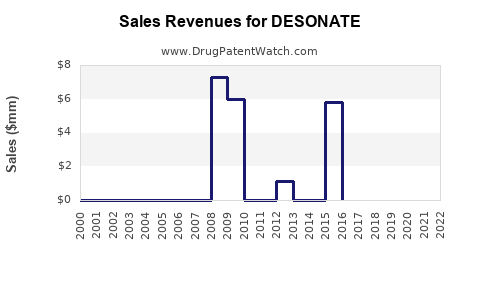
Drug Sales Revenue Trends for DESONATE

See drug sales revenues for DESONATE

Recent Clinical Trials for DESONATE

Identify potential brand extensions & 505(b)(2) entrants

SponsorPhase
Wake Forest UniversityPhase 4

See all DESONATE clinical trials

Paragraph IV (Patent) Challenges for DESONATE
Tradename Dosage Ingredient Strength NDA ANDAs Submitted Submissiondate
DESONATE Gel desonide 0.05% 021844 1 2010-12-01

US Patents and Regulatory Information for DESONATE

Applicant Tradename Generic Name Dosage NDA Approval Date TE Type RLD RS Patent No. Patent Expiration Product Substance Delist Req. Exclusivity Expiration
Leo Pharma As DESONATE desonide GEL;TOPICAL 021844-001 Oct 20, 2006 DISCN Yes No ⤷  Get Started Free ⤷  Get Started Free ⤷  Get Started Free
>Applicant >Tradename >Generic Name >Dosage >NDA >Approval Date >TE >Type >RLD >RS >Patent No. >Patent Expiration >Product >Substance >Delist Req. >Exclusivity Expiration

International Patents for DESONATE

See the table below for patents covering DESONATE around the world.

Country Patent Number Title Estimated Expiration
Canada 2417646 SYSTEME DE DISTRIBUTION D'UN GEL TOPIQUE (TOPICAL GEL DELIVERY SYSTEM) ⤷  Get Started Free
Spain 2437321 ⤷  Get Started Free
Portugal 1304992 ⤷  Get Started Free
Austria 429922 ⤷  Get Started Free
South Korea 20030057526 ⤷  Get Started Free
South Korea 100840169 ⤷  Get Started Free
Australia 2001279002 ⤷  Get Started Free
>Country >Patent Number >Title >Estimated Expiration

Supplementary Protection Certificates for DESONATE

Patent Number Supplementary Protection Certificate SPC Country SPC Expiration SPC Description
1304992 CR 2013 00053 Denmark ⤷  Get Started Free PRODUCT NAME: CLINDAMYCIN (SOM CLINDAMYCIN PHOSPHATE) OG TRETINOIN; NAT. REG. NO/DATE: 48954 20130416; FIRST REG. NO/DATE: IE PA1332/043/001 20130322
1304992 C300617 Netherlands ⤷  Get Started Free PRODUCT NAME: COMBINATIE VAN CLINDAMYCINE, DESGEWENST IN DE VORM VAN CLINDAMYCINEFOSFAAT EN TRETINOINE; NAT. REGISTRATION NO/DATE: RVG 109745 20130626; FIRST REGISTRATION: PA1332/043/001 20130322
1304992 C01304992/01 Switzerland ⤷  Get Started Free PRODUCT NAME: CLINDAMYCINI PHOSPHAS ET TRETINOINUM; REGISTRATION NO/DATE: SWISSMEDIC 62513 28.03.2014
1304992 PA2013025 Lithuania ⤷  Get Started Free PRODUCT NAME: CLINFAMYCINUM + TRETINOINUM; REGISTRATION NO/DATE: LT/1/13/3279/001, 2013 04 26 LT/1/13/3279/002, 2013 04 26 PA1332/043/001 20130323
1304992 SPC/GB13/061 United Kingdom ⤷  Get Started Free PRODUCT NAME: CLINDAMYCIN PHOSPHATE IN COMBINATION WITH TRETINOIN.; REGISTERED: IE PA1332/043/001 20130322; UK PL15142/0249 20130624
1304992 2013C/060 Belgium ⤷  Get Started Free PRODUCT NAME: CLINDAMYCINE (ALS CLINDAMYCINE FOSFAAT) EN TRETINOINE; AUTHORISATION NUMBER AND DATE: BE437507 20130506
2435024 301102 Netherlands ⤷  Get Started Free PRODUCT NAME: COMBINATIE VAN FORMOTEROL (MET INBEGRIP VAN DE FARMACEUTISCH AANVAARDBARE ZOUTEN, ESTERS, SOLVATEN OF ENANTIOMEREN ERVAN), GLYCOPYRROLAAT (MET INBEGRIP VAN DE FARMACEUTISCH AANVAARDBARE ZOUTEN, ESTERS, SOLVATEN OF ENANTIOMEREN ERVAN) EN BUDESONIDE (MET INBEGRIP VAN DE FARMACEUTISCH AANVAARDBARE ZOUTEN, ESTERS, SOLVATEN OF ENANTIOMEREN ERVAN); REGISTRATION NO/DATE: EU/1/20/1498 20201210
>Patent Number >Supplementary Protection Certificate >SPC Country >SPC Expiration >SPC Description

Market Dynamics and Financial Trajectory for Desonate

Last updated: July 29, 2025

Introduction

Desonate (desonide ophthalmic suspension or gel) emerges as a notable corticosteroid treatment designated for managing ocular inflammatory conditions. As with many niche pharmaceuticals, its market landscape is shaped by factors including clinical demand, regulatory environment, patent status, competitive dynamics, and emerging therapeutic alternatives. This analysis delineates the current market structure, anticipated growth trajectory, and strategic insights into Desonate’s financial prospects.

Pharmacological Profile and Therapeutic Indications

Desonate, a low-potency corticosteroid, is primarily indicated for allergic conjunctivitis, anterior uveitis, and ocular inflammation following surgery or trauma. Its favorable safety profile, owing to minimal systemic absorption, makes it a first-line topical treatment in ophthalmology. The drug’s targeting of inflammation with reduced adverse effects relative to higher-potency counterparts positions it as a preferred option, especially in delicate patient populations.

Market Landscape and Key Drivers

1. Growing Prevalence of Ocular Inflammatory Diseases

The expanding base of patients suffering from ocular inflammation plays a pivotal role in market expansion. Rising incidences are attributed to aging populations, increased screening protocols, and higher prevalence of allergic conjunctivitis, especially in urbanized regions with environmental pollutants. The Global Ocular Inflammation Market was valued at approximately USD 1.1 billion in 2022, with projections indicating a CAGR of around 4.2% through 2030 [1].

2. Advancements in Ophthalmic Drug Technologies

Development of formulations that improve drug bioavailability, reduce dosing frequency, and enhance patient adherence critically influences Desonate’s market share. The ophthalmic drug delivery sector is witnessing innovation in sustained-release and minimally invasive delivery systems, implicitly pressuring traditional corticosteroid offerings.

3. Regulatory and Reimbursement Dynamics

Approval pathways for ophthalmic steroids are well-established, with Desonate already cleared in the U.S. and Europe. Reimbursement frameworks in these territories favor drugs with proven safety profiles and cost-effective management options, supporting sustained market penetration. However, pricing pressures due to competitive generics and biosimilars could influence revenue streams.

4. Competitive Landscape

Generic corticosteroids, such as prednisolone acetate and dexamethasone formulations, dominate the market due to lower cost. The key differentiator for Desonate hinges on its safety profile, dosing regimen, and clinician preference. Major players include Alcon, Allergan (AbbVie), and pharmaceutical companies developing newer anti-inflammatory agents, including biologics.

5. Impact of Biologic and Nonsteroidal Alternatives

Emerging biologics and non-steroidal anti-inflammatory drugs (NSAIDs) targeting ocular inflammation threaten to erode market share, especially as these agents demonstrate comparable efficacy with fewer side effects. The introduction of these therapies could cap the growth potential of traditional corticosteroids like Desonate in certain applications.

Financial Trajectory and Market Forecasts

1. Revenue Projections

Although precise sales data for Desonate are proprietary, industry estimates suggest that the ophthalmic corticosteroid segment, including Desonate, grew modestly at about 3–5% CAGR over the past five years. Based on market analyses [2], Desonate’s sales are projected to reach USD 150–200 million globally within the next five years, contingent on regulatory approval expansion, physician adoption, and formulary inclusion.

2. Pricing and Reimbursement Trends

Pricing strategies will significantly influence revenue. As patents age and generics flood the market, prices are expected to decline, exerting downward pressure on margins. Contractual discounts, rebates, and tiered reimbursement models could further impact net revenues.

3. Patent and Regulatory Outlook

Desonate’s patent exclusivity benefits are expected to expire by 2025–2027, after which significant generic competition will likely suppress prices and market share. Conversely, securing additional formulations, combination therapies, or indications could extend its financial lifespan, provided new patents or regulatory protections are granted.

4. Strategic Opportunities and Risks

Investment in targeted clinical trials to expand indications (e.g., dry eye, other inflammatory pathologies) could open new revenue streams. However, risks include rapid market entry by biosimilars, regulatory delays, and unfavorable reimbursement policies.

Market Entry and Expansion Strategies

  • Clinical Differentiation: Highlighting safety and tolerability in prescriber education.
  • Formulation Innovation: Developing sustained-release or combination drugs.
  • Geographic Expansion: Prioritizing emerging markets with increasing ophthalmic disease burdens.
  • Partnerships: Collaborating with global distributors and ophthalmology networks.

Conclusion

Desonate is poised at a juncture where its relatively established safety profile and targeted indications can foster steady growth. Nonetheless, intensifying generic competition, evolving treatment paradigms, and patent expirations present significant hurdles. Strategic adaptation—through formulation enhancements, indication expansion, and geographic penetration—will be instrumental in optimizing its financial trajectory over the coming decade.


Key Takeaways

  • Desonate occupies a niche in ophthalmic corticosteroids with favorable safety, positioning it for continued moderate growth.
  • The expanding global burden of ocular inflammatory conditions supports demand, but competition from generics and novel therapies constrains upside potential.
  • Patent expirations around 2025–2027 threaten revenue streams; strategic innovation and indication expansion are vital.
  • Price reductions due to generics will likely pressure margins; partnerships and formulation advancements offer mitigative pathways.
  • A balanced approach focusing on clinical differentiation and geographic expansion can sustain Desonate’s market relevance.

FAQs

1. When will Desonate face patent expiry, and how will it impact the market?
Patent protection for Desonate is expected to expire between 2025 and 2027, after which generic competitors could significantly reduce its market share and revenue.

2. How does Desonate compare against competing corticosteroids in terms of safety?
Desonate’s low potency and minimal systemic absorption confer a superior safety profile, especially in long-term or repeated use scenarios, making it preferable over higher-potency corticosteroids in sensitive patients.

3. What are the primary factors influencing Desonate’s market growth?
Key drivers include rising prevalence of ocular inflammation, clinician preference for safety profiles, regulatory approval status, and competitive landscape shifts, including biosimilar entry.

4. Are there any recent regulatory changes affecting Desonate’s market?
While no recent regulatory amendments directly impact Desonate, evolving guidelines favoring safer, lower-risk ophthalmic corticosteroids bolster its clinical utility.

5. What strategic moves can pharmaceutical companies undertake to extend Desonate’s financial lifespan?
Innovations in formulation, expanding indications beyond inflammation, pursuing new geographic markets, and establishing strategic alliances can prolong its market viability.


Sources:
[1] MarketsandMarkets, “Ocular Inflammation Market,” 2022.
[2] IQVIA, Pharmaceutical Market Reports, 2022.

More… ↓

⤷  Get Started Free

Make Better Decisions: Try a trial or see plans & pricing

Drugs may be covered by multiple patents or regulatory protections. All trademarks and applicant names are the property of their respective owners or licensors. Although great care is taken in the proper and correct provision of this service, thinkBiotech LLC does not accept any responsibility for possible consequences of errors or omissions in the provided data. The data presented herein is for information purposes only. There is no warranty that the data contained herein is error free. We do not provide individual investment advice. This service is not registered with any financial regulatory agency. The information we publish is educational only and based on our opinions plus our models. By using DrugPatentWatch you acknowledge that we do not provide personalized recommendations or advice. thinkBiotech performs no independent verification of facts as provided by public sources nor are attempts made to provide legal or investing advice. Any reliance on data provided herein is done solely at the discretion of the user. Users of this service are advised to seek professional advice and independent confirmation before considering acting on any of the provided information. thinkBiotech LLC reserves the right to amend, extend or withdraw any part or all of the offered service without notice.