Last updated: September 8, 2026
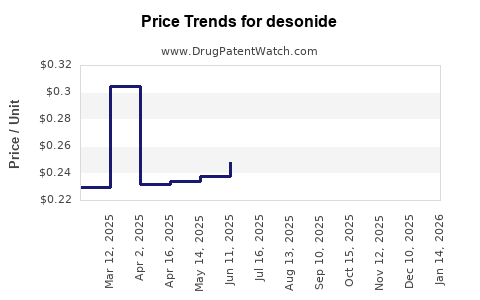
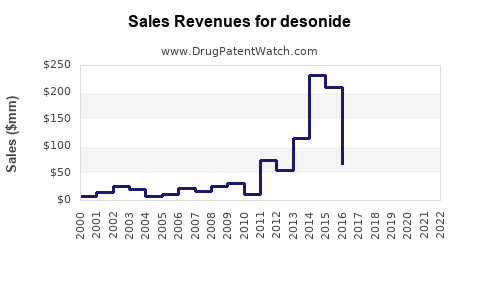
Desonide is a mature, low-potency topical corticosteroid with a stable prescription market and limited brand economics. The U.S. market is dominated by generic cream, ointment, lotion, gel, and foam products. Original branded products such as DesOwen, Desonate, and Verdeso have faced long-standing generic competition, while formulation-specific products retain some commercial differentiation. Public companies generally do not disclose desonide revenue separately, so the financial trajectory is best assessed through product maturity, generic penetration, dosage-form mix, pricing, and manufacturing competition rather than reported brand sales.
What is desonide used for and how large is its addressable market?
Desonide is a low-potency topical corticosteroid used to treat corticosteroid-responsive dermatoses, including atopic dermatitis, eczema, seborrheic dermatitis, and allergic or irritant contact dermatitis. U.S. approved products generally contain desonide at a 0.05% concentration and are available in several topical dosage forms (U.S. Food and Drug Administration [FDA], 2024a).
The primary commercial demand drivers are:
- Pediatric and adult atopic dermatitis
- Eczema and inflammatory dermatitis
- Facial and intertriginous disease, where lower potency is preferred
- Primary-care prescribing
- Dermatology prescribing
- Chronic disease recurrence requiring intermittent treatment
Desonide competes in a broad low- to mid-intensity topical steroid market. Its closest pharmacologic alternatives include hydrocortisone, alclometasone dipropionate, fluocinolone acetonide, and low-strength triamcinolone acetonide. Nonsteroidal alternatives include tacrolimus, pimecrolimus, crisaborole, and topical ruxolitinib.
The addressable market is large in patient volume but modest in revenue per prescription. Desonide is usually prescribed for short courses or intermittent use, which limits annual revenue per patient. Generic substitution also constrains price.
How has the desonide market evolved financially?
Desonide has followed the standard financial trajectory of an established topical generic:
| Market phase |
Commercial characteristics |
Financial effect |
| Branded launch period |
Product differentiation by dosage form, vehicle, packaging, and dermatology promotion |
Higher price and stronger gross margins |
| Early generic entry |
Multiple manufacturers enter common cream, ointment, and lotion forms |
Rapid price erosion |
| Mature generic period |
High substitution, fragmented supply, limited promotional spending |
Low unit economics but recurring prescription demand |
| Specialty formulation period |
Foam and gel products retain vehicle-based differentiation |
Higher price per unit, but smaller volume |
| Current market |
Generic base with residual branded or authorized-branded products |
Stable volume, limited aggregate growth |
The financial market has likely shifted from innovation-driven growth to maintenance economics. Revenue depends more on:
- Prescription volume.
- Formulation mix.
- Payer reimbursement.
- Retail and mail-order channel access.
- Manufacturing cost.
- Product availability.
- Contracting with wholesalers and pharmacy benefit managers.
A company selling generic desonide cream typically has limited pricing power. A company selling foam or gel can command a higher price if the formulation has a favorable sensory profile, easier application, or better patient adherence. That premium is exposed to substitution from lower-cost creams and ointments.
No major pharmaceutical company publicly reports desonide as a standalone revenue line. Product sales are generally embedded in broader dermatology, generic, or specialty portfolios. As a result, a precise global desonide revenue figure cannot be derived from public issuer disclosures.
Which desonide dosage forms have the strongest commercial position?
Cream, ointment, and lotion
Cream, ointment, and lotion are the most exposed to generic competition. These forms have relatively straightforward manufacturing requirements and established prescribing patterns.
Cream is generally the core commercial form because it balances patient acceptability, spreadability, and broad use. Ointment remains relevant for dry or thickened lesions but can have lower cosmetic acceptability. Lotion may be useful for larger areas or hair-bearing skin.
These forms have:
- High generic availability
- Low barriers to substitution
- Limited brand differentiation
- Strong payer pressure
- Low expected margins per prescription
Gel
Desonide gel products occupy a narrower segment. Gels can offer different cosmetic properties and may be preferred for selected areas, including scalp or oily skin. The commercial advantage depends on vehicle performance rather than the active ingredient alone.
Gel products can preserve higher pricing than standard creams if generic competition is limited. That advantage weakens when an approved generic or therapeutically substitutable product reaches the same channel.
Foam
Desonide foam, including the branded Verdeso product, is differentiated by delivery vehicle. Foam products can be easier to apply to hair-bearing areas and may improve patient acceptance. They also have higher manufacturing and packaging complexity than conventional creams.
Foam economics depend on:
- Propellant and container costs
- Device reliability
- Manufacturing scale
- Formulation know-how
- Patent or regulatory exclusivity
- Reimbursement classification
- Availability of generic equivalents
Foam is the formulation with the strongest potential for residual brand value, but it also carries higher production costs and greater supply-chain complexity.
What patents protect desonide products?
The active ingredient itself is not the primary source of present-day exclusivity. Desonide has been used in topical corticosteroid products for decades, and basic active-ingredient protection has expired or is no longer commercially relevant in the United States.
Current intellectual-property value, where it exists, is more likely to involve:
- Vehicle composition
- Foam structure
- Propellant system
- Stability profile
- Packaging and dispensing system
- Manufacturing process
- Particle-size or suspension characteristics
- Specific treatment regimens
- Combination formulations
How strong is the desonide patent estate?
The overall estate is weak for conventional generic formulations and stronger only for selected delivery technologies. A generic company can generally compete in cream, ointment, or lotion without relying on the proprietary formulation of an original branded product, provided it obtains FDA approval through the applicable abbreviated pathway.
Formulation patents may delay direct substitution for a particular foam or gel, but they do not prevent competition from other desonide dosage forms. A cream generic can remain a commercial alternative even when a branded foam has formulation protection.
Patent strength is therefore fragmented:
| Asset type |
Present commercial strength |
| Desonide active ingredient |
Low |
| Standard cream or ointment |
Low |
| Standard lotion |
Low |
| Proprietary gel vehicle |
Moderate, depending on claims and expiration |
| Foam formulation |
Moderate to potentially strong |
| Device or package |
Narrow and design-around risk is material |
| Method-of-use claims |
Usually limited economic value for a broadly used topical steroid |
What is the FDA regulatory status of desonide?
Desonide is an FDA-approved prescription topical corticosteroid. Approved products have included cream, ointment, lotion, gel, and foam dosage forms. FDA-approved generic products are generally reviewed through abbreviated new drug applications that demonstrate pharmaceutical equivalence and bioequivalence or applicable comparative performance, depending on the product (FDA, 2024a; FDA, 2024b).
The regulatory environment has several commercial consequences:
- The active ingredient has a well-established safety and efficacy history.
- Development risk is lower than for a new dermatology active ingredient.
- Formulation development remains important for semisolid and foam products.
- Manufacturing-site compliance can affect supply continuity.
- Approval of a generic in one dosage form does not automatically create competition in every other dosage form.
Topical products face technical requirements involving formulation sameness, rheology, viscosity, emulsion characteristics, particle size, drug release, and skin permeation. These requirements create more development complexity than the age of the active ingredient might suggest.
What is the Orange Book status of desonide?
The FDA Orange Book lists approved prescription products and patent or exclusivity information where applicable. For mature desonide products, the key commercial issue is not basic active-ingredient exclusivity but the status of product-specific patents and approved formulation equivalents (FDA, 2024b).
Orange Book analysis should be performed by:
- Identifying the exact reference listed drug.
- Separating cream, ointment, lotion, gel, and foam products.
- Reviewing listed patents and expiration dates.
- Checking whether patents are formulation, method-of-use, or device claims.
- Comparing the reference product with approved ANDA products.
- Assessing whether a Paragraph IV certification was filed.
A single “desonide patent expiration date” is misleading because the product family contains multiple dosage forms and historical approvals. Standard generic forms generally have little remaining exclusivity value, while a particular foam or gel may have separate product-specific protections.
When does desonide lose exclusivity?
For conventional desonide products, meaningful market exclusivity has already expired. The active ingredient is a legacy corticosteroid, and generic competition has been present for many years.
The relevant exclusivity questions are product-specific:
- Standard cream, ointment, and lotion: mature generic competition.
- Gel: potentially limited formulation-specific protection.
- Foam: potentially later formulation and device protection.
- New method of use: dependent on the scope and enforceability of the claims.
- New combination product: potentially separate regulatory and patent protection.
FDA regulatory exclusivity and patent exclusivity are separate. A product may have no meaningful regulatory exclusivity but still face a listed patent. Conversely, a patent may exist without preventing competition from a different formulation.
Which companies compete in the desonide market?
Competition includes generic manufacturers, specialty dermatology companies, and branded-product owners. The exact supplier mix changes over time because ANDA ownership, distribution agreements, manufacturing sites, and product availability change.
The competitive landscape includes:
- Generic dermatology manufacturers supplying desonide cream, ointment, lotion, or gel
- Specialty pharmaceutical companies marketing branded topical vehicles
- Contract manufacturers producing semisolid and aerosol products
- Retail generic suppliers competing primarily on acquisition cost
- Pharmacy and wholesaler channels influencing product visibility and substitution
The most important competitive distinction is not usually the molecule. It is the dosage form, retail price, reimbursement status, supply reliability, and prescriber preference.
Which companies are challenging desonide patents through Paragraph IV filings?
Paragraph IV litigation must be assessed against each reference product and its Orange Book-listed patents. There is no single Paragraph IV case category covering all desonide products.
For mature cream, ointment, and lotion products, the likelihood of ongoing high-value patent litigation is low because generic entry has already occurred. Any remaining litigation risk is more likely to involve:
- A branded foam
- A proprietary gel
- A newly approved delivery system
- A formulation patent with narrow claims
- A device or container patent
- A product with a limited number of approved competitors
A Paragraph IV certification can trigger litigation and a potential 30-month stay under the Hatch-Waxman framework, but that mechanism is relevant only when qualifying Orange Book-listed patents remain in force (FDA, 2024b).
What patent litigation and settlement risks affect desonide?
Patent litigation risk is low for basic desonide products and higher for differentiated vehicles. Settlement agreements, if any, must be evaluated by reference product, defendant, patent family, and launch date. Generic settlements can include:
- A license with an agreed entry date
- Authorized-generic supply arrangements
- Restrictions on formulation or channel
- No-admission clauses
- Commercial terms unrelated to patent validity
No broad industry-wide settlement can be inferred from the existence of historical desonide litigation. Each formulation has a separate legal and commercial profile.
What generic entry risks exist for branded desonide?
Branded desonide products face four principal entry risks.
Direct generic substitution
A generic with the same dosage form can create immediate price pressure and reduce branded prescription retention.
Cross-formulation substitution
Even when no exact generic equivalent exists, physicians may switch patients to a lower-cost cream, ointment, or lotion.
Payer formulary controls
Preferred-product placement can shift prescribing toward the lowest-cost topical steroid. Prior authorization and step therapy can reduce access to higher-priced foam or gel products.
Supply-driven switching
Pharmacy shortages or wholesaler allocation can move demand between manufacturers. This can temporarily benefit an alternative supplier but does not create durable pricing power.
How does desonide compare with competing topical corticosteroids?
| Product |
Relative potency |
Competitive position |
Commercial implication |
| Hydrocortisone |
Low |
Very broad, including nonprescription strengths |
Strongest price competition |
| Desonide |
Low |
Prescription-focused with multiple dosage forms |
Stable niche, limited pricing power |
| Alclometasone |
Low to moderate |
Prescription alternative |
Competes on potency and formulary status |
| Fluocinolone acetonide |
Low to moderate |
Broad topical availability |
Competes across several vehicles |
| Triamcinolone acetonide |
Moderate |
High-volume generic |
Often selected when greater potency is needed |
| Tacrolimus |
Nonsteroidal |
Steroid-sparing alternative |
Higher-cost option for selected patients |
| Crisaborole |
Nonsteroidal |
Branded or specialty positioning |
Competes for atopic dermatitis patients |
| Topical ruxolitinib |
Nonsteroidal JAK inhibitor |
Specialty dermatology product |
Higher price and different risk-benefit profile |
Desonide’s advantage is its established low-potency profile. Its weakness is that the same clinical positioning is served by lower-cost alternatives, especially hydrocortisone and generic low-potency corticosteroids.
What is the outlook for desonide revenue?
The expected financial trajectory is flat to modestly declining for standard products, with isolated growth opportunities in differentiated delivery systems.
Base case
Generic cream, ointment, and lotion volumes remain stable, while net prices decline gradually. Aggregate revenue falls or remains broadly flat because unit growth does not offset price erosion.
Upside case
A branded or specialty foam gains formulary access, improves adherence, or expands use in pediatric and hair-bearing areas. Revenue growth would come from formulation premium rather than increased active-ingredient demand.
Downside case
Additional generic entrants, formulary exclusions, manufacturing disruption, or a successful design-around of a protected vehicle accelerates price erosion.
The most defensible investment view is that desonide is a cash-flow maintenance product rather than a growth asset. Its value lies in recurring demand, low clinical development risk, and portfolio synergies in dermatology manufacturing. It has limited standalone strategic value unless paired with a differentiated vehicle, broad distribution, or a larger topical dermatology franchise.
Key Takeaways
- Desonide is a mature, low-potency topical corticosteroid with established prescription demand.
- Standard cream, ointment, and lotion products are heavily genericized.
- Foam and gel products have greater formulation differentiation and potentially higher margins.
- Basic active-ingredient patent protection is no longer the principal commercial barrier.
- Patent value is concentrated in vehicles, foam systems, packaging, manufacturing processes, and narrow method-of-use claims.
- Public companies generally do not disclose desonide revenue separately.
- Standard-product revenue is likely stable to declining because generic price erosion offsets prescription growth.
- Branded formulation growth depends on reimbursement, patient acceptance, manufacturing reliability, and the absence of an equivalent generic.
- Biosimilar risk is not applicable because desonide is a small-molecule drug, not a biologic.
- Generic entry risk is high for conventional dosage forms and more formulation-specific for foam and gel products.
FAQs
Is desonide a biologic or biosimilar product?
No. Desonide is a synthetic small-molecule corticosteroid. Biosimilar approval pathways do not apply.
Is desonide available over the counter in the United States?
Prescription desonide products are regulated as prescription drugs in the United States. Lower-potency hydrocortisone products occupy the principal over-the-counter corticosteroid segment.
Which desonide formulation has the highest commercial defensibility?
Foam generally has the greatest potential defensibility because it requires more specialized formulation, container, propellant, and manufacturing capabilities. That protection remains product-specific and can weaken when competing vehicles reach the market.
Does a generic desonide cream substitute for branded desonide foam?
Not automatically. The products may contain the same active ingredient and strength but have different dosage forms, vehicles, application characteristics, and FDA product codes. Clinical substitution depends on the prescriber, pharmacist, payer, and applicable state law.
Can a company obtain new patents on an old desonide product?
Yes. New patents may cover a novel formulation, delivery system, manufacturing method, device, packaging configuration, or treatment regimen. Such patents do not restore exclusivity for the underlying active ingredient and must meet statutory patentability and enforceability requirements.
References
-
U.S. Food and Drug Administration. (2024a). Drugs@FDA: FDA-approved drugs. https://www.accessdata.fda.gov/scripts/cder/daf/
-
U.S. Food and Drug Administration. (2024b). Approved drug products with therapeutic equivalence evaluations: Orange Book. https://www.fda.gov/drugs/drug-approvals-and-databases/approved-drug-products-therapeutic-equivalence-evaluations-orange-book
-
U.S. Food and Drug Administration. (2023). Abbreviated new drug application submissions: Refuse-to-receive standards. https://www.fda.gov/drugs
-
U.S. National Library of Medicine. (2024). DailyMed: Desonide drug labels. https://dailymed.nlm.nih.gov/dailymed/
-
U.S. Food and Drug Administration. (2023). Approved drug products with therapeutic equivalence evaluations and patent certification requirements. https://www.fda.gov/drugs Abbreviated New Drug Application ANDA submissions.