Last updated: September 17, 2026
Corlanor, the U.S. brand for ivabradine, is a differentiated heart-failure and heart-rate-control product with a mature regulatory profile and limited remaining exclusivity value. Its commercial opportunity is constrained by a narrow labeled population, substantial competition from beta blockers and other heart-failure therapies, and the absence of standalone revenue disclosure from Amgen. The principal strategic question is generic-entry timing rather than biosimilar risk: ivabradine is a small molecule, and any U.S. loss of exclusivity will depend on Orange Book patents, pediatric exclusivity, Paragraph IV litigation and FDA approval timing.
What is Corlanor and how does it work?
Corlanor is an oral formulation of ivabradine hydrochloride. It selectively inhibits the cardiac pacemaker current, known as the If current, in the sinoatrial node. Unlike beta blockers, ivabradine reduces heart rate without directly reducing myocardial contractility or lowering blood pressure to the same extent.
The FDA approved Corlanor in April 2015 for adults with stable symptomatic heart failure with reduced left ventricular ejection fraction, generally those with an LVEF of 35% or less, sinus rhythm and a resting heart rate of at least 70 beats per minute despite maximally tolerated beta-blocker therapy or a contraindication to beta-blocker use. The approval was based primarily on the SHIFT heart-failure trial. In 2019, FDA expanded the label to include certain pediatric patients with stable heart failure caused by dilated cardiomyopathy.[1][2]
Corlanor is available as:
| Product |
Strength or form |
Primary use |
| Corlanor tablets |
5 mg and 7.5 mg |
Adult heart failure |
| Corlanor oral solution |
1 mg/mL |
Pediatric patients and patients unable to swallow tablets |
| Ivabradine active ingredient |
Small molecule |
Heart-rate reduction through If-current inhibition |
The product carries important restrictions. It is not indicated for atrial fibrillation, should not be used in patients with significant bradycardia or conduction disease without appropriate pacing support, and requires monitoring for bradycardia and atrial fibrillation.[1]
What is the FDA regulatory status of Corlanor?
Corlanor has full U.S. approval under NDA 206143. Its U.S. regulatory profile includes the original adult indication and the later pediatric supplement.
| FDA milestone |
Date |
| Original U.S. approval |
April 15, 2015 |
| Adult indication |
Chronic heart failure with reduced ejection fraction |
| Pediatric supplement |
2019 |
| Dosage forms |
Tablets and oral solution |
| Regulatory pathway |
Full NDA approval |
| Reference product |
Corlanor, ivabradine hydrochloride |
The FDA approval did not establish Corlanor as a broad heart-failure replacement for guideline-directed therapies. It positioned ivabradine as an add-on or alternative for a narrower subgroup of patients whose heart rate remains elevated despite standard treatment.[1]
The commercial implications are material. Corlanor competes in a treatment sequence rather than at the first-line point of care. Physicians generally consider beta blockers, angiotensin receptor-neprilysin inhibitors, mineralocorticoid receptor antagonists, sodium-glucose cotransporter-2 inhibitors and diuretics before considering ivabradine in eligible patients.[3]
When does Corlanor lose exclusivity?
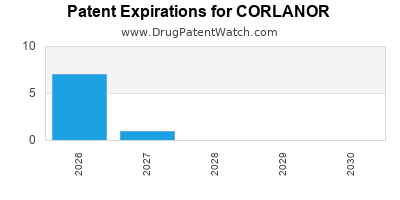
Corlanor’s five-year new chemical entity exclusivity expired in April 2020. That date prevented an ANDA approval based solely on the full five-year NCE period, but it did not eliminate patent protection or other regulatory protections.
The main commercial exclusivity issues are:
| Exclusivity layer |
Status |
| New chemical entity exclusivity |
Expired in 2020 |
| U.S. composition-of-matter protection |
Historical ivabradine patents have expired or are no longer the central barrier |
| Heart-failure method-of-use protection |
The principal potential barrier was tied to the later heart-failure indication |
| Pediatric exclusivity |
Potential six-month extension associated with FDA pediatric obligations |
| Small-molecule generic pathway |
ANDA pathway applies |
| Biosimilar pathway |
Not applicable |
The central patent historically associated with U.S. heart-failure protection is U.S. Patent No. 7,361,676, assigned to Servier-related entities and directed to use of ivabradine in heart failure. The patent was issued in 2008 and had a term extending into the 2020s. The exact commercial effect depended on the Orange Book listing, patent-term adjustment and any pediatric extension.[4][5]
What patents protect Corlanor?
Corlanor’s patent estate is more limited than the estates of many newer specialty drugs. The original molecule has been known for decades, and the principal U.S. value shifted from compound protection to indication-specific protection.
Key patent categories include:
| Patent category |
Commercial role |
Current risk profile |
| Ivabradine compound patents |
Protected the active pharmaceutical ingredient |
Largely expired or commercially exhausted |
| Heart-failure method patents |
Covered use in selected heart-failure patients |
Historically important for delayed generic entry |
| Dosage and titration claims |
May cover patient selection or dosing approaches |
Usually narrower and easier to design around |
| Oral-solution formulation claims |
Could protect pediatric administration |
Potentially relevant to liquid products |
| Manufacturing patents |
May cover intermediates or process steps |
More relevant to supply-chain control than broad market exclusivity |
Orange Book analysis should distinguish listed patents from patents that remain enforceable against a specific ANDA. A method-of-use patent can delay a generic only for the patented indication if the applicant uses a valid section viii statement or omits the protected use. The product may still receive approval for non-infringing indications.
How strong is the Corlanor patent estate?
The Corlanor estate is moderate to weak from a long-term exclusivity perspective.
Its strongest historical feature was the ability to protect the heart-failure indication after the underlying molecule had become old. That protection was commercially useful because the principal FDA-approved use was heart failure, not because ivabradine had broad composition-of-matter exclusivity remaining.
Its limitations are structural:
- Ivabradine is a small molecule with an old discovery history.
- The adult heart-failure indication is clinically narrow.
- Generic applicants can challenge use patents or carve out protected indications.
- The pediatric indication is commercially smaller than the adult market.
- Dosage-form and formulation patents generally do not prevent all tablet competition.
The estate is therefore better viewed as a timing barrier than as a durable platform. It may delay generic entry, but it does not create the type of long-duration protection associated with a recently launched biologic or a product supported by multiple formulation, device and manufacturing patents.
Has Corlanor faced Paragraph IV challenges or patent litigation?
The principal generic-entry route is an ANDA containing a Paragraph IV certification against listed patents. A Paragraph IV filing alleges that a patent is invalid, unenforceable or not infringed. If the brand company receives timely notice and files suit within 45 days, FDA approval can be subject to a 30-month stay, subject to litigation outcomes and statutory exceptions.[6]
Publicly available FDA and court records should be reviewed together because an Orange Book listing does not establish that a patent remains enforceable or that litigation has resulted in a final judgment. The relevant issues for Corlanor include:
- Whether an ANDA applicant challenged U.S. Patent No. 7,361,676.
- Whether any applicant used a section viii statement to omit the heart-failure indication.
- Whether the brand holder filed a timely infringement action.
- Whether the parties entered a settlement with an agreed generic-entry date.
- Whether pediatric exclusivity altered the first possible approval date.
- Whether any later-listed formulation or oral-solution patents were asserted.
No broad biologic-style patent thicket is associated with Corlanor. Litigation risk is concentrated in use patents and product-specific formulation claims.
What is the Orange Book status of Corlanor?
Corlanor’s Orange Book status is commercially important because the product has no biosimilar pathway and no permanent protection from generic substitution. The Orange Book identifies the reference listed drug, approved dosage forms and patents submitted by the NDA holder.
The principal Orange Book questions are:
| Question |
Commercial significance |
| Are patents still listed? |
Determines ANDA certification requirements |
| Are patents expired? |
Determines whether a certification still blocks approval |
| Is pediatric exclusivity attached? |
Can extend the effective barrier by six months |
| Is the tablet and oral solution separately protected? |
May allow partial generic entry |
| Are use codes narrow? |
May permit label carving and earlier approval |
The Orange Book should not be interpreted as proof that all listed claims are valid. It is a regulatory listing system, while enforceability and infringement are determined through litigation or settlement.
What is Corlanor’s financial trajectory?
Amgen does not report Corlanor as a separately disclosed revenue line in its principal financial statements. The product is included within broader product or revenue categories, which prevents a precise public reconstruction of annual Corlanor sales from Amgen’s consolidated filings.[7]
The financial trajectory can therefore be assessed through commercial drivers rather than a verified standalone revenue series.
Launch and adoption phase
Corlanor entered the U.S. market in 2015 with a differentiated mechanism and a label aimed at patients with persistent tachycardia despite standard therapy. Uptake depended on:
- Identification of patients in sinus rhythm with elevated resting heart rate.
- Prior use or intolerance of beta blockers.
- Payer authorization requirements.
- Physician familiarity with the SHIFT trial.
- Distribution through specialty and retail channels.
- Patient affordability and copay support.
The product did not receive the broad treatment positioning of newer heart-failure medicines. Its addressable population was smaller, which limited peak-sales potential even when clinical use expanded.
Mature-brand phase
After NCE exclusivity ended in 2020, Corlanor moved into a mature-brand phase. At this stage, revenue is affected by:
- Generic-entry probability.
- Net price reductions and rebates.
- Declining branded prescriptions.
- Payer substitution.
- Continued use in patients who are difficult to control with standard therapy.
- Pediatric demand for oral solution.
- International sales under the Procoralan brand and other names.
The pediatric indication supports a specialized segment but does not materially change the overall market profile. Pediatric heart failure caused by dilated cardiomyopathy is a smaller population, and oral-solution demand is unlikely to offset broad tablet genericization if generic ivabradine becomes available.
Revenue exposure
Corlanor is unlikely to be a major driver of Amgen’s consolidated financial performance. Amgen’s core revenue base is concentrated in larger products such as Repatha, Prolia, XGEVA, Otezla and oncology products. Corlanor’s strategic value is more relevant at the portfolio and lifecycle-management level than at the consolidated-company level.[7]
A generic launch would have a limited effect on Amgen’s total revenue but could produce a sharp percentage decline in Corlanor-associated branded revenue. The impact would depend on whether generic products enter only the tablet market or also compete in the oral-solution segment.
What generic entry risks exist for Corlanor?
The likely entry scenarios are:
| Scenario |
Timing effect |
Commercial result |
| No active ANDA challenge |
Generic entry follows final patent and exclusivity expiry |
Gradual substitution |
| Paragraph IV challenge with litigation |
Approval may be delayed by litigation or stay |
Potential settlement or court-led entry |
| Section viii label carve-out |
Generic enters for non-protected uses |
Partial competition |
| Tablet-only entry |
Oral solution retains some branded demand |
Split market |
| Multiple ANDA approvals |
Rapid price erosion |
High substitution and low branded retention |
| Authorized generic or licensed entry |
Brand controls some price erosion |
More orderly transition |
Because Corlanor is a tablet-based small molecule, generic substitution can be rapid once an approved ANDA is commercially launched. The brand may retain patients requiring the oral solution, patients with payer restrictions, and prescribers who prefer the branded product, but these segments are unlikely to preserve historical branded economics.
How does Corlanor compare with competing heart-failure drugs?
| Product or class |
Mechanism |
Market position versus Corlanor |
| Beta blockers |
Reduce sympathetic activity and heart rate |
Broader first-line role and usually lower cost |
| Sacubitril/valsartan |
Neprilysin and angiotensin-pathway inhibition |
Broad guideline-directed therapy |
| SGLT2 inhibitors |
Cardiorenal and heart-failure benefits |
Broad use across diabetic and non-diabetic populations |
| Digoxin |
Positive inotropy and rate-control effects |
Older, inexpensive alternative with monitoring concerns |
| Vericiguat |
Soluble guanylate cyclase stimulation |
Used in selected high-risk heart-failure patients |
| Corlanor |
Selective If-current inhibition |
Narrow use in sinus rhythm with elevated heart rate |
Corlanor’s main competitive advantage is heart-rate reduction without the same pharmacologic profile as beta blockers. Its main disadvantage is that it does not replace the mortality and hospitalization benefits associated with the broader foundational heart-failure regimen.
What licensing deals and commercial relationships affect Corlanor?
Ivabradine originated from Servier, which markets the product outside the United States under the Procoralan brand. Amgen obtained U.S. rights and commercialized Corlanor in the U.S. market. The commercial structure creates a distinction between:
- U.S. product economics controlled through Amgen.
- International ivabradine economics controlled primarily through Servier and regional partners.
- Patent ownership and licensing rights associated with the original discovery and later indications.
- Regulatory obligations held by the U.S. NDA holder.
Any assessment of licensing value should separate the U.S. heart-failure indication from international cardiovascular uses. The U.S. asset is mature, while international value depends on country-specific reimbursement, regulatory approvals and generic competition.
What is the outlook for Corlanor?
Corlanor’s outlook is stable to declining in branded terms. The product retains clinical utility in a defined heart-failure subgroup, but its commercial growth is constrained by its narrow label and competition from broad guideline-directed therapies.
The principal value drivers are:
- The timing and scope of U.S. generic approval.
- The enforceability of remaining method-of-use or formulation patents.
- Retention of pediatric oral-solution demand.
- Payer treatment of branded ivabradine after generic entry.
- International lifecycle management by Servier and regional partners.
- Amgen’s ability to preserve net pricing without standalone reporting transparency.
Key Takeaways
- Corlanor is ivabradine, a small-molecule heart-rate-lowering therapy approved for selected heart-failure patients.
- FDA approval began in 2015, with a pediatric heart-failure expansion in 2019.
- New chemical entity exclusivity expired in 2020.
- U.S. Patent No. 7,361,676 was the principal historically important heart-failure use patent.
- The product has no biosimilar risk; the relevant threat is ANDA-based generic entry.
- The patent estate is a timing barrier rather than a durable, multi-layered exclusivity platform.
- Amgen does not separately disclose Corlanor revenue, so exact annual sales and margins cannot be derived from public consolidated filings.
- Branded revenue is expected to decline as generic ivabradine becomes available, while pediatric oral-solution demand may provide limited residual protection.
- Corlanor is strategically relevant as a mature specialty cardiovascular product, not as a major consolidated Amgen revenue driver.
FAQs
Is Corlanor still under patent protection?
The original compound protection is no longer the primary barrier. Historical heart-failure method protection, including U.S. Patent No. 7,361,676, was the more important U.S. exclusivity layer. Current entry analysis depends on Orange Book status, patent-term adjustments, pediatric exclusivity and any later-listed patents.
Can a generic ivabradine product launch without using the heart-failure indication?
Potentially. An ANDA applicant can use a section viii statement to omit a patented method of use from its labeling if the remaining label supports approval. The resulting product may compete in non-protected uses while avoiding the patented indication.
Does Corlanor have a biosimilar competitor?
No. Ivabradine is a chemically synthesized small molecule, so competitors use the ANDA generic-drug pathway rather than the biosimilar pathway under the Public Health Service Act.
Why is Corlanor not a first-line heart-failure drug?
Its FDA label targets patients with stable symptomatic heart failure, reduced ejection fraction, sinus rhythm and elevated resting heart rate despite maximally tolerated beta-blocker therapy or contraindication. Foundational therapies have broader outcome data and guideline roles.[1][3]
Does Amgen disclose Corlanor sales separately?
Amgen’s principal public financial filings do not provide a standalone Corlanor revenue line. Corlanor is reported within broader product or company revenue categories, limiting direct assessment of annual product-level sales.[7]
References
-
U.S. Food and Drug Administration. (2023). Corlanor (ivabradine) prescribing information. FDA.
-
U.S. Food and Drug Administration. (2019). FDA approves Corlanor for pediatric patients with heart failure due to dilated cardiomyopathy. FDA.
-
Heidenreich, P. A., Bozkurt, B., Aguilar, D., et al. (2022). 2022 AHA/ACC/HFSA guideline for the management of heart failure. Circulation, 145(18), e895-e1032.
-
U.S. Patent No. 7,361,676. (2008). Use of ivabradine for the treatment of heart failure. United States Patent and Trademark Office.
-
U.S. Food and Drug Administration. (2024). Approved drug products with therapeutic equivalence evaluations: Orange Book. FDA.
-
Hatch-Waxman Act, 21 U.S.C. § 355(j). (1984). Abbreviated new drug applications and patent certifications.
-
Amgen Inc. (2024). 2023 annual report on Form 10-K. U.S. Securities and Exchange Commission.