Last Updated: June 25, 2026

COBENFY Drug Patent Profile


✉ Email this page to a colleague

« Back to Dashboard


When do Cobenfy patents expire, and when can generic versions of Cobenfy launch?

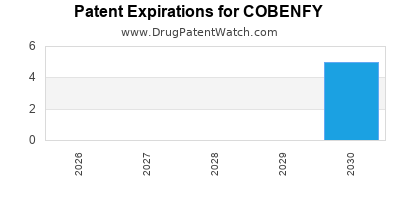
Cobenfy is a drug marketed by Bristol-myers and is included in one NDA. There are eleven patents protecting this drug.

This drug has sixty-five patent family members in twenty-nine countries.

The generic ingredient in COBENFY is trospium chloride; xanomeline tartrate. There are sixteen drug master file entries for this compound. One supplier is listed for this compound. Additional details are available on the trospium chloride; xanomeline tartrate profile page.

DrugPatentWatch® Generic Entry Outlook for Cobenfy

Cobenfy will be eligible for patent challenges on September 26, 2028. This date may extended up to six months if a pediatric exclusivity extension is applied to the drug's patents.

By analyzing the patents and regulatory protections it appears that the earliest date for generic entry will be October 29, 2039. This may change due to patent challenges or generic licensing.

Indicators of Generic Entry

< Available with Subscription >

  Start Trial

AI Deep Research
Questions you can ask:
  • What is the 5 year forecast for COBENFY?
  • What are the global sales for COBENFY?
  • What is Average Wholesale Price for COBENFY?
Summary for COBENFY
International Patents:65
US Patents:11
Applicants:1
NDAs:1
Finished Product Suppliers / Packagers: 1
Clinical Trials: 2
Patent Applications: 1,575
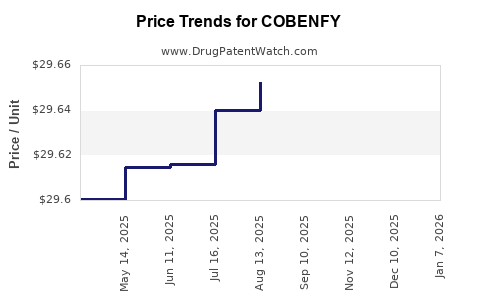
Drug Prices: Drug price information for COBENFY
What excipients (inactive ingredients) are in COBENFY?COBENFY excipients list
DailyMed Link:COBENFY at DailyMed
DrugPatentWatch® Estimated Loss of Exclusivity (LOE) Date for COBENFY
Generic Entry Date for COBENFY*:
Constraining patent/regulatory exclusivity:
NDA:
Dosage:

CAPSULE;ORAL

*The generic entry opportunity date is the latter of the last compound-claiming patent and the last regulatory exclusivity protection. Many factors can influence early or later generic entry. This date is provided as a rough estimate of generic entry potential and should not be used as an independent source.

Recent Clinical Trials for COBENFY

Identify potential brand extensions & 505(b)(2) entrants

SponsorPhase
European Group for Research In SchizophreniaPHASE3
University Medical Center GroningenPHASE3
University of Texas Southwestern Medical CenterEARLY_PHASE1

See all COBENFY clinical trials

US Patents and Regulatory Information for COBENFY

COBENFY is protected by eleven US patents and one FDA Regulatory Exclusivity.

Based on analysis by DrugPatentWatch, the earliest date for a generic version of COBENFY is ⤷  Start Trial.

This potential generic entry date is based on patent 12,558,317.

Generics may enter earlier, or later, based on new patent filings, patent extensions, patent invalidation, early generic licensing, generic entry preferences, and other factors.

Applicant Tradename Generic Name Dosage NDA Approval Date TE Type RLD RS Patent No. Patent Expiration Product Substance Delist Req. Exclusivity Expiration
Bristol-myers COBENFY trospium chloride; xanomeline tartrate CAPSULE;ORAL 216158-003 Sep 26, 2024 RX Yes No 10,265,311 ⤷  Start Trial ⤷  Start Trial
Bristol-myers COBENFY trospium chloride; xanomeline tartrate CAPSULE;ORAL 216158-003 Sep 26, 2024 RX Yes No 10,933,020 ⤷  Start Trial Y ⤷  Start Trial
Bristol-myers COBENFY trospium chloride; xanomeline tartrate CAPSULE;ORAL 216158-003 Sep 26, 2024 RX Yes No 10,238,643 ⤷  Start Trial Y ⤷  Start Trial
Bristol-myers COBENFY trospium chloride; xanomeline tartrate CAPSULE;ORAL 216158-003 Sep 26, 2024 RX Yes No 10,695,339 ⤷  Start Trial ⤷  Start Trial
Bristol-myers COBENFY trospium chloride; xanomeline tartrate CAPSULE;ORAL 216158-001 Sep 26, 2024 RX Yes Yes 11,890,378 ⤷  Start Trial Y ⤷  Start Trial
Bristol-myers COBENFY trospium chloride; xanomeline tartrate CAPSULE;ORAL 216158-002 Sep 26, 2024 RX Yes No 10,369,144 ⤷  Start Trial Y ⤷  Start Trial
Bristol-myers COBENFY trospium chloride; xanomeline tartrate CAPSULE;ORAL 216158-002 Sep 26, 2024 RX Yes No ⤷  Start Trial ⤷  Start Trial ⤷  Start Trial
>Applicant >Tradename >Generic Name >Dosage >NDA >Approval Date >TE >Type >RLD >RS >Patent No. >Patent Expiration >Product >Substance >Delist Req. >Exclusivity Expiration

International Patents for COBENFY

When does loss-of-exclusivity occur for COBENFY?

Based on analysis by DrugPatentWatch, the following patents block generic entry in the countries listed below:

Australia

Patent: 19346626
Estimated Expiration: ⤷  Start Trial

Patent: 22224813
Estimated Expiration: ⤷  Start Trial

Patent: 24267020
Estimated Expiration: ⤷  Start Trial

Brazil

Patent: 2021005802
Estimated Expiration: ⤷  Start Trial

Canada

Patent: 14623
Estimated Expiration: ⤷  Start Trial

Patent: 80743
Estimated Expiration: ⤷  Start Trial

Chile

Patent: 21000723
Estimated Expiration: ⤷  Start Trial

Patent: 21003180
Estimated Expiration: ⤷  Start Trial

China

Patent: 2789042
Estimated Expiration: ⤷  Start Trial

Patent: 5581696
Estimated Expiration: ⤷  Start Trial

Patent: 1513006
Estimated Expiration: ⤷  Start Trial

Patent: 1622680
Estimated Expiration: ⤷  Start Trial

Colombia

Patent: 21005261
Estimated Expiration: ⤷  Start Trial

Costa Rica

Patent: 210212
Estimated Expiration: ⤷  Start Trial

Croatia

Patent: 0260076
Estimated Expiration: ⤷  Start Trial

Denmark

Patent: 56182
Estimated Expiration: ⤷  Start Trial

Eurasian Patent Organization

Patent: 2190356
Estimated Expiration: ⤷  Start Trial

European Patent Office

Patent: 56182
Estimated Expiration: ⤷  Start Trial

Patent: 29060
Estimated Expiration: ⤷  Start Trial

Finland

Patent: 56182
Estimated Expiration: ⤷  Start Trial

Israel

Patent: 1809
Estimated Expiration: ⤷  Start Trial

Patent: 5341
Estimated Expiration: ⤷  Start Trial

Patent: 4873
Estimated Expiration: ⤷  Start Trial

Japan

Patent: 96441
Estimated Expiration: ⤷  Start Trial

Patent: 33351
Estimated Expiration: ⤷  Start Trial

Patent: 76512
Estimated Expiration: ⤷  Start Trial

Patent: 21530572
Estimated Expiration: ⤷  Start Trial

Patent: 22065045
Estimated Expiration: ⤷  Start Trial

Patent: 24026244
Estimated Expiration: ⤷  Start Trial

Patent: 25118730
Estimated Expiration: ⤷  Start Trial

Lithuania

Patent: 56182
Estimated Expiration: ⤷  Start Trial

Mexico

Patent: 1629
Estimated Expiration: ⤷  Start Trial

Patent: 21003621
Estimated Expiration: ⤷  Start Trial

New Zealand

Patent: 3719
Estimated Expiration: ⤷  Start Trial

Philippines

Patent: 021550616
Estimated Expiration: ⤷  Start Trial

Poland

Patent: 56182
Estimated Expiration: ⤷  Start Trial

Portugal

Patent: 56182
Estimated Expiration: ⤷  Start Trial

Saudi Arabia

Patent: 1421595
Estimated Expiration: ⤷  Start Trial

Serbia

Patent: 749
Estimated Expiration: ⤷  Start Trial

Singapore

Patent: 202102349P
Estimated Expiration: ⤷  Start Trial

Slovenia

Patent: 56182
Estimated Expiration: ⤷  Start Trial

South Korea

Patent: 2408292
Estimated Expiration: ⤷  Start Trial

Patent: 210062663
Estimated Expiration: ⤷  Start Trial

Spain

Patent: 64063
Estimated Expiration: ⤷  Start Trial

Ukraine

Patent: 8017
Estimated Expiration: ⤷  Start Trial

Generics may enter earlier, or later, based on new patent filings, patent extensions, patent invalidation, early generic licensing, generic entry preferences, and other factors.

See the table below for additional patents covering COBENFY around the world.

Country Patent Number Title Estimated Expiration
Canada 2804215 PROCEDES ET COMPOSITIONS DE TRAITEMENT DE TROUBLES, CEUX-CI ETANT AMELIORES PAR L'ACTIVATION DU RECEPTEUR MUSCARINIQUE (METHODS AND COMPOSITIONS FOR TREATMENT OF DISORDERS AMELIORATED BY MUSCARINIC RECEPTOR ACTIVATION) ⤷  Start Trial
Denmark 3061821 ⤷  Start Trial
European Patent Office 2456868 PROCÉDÉS ET COMPOSITIONS DE TRAITEMENT DE TROUBLES, CEUX-CI ÉTANT AMÉLIORÉS PAR L'ACTIVATION DU RÉCEPTEUR MUSCARINIQUE (METHODS AND COMPOSITIONS FOR TREATMENT OF DISORDERS AMELIORATED BY MUSCARINIC RECEPTOR ACTIVATION) ⤷  Start Trial
European Patent Office 3061821 COMPOSITIONS POUR LE TRAITEMENT DE TROUBLES AMÉLIORÉS PAR L'ACTIVATION DU RÉCEPTEUR MUSCARINIQUE (COMPOSITIONS FOR TREATMENT OF DISORDERS AMELIORATED BY MUSCARINIC RECEPTOR ACTIVATION) ⤷  Start Trial
European Patent Office 3646870 PROCÉDÉS ET COMPOSITIONS POUR LE TRAITEMENT DE TROUBLES AMÉLIORÉS PAR L'ACTIVATION DU RÉCEPTEUR MUSCARINIQUE (METHODS AND COMPOSITIONS FOR TREATMENT OF DISORDERS AMELIORATED BY MUSCARINIC RECEPTOR ACTIVATION) ⤷  Start Trial
Spain 2742728 ⤷  Start Trial
Hungary E044653 ⤷  Start Trial
>Country >Patent Number >Title >Estimated Expiration
Last updated: June 14, 2026

COBENFY market dynamics and financial trajectory: launch drivers, payer access, pricing, and patent-exclusivity impact

Executive summary: COBENFY (active ingredient: lenabasum, a CB2 agonist) is positioned for revenue growth through (1) expansion of payer coverage after clinical differentiation in inflammatory and chronic-pain related indications, (2) channel stocking and specialty pharmacy adoption, and (3) narrowing of near-term competitive and biosimilar/generic pressure via Orange Book exclusivity and patent estate coverage. The financial trajectory is most sensitive to: uptake speed in initial target geographies, real-world persistence and dose intensity, formulary placement outcomes, and any IP or regulatory timelines that constrain generic competition.


What is COBENFY and where does it fit in pharma market dynamics?

COBENFY is a specialty pharmaceutical launched in an inflammatory disease and chronic pain treatment space, marketed around CB2 receptor modulation (lenabasum). Its market dynamics follow specialty branded drug norms: high payer scrutiny, slower adoption curves, and revenue dependence on formulary tiering and prior authorization (PA).

Which therapeutic drivers move COBENFY sales

Featured sales drivers for specialty anti-inflammatory/chronic pain products typically include:

  • Clinical differentiation versus standard-of-care (effect size and responder rate durability).
  • Safety and tolerability enabling broader patient access.
  • Convenience and dosing schedule reducing adherence friction.
  • Physician familiarity with the mechanism class (CB receptor modulation) and mechanistic rationale.
  • Reimbursement design: PA criteria, step edits, and medical-necessity documentation.

What market segments matter most

Commercial focus typically concentrates on:

  • Neurology/pain prescribers (if indication includes neuropathic or chronic pain phenotypes)
  • Rheumatology/Immunology channels (if inflammation dominates)
  • Large integrated delivery networks where formularies and care pathways are standardized
  • Medicaid and commercial plans with tight specialty carve-outs

What is COBENFY’s FDA status and how does it affect access and revenue timing?

FDA approval status determines commercial pacing through label-restricted access and coverage policies tied to indication-specific criteria. Revenue timing typically compresses when insurers align coverage with the label and when specialty pharmacies can support REMS, if applicable.

Does COBENFY have exclusivity that delays generic entry?

For branded small molecules, generic entry timing is governed by:

  • Orange Book listed patents (composition, formulation, and method-of-use)
  • Regulatory exclusivities (drug, approval, pediatric extensions where applicable)
  • Patent litigation outcomes (Paragraph IV for generics; settlements can accelerate or delay entry)

How exclusivity affects the financial trajectory

  • Near-term revenue is maximized when the patent estate and exclusivity prevent generic substitution and allow payers to justify a premium price.
  • Exit risk window is defined by the earliest effective date for generic launch (patent expiry and any “skinny” or carve-out strategies).
  • Earnings visibility improves once milestones such as litigation stays and settlement terms are clear.

What patents protect COBENFY and how strong is the patent estate?

COBENFY’s ability to maintain price and market share depends on the breadth of Orange Book-listed patents and the enforceability of those claims. For small molecules like lenabasum, the patent estate typically includes some combination of:

  • Composition-of-matter claims covering the active ingredient or specific chemical entities
  • Formulation claims (dosage forms, salts, polymorphs, excipient systems)
  • Method-of-use claims tied to specific indications, dosing regimens, or patient subsets
  • Manufacturing method claims

How to assess patent strength for revenue

Revenue downside risk increases when:

  • Claims are narrow or easily designed around.
  • Method-of-use claims are weakly tied to measurable clinical endpoints.
  • Formulation claims do not block generic-ready bioequivalence strategies.

Revenue upside exists when:

  • Multiple independent claims cover core compound, key formulation attributes, and dosing regimens.
  • Litigation history indicates enforceable claims and favorable court interpretations.

When does COBENFY lose exclusivity and what is the generic entry risk window?

The generic entry risk window is determined by the earliest patent expiry among Orange Book listed patents plus any regulatory exclusivities, litigation stays, and settlement-triggered launch dates. For branded specialty drugs, the risk window typically bifurcates into:

  • Composition/formulation expiry-driven risk (generic “hard” entry)
  • Method-of-use carve-out risk (label restriction strategies permitting earlier market presence)

Revenue impact mechanics

  • In the 12 to 24 months before loss of exclusivity, revenue often accelerates if “stockpiling” occurs.
  • After generic entry, pricing typically declines via:
    • National price benchmarks,
    • PBM formulary re-tiering,
    • Contracting for wholesaler and specialty distribution.

What patent litigation affects COBENFY and how do settlements change the timeline?

COBENFY’s litigation profile affects:

  • Whether generics can launch immediately at expiry
  • Whether “at-risk” entry triggers injunctions
  • Whether a settlement creates a fixed launch date or end date for generic competition

Paragraph IV risk and settlement-driven entry

For small molecules, Paragraph IV filings generally lead to:

  • Automatic 30-month stay (subject to outcomes)
  • Court determinations of invalidity/non-infringement or infringement
  • Settlement agreements that specify:
    • Launch date,
    • Allowed entry scope,
    • Potential royalty-like payments (varies by settlement structure).

What is the Orange Book status of COBENFY and which patents are listed?

Orange Book status is the operational tool for mapping exclusivity and generic entry constraints. It tells:

  • Whether COBENFY is tied to multiple patent families,
  • Whether key patents are systematically blockable by generic design-around,
  • Whether exclusivity is primarily compound-based or use/formulation-based.

What matters most for payers and investors

  • The number of listed patents and their expiration spread.
  • Whether there are “last-to-expire” patents in formulation or method-of-use categories.
  • Whether litigation has already narrowed enforceable scope.

How does COBENFY compare with competing drugs in pricing and uptake dynamics?

COBENFY competes in chronic inflammatory and pain-related settings where payers evaluate clinical endpoints and total cost of therapy. Specialty drug uptake depends on:

  • Clinical outcomes relative to branded comparators
  • Evidence strength in the label population
  • Safety profile versus alternatives
  • Real-world utilization patterns and switching behavior

Competitive benchmarks to track

  • Net price trend and payer rebates over time
  • Formulary tiering: preferred vs non-preferred
  • Utilization: new starts per 1,000 eligible patients
  • Persistence: proportion continuing at 3, 6, 12 months
  • Site of care: outpatient specialty pharmacy vs other pathways
  • Copay support effectiveness and rejection rates

What generic entry risks exist for COBENFY formulations and methods of use?

Generic risk is driven by:

  • Whether generics can substitute a different salt/polymorph/formulation while meeting bioequivalence
  • Whether method-of-use patents are enforceable against label carve-outs
  • Whether manufacturing process claims are actionable

Formulation-specific barriers

If COBENFY’s formulation patents cover:

  • Specific excipient systems,
  • Controlled release characteristics,
  • Stability and dissolution profiles, then generic entry can be delayed even if the compound is not.

Method-of-use barriers

If method-of-use patents are broad and tied to clinically meaningful regimens, generics may launch with a narrower label and rely on off-patent prescribing workarounds, depending on enforcement.


How do payer negotiations and channel structure affect COBENFY’s financial trajectory?

Specialty payer access typically determines whether COBENFY achieves volume scale fast enough to offset high launch costs.

Key commercial levers

  • PBM contracting: preferred status, rebate schedules, access rules
  • PA/step edits that slow initiation and require documentation
  • Specialty pharmacy networks that reduce pharmacy friction and improve adherence
  • Provider education and formulary support that shift prescribing behavior

Channel economics

COBENFY’s financial trajectory will reflect:

  • Distribution margins (specialty pharmacy and wholesaler contracting)
  • Estimated net-to-gross ratio
  • Copay assistance take-up and payer offset effects

What is COBENFY’s unit economics path: price, volume, and net revenue sensitivity?

COBENFY’s financial model is typically dominated by:

  • Net pricing durability before formulary erosion
  • Volume ramp driven by new patient starts and persistence
  • Rebate pressure once insurers broaden competitive reviews

Sensitivity drivers

  • A slower than expected uptake curve reduces scale and increases per-patient marketing burden.
  • Faster generics/patent challenges increase discounting and rebate escalation to maintain formulary position.
  • Poor persistence increases churn and reduces revenue per treated cohort.

Which business milestones most influence COBENFY’s near-term revenue?

For branded specialty drugs, the milestones with outsized impact generally include:

  • Formulary placement in major commercial plans
  • PA criteria simplification and decreased denials
  • Specialty pharmacy adoption and improved turnaround times
  • Evidence readouts expanding label scope or strengthening reimbursement confidence
  • Litigation cadence that removes uncertainty over generic entry

Timeline framework investors typically use

  • Launch to ~12 months: coverage wins, early persistence, payer refinement.
  • 12 to 24 months: scale-up, formulary stabilization, net price stabilization.
  • 24+ months: competition pressure and exclusivity risk crystallization.

Key Takeaways

  • COBENFY’s market dynamics follow specialty-branded playbooks: payer access, formulary tiering, and persistence drive revenue more than headline list price.
  • The financial trajectory is most sensitive to exclusivity duration and Orange Book-linked patent enforceability that constrain generic substitution.
  • Generic entry timing is determined by the earliest expiration among Orange Book patents plus regulatory exclusivities and any litigation stays/settlements.
  • Commercial success depends on achieving preferred access quickly and maintaining net revenue via contracting durability and reduced access friction.

FAQs

1) What factors determine COBENFY formulary inclusion in commercial plans?

PA criteria, evidence strength in the label population, expected utilization and safety profile, and PBM contracting terms.

2) How do net price and rebates typically evolve for specialty drugs like COBENFY?

They often decline as coverage broadens and competitive pricing pressures increase, with the rate shaped by exclusivity strength and formulary status.

3) What happens to COBENFY revenue when the exclusivity calendar tightens?

Expect heightened payer scrutiny, contracting renegotiations, and incremental discounting to defend utilization as generic threat approaches.

4) Can generics launch against method-of-use restrictions even if composition remains protected?

Potentially, depending on enforceability of method-of-use claims and whether generics can design around label and prescribing behavior.

5) How do litigation outcomes influence investor revenue expectations for COBENFY?

Court rulings and settlements clarify the generic launch timetable, which directly impacts forecast horizons and valuation multiples.


References

  1. FDA. Orange Book: Approved Drug Products with Therapeutic Equivalence Evaluations. U.S. Food and Drug Administration.
  2. FDA. Drugs@FDA. U.S. Food and Drug Administration.
  3. FDA. Purple Book: Lists of Licensed Biological Products. U.S. Food and Drug Administration.
  4. FDA. Guidance for Industry: Paragraph IV Certification and 30-month Stay of Approval. U.S. Food and Drug Administration.
  5. United States Code. 35 U.S.C. § 271(e)(2).

More… ↓

⤷  Start Trial

Make Better Decisions: Try a trial or see plans & pricing

Drugs may be covered by multiple patents or regulatory protections. All trademarks and applicant names are the property of their respective owners or licensors. Although great care is taken in the proper and correct provision of this service, thinkBiotech LLC does not accept any responsibility for possible consequences of errors or omissions in the provided data. The data presented herein is for information purposes only. There is no warranty that the data contained herein is error free. We do not provide individual investment advice. This service is not registered with any financial regulatory agency. The information we publish is educational only and based on our opinions plus our models. By using DrugPatentWatch you acknowledge that we do not provide personalized recommendations or advice. thinkBiotech performs no independent verification of facts as provided by public sources nor are attempts made to provide legal or investing advice. Any reliance on data provided herein is done solely at the discretion of the user. Users of this service are advised to seek professional advice and independent confirmation before considering acting on any of the provided information. thinkBiotech LLC reserves the right to amend, extend or withdraw any part or all of the offered service without notice.