Last updated: February 19, 2026
Cimetidine, a histamine H2 receptor antagonist, generated significant revenue for its originator, SmithKline Beecham (now GlaxoSmithKline), primarily through its prescription drug formulation, Tagamet. Its market trajectory reflects a classic patent cliff impact and the subsequent rise of generic competition.
What was Cimetidine's Initial Market Positioning?
Cimetidine was introduced in 1976 by SmithKline as Tagamet. It was the first effective H2 receptor antagonist for treating peptic ulcers and gastroesophageal reflux disease (GERD). Prior to cimetidine, treatment options were limited and often involved surgery. The drug’s efficacy established it as a blockbuster product, transforming the treatment of acid-related disorders. Its mechanism of action involved reducing gastric acid production, offering relief and promoting healing of damaged stomach and duodenal tissue.
The initial market entry saw rapid adoption due to a significant unmet medical need. Physicians prescribed Tagamet widely for conditions such as:
- Duodenal ulcers
- Gastric ulcers
- Gastroesophageal reflux disease (GERD)
- Zollinger-Ellison syndrome
The prescription market was the primary focus, with Tagamet achieving peak annual sales exceeding $1 billion by the late 1980s. This made it one of the first drugs to reach such a sales milestone [1].
How did Patent Expiration Impact Cimetidine's Market?
The patent protection for Tagamet was a critical factor in its initial market exclusivity. SmithKline Beecham held exclusive marketing rights for a defined period. Upon the expiration of these patents in the mid-1990s, the market dynamics shifted dramatically.
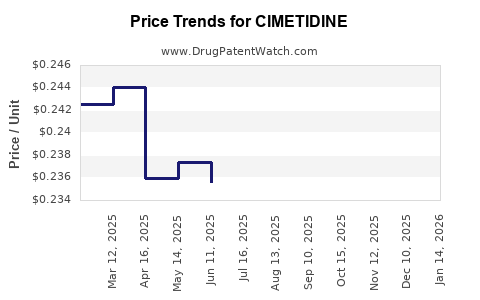
The expiration of the primary patents allowed for the entry of generic manufacturers. These companies could produce bioequivalent versions of cimetidine at a significantly lower cost. This led to a rapid decline in the price of cimetidine and a corresponding erosion of Tagamet’s market share.
Key impacts of patent expiration:
- Generic Entry: Multiple pharmaceutical companies launched generic cimetidine products.
- Price Compression: Generic competition drove down the average selling price (ASP) of cimetidine by an estimated 50-70% within the first few years of generic availability [2].
- Market Share Shift: The market share of branded Tagamet decreased substantially as physicians and patients opted for less expensive generic alternatives.
- Over-the-Counter (OTC) Transition: SmithKline strategically transitioned Tagamet to an over-the-counter (OTC) product in the United States in 1996, shortly after patent expiry for the prescription version. This move aimed to leverage the brand recognition and capture a portion of the self-medication market. The OTC approval allowed consumers to purchase cimetidine without a prescription for managing heartburn and indigestion [3].
The transition to OTC status created a new market segment but also intensified competition, as a wider range of manufacturers could participate in the non-prescription market.
What were the Financial Trajectories of Branded vs. Generic Cimetidine?
The financial trajectory for branded cimetidine (Tagamet) and its generic counterparts diverged sharply post-patent expiration.
Branded Cimetidine (Tagamet):
- Peak Revenue: Tagamet achieved peak annual sales in the late 1980s, reportedly around $1 billion USD [1].
- Post-Patent Decline: Following the patent expiry in the mid-1990s and the subsequent launch of generics, the prescription sales of Tagamet experienced a steep decline.
- OTC Sales: The transition to OTC status in 1996 allowed for continued revenue generation, albeit at lower price points than prescription sales. However, this segment was also highly competitive.
- Royalty and Licensing: SmithKline Beecham also generated revenue through licensing agreements with companies producing generic versions in certain territories.
Generic Cimetidine:
- Rapid Market Penetration: Generic cimetidine products entered the market quickly after patent expiration, capturing a significant portion of the prescription market within 1-2 years.
- Volume-Driven Growth: The financial success of generic cimetidine was primarily driven by high sales volumes rather than high profit margins per unit.
- Price Sensitivity: The market for generic cimetidine became highly price-sensitive, with manufacturers competing on cost.
- Sustained Revenue Stream: Despite low profit margins, the aggregated revenue from numerous generic cimetidine manufacturers continued to represent a substantial market for the drug over decades.
Comparative Financial Performance:
| Metric |
Branded Tagamet (Pre-Patent Expiry) |
Branded Tagamet (Post-Patent Expiry - OTC) |
Generic Cimetidine |
| Peak Annual Sales |
~$1 billion USD |
Varied, lower than prescription peak |
Aggregated across multiple manufacturers |
| Profit Margins |
High |
Moderate to Low |
Low |
| Pricing |
Premium |
Competitive |
Lowest |
| Market Access |
Prescription (initially) |
Over-the-Counter (primarily) |
Prescription and Over-the-Counter |
| Competition |
Limited |
Moderate to High |
High |
The financial story of cimetidine illustrates how a highly profitable branded drug can transition into a high-volume, lower-margin market driven by generics.
What is Cimetidine's Current Market Status and Outlook?
Cimetidine remains a widely available medication, both by prescription and over-the-counter, globally. Its current market status is characterized by mature product lifecycle and strong generic competition.
Current Market Characteristics:
- Ubiquitous Availability: Cimetidine is a staple in many formularies and a common choice for self-treatment of minor gastrointestinal discomfort.
- Intense Generic Competition: The market is saturated with generic cimetidine products from numerous manufacturers. This has led to sustained low pricing.
- Established Therapeutic Role: While newer proton pump inhibitors (PPIs) have become first-line treatments for more severe GERD and ulcer management, cimetidine still holds a place for mild symptoms and in specific therapeutic contexts.
- Limited Innovation: There has been minimal new drug development or significant product innovation related to cimetidine itself in recent decades. Its development as a molecule is largely complete.
- Market Size: While precise global figures for cimetidine alone are difficult to isolate from the broader H2 antagonist and antacid markets, it represents a significant, albeit mature, segment. The global antacids market, which includes H2 blockers like cimetidine, is valued in the billions of dollars, with generic components forming a large share [4].
Outlook:
The future outlook for cimetidine is for continued market presence as a low-cost generic option.
- Sustained Demand: Demand is expected to remain stable, driven by its established safety profile, affordability, and effectiveness for its indications.
- Competition from Newer Agents: Cimetidine will continue to face competition from PPIs, which offer more potent and longer-lasting acid suppression, particularly for severe conditions.
- Price Erosion Continues: Pricing is unlikely to increase significantly; further minor erosion is possible due to ongoing competitive pressures among generic manufacturers.
- Regulatory Landscape: Cimetidine's regulatory status remains stable for its approved indications. Changes in prescribing guidelines for acid suppression therapies could indirectly affect its usage volumes.
The market for cimetidine is a testament to the enduring value of accessible, affordable generic medications once patents expire.
What are the Key Competitive Landscape Factors for Cimetidine?
The competitive landscape for cimetidine is dominated by generic manufacturers and the broader class of acid-suppressing medications.
Key Competitive Factors:
- Price: This is the most significant factor. Generic manufacturers compete primarily on cost to gain market share. The lowest price often dictates procurement in tenders and formulary decisions.
- Manufacturing Scale and Efficiency: Companies with large-scale, efficient manufacturing operations can produce cimetidine at lower costs, providing a competitive advantage.
- Distribution Networks: Access to broad distribution networks, both domestically and internationally, is crucial for reaching a wide customer base.
- Formulation Variety: While cimetidine is available in standard tablet and liquid forms, minor variations in formulations or combination products (though rare for cimetidine) can offer differentiation.
- Brand Trust (for OTC): For over-the-counter sales, established brand recognition, even for generic products or sub-brands, can influence consumer choice.
- Alternative Therapies: The most significant competitive threat comes from other drug classes, primarily proton pump inhibitors (PPIs) like omeprazole, lansoprazole, and pantoprazole, which are often more effective for severe acid-related conditions. H2 blockers like famotidine and ranitidine (though ranitidine has faced recalls) also compete directly.
- Regulatory Compliance: Adherence to Good Manufacturing Practices (GMP) and other regulatory standards is essential for all manufacturers to maintain market access.
Market Share Distribution:
It is challenging to pinpoint exact market share percentages for individual cimetidine generic manufacturers due to the fragmented nature of the generic market and the proprietary nature of sales data. However, the market is comprised of:
- Large Generic Pharmaceutical Companies: These companies often have broad portfolios and significant production capacity. Examples include Teva Pharmaceuticals, Mylan (now Viatris), and Sandoz.
- Smaller, Regional Generic Producers: These companies may focus on specific markets or product niches.
- Contract Manufacturing Organizations (CMOs): Some companies may outsource production.
The competitive dynamics are characterized by continuous price negotiations and a focus on cost optimization to remain viable in a highly commoditized market.
How Does Cimetidine Compare to Other H2 Receptor Antagonists and PPIs?
Cimetidine's comparative position has evolved significantly since its introduction. It now sits alongside other H2 receptor antagonists and is largely superseded by proton pump inhibitors (PPIs) for many indications.
Cimetidine vs. Other H2 Receptor Antagonists:
- Ranitidine (Zantac): Historically, ranitidine became the top-selling drug worldwide, surpassing cimetidine, due to a perceived better efficacy and fewer side effects profile, particularly drug interactions. However, ranitidine has been largely withdrawn from markets due to nitrosamine contamination concerns [5].
- Famotidine (Pepcid): Famotidine is another widely used H2 blocker. It is generally considered to have a favorable side effect profile and fewer drug interactions compared to cimetidine. It remains a significant competitor in the H2 antagonist space.
- Nizatidine (Axid): Nizatidine is also an H2 antagonist with a similar efficacy profile to famotidine and less potential for drug interactions than cimetidine.
Cimetidine vs. Proton Pump Inhibitors (PPIs):
- Mechanism: PPIs work by irreversibly blocking the proton pump in the parietal cells, leading to more profound and sustained acid suppression than H2 blockers.
- Efficacy: PPIs are generally considered more effective for severe GERD, healing erosive esophagitis, and managing Zollinger-Ellison syndrome.
- Duration of Action: PPIs offer longer duration of acid suppression, often requiring once-daily dosing, whereas H2 blockers may require twice-daily dosing for optimal effect.
- Drug Interactions: Cimetidine is known to interact with a significant number of medications due to its inhibition of cytochrome P450 enzymes (particularly CYP1A2, CYP2D6, and CYP3A4). This is a major drawback compared to famotidine and most PPIs.
- Cost: Cimetidine, being an older generic, is typically among the least expensive options available. Many generic PPIs are also now very affordable, but branded PPIs can still carry a higher cost.
Comparative Table:
| Drug Class |
Example Agents |
Mechanism |
Acid Suppression Potency |
Duration of Action |
Key Side Effects/Concerns |
Common Indications |
| H2 Receptor Antagonists |
Cimetidine, Famotidine, Nizatidine |
Reversibly block histamine H2 receptors on parietal cells. |
Moderate |
Moderate |
Cimetidine: Drug interactions, gynecomastia. Others: Generally well-tolerated. |
Mild heartburn, GERD, duodenal/gastric ulcers. |
| Proton Pump Inhibitors (PPIs) |
Omeprazole, Lansoprazole, Pantoprazole, Esomeprazole |
Irreversibly inhibit the H+/K+-ATPase (proton pump) in parietal cells. |
High |
Long |
Long-term use: Vitamin B12 deficiency, hypomagnesemia, fracture risk. |
Erosive esophagitis, severe GERD, H. pylori eradication, Zollinger-Ellison. |
While cimetidine was revolutionary in its time, its therapeutic niche has narrowed due to the development of more potent and better-tolerated alternatives. Its primary remaining advantage is its very low cost.
Key Takeaways
- Cimetidine (Tagamet) revolutionized peptic ulcer and GERD treatment upon its 1976 introduction, achieving blockbuster status.
- Patent expiration in the mid-1990s led to rapid generic entry, significant price compression, and a decline in branded market share.
- SmithKline Beecham successfully transitioned Tagamet to an over-the-counter (OTC) product in 1996, extending its commercial lifecycle but in a more competitive market.
- The financial trajectory shows a sharp decline in branded revenue per unit, shifting to a high-volume, low-margin model for generic cimetidine.
- Currently, cimetidine remains a widely available, low-cost generic option for mild acid-related symptoms, facing competition from newer H2 blockers and more potent PPIs.
- The competitive landscape is dominated by price, manufacturing efficiency, and the availability of alternative therapies, particularly PPIs.
- Cimetidine's historical significance is offset by modern therapeutic preferences for PPIs due to their superior efficacy and the drug's notable potential for drug interactions.
Frequently Asked Questions
-
What specific cytochrome P450 enzymes does cimetidine inhibit, and what are the clinical implications?
Cimetidine inhibits CYP1A2, CYP2D6, and CYP3A4, as well as other enzymes. This can lead to increased plasma concentrations and potential toxicity of co-administered drugs metabolized by these enzymes, such as warfarin, theophylline, phenytoin, and some benzodiazepines [6].
-
Did the over-the-counter (OTC) switch of Tagamet significantly impact its overall revenue?
Yes, the OTC switch allowed the brand to continue generating revenue by targeting the self-medication market for heartburn and indigestion. While revenue per unit was lower than prescription sales, it maintained brand presence and access to a broad consumer base.
-
What was the primary reason for ranitidine surpassing cimetidine in sales prior to ranitidine's withdrawal?
Ranitidine was perceived to have a more favorable side effect profile, particularly fewer drug interactions compared to cimetidine, and was thought by some to be more potent for certain indications, leading to its widespread adoption.
-
How does the cost of generic cimetidine compare to generic proton pump inhibitors (PPIs)?
Generally, generic cimetidine is among the least expensive acid-suppressing medications available. Generic PPIs are also very affordable but may still be priced slightly higher per dose, although this can vary by manufacturer and region.
-
Are there any ongoing clinical trials or new research investigating cimetidine for novel indications?
As of late 2023, there is no significant active clinical development or research for novel indications of cimetidine. Its use is primarily confined to its established roles in acid suppression.
Citations
[1] Roberts, R. (2011). The Greatest: The Quest for the Ultimate Marketing Campaign. Kogan Page Publishers.
[2] Generic Pharmaceutical Association. (2005). The Value of Generics.
[3] U.S. Food and Drug Administration. (1996). FDA approves Tagamet HB for over-the-counter use.
[4] Grand View Research. (2023). Antacids Market Size, Share & Trends Analysis Report.
[5] U.S. Food and Drug Administration. (2020). FDA Investigates Potential Cancer Risk in Recalled Ranitidine Products.
[6] Drugbank. (n.d.). Cimetidine: DrugBank Profile. Retrieved from https://go.drugbank.com/drugs/DB00441