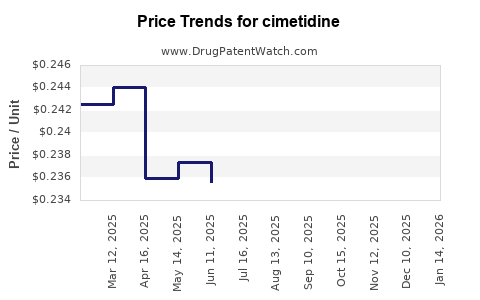
Last updated: August 20, 2026
Cimetidine is a mature, fully genericized histamine-2 receptor antagonist with limited commercial growth potential. Its U.S. composition-of-matter patent expired in the early 1990s, prescription exclusivity ended decades ago, and current competition comes from low-cost generic cimetidine, famotidine, proton-pump inhibitors, and nonprescription gastrointestinal products. The drug remains FDA-approved and commercially available, but its financial profile is defined by price erosion, low promotional spending, and niche demand rather than branded pharmaceutical growth.
What is cimetidine and how is it used?
Cimetidine is an H2-receptor antagonist that reduces gastric acid secretion. It was developed by SmithKline & French and marketed as Tagamet. The FDA approved Tagamet in 1977 for duodenal ulcer disease and related acid-mediated disorders.[1]
Common indications include:
- Duodenal and gastric ulcers
- Gastroesophageal reflux disease
- Heartburn and acid indigestion
- Hypersecretory conditions such as Zollinger-Ellison syndrome
- Maintenance therapy for selected ulcer patients
Cimetidine is available in prescription and over-the-counter forms. Prescription strengths have historically included 300 mg, 400 mg, and 800 mg tablets, as well as oral solutions. Tagamet HB has been marketed for nonprescription heartburn relief, although the consumer market is dominated by other acid-reducing products.
Cimetidine differs from later H2 antagonists because it has a comparatively high interaction burden. It inhibits several cytochrome P450 enzymes and can increase exposure to drugs including warfarin, phenytoin, theophylline, and selected benzodiazepines.[2] This pharmacokinetic liability contributed to the commercial shift toward famotidine and proton-pump inhibitors.
When did cimetidine lose patent exclusivity?
Cimetidine’s core U.S. patent protection expired in the early 1990s. The original U.S. compound patent was U.S. Patent No. 3,950,333, assigned to SmithKline Corporation and directed to cimetidine and related guanidine compounds.[3]
| Milestone |
Approximate date |
Commercial effect |
| Original compound patent filed |
Early 1970s |
Created core exclusivity |
| FDA approval of Tagamet |
1977 |
Began U.S. commercial sales |
| Core patent expiry |
Early 1990s |
Opened market to generic competition |
| Generic cimetidine expansion |
1990s |
Reduced branded pricing and share |
| Current market |
2020s |
Mature generic and OTC product |
The exact loss-of-exclusivity date depends on the relevant patent, terminal disclaimers, patent-term rules, and product presentation. The core composition patent no longer creates a commercial barrier. Any remaining U.S. patent listings associated with current cimetidine products would need to be checked in the FDA Orange Book by product and application number. Cimetidine is not generally considered to have a meaningful live patent estate protecting the active ingredient.
What patents protect cimetidine today?
No commercially material U.S. composition-of-matter patent protects cimetidine today. The principal patent value was concentrated in the original chemical entity and early formulation and use claims.
Core compound protection
The original cimetidine patent covered the active chemical class and specific cimetidine structure. That protection was the principal barrier to generic entry and supported Tagamet’s initial premium pricing.
Formulation patents
Cimetidine tablets, oral solutions, and OTC products may have been covered historically by formulation, manufacturing, or dosage-form claims. Those protections are no longer viewed as meaningful barriers to generic entry. Standard immediate-release cimetidine products are technically straightforward to manufacture.
Method-of-use patents
Cimetidine’s historical method-of-use claims covered acid-related disorders and therapeutic dosing. These uses are long established, and the relevant exclusivity period has ended. Current generic manufacturers can market cimetidine for approved indications subject to applicable labeling and regulatory requirements.
Manufacturing and process protection
Manufacturing know-how may still have value at the supplier level, including impurity control, crystallization, yield optimization, and active pharmaceutical ingredient sourcing. These are commercial process advantages rather than durable market-exclusion rights. A manufacturer with an efficient cimetidine supply chain can compete on cost, but cannot prevent other qualified manufacturers from producing the drug.
What is the FDA regulatory status of cimetidine?
Cimetidine remains an FDA-approved active ingredient in prescription and OTC products. Generic manufacturers market cimetidine through abbreviated new drug applications, while consumer products such as Tagamet HB are regulated under the OTC drug framework or associated approved labeling.
The drug has no biosimilar pathway because cimetidine is a small-molecule chemical drug, not a biologic. Competitive entry occurs through generic approval, not biosimilar interchangeability.
FDA regulatory characteristics
| Regulatory issue |
Cimetidine status |
| Drug type |
Small-molecule chemical drug |
| Original brand |
Tagamet |
| FDA approval |
1977 |
| Generic pathway |
ANDA |
| Biosimilar pathway |
Not applicable |
| Prescription status |
Generic prescription products remain available |
| OTC status |
Tagamet HB and other consumer acid-reduction products |
| Current exclusivity |
None of commercial significance |
| Orange Book relevance |
Product-specific patent and exclusivity review |
The FDA’s Orange Book identifies approved drug products and, where applicable, associated patents and exclusivity. For a mature generic drug such as cimetidine, the principal Orange Book issue is product availability and any current listing tied to a specific application, not protection of the underlying molecule.[4]
How many patents cover cimetidine?
The number of historically issued cimetidine-related patents is much greater than the number of patents with current commercial relevance. Early patents covered the active compound, salts, intermediates, synthesis routes, formulations, therapeutic uses, and combinations. Most have expired.
A current competitive analysis should distinguish among:
- Expired composition patents.
- Expired formulation and process patents.
- Historical method-of-use patents.
- Any current product-specific Orange Book listings.
- Non-patent manufacturing know-how.
For generic-entry purposes, the commercially relevant count is effectively zero for core molecule protection. Patent risk is materially lower than regulatory, supply-chain, quality, or demand risk.
Are there Paragraph IV challenges involving cimetidine?
Paragraph IV litigation is not a major current market issue for cimetidine. Paragraph IV certifications are most commercially important when a generic applicant seeks approval before expiration of a listed patent. Cimetidine’s core patent protection expired decades ago, so modern generic competition does not depend on challenging a live blockbuster patent.
Historical generic filings may have involved patent certifications, but any litigation connected with the original Tagamet exclusivity period is no longer a meaningful determinant of market access. Current entrants would focus on FDA approval, product quality, bioequivalence, manufacturing capacity, and commercial economics.
What generic entry risks exist for cimetidine?
Generic entry risk is high because the product is technically mature and the active ingredient is unprotected. At the same time, the economic incentive for new entrants is modest.
Entry advantages
- No meaningful composition patent barrier
- Established analytical methods
- Familiar dosage forms
- Long clinical history
- Low development cost relative to innovative drugs
- Multiple potential API sources
- Established FDA regulatory precedent
Entry constraints
- Low selling prices
- Limited market growth
- Competition from famotidine and PPIs
- Small prescription volumes
- Retail substitution and pharmacy purchasing pressure
- Potential supply-chain concentration
- Limited return on new manufacturing investment
A new generic manufacturer can enter if it secures FDA approval and commercial supply, but entry may produce only incremental revenue. The market does not have the volume or pricing profile that typically attracts large-scale branded investment.
How does cimetidine compare with famotidine and proton-pump inhibitors?
Cimetidine has lost most of its therapeutic and commercial position to famotidine and proton-pump inhibitors.
| Attribute |
Cimetidine |
Famotidine |
Proton-pump inhibitors |
| Drug class |
H2 antagonist |
H2 antagonist |
Acid pump inhibitor |
| Acid suppression |
Moderate |
Moderate to strong |
Strong |
| Drug interactions |
Relatively high |
Lower than cimetidine |
Product-specific |
| Prescription status |
Generic |
Generic |
Generic and OTC |
| Brand opportunity |
Minimal |
Minimal to limited |
Limited in mature products |
| Main commercial use |
Niche prescription and OTC |
OTC and prescription |
Broad GERD and ulcer treatment |
| Biosimilar risk |
None |
None |
None |
| Patent risk |
Expired |
Largely expired |
Product-specific but generally mature |
Famotidine has a cleaner interaction profile and became the preferred H2 antagonist for many clinicians. Proton-pump inhibitors such as omeprazole, esomeprazole, lansoprazole, and pantoprazole provide stronger and more durable acid suppression and have captured much of the treatment market.
The withdrawal of ranitidine from the U.S. market in 2020 temporarily increased attention on famotidine and other H2 antagonists. It did not restore cimetidine to its former commercial position because safety, interaction, and prescribing preferences continued to favor alternatives.[5]
What is the financial trajectory for cimetidine?
Cimetidine’s financial trajectory has four phases:
1. Branded growth: late 1970s through the 1980s
Tagamet was one of the earliest major commercial acid-suppression products. Its launch created substantial prescription demand for a new ulcer and reflux therapy. The product benefited from broad clinical adoption and limited early competition.
2. Patent expiry and generic erosion: 1990s
Generic entry sharply reduced branded pricing and market share. As pharmacies and health plans substituted generic cimetidine, the economic value shifted from the originator to low-cost manufacturers and distributors.
3. Therapeutic displacement: 1990s through 2010s
Famotidine and proton-pump inhibitors reduced cimetidine demand. The product retained use in selected patients but lost broad first-line status.
4. Mature niche market: 2020s
Cimetidine generates residual prescription and OTC sales, but no major publicly traded manufacturer reports it as a standalone growth product. Revenue is generally embedded within broader generic portfolios or consumer-health categories. Publicly available company disclosures do not provide a reliable, product-level global revenue figure for cimetidine.
Commercial economics are therefore better assessed through volume, average selling price, active manufacturer count, pharmacy reimbursement, and API cost than through branded revenue forecasts.
Which companies manufacture or market cimetidine?
Cimetidine is supplied through a fragmented generic and consumer-health ecosystem. Participants can include:
- Generic pharmaceutical manufacturers with approved ANDAs
- Contract manufacturers
- API suppliers
- Wholesalers and pharmacy suppliers
- Consumer-health marketers
- Retail pharmacy private-label suppliers
The original Tagamet brand has historical association with SmithKline Beecham and later GSK-related consumer-health operations. Ownership and commercialization arrangements for branded OTC products can change through asset transfers, licensing, or portfolio transactions. Generic supply is typically more important than brand ownership in determining market access.
The primary competitive variables are product availability, wholesale acquisition cost, contract terms, manufacturing reliability, and pharmacy stocking decisions.
What patent litigation and settlement agreements affect cimetidine?
Cimetidine has no current litigation profile comparable with patented oncology, immunology, or specialty medicines. Its historical litigation was linked to originator patent enforcement and generic entry during the period when Tagamet exclusivity had commercial value.
Current litigation risk is more likely to involve:
- Product liability
- Manufacturing defects
- FDA compliance
- Labeling
- Distribution contracts
- Supply agreements
- Competition-law issues
Settlement agreements from the original patent period are unlikely to impose meaningful present-day restrictions on generic entry. Any historical agreement must be analyzed against its expiration, release language, and surviving contractual obligations.
How strong is the cimetidine patent estate?
The patent estate is commercially weak because the core claims have expired and the market has extensive generic substitution.
| Patent-estate factor |
Assessment |
| Core molecule protection |
Expired |
| Formulation protection |
Generally expired or non-blocking |
| Method-of-use protection |
Expired |
| Manufacturing know-how |
Potentially useful but nonexclusive |
| Current generic barrier |
Low |
| Litigation exposure |
Low |
| Pricing power |
Very low |
| Opportunity for life-cycle management |
Limited |
Cimetidine has no credible path to premium pricing based on the original molecule. A reformulation could create a new patent position, but the commercial case would be difficult because famotidine, PPIs, and low-cost generic alternatives already meet most demand.
What geographic markets remain commercially relevant?
The United States remains relevant because cimetidine is approved in prescription and OTC forms, but it is a mature, low-value market. Other markets may retain demand for cimetidine where:
- Generic medicine access is price-sensitive.
- Older treatment protocols remain common.
- Famotidine availability is limited.
- Local manufacturers have established distribution.
- OTC gastrointestinal products are widely used.
International patent protection has expired in major markets. Geographic differences mainly involve regulatory registration, local pricing, reimbursement, API sourcing, and manufacturing standards. There is no broad global exclusivity position that would support premium pricing.
What generic launch scenarios are plausible?
Base case
Existing generic suppliers continue serving a stable but declining or low-growth market. Prices remain compressed, and cimetidine retains niche prescription and OTC demand.
Downside case
Manufacturers exit because margins are insufficient. Fewer suppliers create intermittent shortages or higher procurement costs without restoring durable brand pricing.
Upside case
A temporary shortage of competing H2 antagonists or a consumer-health marketing campaign increases demand. Any gain is likely to be limited and reversible because substitutes are widely available.
Strategic investment case
The strongest opportunity is not molecule ownership. It is low-cost supply, contract manufacturing, private-label OTC distribution, or portfolio aggregation. A standalone branded redevelopment strategy would face weak differentiation and limited pricing power.
Key Takeaways
- Cimetidine is a mature generic H2 antagonist with no meaningful active core patent barrier.
- Tagamet’s original U.S. exclusivity ended in the early 1990s.
- The FDA-approved drug remains available in prescription and OTC formats.
- Paragraph IV litigation and biosimilar risk are not current material issues.
- Famotidine and proton-pump inhibitors have displaced cimetidine in most treatment settings.
- Current revenue is fragmented across generic and consumer-health suppliers, with no reliable standalone public revenue figure.
- Financial performance depends on manufacturing cost, supply continuity, pharmacy contracts, and residual demand.
- The main risks are price erosion, therapeutic substitution, supplier exit, and regulatory or quality disruption.
- The patent estate is commercially weak, while manufacturing execution remains the principal competitive variable.
FAQs About Cimetidine Market and Patent Risk
Does cimetidine still have market exclusivity?
No. Cimetidine’s original composition-of-matter exclusivity expired decades ago, and the product is broadly genericized.
Is Tagamet still a patented drug?
The original Tagamet molecule is no longer protected by an enforceable composition patent. A specific branded presentation could have product-specific regulatory or trademark rights, but those rights do not block generic cimetidine.
Can a generic company launch cimetidine without a Paragraph IV challenge?
Yes. Because the original patent protection has expired, a current applicant would generally not need to rely on a Paragraph IV challenge to enter the market, subject to applicable FDA requirements and any product-specific listings.
Is cimetidine affected by the ranitidine withdrawal?
Cimetidine was not the subject of the same market withdrawal as ranitidine. The ranitidine withdrawal temporarily increased attention on alternative H2 antagonists, but it did not materially reverse cimetidine’s long-term commercial decline.
Is cimetidine a good candidate for a new formulation patent?
Technically possible, but commercially challenging. Any new formulation would need meaningful clinical or convenience differentiation to overcome competition from inexpensive cimetidine, famotidine, PPIs, and established OTC gastrointestinal products.
References
-
U.S. Food and Drug Administration. (1977). Tagamet approval history and labeling information. Drugs@FDA. https://www.accessdata.fda.gov/scripts/cder/daf/
-
U.S. National Library of Medicine. (2024). Cimetidine: Drug information and prescribing considerations. MedlinePlus. https://medlineplus.gov/druginfo/meds/a682256.html
-
U.S. Patent and Trademark Office. (1976). U.S. Patent No. 3,950,333: N-cyano-N'-methyl-N''-[2-[[(5-methyl-1H-imidazol-4-yl)methyl]thio]ethyl]guanidine. Google Patents. https://patents.google.com/patent/US3950333
-
U.S. Food and Drug Administration. (2024). Approved drug products with therapeutic equivalence evaluations. https://www.fda.gov/drugs/drug-approvals-and-databases/orange-book
-
U.S. Food and Drug Administration. (2020). FDA requests removal of all ranitidine products from the market. https://www.fda.gov/news-events/press-announcements/fda-requests-removal-all-ranitidine-products-market