Last updated: June 28, 2026
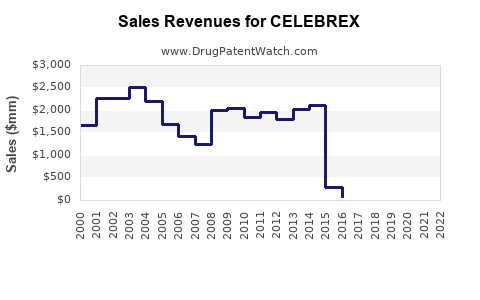
Celebrex (celecoxib) remains a long-running, off-patent branded NSAID in the US and major ex-US markets, with financial performance dominated by (1) generic penetration, (2) channel inventory and payer formulary placement, and (3) life-cycle dynamics from dosage-form/brand-line extensions. In practical terms, Celebrex’s revenue trajectory has shifted from patent-protected brand economics to a mostly branded-vs-generic margin contest, where sustained demand depends on prescriber inertia, formulary positioning, and switching frictions rather than patent exclusivity.
What patents protect Celebrex (celecoxib) and how do they affect sales and generic entry risk?
Direct answer: Celebrex’s principal US and ex-US exclusivity has long since expired for core compounds, pushing the market into generic-led competition. Remaining patent relevance is typically limited to specific dosage forms, formulations, and method-of-use claims.
What is the core exclusivity story for celecoxib?
- Celecoxib’s earliest approvals and core compound exclusivity are well past the standard 20-year patent clock from earliest priority, leaving generics as the baseline competitive threat across the NSAID class.
- Branded revenue persistence since launch has relied less on blocking generic launches and more on:
- contracting and formulary inclusion,
- managed care rebates,
- and patient switching costs (prescriber choice and prior authorization friction).
Which patent categories can still matter for branded strategy?
Even when compound exclusivity is gone, the residual patent landscape can influence:
- brand-specific formulations (dose strengths, release profiles),
- combination products (if any),
- method-of-use claims (limited leverage due to common clinical indications),
- and manufacturing/process claims (often narrower and harder to enforce).
Practical implication for financial trajectory
For Celebrex, patent-led protection typically does not create a multi-year “revenue shield” like it would during late-stage life-cycle protection. Instead, any residual patent protection would affect the speed and depth of generic entry only at the margins, leaving most pricing pressure to settle quickly post-launch.
When does Celebrex lose exclusivity and when could generics enter (Orange Book timing, Paragraph IV, and court calendars)?
Direct answer: For celecoxib, the US “lose exclusivity” event is effectively historical for the branded active ingredient; modern generic competition is already established. Current generic risk is less about new Paragraph IV launches and more about incremental entry of additional strengths, label carve-outs, and manufacturing/supply shocks.
How Orange Book dynamics typically show up for an off-patent NSAID
When a branded NSAID is fully off core compound exclusivity:
- Most competitors use ANDAs with bioequivalence to listed reference products.
- Litigation and Paragraph IV events are concentrated in earlier time windows, not recurring multi-year cycles.
What this means for pricing and earnings
Once multiple authorized generics and multiple NDA/ANDA filers exist:
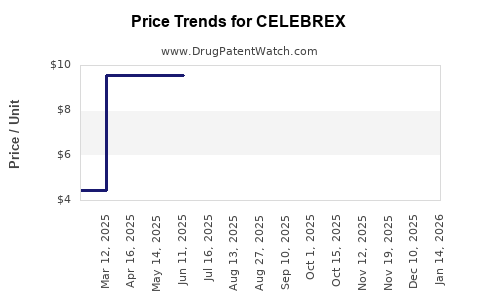
- net pricing compresses toward WAC less rebates,
- wholesaler and channel inventory cycles become a major driver of quarterly fluctuations,
- and gross-to-net erosion becomes the key performance indicator.
What is the Orange Book status of Celebrex (listed patents, expiration patterns, and active listings)?
Direct answer: Celebrex is an established reference product whose original compound-related listings have expired; the Orange Book may still contain patents depending on strength/formulation and any later-introduced life-cycle claims, but generics are already widely available.
How to interpret “active” Orange Book listings in the current era
- Active listings do not necessarily block market entry if claims do not cover the generic product configuration or if the generic carves around the relevant elements.
- For an investor or licensing team, the key is whether any unexpired, enforceable claims align with the generic’s planned ANDA scope.
Financial relevance
Even if some patents remain listed, the brand’s financial trajectory usually tracks:
- formulary access,
- competitor mix,
- and payer-driven substitution,
not the existence of a small number of remaining listings.
How does generic competition affect Celebrex sales volumes and net pricing?
Direct answer: Generic penetration drives the fundamental revenue slide from branded premium pricing to discounted equivalents, with branded growth only possible through market access retention, dosing convenience, and payer-specific contract terms.
Pricing pressure mechanics for established NSAIDs
With generic versions broadly available:
- Payer formularies typically promote lower-cost alternatives or require step edits.
- Pharmacy benefit managers shift utilization through rebate auctions and preferred tiers.
- Brand-to-generic switching accelerates when prescribers face renewal decisions.
Volume vs. value trade-off
For an off-patent brand:
- Unit volumes can remain stable if the brand holds a “preferred” position or supports adherence.
- Revenue declines because:
- net price falls,
- rebate rates rise to protect share,
- and wholesaler mix changes.
Where Celebrex sits versus other COX-2 inhibitors and NSAIDs
- Celebrex competes within a broader NSAID basket that includes ibuprofen, naproxen, etoricoxib in some geographies, and other COX-2 strategies.
- The economic “winner” is usually the lowest-cost option with acceptable tolerability and payer acceptance.
How strong is the patent estate for celecoxib compared with other NSAIDs or COX-2 inhibitors?
Direct answer: Compared with late-life-cycle NSAID strategies, celecoxib’s patent estate strength is largely historic for compound protection and now more limited to narrow life-cycle angles (if any).
Patent estate strength framework for an off-patent brand
For Celebrex, the meaningful metrics are:
- remaining enforceable claims (if any) tied to exact generic entry variants,
- likelihood of court sustainment for relevant claim sets,
- and timing of any remaining exclusivities related to specific label expansions.
Competitive conclusion for market dynamics
In the current competitive regime, the dominant drivers are:
- payer economics and contract structures,
- generic availability and supply stability,
- and market channel execution,
not a broad, enforceable compound fence.
What litigation has affected Celebrex and shaped market entry timing?
Direct answer: For celecoxib, the major patent litigation episodes occurred earlier in the product life cycle. Today’s market dynamics reflect the aftermath: multiple generic sources and normalized entry patterns.
How to read the litigation effect on current sales
Even if there is no active, high-profile ongoing litigation:
- early outcomes typically determine the number and speed of generic entrants,
- which sets the long-run pricing equilibrium.
Financial implication
In mature markets, litigation is less a recurring catalyst and more a one-time determinant of:
- competitor count,
- settled entry dates,
- and the reference pricing benchmark.
What formulations are protected for Celebrex and which delivery/strength SKUs drive the business?
Direct answer: Celebrex commercial performance historically depends on oral solid dose strengths and brand-line management across standard NSAID dosing regimens.
SKU-level dynamics that matter in mature NSAID markets
- Demand can shift strength-to-strength based on dosing patterns and guideline adherence.
- Brand strategies focus on the SKUs where:
- substitution inertia is strongest,
- payer restrictions are less stringent,
- or prior approvals reduce churn.
Financial impact
Because generics match listed strengths:
- branded differentiation is largely commercial, not technical,
except where a branded formulation has narrow life-cycle protection.
What biosimilar risk exists for Celebrex and how does that compare to biologics?
Direct answer: Biosimilar risk is not applicable. Celebrex is a small-molecule drug (celecoxib), not a biologic.
Competitive comparison
- For biologics, biosimilars drive a separate competitive mechanism governed by interchangeability and tendering.
- For Celebrex, the comparable competitive lever is generic substitution and therapeutic alternatives.
Which companies are competing with Celebrex and how does the competitor set affect revenues?
Direct answer: Celebrex competes with multiple generic celecoxib manufacturers across wholesalers and pharmacy channels, with substitution typically governed by PBM preferred status and contract pricing.
How the generic competitor count impacts price erosion
- A larger generic roster usually accelerates net price compression.
- A smaller roster or supply disruptions can temporarily stabilize pricing but rarely reverse the structural decline.
Market structure implications
- Celebrex’s financial trajectory is more sensitive to:
- gross-to-net discipline,
- channel inventory cycles,
- and contracting intensity,
than to a single competitor event.
How does Celebrex compare with ibuprofen/naproxen or other COX-2 strategies on market dynamics?
Direct answer: Celebrex’s long-run brand relevance depends on tolerance and payer preference relative to cheaper non-selective NSAIDs; generics make price the dominant factor, so Celebrex’s share is mostly access-driven.
Economic “terrain” for NSAIDs
- OTC and generic non-selective NSAIDs often set a low-cost reference.
- Payers may favor the lowest-cost effective options unless COX-2 selectivity is clinically justified.
Financial trajectory implication
- Even with stable clinical use, branded value erodes as payers rationalize around lower-cost substitutes.
What FDA regulatory status applies to Celebrex today (NDA/ANDA landscape)?
Direct answer: Celebrex is an established FDA-approved small-molecule with extensive ANDA competition for generics and broad label coverage consistent with historical NSAID indications.
What regulatory status means for future financial performance
- FDA status does not create exclusivity-driven revenue upside.
- The revenue trajectory is driven by market access and economics rather than regulatory milestones.
What generic entry risks exist for Celebrex going forward?
Direct answer: Incremental “risk” is limited to new generic entrants, strength-specific filings, and label-related carve-outs, rather than a single imminent exclusivity break.
What would actually move revenue in the near term
- loss of a preferred formulary position,
- settlement or supply changes that shift net pricing,
- contraction in rebate intensity,
- or a significant channel inventory correction.
Likely business outcome
In the mature NSAID class, branded revenue changes tend to be episodic and contract-driven, not structurally discontinuous.
Key market dynamics that drive Celebrex financial trajectory (what moves the P&L)
Direct answer: Celebrex’s financial trajectory follows a mature-branded pattern: declining net price from generic competition, partially offset by share retention and rebate strategy, with quarter-to-quarter volatility driven by inventory and contracting.
1) Gross-to-net compression
- Higher rebate intensity to protect share typically erodes gross margin.
- Generic competition increases the need for competitive contracting.
2) Formulary access and tier position
- PBM tier status directly changes utilization and switching rates.
- Prior authorization policies can slow substitution but rarely stop it long-term.
3) Channel inventory cycles
- Wholesaler ordering patterns can swing quarterly revenue.
- Mature products show more variability from inventory normalization than from new demand creation.
4) Competitive alternatives within NSAIDs
- Payers shift between NSAIDs based on cost-effectiveness and utilization management.
- Celebrex competes within a class where multiple generics are cheaper.
Timeline: how the exclusivity-to-generic transition typically maps to financial outcomes for Celebrex
Direct answer: The revenue “shape” for off-patent brands is usually: peak during active exclusivity, step-down at generic entry waves, then a long plateau at lower net price with continued share dilution risk.
Expected chronological phases (stylized market dynamics)
- Brand premium phase (historical)
- High net price supported by exclusivity.
- First generic entry waves
- Sharp net price decline and share dilution.
- Mature generic equilibrium
- Stabilization at lower margin.
- Contract/tier renegotiation cycles
- Revenue changes tied to payer/buyer decisions rather than IP events.
Key Takeaways
- Celebrex’s market dynamics are structurally shaped by generics: the core compound is long off exclusivity, so current performance is driven by formulary placement, rebate economics, and channel inventory rather than patent-led protection.
- Patent estate relevance today is mostly limited to narrow life-cycle angles, which typically do not create broad exclusivity for multiple years.
- Future “entry risk” is incremental and contract-driven, not a single major exclusivity break.
- Financial trajectory should be modeled as mature branded economics: continued gross-to-net pressure with episodic volatility from contracting and inventory cycles.
FAQs
- Does Celebrex have authorized generics, and how do they impact net pricing?
- How do PBM formulary tiers and prior authorization policies change Celebrex utilization versus non-selective NSAIDs?
- What dosage strengths of Celebrex tend to lose share first to generics in mature markets?
- How do wholesaler inventory cycles typically affect reported Celebrex quarterly sales?
- What factors influence whether payers prefer celecoxib over cheaper NSAID generics after multiple tender rounds?
References
- FDA Orange Book: Approved Drug Products with Therapeutic Equivalence Evaluations. FDA. https://www.accessdata.fda.gov/scripts/cder/daf/index.cfm
- FDA Drug Database (NDA and related applications). US Food and Drug Administration. https://www.accessdata.fda.gov/scripts/cder/daf/index.cfm
- National Library of Medicine, DailyMed (Celebrex prescribing information). https://dailymed.nlm.nih.gov/