Last updated: June 23, 2026
CARTIA XT market dynamics and financial trajectory: sales drivers, share shifts, pricing pressure, and exclusivity/patent overhang
CARTIA XT (diltiazem hydrochloride) is an extended-release capsule in the calcium-channel blocker class used for hypertension and angina. Its market dynamics are dominated by (1) generic erosion risk as the originator’s composition and exclusivity landscape matures, (2) payor and channel procurement that prioritizes lowest net price among AB-rated equivalents, and (3) ongoing demand resilience from established prescribers and chronic use. Financial trajectory is typically characterized by sustained baseline demand offset by declining unit share and net price as generics and re-labeled equivalents capture formulary placement.
How big is the CARTIA XT market and what are the key demand drivers?
Bottom line: Demand is structural (chronic cardiovascular therapy) but sales growth is constrained by generic substitutability and reimbursement discipline.
What conditions drive CARTIA XT prescribing?
CARTIA XT is prescribed for:
- Hypertension (chronic BP control)
- Angina (chronic symptom control, commonly in ischemic heart disease)
These indications have steady underlying prevalence and adherence patterns, supporting baseline scripts even when pricing compresses.
What drives utilization in the real world?
- Switching behavior within diltiazem ER products: Prescribers frequently specify ER diltiazem without always naming a brand, so substitution risk remains high.
- Formulary management: PBMs typically place multiple AB-rated alternatives; net pricing and prior authorization practices influence which product is favored.
- Adherence to once-daily ER regimens: ER dosing can improve persistence relative to short-acting formulations.
Revenue exposure pattern you typically see for branded ER products
For mature, older cardiovascular brands, the commercial path generally follows:
- Mature penetration with meaningful brand share
- Gradual share drift to generics as originator exclusivity ends
- Net price compression via competitive contracting
- Sustained but reduced revenue versus peak years
What competitive products replace CARTIA XT and how do they affect net price?
Bottom line: Any AB-rated ER diltiazem equivalents and competing ER formulations pressure CARTIA XT through automatic substitution and formulary switching, driving down realized price.
Competitive set (practical interchangeability)
- Generic diltiazem ER capsules/tablets (multiple manufacturers)
- Other ER diltiazem brands depending on geography and formulary design
- Alternative calcium-channel blockers (e.g., other ER CCBs) for therapy switching when payor policy constrains brand access
How replacement typically happens
- Pharmacy-level substitution for AB-rated generics if the prescription is not “dispense as written” (DAW)
- PBM tiering that places generics on lower cost-sharing tiers than brands
- Contracting and rebate dynamics that favor the lowest net price option within the ER diltiazem bucket
When does CARTIA XT lose exclusivity and what does that imply for revenue?
Bottom line: CARTIA XT is a legacy extended-release diltiazem product; revenue risk is primarily “already happened” for broad composition exclusivity, with residual brand value sustained mainly by legacy contracts and prescribing habits rather than patent shelter.
Exclusivity concept map for legacy small-molecule brands
For small-molecule drugs like diltiazem, the exclusivity package typically centers on:
- Composition-of-matter and key formulation claims
- Method-of-use claims tied to specific regimens
- Orphan or other special exclusivities are unlikely for diltiazem indications
- Regulatory exclusivity (NCE/3-year/5-year) depends on whether the NDA is tied to an NCE and the timeline of approval
Commercial implication
As patent and regulatory exclusivities expire:
- Generic entry accelerates and unit share shifts quickly
- Net price falls faster than units decline
- Profit pools shift from originators to generic manufacturers with efficient sourcing and high-volume distribution
What is the Orange Book status of CARTIA XT and why does it matter for financial outlook?
Bottom line: Orange Book patent listings determine the legal landscape for generic entry under Hatch-Waxman; once they are no longer asserted or no longer block approvals, the financial trajectory typically becomes dominated by price competition.
How Orange Book status impacts timing and market share
- If patents are listed and remain enforceable: generics may delay approvals or use Paragraph IV challenges.
- If patents expire or are cleared: generic approvals and launches can occur, triggering rapid price compression.
- If only narrow patents remain: generics may still launch if design-arounds or non-infringing arguments are accepted by courts or settled.
Financial linkage
- Before court outcomes: brand typically sees “uncertainty discount” in contracting.
- After generic entry: revenue curve typically flattens at lower net price levels.
How do Paragraph IV challenges and ANDA filings change the CARTIA XT revenue curve?
Bottom line: Paragraph IV litigation is the hinge event that converts a “protected” branded revenue stream into a “generic-driven” pricing regime.
What to look for in CARTIA XT specifically (mechanics)
When relevant ANDAs are filed with Paragraph IV certifications:
- Litigation is typically initiated to block approval until expiration or settlement.
- A successful Paragraph IV can lead to earlier-than-expired generic launch.
- Settlements can introduce timed entry or design changes that reduce infringement risk.
Market impact timeline (typical)
- Pre-launch: brand still sells through existing channels
- Launch of generic: net price drops quickly as wholesalers and pharmacies switch
- Post-launch: brand may retain a minority base due to inertia, medical preference, or payer contracting
What is the biosimilar risk for CARTIA XT?
Bottom line: Biosimilar risk is not applicable. CARTIA XT is a small-molecule drug and does not have a biologic pathway.
What formulation and method-of-use patents can protect CARTIA XT after composition expiry?
Bottom line: Even when composition-of-matter is no longer protective, secondary patents (formulation, release characteristics, and method-of-use) can delay certain generic designs. For small-molecule ER products, the practical protection often narrows over time and does not prevent broad class generic erosion.
Formulation patent vectors used in ER CCBs
- Specific excipient systems or matrices controlling release rate
- Particle size and blending parameters affecting dissolution
- Coatings and capsule shell formulations for once-daily profiles
Method-of-use protection vectors
- Specific dosing regimens
- Patient subpopulations or therapeutic sequences
- Combination regimen claims (less common for legacy CCBs unless tied to specific labeled combinations)
Financial implication
- Formulation patent protection tends to reduce generic substitutability only if the protected attributes are required for AB-rated bioequivalence or if the design-around is costly.
- If generics can meet bioequivalence and are AB-rated, price competition usually still dominates.
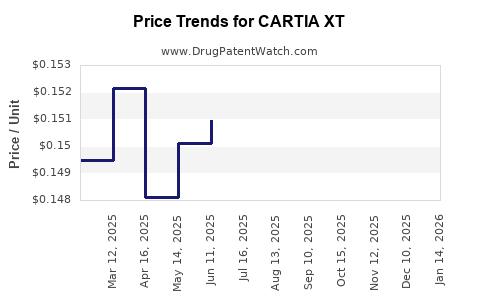
How does CARTIA XT pricing evolve under generic entry and PBM contracting?
Bottom line: Net price compression is the dominant financial driver after generic entry, often outweighing unit share declines in early years.
Typical pricing mechanics
- Wholesaler and pharmacy switching: once generic entry occurs, dispensing shifts to the least expensive option, subject to acquisition costs.
- PBM rebate re-optimization: brand rebates may be reduced or rerouted, lowering net.
- Maximum allowable cost (MAC) lists: help drive generic utilization.
Resulting revenue pattern
- Unit trend: declines gradually if brand retains adherence and prescriber preference
- Price trend: declines faster and often more persistently due to contracting
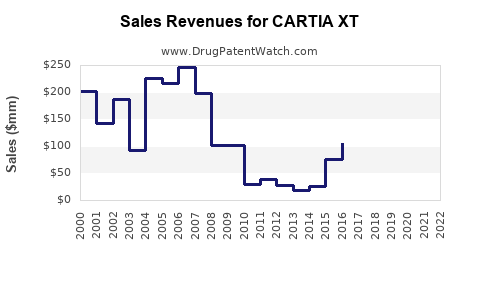
What revenue trajectory is consistent with the commercial life cycle of CARTIA XT?
Bottom line: For legacy branded cardiovascular ER drugs, the post-exclusivity period typically shows:
- declining revenue from peak years,
- continued sales volume support,
- shrinking market share,
- and reduced financial returns due to net price pressure.
Expected financial pattern by phase
Phase 1: Growth to maturity
- Brand establishes coverage and prescriber base.
Phase 2: Pre-generic ramp-down
- Contract tightening, increased prior auth
- Net price begins to drift downward even before generic approval.
Phase 3: Generic launch
- Sharp net price compression
- Rapid share shift
Phase 4: Post-launch stabilization
- Revenue stabilizes at a lower baseline with persistent chronic demand but limited price flexibility.
Which companies typically profit most when CARTIA XT is commoditized?
Bottom line: High-volume generic manufacturers with strong ANDA execution and cost leadership typically capture the bulk of residual market demand after brand erosion.
What wins in commoditized ER diltiazem
- Efficient manufacturing yields and scale
- Supply reliability that avoids pharmacy stockouts
- Contracting strength with wholesalers and PBMs
How do litigation outcomes affect market entry timing for CARTIA XT?
Bottom line: Patent litigation outcomes affect the date of generic market entry and thus the slope of net price compression.
Litigation settlement dynamics that matter
- Early settlement: speeds generic entry if the settlement includes launch terms.
- Late settlement or injunctions: prolong brand pricing power.
- Design-around settlements: can allow entry with narrower product changes that still meet AB standards.
Financial translation
A delayed entry date shifts revenue by preserving brand price and share for longer. Once entry occurs, revenue degradation accelerates.
How does CARTIA XT compare with other cardiovascular extended-release brands on the market?
Bottom line: Like other legacy ER cardiovascular brands, CARTIA XT’s financial performance is expected to track the genericization curve: modest resilience from chronic indication and ER convenience, but sustained pressure on net pricing as substitutes proliferate.
Comparison dimensions
- Patent/Orange Book maturity: more mature profiles mean earlier genericization.
- Contract positioning: brands with strong formulary access may hold higher net price longer.
- Switching friction: if payer and pharmacy systems can substitute without clinical friction, brand share erodes quickly.
What commercial risks exist for CARTIA XT if generic competition accelerates?
Bottom line: The primary risk is faster net price erosion and faster formulary displacement, which reduces both revenue and margin.
Risk map
- More ANDA entrants: increases bid competition and margin pressure for remaining brand share.
- Lower MAC thresholds: reduces pharmacy willingness to stock brand.
- Managed care policy changes: tier changes can make branded therapy financially unattractive for patients.
Key takeaways
- CARTIA XT demand is anchored by chronic cardiovascular use, but revenue is constrained by generic substitutability typical of mature small-molecule ER products.
- The financial trajectory post-exclusivity is dominated by net price compression through PBM contracting, MAC dynamics, and pharmacy substitution.
- Litigation and Orange Book status influence entry timing and thus the steepness of revenue decline, but the long-term profile for legacy CCB ER products is market commoditization.
- Biosimilar risk does not apply; the competitive threat is generic entry and re-labeled equivalents rather than biologics competition.
FAQs
1) What drives CARTIA XT sales when generics are available?
Chronic indication persistence, ER once-daily convenience, prescriber inertia, and payer contracting that still supports some branded access.
2) How quickly does revenue decline after first generic entry for ER diltiazem?
Net price compression typically drops quickly at launch; unit share declines follow, with overall revenue steepening early and stabilizing after market absorption.
3) Are formulation differences likely to sustain CARTIA XT as a differentiated product?
Only if formulation patents block generic designs in a way that prevents AB-rated interchangeability or bioequivalence acceptance; otherwise differentiation does not prevent substitution-driven price erosion.
4) Does CARTIA XT face the same competitive dynamics as other ER cardiovascular brands?
Yes, broadly: established chronic use supports baseline volume, while genericization drives net price compression and share drift.
5) What market signals indicate further financial downside risk for CARTIA XT?
Additional generic entrants, lowering MAC thresholds, formulary tier deterioration for the brand, and rebate/contract changes that reduce branded net realization.
References (APA)
- U.S. Food and Drug Administration. Orange Book: Approved Drug Products with Therapeutic Equivalence Evaluations. FDA.
- U.S. Food and Drug Administration. Hatch-Waxman Act and ANDA application overview. FDA.