Last updated: September 5, 2026
Carbatrol is an extended-release carbamazepine capsule used for epilepsy and trigeminal neuralgia. Its commercial trajectory is defined by an old active ingredient, expired formulation exclusivity, broad generic availability, and limited public financial disclosure. The product has no biologic or biosimilar exposure, and its principal commercial risk is generic substitution rather than a new patent challenge.
What is Carbatrol and how does it compete in the carbamazepine market?
Carbatrol contains carbamazepine in an extended-release multiparticulate capsule. The product is marketed in 100 mg, 200 mg, and 300 mg strengths. The formulation releases carbamazepine over an extended period and is intended to reduce dosing frequency compared with immediate-release tablets. [1]
Carbatrol is approved for:
- Partial seizures with complex symptomatology
- Generalized tonic-clonic seizures
- Mixed seizure patterns
- Trigeminal neuralgia
Carbatrol competes with several products:
| Product |
Active ingredient |
Dosage form |
Commercial position |
| Carbatrol |
Carbamazepine |
Extended-release capsules |
Brand ER capsule |
| Tegretol-XR |
Carbamazepine |
Extended-release tablets |
Legacy brand ER tablet |
| Generic carbamazepine ER |
Carbamazepine |
Capsules or tablets |
Primary price competitor |
| Immediate-release carbamazepine |
Carbamazepine |
Tablets and suspension |
Lower-cost alternative |
| Equetro |
Carbamazepine |
Extended-release capsules |
Separate branded product, primarily associated with bipolar disorder |
Carbatrol and Equetro both use extended-release carbamazepine technology, but their approved indications and labeling differ. Prescribers may not treat all extended-release carbamazepine products as automatically interchangeable because release characteristics, strengths, capsule contents, and labeling can differ.
When did Carbatrol lose exclusivity?
Carbatrol lost meaningful market exclusivity years ago. The active ingredient, carbamazepine, has been used clinically since the 1960s, and the original product patents expired long before the current generic market matured.
The Carbatrol NDA was approved in the 1990s. Any product-specific formulation or manufacturing protection associated with the original approval has expired or no longer provides a material barrier to generic entry. The commercial market therefore operates as a post-exclusivity market.
Carbatrol exclusivity timeline
| Event |
Approximate timing |
Commercial effect |
| Carbamazepine established as an antiseizure drug |
1960s |
Active-ingredient exclusivity unavailable |
| Carbatrol extended-release capsule approval |
1990s |
Launch of branded ER capsule |
| Initial brand protection period |
Late 1990s to early 2000s |
Limited early competition |
| Generic extended-release competition |
2000s onward |
Progressive price erosion |
| Current market |
2024 |
Mature generic market with limited brand leverage |
The relevant commercial question is no longer whether Carbatrol has exclusivity. It is whether the brand can retain prescriptions through formulation familiarity, supply reliability, physician preference, and pharmacy dispensing practices.
What patents protect Carbatrol?
No unexpired composition-of-matter patent protects Carbatrol. The product’s remaining intellectual-property value, if any, is concentrated in formulation know-how, manufacturing processes, trademarks, regulatory history, and commercial relationships rather than in enforceable exclusivity over carbamazepine.
Formulation patents
Carbatrol’s formulation uses extended-release delivery technology. Formulation protection can cover:
- Drug-loaded beads or pellets
- Polymer coating systems
- Immediate-release and extended-release bead fractions
- Dissolution profiles
- Capsule filling and manufacturing processes
- Stability and moisture-control methods
These protections may have been relevant during the product’s launch period. They do not prevent current generic manufacturers from selling carbamazepine extended-release products after expiration or approval of alternative formulation patents.
The product’s current competitive defense is therefore operational rather than patent-based. Manufacturing consistency and maintenance of an equivalent pharmacokinetic profile are more relevant than patent exclusion.
Orange Book status
The FDA Orange Book identifies approved drug products and relevant patent or exclusivity information. For Carbatrol, the commercially significant patent period has ended. The presence or absence of an historical Orange Book listing does not create new exclusivity after the listed patent has expired. [2]
The practical Orange Book conclusion is:
| Issue |
Carbatrol position |
| Active ingredient patent |
Expired |
| New chemical entity exclusivity |
Expired |
| Formulation exclusivity |
Expired or commercially ineffective |
| Current blocking patent estate |
No material barrier identified |
| Generic approval pathway |
ANDA pathway available |
| Biosimilar pathway |
Not applicable |
How many patents cover Carbatrol today?
No meaningful set of unexpired U.S. patents is required to explain Carbatrol’s current commercial position. Historical patents may still appear in patent databases, but expired patents do not prevent generic approval or substitution.
The relevant intellectual-property assets are more likely to include:
- The Carbatrol trademark
- Proprietary manufacturing procedures
- Product specifications and release-control methods
- Regulatory data and labeling history
- Distribution and customer contracts
These assets can support a branded product but do not replicate the pricing protection of a live patent estate.
Are there Paragraph IV challenges to Carbatrol?
Paragraph IV litigation is not a major current risk for Carbatrol because generic carbamazepine ER products are already established in the market. A Paragraph IV certification is most important when an ANDA applicant challenges an unexpired Orange Book patent before generic launch.
For Carbatrol, the competitive sequence has already occurred:
- Generic manufacturers obtained approval.
- Multiple suppliers entered the market.
- Pharmacy substitution became available.
- Brand price protection weakened.
- Any historic patent disputes ceased to determine market access.
The current risk is generic price competition, supply disruption, or product-specific regulatory action rather than a new first-wave Paragraph IV event.
What is the FDA regulatory status of Carbatrol?
Carbatrol is an FDA-approved small-molecule prescription drug. It is regulated under the NDA framework, while generic carbamazepine ER products are approved through ANDAs demonstrating pharmaceutical equivalence and bioequivalence to the relevant reference product. [1,3]
Important regulatory characteristics include:
- Extended-release oral capsule dosage form
- Narrow therapeutic considerations
- Dose titration requirements
- Clinically relevant drug interactions
- Risk of serious dermatologic reactions in genetically susceptible patients
- Need for attention to formulation substitution and patient response
Carbamazepine is associated with serious adverse reactions, including Stevens-Johnson syndrome and toxic epidermal necrolysis in patients carrying certain HLA alleles. The FDA labeling recommends consideration of genetic testing in patients with ancestry associated with HLA-B*1502. [1]
Carbamazepine also induces hepatic enzymes and can reduce exposure to oral contraceptives, anticoagulants, and other medicines. These factors create some clinical resistance to uncontrolled product switching, but they do not provide patent protection.
How strong is the Carbatrol patent estate?
Carbatrol has a weak patent estate by current commercial standards.
| Patent-strength factor |
Assessment |
| Active ingredient protection |
None |
| New chemical entity protection |
None |
| Patent life remaining |
None of commercial significance |
| Formulation differentiation |
Historical and technically relevant |
| Manufacturing barriers |
Moderate for consistent ER release |
| Regulatory switching barriers |
Moderate |
| Pricing power |
Low |
| Litigation leverage |
Low |
| Trademark value |
Moderate within a mature niche |
The product may retain a formulation advantage over immediate-release carbamazepine, but a formulation advantage is not equivalent to exclusivity. Generic manufacturers can compete through approved extended-release capsules and tablets, even when their delivery systems are not identical at the engineering level.
What generic entry risks exist for Carbatrol?
Generic entry risk is high because carbamazepine ER is a mature small-molecule category with no active composition patent barrier.
The principal generic risks are:
Price erosion
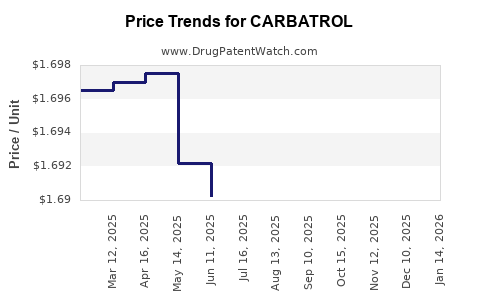
Generic pharmacies and wholesalers can offer substantially lower acquisition prices than the brand. Once several suppliers are available, a branded product generally loses leverage in formularies and pharmacy purchasing.
Prescription substitution
State substitution laws and payer policies can direct prescriptions toward generic carbamazepine ER products unless the prescriber specifies that the brand is medically necessary.
Payer exclusion
Commercial insurers and government plans can place Carbatrol on less favorable formulary tiers or require prior authorization. A generic equivalent is likely to receive preferred positioning.
Supply competition
Carbamazepine ER manufacturing requires reproducible release characteristics. A supplier with a manufacturing interruption can lose market share quickly, but competitors can capture prescriptions if they maintain supply.
Therapeutic-switching concerns
Carbamazepine has a narrow therapeutic margin and significant interaction potential. Physicians may be cautious when switching a stable patient between formulations. That caution can preserve some brand demand, but it is unlikely to offset structural generic pressure.
What is Carbatrol’s financial trajectory?
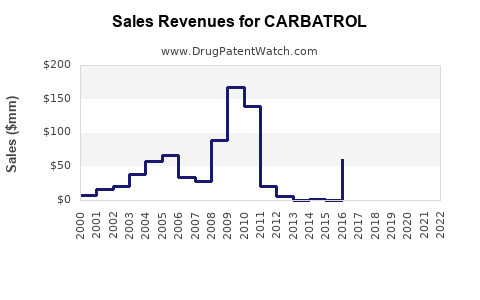
Carbatrol’s standalone revenue is not reported in public company filings with sufficient granularity to establish a reliable annual sales series. The product is generally grouped with broader prescription portfolios, mature products, or specialty pharmaceuticals.
The financial trajectory can be characterized as follows:
| Period |
Revenue pattern |
Main driver |
| Initial launch period |
Growth from conversion to ER therapy |
Differentiated dosing and branded promotion |
| Early generic period |
Decline |
ANDA competition and pharmacy substitution |
| Mature generic period |
Low and declining brand revenue |
Price compression and formulary pressure |
| Current period |
Niche or maintenance revenue |
Brand loyalty, supply reliability, and specific prescriber preference |
Carbatrol is unlikely to be a material growth asset for a large pharmaceutical company. Its value is more consistent with a mature-product portfolio contribution, a niche branded asset, or a product bundled in a licensing or divestiture transaction.
Revenue exposure
The main revenue risks are:
- Continued migration to generic carbamazepine ER
- Reimbursement restrictions
- Loss of pharmacy stocking
- Manufacturer consolidation
- Substitution with other carbamazepine formulations
- Reduced promotional investment
- Competitive pricing from multiple ANDA holders
Potential revenue support comes from:
- Patients stabilized on the brand
- Physicians who prefer the established product
- Consistent supply during generic shortages
- Institutional purchasing relationships
- Product familiarity in epilepsy treatment
Without separately reported net sales, Carbatrol should not be valued using growth-drug assumptions. A mature-product valuation should emphasize residual cash flow, manufacturing economics, channel access, and portfolio fit.
Which companies compete with Carbatrol?
Carbatrol competes against branded and generic suppliers rather than a single dominant rival.
Direct competitors
- Generic carbamazepine extended-release capsule suppliers
- Generic carbamazepine extended-release tablet suppliers
- Tegretol-XR and generic versions of Tegretol-XR
- Immediate-release carbamazepine tablets and suspension
- Equetro in overlapping extended-release carbamazepine use cases
Indirect therapeutic competitors
Other antiseizure medicines can displace carbamazepine in selected patients, including:
- Oxcarbazepine
- Lamotrigine
- Levetiracetam
- Valproate
- Lacosamide
- Topiramate
Clinical choice depends on seizure type, comorbidities, drug interactions, reproductive considerations, tolerability, and prior response. These products compete for the treatment decision, while generic carbamazepine products compete most directly for the prescription.
What patent litigation affects Carbatrol?
Current commercial exposure to patent litigation is low. The product has passed the period in which patent litigation would normally determine first generic entry. Litigation risk is more likely to arise from:
- Manufacturing disputes
- Trademark enforcement
- Product liability claims
- ANDA-related disputes involving a particular generic supplier
- Regulatory actions involving quality or bioequivalence
A new patent lawsuit would have limited economic significance unless it involved an unexpected, unexpired formulation or manufacturing patent with a credible injunction path. The known age of the product makes that scenario unlikely.
Are there licensing deals involving Carbatrol?
Carbatrol has had changes in commercial ownership and product stewardship over its life, but public disclosures do not provide a consistent, standalone accounting of current licensing economics. Any transaction value would depend on the broader portfolio in which Carbatrol was transferred.
For diligence purposes, the important contractual questions are:
- Who holds the NDA?
- Who owns the Carbatrol trademark?
- Who manufactures the capsules?
- Is supply internal or contract-based?
- Are territories divided by geography?
- Does the agreement include generic or authorized-generic rights?
- Are there minimum purchase commitments?
- Are manufacturing deviations allocated to the licensee or licensor?
The product’s lack of active patent protection means that a licensing transaction would be driven by commercial infrastructure and cash flow rather than exclusivity.
How does Carbatrol compare with Tegretol-XR and generic carbamazepine ER?
| Factor |
Carbatrol |
Tegretol-XR |
Generic carbamazepine ER |
| Active ingredient |
Carbamazepine |
Carbamazepine |
Carbamazepine |
| Release type |
Extended release |
Extended release |
Extended release |
| Brand status |
Legacy brand |
Legacy brand |
Generic |
| Patent strength |
Weak or expired |
Weak or expired |
Not applicable |
| Price |
Highest |
High |
Lowest |
| Substitution pressure |
High |
High |
Competitive among suppliers |
| Clinical differentiation |
Formulation and familiarity |
Formulation and familiarity |
Bioequivalence and price |
| Long-term outlook |
Stable niche or decline |
Stable niche or decline |
Largest share opportunity |
Carbatrol’s commercial position depends on whether physicians and pharmacies view its capsule formulation as meaningfully preferable to generic ER products. In most payer environments, price and availability will dominate once an approved generic is stocked.
What is the geographic coverage of Carbatrol?
Carbatrol’s most relevant commercial market is the United States, where the product is tied to an FDA NDA and the U.S. generic approval system. Carbamazepine extended-release products are also sold internationally, but product names, patent records, regulatory pathways, and manufacturers vary by country.
Geographic commercial analysis should separate:
- U.S. NDA and Orange Book status
- European national or centralized approvals
- Canadian product registrations
- Latin American local registrations
- Emerging-market generic supply
A U.S. patent conclusion does not establish freedom to operate in Europe, Canada, Japan, or other jurisdictions. In this case, however, the age of carbamazepine and the maturity of international generic supply indicate limited residual exclusivity outside the United States as well.
Key Takeaways
- Carbatrol is an extended-release carbamazepine capsule for epilepsy and trigeminal neuralgia.
- Its active ingredient and meaningful product exclusivity are long expired.
- The current market is driven by generic carbamazepine ER competition.
- No material live patent estate is required to explain current commercial protection.
- Paragraph IV litigation is not the central market risk because generic entry has already occurred.
- Biosimilar competition does not apply because carbamazepine is a small molecule.
- Standalone Carbatrol revenue is not separately disclosed in a reliable public series.
- The financial trajectory is mature, low-growth, and exposed to price erosion.
- Residual value lies in manufacturing consistency, brand recognition, supply reliability, and portfolio cash flow.
- Generic substitution, payer exclusion, and supplier competition are the main threats to future revenue.
FAQs
Is Carbatrol still commercially available?
Carbatrol has historically remained available as a branded extended-release carbamazepine capsule, although commercial availability can vary by supplier, strength, and pharmacy channel. Generic carbamazepine ER products provide the principal alternative.
Is Carbatrol the same as Tegretol-XR?
Both contain carbamazepine in an extended-release formulation, but they are different branded products with different delivery systems and labeling histories. Substitution should follow FDA-approved product and pharmacy requirements.
Does Carbatrol have a 180-day generic exclusivity period remaining?
No. Any initial generic exclusivity associated with the first approved ANDA would have expired long ago. Current generic competition is mature.
Can Carbatrol be substituted automatically with generic carbamazepine?
Substitution depends on state pharmacy law, the prescribed product, payer rules, and whether the product is considered therapeutically interchangeable. Carbamazepine formulation changes may require clinical monitoring.
Is Carbatrol an attractive pharmaceutical acquisition target?
Carbatrol is more suitable as a mature-product or specialty-portfolio asset than as a growth or patent-protected acquisition. Valuation depends on net price, manufacturing cost, supply reliability, prescription retention, and the durability of brand demand.
References
- U.S. Food and Drug Administration. (n.d.). Carbatrol (carbamazepine) extended-release capsules prescribing information. FDA/DailyMed.
- U.S. Food and Drug Administration. (n.d.). Approved drug products with therapeutic equivalence evaluations, Orange Book. FDA.
- U.S. Food and Drug Administration. (n.d.). Abbreviated new drug application process and generic drug approvals. FDA.