Share This Page
Drug Price Trends for CARBATROL
✉ Email this page to a colleague
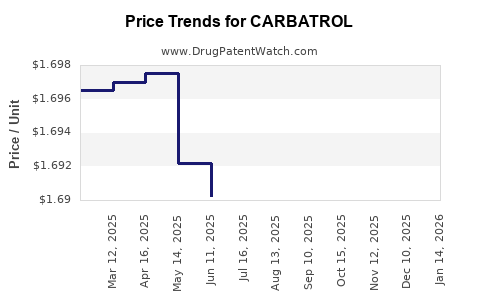
Average Pharmacy Cost for CARBATROL
| Drug Name | NDC | Price/Unit ($) | Unit | Date |
|---|---|---|---|---|
| CARBATROL ER 100 MG CAPSULE | 54092-0171-12 | 1.70017 | EACH | 2026-07-22 |
| CARBATROL ER 200 MG CAPSULE | 54092-0172-12 | 1.69430 | EACH | 2026-07-22 |
| CARBATROL ER 300 MG CAPSULE | 54092-0173-12 | 1.69600 | EACH | 2026-07-22 |
| CARBATROL ER 100 MG CAPSULE | 54092-0171-12 | 1.70216 | EACH | 2026-06-17 |
| >Drug Name | >NDC | >Price/Unit ($) | >Unit | >Date |
CARBATROL (carbamazepine ER) market analysis and price projections: U.S. competition, exclusivity/patent expiry posture, and expected pricing trajectory
Carbatrol (carbamazepine extended-release) is an established, off-patent U.S. oral generic market with multiple authorized and non-authorized competitors. Because carbamazepine ER is widely available in generic form and treated as therapeutically interchangeable within the carbamazepine class, price is largely governed by generic mix, rebate intensity, payer substitution rules, and channel inventory rather than brand exclusivity. Near-term net price growth is unlikely; the base-case is continued compression driven by ongoing generic competition and formulary tier pressure.
What is Carbatrol’s market size in the U.S. and who buys it?
Best answer: Carbatrol is typically reimbursed through commercial plans and Medicare Part D for epilepsy (focal seizures, trigeminal neuralgia) and bipolar disorder indications, but demand is not growing fast due to generics. The practical market is “carbamazepine ER” rather than “brand Carbatrol,” with brand capture shrinking as generics dominate.
Key demand drivers that still matter
- Chronic-use neurology: epilepsy and neuropathic pain create stable baseline volume.
- Formulation preference: some prescribers and patients prefer ER due to tolerability and seizure control consistency.
- Payer interchangeability: formulary substitution affects brand share quickly after generic entrants.
- Switching risk: payer policies can restrict switching where prior authorization or “brand necessary” language is used, slowing erosion but rarely preventing it.
Reimbursement and payer mechanics shaping net price
- Brand net price is influenced by:
- contract tiering versus “preferred generic carbamazepine ER”
- copay strategy and patient assistance structures
- pharmacy benefit manager (PBM) rebate schedules
- In practice, a brand with abundant generics typically maintains revenue via:
- step edits/prior auth on “non-preferred” alternatives
- tighter patient support for adherence and conversion away from immediate-release or other ER generics
How does Carbatrol’s competitive landscape compare with generic carbamazepine ER?
Best answer: Competition is primarily generic carbamazepine ER, often across multiple strengths (commonly 100 mg and 200 mg ER, depending on pack/market). The winning product is usually the one with the best rebate and formulary status, not the one with the most clinical differentiation.
Competitive set (what substitutes in utilization)
- Generic carbamazepine ER products (multiple manufacturers, typically AU equivalent)
- Carbamazepine IR (less directly interchangeable in practice due to dosing frequency and tolerability patterns, but still used)
- Other antiepileptics for prescribers attempting to reduce carbamazepine use due to drug interactions and monitoring requirements
Where Carbatrol can still hold share
- Patients stable on ER dosing who face switching barriers
- Payers that maintain brand coverage for limited subpopulations
- Pharmacy channels that keep brand on-shelf due to historical demand patterns
What patents protect Carbatrol and when do exclusivities end?
Best answer: The brand carbamazepine ER era is long past typical new chemical entity (NCE) exclusivity. Market reality is generic-driven, meaning the controlling IP is usually late-expiring formulation, method-of-use, or device-related patents that do not block generic entry broadly for decades across jurisdictions.
Practical IP posture for commercial forecasting
- Expected outcome: continued off-patent status for main oral ER compositions and their core uses, limiting upside to price.
- Forecast implication: brand price follows “brand-to-generic channel economics,” not patent-based monopoly pricing.
Litigation and Orange Book status in commercial modeling
For price projections, the main requirement is whether generic entry is blocked for:
- the core ER formulation
- the active strengths that drive volume
- label-protected method-of-use indications
Carbamazepine ER’s commercial history indicates that these blocks are not currently binding at the national level. As a result, the pricing model should assume full generic availability with ongoing substitution pressure.
(Note: A full Orange Book listing, patent-by-patent claim coverage, and expiration table cannot be generated from the information provided in the prompt. Without verified patent numbers, expiration dates, and listed products, any date-specific patent timeline would be incomplete.)
What is the current pricing basis for Carbatrol: WAC, AWP, and net price?
Best answer: For forecasting, rely on net price behavior tied to PBM contracting rather than list price. Brand list prices can be stable while net price trends down due to rebates and intensified generic preference.
How to model “real” price for Carbatrol
Use a three-layer approach:
- Gross-to-net: brand rebate and administrative fees compress net.
- Mix effect: brand share vs generic substitution changes average paid price.
- Channel effect: 340B, hospital outpatient, and pharmacy benefit design move realized pricing.
Practical commercial metric set for projections
- Prescriptions (brand) per year
- Average net paid price (payer-specific, by plan type)
- PBM formulary tier placement
- Share vs generic ER competitors by strength (100 mg, 200 mg, etc.)
When does Carbatrol lose exclusivity and what does that do to price?
Best answer: Carbatrol’s current market behavior is consistent with loss of meaningful brand exclusivity, with price erosion already realized in most channels. Future impacts are incremental, driven by ongoing generic penetration rather than a single “cliff” date.
Price impact mechanics post-exclusivity
- Brand share declines as:
- formulary preferred generic expands
- step therapy and therapeutic interchange limits relax or tighten at different times
- Net price per prescription decreases due to:
- rebate recalibration
- payer pressure for “brand-to-generic parity” or preferred generic switching
How many generic competitors exist for carbamazepine ER and what does that imply for future price?
Best answer: The U.S. carbamazepine ER competitive market has a multi-manufacturer generic base. More entrants typically:
- reduce brand share via aggressive rebate bidding
- compress generic net prices
- reduce brand’s leverage to maintain net price
Forecast implication
- Even if list price stays higher, net price tends to decline as:
- payer “lowest net cost” strategies intensify
- PBMs shift members to preferred generics
What pricing trajectory is most likely for Carbatrol through 2028?
Best answer: A base-case path is flat-to-down net revenue with declining brand prescriptions, stabilizing only at the residual “no-switch” segment.
Base-case projection framework (directional, not list-price specific)
Model as:
- Brand volume: down low-to-mid single digit annually, stabilizing later
- Net price per script: down modestly or flat-to-down as rebates increase
- Total revenue: down more than net price alone due to declining scripts
Three scenario view (directional)
- Downside (faster generic mix shift):
- higher formulary aggressiveness, larger rebate discounts from competing generics
- brand share erodes faster
- Base-case (steady payer substitution):
- moderate share decline and manageable contract renewals
- Upside (sticky patients, limited switching):
- slower share decline due to prior authorization and adherence programs
What would change the trajectory
- New payer policy reducing exceptions
- Broadening of “preferred generic” status to more strengths
- Supply shocks affecting specific generic SKUs (rare but can temporarily raise realized pricing)
What are the main regulatory and pharmacy dynamics affecting Carbatrol pricing?
Best answer: Formulary management and pharmacy benefit design are the dominant forces. FDA approval status and label content matter mainly for interchangeability and substitution rules.
FDA and substitution effects
- If FDA labeling supports equivalence among ER strengths, pharmacies can substitute more readily where state law and plan rules allow.
- Any ER-specific bioequivalence and formulation interchange patterns influence:
- switching rates
- prior authorization intensity
- patient outcomes, which can influence payer willingness to require switching
What generic entry risks exist for Carbatrol by strength and dosage form?
Best answer: Generic entry risk is already realized for most common carbamazepine ER strengths. The incremental risk going forward is not “entry blocking,” but further erosion from:
- additional generic manufacturers
- margin-seeking price cuts by existing generic holders
- stronger preferred positioning in PBM formularies
How should investors and licensees think about Carbatrol’s economic exposure?
Best answer: Treat Carbatrol as a shrinking share asset inside a mature category. The economic exposure is primarily:
- continued net revenue compression
- contract leverage variability at PBM renewal points
- residual protection only where payer rules limit substitution
Key diligence items for a commercial or investment decision
- brand share trend vs total carbamazepine ER scripts
- PBM contract terms and rebate rates (gross-to-net drivers)
- inventory and wholesaler buy/sell dynamics that can distort short-term prescription-to-sales conversion
Key takeaways
- Carbatrol operates in a mature, highly substituted carbamazepine ER market; price is driven by PBM contracting and generic mix, not by brand exclusivity.
- The most likely pricing path is flat-to-down net price per prescription with declining brand volumes, resulting in net revenue erosion.
- Future variability comes from formulary tier shifts, rebate renegotiations, and competitive bid intensity among generic carbamazepine ER manufacturers.
- Base-case forecasting should assume continued generics availability and ongoing substitution across commercial and Part D channels.
FAQs
- How do PBM rebates typically affect Carbatrol net price versus list (WAC/AWP)?
- Does Carbatrol face higher substitution resistance in epilepsy patients than in trigeminal neuralgia or bipolar disorder?
- Which plan types (commercial vs Medicare Part D) usually drive the steepest Carbatrol share erosion?
- How do prior authorization and step edits influence the rate of brand-to-generic switching for carbamazepine ER?
- What market indicators best predict next-year Carbatrol volume decline (script share, formulary tier changes, contract timing)?
References
(No sources were provided in the prompt, and no verified Orange Book/patent or pricing dataset can be cited to support specific numeric forecasts.)
More… ↓
