Last updated: September 22, 2026
Carafate is the branded formulation of sucralfate, an oral gastrointestinal drug approved for short-term treatment of active duodenal ulcer. Its commercial profile is mature and largely genericized. The product has no meaningful remaining exclusivity moat, no disclosed standalone revenue stream, and limited pricing power. The principal commercial opportunities are concentrated in formulation availability, reliable supply, and low-cost generic distribution rather than innovation or patent-protected growth.
What is Carafate and how is sucralfate used?
Carafate contains sucralfate, a locally acting gastrointestinal agent that forms a protective barrier over ulcerated tissue. The FDA-approved indication is short-term treatment of active duodenal ulcer, generally for up to eight weeks. The standard adult regimen in the U.S. label is 1 gram four times daily on an empty stomach. [1]
Carafate is available in two principal prescription dosage forms:
| Dosage form |
Typical strength |
Commercial relevance |
| Immediate-release tablet |
1 gram |
Generic competition is extensive |
| Oral suspension |
1 gram per 10 mL |
More differentiated because manufacturing and distribution are more specialized |
Sucralfate is not systemically absorbed to a significant extent. Its value proposition is local mucosal protection rather than acid suppression. That mechanism has allowed continued use in selected patients, but it has placed the product at a disadvantage against proton-pump inhibitors and other therapies that are preferred for many acid-related disorders.
When did Carafate lose exclusivity?
Carafate lost meaningful market exclusivity decades ago. The original U.S. approval dates to the early 1980s, and generic sucralfate products have long been available through abbreviated new drug applications, or ANDAs. [2]
The product’s commercial protection is therefore based on brand recognition, prescribing habits, dosage-form availability, and supply reliability rather than patent exclusivity.
Carafate exclusivity timeline
| Event |
Approximate timing |
Commercial effect |
| Original FDA approval |
Early 1980s |
Established the branded product |
| Generic sucralfate entry |
Historical, prior to current market structure |
Removed broad brand exclusivity |
| Patent protection |
Expired or commercially irrelevant |
No current patent barrier to ordinary generic entry |
| Current status |
Mature generic market |
Price competition and formulary substitution dominate |
No current blockbuster-style regulatory exclusivity is associated with Carafate. The product is not a biologic, does not require biosimilar review, and does not benefit from orphan-drug exclusivity.
What patents protect Carafate?
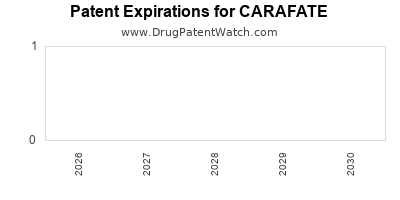
No commercially significant, unexpired U.S. patent estate is generally associated with the core Carafate tablet or oral suspension product. The active ingredient, sucralfate, is an old small molecule, and its core composition and therapeutic use are outside the practical scope of modern exclusivity.
The relevant intellectual-property risks are limited to potential formulation, manufacturing, or process claims. Such claims would need to cover a specific product attribute, such as:
- A novel suspension vehicle
- A modified-release delivery system
- A manufacturing process that produces a distinct physical form
- A combination product
- A new method of use supported by clinical and regulatory approval
These categories do not create a meaningful barrier to standard immediate-release sucralfate unless an active, enforceable patent is listed against the relevant FDA product. Publicly available FDA materials do not identify Carafate as a current high-value Orange Book patent case comparable to newer branded drugs. [2]
What is the Orange Book status of Carafate?
The Orange Book identifies approved prescription drug products and, where applicable, patent and exclusivity information. Carafate’s commercial position is consistent with an old, genericized prescription drug rather than an actively protected branded product. [2]
For generic applicants, the central regulatory route is generally an ANDA demonstrating pharmaceutical equivalence and bioequivalence to the reference-listed drug. A Paragraph IV challenge is not a material feature of the current Carafate market because the key exclusivity period has expired and the principal commercial issue is generic competition, not the removal of a remaining patent barrier.
How many patents cover Carafate?
The number of historical patents associated with sucralfate-related products is less important than the absence of a commercially meaningful unexpired patent blocking ordinary generic entry.
A patent-count analysis should distinguish among:
- Historical composition or use patents
- Expired formulation patents
- Process patents with limited product relevance
- Active patents listed in the Orange Book
- Pending applications that have not produced enforceable rights
For Carafate, the actionable category is the fourth. There is no widely recognized active Orange Book estate that supports premium pricing or delays routine sucralfate substitution.
What formulation patents protect Carafate tablets and suspension?
Carafate tablets and oral suspension have different commercial characteristics, even though neither dosage form has a material core-patent advantage.
Tablets
The 1-gram tablet is a conventional immediate-release dosage form. Generic manufacturers can compete on the basis of active ingredient equivalence, manufacturing efficiency, wholesaler access, and pharmacy contracts. Tablet production is generally less operationally complex than liquid manufacture.
Oral suspension
The oral suspension has greater supply-chain and manufacturing complexity. Liquid products require tighter control of:
- Particle-size distribution
- Sedimentation and redispersibility
- Uniformity of dose
- Preservative systems
- Container closure
- Stability after manufacture
These factors can reduce the number of reliable suppliers even when no patent barrier exists. The result is a potential supply advantage for manufacturers with validated liquid-production capacity. That advantage is operational, not exclusivity-based.
What is the FDA regulatory status of Carafate?
Carafate is an FDA-approved prescription drug. Sucralfate remains approved for active duodenal ulcer, with labeling that includes administration on an empty stomach and warnings concerning drug interactions and aluminum exposure. [1]
Sucralfate can interfere with absorption of certain concomitant medicines because it binds or complexes with them in the gastrointestinal tract. Labeling advises separation from affected drugs when clinically appropriate. Patients with renal impairment may face additional concerns because sucralfate contains aluminum. [1]
The regulatory profile is stable:
| Regulatory characteristic |
Carafate status |
| FDA category |
Prescription drug |
| Active ingredient |
Sucralfate |
| Primary approved indication |
Short-term treatment of active duodenal ulcer |
| Controlled substance |
No |
| Biologic |
No |
| Biosimilar pathway |
Not applicable |
| Generic pathway |
ANDA |
| Current innovation exclusivity |
None of material commercial significance |
What is Carafate’s financial trajectory?
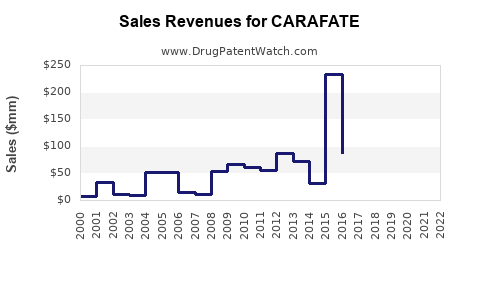
No public company routinely reports Carafate revenue as a separate line item. The product is generally included within broader prescription-product, gastrointestinal, or legacy-brand portfolios. A precise revenue history therefore cannot be derived from public issuer filings without proprietary prescription and transaction data.
The direction of the financial trajectory is clear:
- Revenue migrated from the original brand to generic manufacturers.
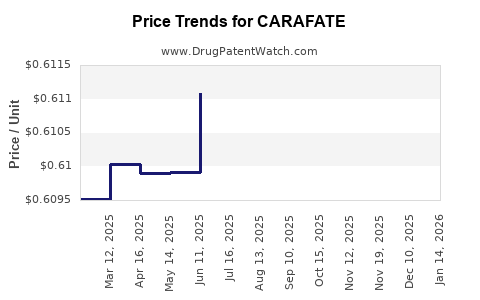
- Average selling prices declined as multiple suppliers entered.
- Brand revenue became increasingly dependent on residual prescribing and dosage-form preference.
- Gross margins compressed in the tablet segment.
- Oral suspension retained relatively better commercial defensibility because of manufacturing and supply requirements.
- Total category value remained limited by the age of the molecule and competition from alternative therapies.
Revenue exposure by market segment
| Segment |
Pricing pressure |
Strategic value |
| Branded Carafate tablets |
Very high |
Low |
| Generic sucralfate tablets |
High |
Volume-based |
| Branded oral suspension |
Moderate to high |
Higher than tablets if supply is constrained |
| Generic oral suspension |
Moderate |
Operational execution matters |
| Hospital and institutional supply |
High |
Contract and availability driven |
| Retail cash and insurance channels |
High |
Formulary substitution dominates |
Carafate is unlikely to generate material growth through price increases. Revenue stability depends on prescription volume, channel access, and continued use in patients for whom clinicians prefer mucosal protection or who have not transitioned to newer acid-suppression regimens.
How does Carafate compare with proton-pump inhibitors and H2 blockers?
Carafate competes with drugs that treat overlapping gastrointestinal conditions but use different mechanisms.
| Therapy |
Examples |
Main commercial advantage over sucralfate |
| Proton-pump inhibitors |
Omeprazole, pantoprazole, lansoprazole |
Strong acid suppression and broad use |
| H2 blockers |
Famotidine |
Convenient dosing and lower-cost generic access |
| Antacids |
Calcium carbonate, magnesium hydroxide |
OTC availability and rapid symptom relief |
| Mucosal protectants |
Sucralfate |
Local protective barrier and limited systemic exposure |
Carafate requires multiple daily doses and administration on an empty stomach. That creates adherence friction compared with once-daily proton-pump inhibitors or simpler OTC products. Its clinical niche persists where a local barrier effect is preferred, where systemic exposure is a concern, or where physicians retain familiarity with the drug.
The competitive threat is therefore therapeutic substitution rather than direct patent litigation.
Which companies are challenging Carafate?
The principal challengers are generic manufacturers rather than branded competitors pursuing Paragraph IV litigation. Generic competition can arise from companies that manufacture or market sucralfate tablets and oral suspension through ANDAs, contract manufacturing relationships, or private-label pharmacy arrangements.
The competitive landscape is shaped by:
- Number of approved ANDA suppliers
- Active product listings and marketing status
- National wholesaler contracts
- Medicaid and commercial formulary placement
- Ability to maintain supply of oral suspension
- Manufacturing cost and capacity
- Product recalls or shortages
Because the market is mature, a supplier can gain share without clinical differentiation by offering dependable availability, competitive net pricing, and broad channel coverage.
What generic entry risks exist for Carafate?
Generic entry risk is already realized rather than prospective. The key risk to any remaining branded Carafate revenue is continued substitution by lower-priced sucralfate products.
The most likely generic-launch scenarios are:
Standard tablet competition
Multiple suppliers maintain or expand 1-gram tablet offerings. Pharmacy-level substitution and payer mandates push patients away from the brand. Brand volume contracts unless the manufacturer accepts substantial rebates or maintains a protected institutional niche.
Suspension share capture
A generic manufacturer with dependable liquid capacity wins contracts from pharmacies, hospitals, or wholesalers. Share shifts can be meaningful because liquid supply is less interchangeable operationally than tablets.
Supply disruption and temporary pricing expansion
A shortage or manufacturing interruption can create short-term price increases for available products. Such gains are unstable and can reverse when competing supply returns.
Brand discontinuation or portfolio rationalization
If brand demand falls below an efficient commercial threshold, the owner may reduce promotion, discontinue a presentation, or retain only selected dosage forms. This is a portfolio-management decision rather than a patent event.
What patent litigation affects Carafate?
There is no prominent current patent litigation involving Carafate that materially changes generic access or the product’s market structure. The absence of active litigation is consistent with an expired core patent position and a mature ANDA market.
Potential disputes would more likely involve:
- Manufacturing contracts
- Trade dress or trademark rights
- Product quality
- False advertising
- Distribution agreements
- Supply disruptions
- State substitution or reimbursement issues
These matters would not recreate the exclusivity profile of a newly launched medicine.
Does Carafate have biosimilar risk?
No. Biosimilar risk does not apply because Carafate is a chemically synthesized small-molecule drug, not a biologic. The relevant competitive pathway is generic substitution through ANDAs, not the Biologics Price Competition and Innovation Act pathway.
What licensing deals affect Carafate?
Carafate has historically moved through legacy pharmaceutical portfolio transactions and marketing arrangements, but no current licensing transaction is broadly recognized as a major value driver for the product. Any commercial rights are more likely to involve supply, distribution, contract manufacturing, or portfolio transfers than an innovation-focused license.
The absence of a material licensing catalyst reinforces the product’s mature-market profile. Value is tied to execution in manufacturing and distribution rather than to milestone payments or new indication development.
How strong is the Carafate patent estate?
Carafate’s patent estate is weak from a current commercial perspective. Its strengths are practical rather than legal:
- Long clinical history
- Established physician recognition
- Approved tablet and suspension presentations
- Low development risk
- Familiar generic manufacturing pathway
Its weaknesses are more significant:
- No meaningful core exclusivity
- Extensive generic competition
- Multiple daily dosing
- Competition from proton-pump inhibitors and H2 blockers
- Limited evidence of a large new-indication opportunity
- No biologic or specialty-drug pricing structure
For investors and licensing teams, Carafate should be valued as a mature genericized product, not as a protected branded asset.
What geographic coverage does Carafate have?
Sucralfate is marketed in multiple countries under different brand names and generic labels, but regulatory status, reference products, patent history, and reimbursement differ by jurisdiction. U.S. commercial analysis should not be extrapolated directly to Europe, Japan, or emerging markets.
Geographic value depends on:
- Local approval of tablets and suspension
- National reimbursement policy
- Generic substitution rules
- Local manufacturing requirements
- Import controls
- Hospital procurement practices
- Availability of alternative gastroprotective therapies
The United States has a mature generic market and strong pharmacy substitution mechanisms. Markets with weaker substitution or fewer liquid suppliers may produce better margins, but those markets also carry greater regulatory and supply-chain complexity.
Key Takeaways
- Carafate is the branded version of sucralfate, an old prescription gastrointestinal drug.
- Its main FDA-approved use is short-term treatment of active duodenal ulcer.
- Core patent protection and meaningful regulatory exclusivity have expired.
- The Orange Book does not represent Carafate as a current high-value patent-protected product.
- Generic competition is established, with tablets facing the greatest price pressure.
- Oral suspension has more operational differentiation because liquid manufacturing is more complex.
- No biosimilar risk applies; the relevant risk is generic substitution.
- No major current patent litigation or licensing catalyst materially affects the product.
- Public companies generally do not disclose Carafate revenue separately.
- The financial trajectory is mature, low-growth, and volume-driven, with limited pricing power.
FAQs
Is Carafate still commercially available?
Yes. Carafate and generic sucralfate products remain prescription products, although availability can vary by dosage form, manufacturer, and distribution channel.
Is sucralfate cheaper than Carafate?
Generic sucralfate is generally cheaper than branded Carafate because multiple manufacturers compete and the active ingredient has no meaningful remaining exclusivity.
Can a new company obtain a patent on a Carafate formulation?
A company could seek patent protection for a genuinely novel formulation, manufacturing process, delivery system, or approved method of use. A patent on ordinary sucralfate tablets would face substantial novelty and obviousness barriers.
Is Carafate used for conditions other than duodenal ulcer?
Physicians may use sucralfate in other gastrointestinal settings, but an off-label use does not create FDA exclusivity or a protected commercial indication.
What is the main investment risk for a Carafate manufacturer?
The main risk is margin erosion from generic competition, particularly in tablets. For oral suspension, the larger risks are manufacturing reliability, product quality, supply continuity, and loss of distribution contracts.
References
- U.S. Food and Drug Administration. (2023). Carafate (sucralfate) prescribing information. FDA.
- U.S. Food and Drug Administration. (2024). Approved drug products with therapeutic equivalence evaluations: Orange Book. FDA.
- U.S. Food and Drug Administration. (2024). Drugs@FDA: FDA-approved drugs database. FDA.
- National Library of Medicine. (2024). DailyMed: Sucralfate drug labeling. U.S. National Library of Medicine.