Last updated: August 31, 2026
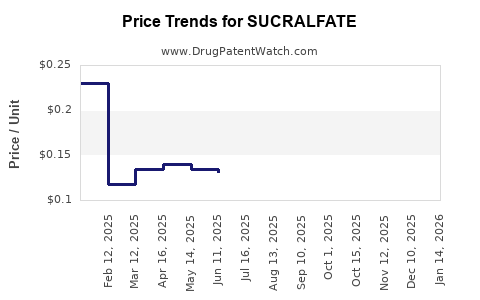
Sucralfate is a mature, off-patent gastrointestinal drug with limited product-level financial disclosure, low unit economics, and broad generic availability. Its commercial value is concentrated in prescription tablets, oral suspension, hospital use, and veterinary demand rather than in a protected branded franchise. The principal competitive threats are proton-pump inhibitors, H2-receptor antagonists, alginate products, and low-cost generic sucralfate suppliers.
Sucralfate has no meaningful remaining U.S. regulatory exclusivity, no biosimilar exposure, and limited patent-based barriers. Financial performance is likely to remain stable to modestly declining in developed markets, with volume growth in selected emerging markets offset by price erosion.
What is sucralfate and how is it used?
Sucralfate is a cytoprotective gastrointestinal agent composed of a basic aluminum salt of sucrose octasulfate. In an acidic environment, it forms a viscous protective barrier that adheres to ulcerated mucosa and limits exposure to acid, pepsin, and bile salts.
The FDA-approved U.S. indication is short-term treatment of active duodenal ulcer, generally for up to eight weeks. Sucralfate is available primarily as:
- 1-gram immediate-release tablets
- 1-gram-per-10-mL oral suspension
- Generic prescription products
- Compounded veterinary preparations
The drug is used off label in some settings for gastric ulcers, mucositis, radiation injury, and selected reflux-related conditions. Those uses should not be confused with FDA-approved indications. The American College of Gastroenterology guidelines prioritize proton-pump inhibitors for gastroesophageal reflux disease and do not position sucralfate as a primary modern treatment for most reflux patients.[1]
What is the mechanism of action?
Sucralfate has local gastrointestinal activity and minimal systemic absorption. The drug binds to damaged mucosa and creates a physical barrier. Its limited systemic exposure reduces concerns associated with systemically absorbed drugs, but the aluminum component creates clinically relevant interaction and renal-impairment considerations.
Sucralfate can reduce absorption of several orally administered medicines, including some antibiotics, thyroid replacement products, and other drugs with pH- or binding-sensitive absorption. Product labeling recommends separating administration from affected medicines.[2]
What is the FDA regulatory status of sucralfate?
Sucralfate is an FDA-approved prescription small molecule. The original U.S. product was Carafate, marketed in tablet and suspension forms. Generic sucralfate products are approved through abbreviated new drug applications under the FDA’s ANDA pathway.
| Regulatory attribute |
Sucralfate status |
| FDA classification |
Small-molecule prescription drug |
| Original branded product |
Carafate |
| U.S. approval pathway for generics |
ANDA |
| Main dosage forms |
Tablets and oral suspension |
| FDA-approved core indication |
Short-term treatment of active duodenal ulcer |
| U.S. regulatory exclusivity |
Expired |
| Biosimilar pathway |
Not applicable |
| Current market structure |
Multiple generic suppliers and branded-generic products |
The product’s mature regulatory status allows manufacturers to compete primarily on price, supply reliability, dosage form, packaging, and distribution coverage.
When does sucralfate lose exclusivity?
Sucralfate lost meaningful U.S. exclusivity decades ago. The original compound and product patents are long expired, and the market has no modern new-chemical-entity exclusivity supporting a branded price premium.
The FDA Orange Book is the principal source for approved drug patents and regulatory exclusivity in the United States.[3] Current sucralfate listings do not create a material patent-based barrier to ANDA competition. Any remaining intellectual-property value would more likely involve manufacturing know-how, packaging, formulation execution, trademarks, or jurisdiction-specific rights rather than composition-of-matter protection.
Are there active Orange Book patents for sucralfate?
No active Orange Book patent estate is known to block ordinary generic sucralfate competition in the United States. The practical market position is therefore:
- No enforceable composition-of-matter exclusivity
- No meaningful pediatric exclusivity
- No current orphan-drug exclusivity
- No active branded formulation moat comparable with newer gastrointestinal drugs
- No patent-based delay to standard generic entry
The absence of a blocking patent does not eliminate commercial barriers. Manufacturers still must demonstrate pharmaceutical equivalence, bioequivalence where applicable, product quality, stability, and compliance with current good manufacturing practices.
How many patents cover sucralfate?
The relevant number is effectively zero for commercially significant U.S. product protection. Historical patents covering sucralfate chemistry and early formulations expired long ago. Patent databases may contain later documents relating to compositions, manufacturing methods, combinations, or particular dosage forms, but those documents do not establish a broad, active monopoly over standard sucralfate tablets or suspension.
A current freedom-to-operate review would need to distinguish:
- Expired historical composition patents
- Abandoned or expired formulation applications
- Narrow process patents
- Non-U.S. rights
- Patents unrelated to ordinary human sucralfate products
For the core U.S. market, the commercial question is not whether sucralfate is patent-free in an absolute sense. It is whether a live patent can prevent a compliant manufacturer from selling standard sucralfate. The answer is generally no.
What is the market structure for sucralfate?
Sucralfate competes in a fragmented mature-generic market. Product differentiation is limited, and wholesalers, pharmacy benefit managers, hospital formularies, and retail pharmacies often treat products as substitutable.
Principal competitors
Sucralfate competes with two groups of products:
| Competitive group |
Examples |
Commercial effect |
| Acid-suppressing drugs |
Omeprazole, esomeprazole, pantoprazole, famotidine |
Reduce use of sucralfate for acid-mediated conditions |
| Mucosal-protective or barrier products |
Bismuth products, alginates, antacids |
Compete in symptom relief and ulcer-supportive care |
| Generic sucralfate |
Tablets and suspension from multiple manufacturers |
Drives price erosion and supply substitution |
| Veterinary products |
Compounded tablets, suspension, and specialty formulations |
Creates a separate demand channel |
Proton-pump inhibitors have the largest strategic impact. They are widely used for peptic ulcer disease, gastroesophageal reflux disease, Helicobacter pylori treatment regimens, and prevention of NSAID-related ulcer complications. Sucralfate retains use where local mucosal protection, low systemic absorption, or clinical preference is valued.
What is the financial trajectory of sucralfate?
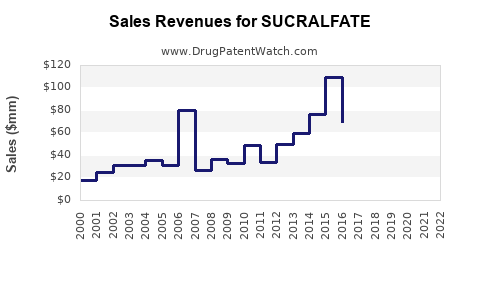
Sucralfate has the financial profile of a mature generic rather than a growth pharmaceutical asset.
Public company filings generally do not disclose sucralfate revenue separately. Revenue is usually grouped within larger generic, specialty, hospital, or international portfolios. As a result, a precise global sucralfate market size or manufacturer-level revenue ranking cannot be established from audited public filings.
The expected financial trajectory is:
| Period |
Financial direction |
Main drivers |
| Historical branded period |
High price relative to manufacturing cost |
Carafate brand recognition and limited competition |
| Generic expansion |
Sharp price and share erosion |
ANDA approvals and therapeutic substitution |
| Current mature phase |
Low revenue per prescription, stable volume |
Chronic generic demand and broad availability |
| Medium term |
Flat to modest decline in developed markets |
PPI competition, reimbursement pressure, generic pricing |
| Selected emerging markets |
Potential volume growth |
Wider diagnosis, lower-cost treatment access, local manufacturing |
Revenue exposure for manufacturers
Sucralfate is unlikely to represent a material revenue concentration for diversified pharmaceutical companies. For a small generic manufacturer, however, the product can provide useful portfolio revenue if the company has:
- Reliable access to active pharmaceutical ingredient
- FDA-compliant tablet or suspension capacity
- Hospital and retail distribution
- Competitive contract pricing
- A differentiated suspension presentation
- Stable supply during competitor shortages
The product’s low price limits absolute revenue potential. Manufacturing scale and portfolio bundling are more important than brand investment.
What factors affect sucralfate pricing?
Price competition is the dominant commercial force. The main pricing variables are:
Generic supplier count
More approved suppliers generally reduce average selling prices. Pharmacy substitution and wholesaler procurement shift volume toward the lowest reliable-cost supplier.
Dosage form
Tablets are easier to manufacture, package, store, and distribute. Oral suspension has higher complexity because of:
- Physical stability
- Uniformity of active ingredient
- Preservative and microbial-control requirements
- Packaging and dosing accuracy
- Shipping and storage considerations
Suspension can therefore support a modest commercial premium, but the premium is constrained by generic substitution and institutional purchasing.
Shortages and discontinuations
Mature generic markets can experience temporary shortages when one or more manufacturers exit, encounter manufacturing problems, or reduce production because of low margins. A shortage can improve pricing temporarily, but the effect is usually limited once competing supply returns.
Reimbursement
In the United States, pharmacy reimbursement and formulary placement influence realized revenue more than list price. Manufacturers selling through wholesalers and group purchasing organizations often face contract discounts that reduce net sales.
What manufacturing and intellectual-property barriers exist?
Sucralfate has low patent barriers but nonzero manufacturing barriers. The drug’s commercial formulation requires control of particle properties, suspension behavior, assay, impurities, dissolution, and content uniformity.
The main operational risks are:
- Dependence on qualified aluminum and sucrose-octasulfate-related raw materials
- Limited active pharmaceutical ingredient suppliers
- Scale-up problems in suspension products
- Stability failures
- Packaging defects
- FDA inspection findings
- Low manufacturing margins that discourage redundant capacity
These barriers favor established generic manufacturers with validated facilities. They do not create a durable monopoly, but they can affect supply continuity and short-term pricing.
What patent litigation and Paragraph IV challenges affect sucralfate?
Sucralfate has no material current Paragraph IV litigation profile comparable with recently launched branded drugs. Paragraph IV litigation is mainly relevant when an ANDA applicant challenges an unexpired listed patent. Because the core sucralfate patents expired long ago and standard products lack a meaningful Orange Book barrier, a new applicant would not normally face a strategically important patent challenge involving the basic molecule.
Any litigation involving a specific sucralfate product would more likely concern:
- Trademark or trade dress
- Product liability
- Manufacturing quality
- Distribution contracts
- Narrow formulation claims
- Regulatory compliance
There is no known modern litigation event that materially changes generic access to standard U.S. sucralfate.
Are there biosimilar risks for sucralfate?
No. Sucralfate is a chemically defined small molecule, not a biologic. Biosimilar competition under the Public Health Service Act does not apply. Generic competition proceeds through ANDAs and pharmaceutical-equivalence requirements.
The competitive risk is therefore conventional generic substitution, not biosimilar interchangeability or biologic reference-product erosion.
Which companies compete in the sucralfate market?
The market includes the former Carafate franchise, generic manufacturers, contract manufacturers, regional pharmaceutical companies, and veterinary compounders. Supplier participation can vary by country and dosage form.
In the United States, commercial competition is likely to include:
- Generic manufacturers holding approved sucralfate ANDAs
- Branded-generic suppliers
- Hospital-focused pharmaceutical companies
- Wholesale and private-label distributors
- Compounding pharmacies in veterinary channels
The absence of a stable public revenue breakdown makes it inappropriate to rank companies by sucralfate sales. A company may hold an approved ANDA without maintaining meaningful commercial distribution, while a distributor may sell the product under a private label without manufacturing it.
How does sucralfate compare with proton-pump inhibitors?
| Attribute |
Sucralfate |
Proton-pump inhibitors |
| Primary action |
Local mucosal barrier |
Systemic suppression of gastric acid |
| Systemic exposure |
Minimal |
Present |
| Main U.S. ulcer role |
Short-term duodenal-ulcer treatment |
Broad ulcer and reflux treatment |
| Patent status |
Long expired |
Mostly generic, with some differentiated formulations |
| Price profile |
Low generic pricing |
Low for standard generics; higher for modified products |
| Administration burden |
Often multiple daily doses on an empty stomach |
Usually once daily for many products |
| Interaction profile |
Binding and absorption interactions |
CYP and long-term-use considerations vary |
| Growth outlook |
Mature or declining |
Larger and more durable therapeutic market |
Sucralfate’s dosing burden and administration restrictions reduce convenience. Its advantages include local activity and limited systemic absorption. The product remains commercially viable where those characteristics match physician or patient preferences.
What is the generic launch outlook for sucralfate?
A new standard tablet entrant would face low regulatory barriers but weak economic incentives. Expected launch conditions include:
- No meaningful patent delay
- Established reference products
- Several possible generic competitors
- Low selling prices
- Limited physician loyalty
- Distribution-driven market access
- Potential supply opportunity during shortages
A suspension entrant may have a better commercial position than a tablet entrant if it can demonstrate reliable stability, dosing convenience, and consistent supply. The opportunity remains incremental rather than transformational.
What is the geographic coverage of the sucralfate market?
Sucralfate is marketed in numerous countries, but commercial positioning differs by jurisdiction. Developed markets generally treat it as a low-cost generic or legacy therapy. In emerging markets, it may retain broader use because of lower cost, prescribing habits, local manufacturing, and access limitations affecting newer therapies.
Country-level opportunity depends on:
- Local registration requirements
- Prescription versus over-the-counter classification
- Reference-product requirements
- Import controls
- Local API sourcing
- Public-sector procurement
- Hospital tender systems
- Availability of PPIs and H2 antagonists
The product is more attractive for regional manufacturers with established gastrointestinal portfolios than for multinational companies seeking a high-growth asset.
Key Takeaways
- Sucralfate is a mature, off-patent prescription gastrointestinal drug.
- U.S. regulatory exclusivity and core patent protection expired decades ago.
- Standard tablets and suspension products face broad generic competition.
- No biosimilar pathway applies.
- Product-level revenue is not separately disclosed by most manufacturers.
- Developed-market sales are likely stable to declining because of PPI competition and price erosion.
- Emerging markets and veterinary use provide the clearest volume opportunities.
- Suspension manufacturing, supply reliability, and distribution are more important than patents.
- Paragraph IV litigation and Orange Book barriers do not materially restrict ordinary generic entry.
- The commercial profile favors portfolio manufacturers, contract suppliers, and regional generic companies rather than branded-drug investors.
Frequently Asked Questions
Is sucralfate still profitable for pharmaceutical manufacturers?
Yes, but usually as a low-margin portfolio product. Profitability depends on manufacturing scale, distribution efficiency, supply reliability, and the number of competing suppliers.
Does sucralfate have an active U.S. composition patent?
No meaningful active composition patent is known to protect standard U.S. sucralfate products. Historical composition and formulation patents expired long ago.
Can a generic company launch sucralfate without a Paragraph IV challenge?
Generally yes, if no unexpired Orange Book patent blocks the applicable product. The applicant would still need FDA approval through the ANDA pathway.
Is sucralfate approved for GERD in the United States?
No. The FDA-approved core indication is short-term treatment of active duodenal ulcer. GERD use is not the principal approved indication.
Does veterinary sucralfate represent a significant growth market?
Veterinary use is commercially relevant for some suppliers, particularly through compounded suspension and tablet products. It is a separate channel from the human prescription market and lacks the reporting transparency needed to quantify its share reliably.
References
-
Katz, P. O., Dunbar, K. B., Schnoll-Sussman, F. H., Greer, K. B., Yadlapati, R. H., & Spechler, S. J. (2022). ACG clinical guideline for the diagnosis and management of gastroesophageal reflux disease. The American Journal of Gastroenterology, 117(1), 27-56.
-
National Library of Medicine. (2024). Sucralfate oral suspension and tablet labeling. DailyMed. https://dailymed.nlm.nih.gov/
-
U.S. Food and Drug Administration. (2024). Approved drug products with therapeutic equivalence evaluations: Orange Book. https://www.fda.gov/drugs/drug-approvals-and-databases/approved-drug-products-therapeutic-equivalence-evaluations-orange-book
-
U.S. Food and Drug Administration. (2024). Drugs@FDA: FDA-approved drugs. https://www.accessdata.fda.gov/scripts/cder/daf/
-
U.S. Food and Drug Administration. (2024). Abbreviated new drug application approvals and generic drug requirements. https://www.fda.gov/drugs/abbreviated-new-drug-application-anda/generic-drug-approval-process-infographic