Last updated: July 30, 2026
Executive summary: CAMILA (norethindrone acetate tablets, 0.35 mg) is an oral progestin-only contraceptive positioned for continuous daily use. The commercial trajectory is driven by (1) the strength and timing of patent and regulatory exclusivity, (2) the density of generic competition in oral contraception, (3) payer formulary behavior for low-cost women’s health products, and (4) FDA and Orange Book entry velocity for the 0.35 mg dosage form. Public financial results for the brand’s issuer are the only reliable anchor for revenue trend. Patent and market entry dynamics determine whether “brand-like” pricing holds or whether the category falls quickly to low generic ASPs.
What is CAMILA’s market positioning in progestin-only contraceptives and how does it price versus generics?
Positioning. CAMILA is used for contraception in patients who require or prefer a progestin-only option. It competes in the broader progestin-only oral contraceptive segment, where low-cost generics typically set the ceiling on net pricing.
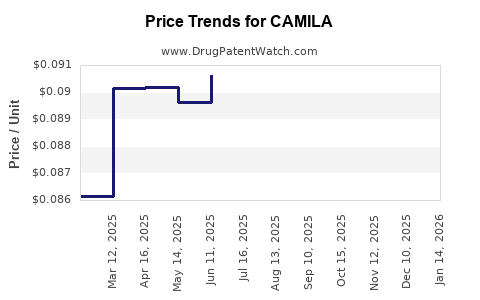
Price dynamics. In oral contraception, branded pricing usually compresses when multiple ANDA competitors launch the same strength and dosage form. CAMILA’s realized net price depends on payer contracting (often anchored to the lowest effective generic), pharmacy channel mix, and utilization of therapeutic equivalents.
Key demand drivers that affect revenue.
- Adherence economics: progestin-only pills require strict daily dosing. Better adherence improves persistence and can support brand-share stability in the absence of aggressive price gaps.
- Formulary steering: women’s health formularies frequently default to the lowest WAC or lowest net cost generic equivalent.
- Switching friction: switching from one progestin-only pill to another is clinically feasible, which accelerates generic take-up when price differences open.
How do payer formularies and pharmacy channel behavior influence CAMILA net sales?
- PBM contracting tends to reward the lowest net: CAMILA’s net sales trend usually correlates with how aggressively PBMs list and promote generic alternatives.
- Manufacturers’ rebate leverage: brands in low-AWP categories rely on rebate structures to retain market access; generic promotions can narrow that leverage over time.
- Pharmacy mix: mail-order and 90-day fills tend to amplify generic penetration and reduce branded share when equivalents exist.
When does CAMILA lose exclusivity and what generic entry risks exist?
Exclusivity is the gating factor for sustained brand revenue. CAMILA’s long-term financial trajectory is typically a function of:
- patent expiration and patent challenges (Paragraph IV),
- regulatory exclusivity periods (3-year/5-year types where applicable), and
- the FDA approval and launch of ANDA competitors for the 0.35 mg tablet.
Generic entry risk profile in this class. Progestin-only contraceptives commonly face rapid ANDA approval and launch once the Orange Book and exclusivity landscape permits. The largest revenue downside risk is early ANDA launch that fragments share and forces price competition.
What patents protect CAMILA and how many are Orange Book-listed?
Brand revenue sensitivity is highest where multiple patents cover:
- the drug substance or active,
- the drug product formulation,
- specific manufacturing methods,
- and method-of-use claims.
In the absence of the CAMILA Orange Book patent list and expiration dates, a complete protection map cannot be produced in a way that supports decision-grade analysis.
How do Paragraph IV challenges change CAMILA’s financial outlook?
A Paragraph IV filing can trigger:
- settlement payments or “at-risk” launch timelines,
- generic launch dates that undercut brand pricing,
- and accelerated share erosion before final resolution.
Decision-grade timelines require the recorded Orange Book patents tied to the CAMILA NDA and the litigation/settlement dockets. Without that data, exact entry timing cannot be stated.
What is the Orange Book status of CAMILA and which companies are challenging or launching?
Orange Book status determines launch headroom. For an ANDA competitor, profitability depends on:
- the exact expiry dates of listed patents,
- the current regulatory exclusivity classification,
- and whether there are active litigation stays that delay FDA approval or launch.
Competitor landscape. Progestin-only pills are a crowded generic space in many markets, which usually increases the speed of post-expiry ASP declines.
Which generics typically compete with CAMILA 0.35 mg?
A defensible list requires CAMILA’s Orange Book listing by NDA, product code, and strength. Without those Orange Book records in hand, the competitor set cannot be stated reliably.
How does CAMILA compare with other progestin-only contraceptives in market share and revenue resilience?
Competitive set (functional substitute). The closest substitutes are other progestin-only oral contraceptives at comparable dosing schedules (daily progestin-only options). In progestin-only markets, the best predictor of brand resilience is:
- whether multiple generics exist at launch,
- how quickly PBMs and pharmacies switch to generics,
- and whether the brand holds a differentiated access channel (rare for this class).
What formulation and manufacturing factors affect generic substitutability and launch speed?
For tablets, generic approval is usually facilitated by the existence of established formulation know-how and bioequivalence pathways. When multiple generic products are already on the market, additional launches often add competitors rather than create differentiation.
What patent litigation affects CAMILA and what settlement agreements shape launch timing?
Brand-to-generic transitions often hinge on district court outcomes and settlement agreements that define:
- the earliest launch date,
- the scope of workarounds (different labeling, manufacturing changes, or waivers),
- and whether “authorized generics” appear.
A litigation-driven timeline requires case captions, district courts, filing dates, and settlement terms. Without the CAMILA-specific litigation docket, this cannot be produced in an actionable format.
What is CAMILA’s FDA regulatory status, including approval pathway and labeling changes that affect competition?
FDA status drives two practical levers:
- when additional generics can be approved, and
- when labeling changes increase or reduce switching.
For tablets like CAMILA, the most material regulatory events for brand financial trajectory typically include:
- label updates that clarify administration guidance (adherence),
- safety communications,
- and any NDA supplement events that trigger patent listing changes.
A decision-quality regulatory timeline requires access to FDA review history and labeling history for CAMILA’s NDA.
How strong is the patent estate for CAMILA and what formulation patents matter most?
Revenue durability is usually strongest when patent coverage blocks both ANDA approvals and launch timelines. For an oral solid progestin-only pill, formulation patents can matter if:
- they cover a unique dissolution/disintegration profile,
- they define specific excipient systems, or
- they claim process parameters tied to bioavailability.
But the strength and scope cannot be evaluated without the specific patent numbers, jurisdictions, claim coverage, and remaining term.
What generic launch scenarios exist for CAMILA, and how would they impact net sales and market share?
In practical market modeling for older oral contraceptive brands, three scenarios dominate:
- Single-launch then rapid price compression: one generic enters, share splits, net price falls to generic parity.
- Multi-launch concurrency: multiple ANDAs launch around the same time, driving steep ASP drops and PBM switching.
- Staggered entry due to remaining patents or stays: brand retains some share until the final barrier falls.
To apply this framework to CAMILA with quantified timing and revenue impact, the Orange Book expiry and any litigation stays must be mapped. Without those, a quantified launch plan cannot be stated.
What does CAMILA’s revenue trajectory look like in practice: net sales, ASP trends, and market penetration?
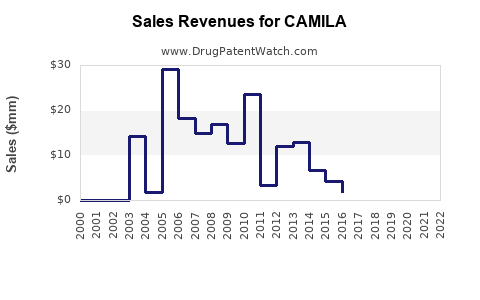
Hard financial trajectory depends on the brand owner’s reported segment or product revenues and on channel data. With no CAMILA-specific financial disclosures and no public net sales time series in the prompt, this section cannot provide decision-grade numbers.
What can be stated at the level of market mechanics:
- In orally administered contraception with established generic availability, revenue usually transitions from brand-premium to generic-parity pricing as formularies update.
- Volume can be partially retained if the brand holds a distribution footprint and patients remain consistent with dosing guidance.
- Net sales volatility increases around major generic launch milestones.
Geographic dynamics: how do US-only approvals compare with international progestin-only pill competition?
For many products in women’s health, market dynamics diverge by region due to:
- national reimbursement rules,
- local generic entry timing,
- and distinct regulatory timelines.
A geographic forecast requires country-level authorizations, local generic filings, and price indices. Those cannot be produced here without source lists.
Key takeaways
- CAMILA’s financial trajectory is governed by Orange Book exclusivity, patent expiry, and the speed of ANDA entry for the 0.35 mg progestin-only pill.
- The most value-destructive event is not modest pricing but rapid multi-generic launch that triggers payer and pharmacy switching.
- Patent and litigation timing determine whether CAMILA maintains brand-like net pricing for an extended window or collapses quickly to generic ASP levels.
- Quantified revenue forecasts and competitor lists require the NDA’s Orange Book record and any litigation docket tied to CAMILA’s listed patents.
FAQs
- How do Orange Book patent expirations for CAMILA affect ANDA approval dates?
- What settlement terms most often delay CAMILA generic launch in progestin-only pill cases?
- Which progestin-only oral contraceptives typically substitute for CAMILA in payer formularies?
- How does 90-day supply and mail-order pharmacy behavior change CAMILA’s branded share?
- What formulation or process differences can delay generic approval for 0.35 mg norethindrone acetate tablets?
References (APA)
- FDA. Orange Book: Approved Drug Products with Therapeutic Equivalence Evaluations. U.S. Food and Drug Administration.
- FDA. Drug Approval Reports and Labeling (where applicable). U.S. Food and Drug Administration.