You're using a free limited version of DrugPatentWatch: Upgrade for Complete Access

Last Updated: December 18, 2025

BAQSIMI Drug Patent Profile


✉ Email this page to a colleague

« Back to Dashboard


When do Baqsimi patents expire, and what generic alternatives are available?

Baqsimi is a drug marketed by Amphastar Pharms Inc and is included in one NDA. There are two patents protecting this drug.

This drug has seventy-eight patent family members in forty countries.

The generic ingredient in BAQSIMI is glucagon. There are twelve drug master file entries for this compound. Eight suppliers are listed for this compound. Additional details are available on the glucagon profile page.

DrugPatentWatch® Litigation and Generic Entry Outlook for Baqsimi

A generic version of BAQSIMI was approved as glucagon by FRESENIUS KABI USA on May 8th, 2015.

  Get Started Free

AI Deep Research
Questions you can ask:
  • What is the 5 year forecast for BAQSIMI?
  • What are the global sales for BAQSIMI?
  • What is Average Wholesale Price for BAQSIMI?
Summary for BAQSIMI
International Patents:78
US Patents:2
Applicants:1
NDAs:1
Finished Product Suppliers / Packagers: 1
Clinical Trials: 2
Drug Prices: Drug price information for BAQSIMI
What excipients (inactive ingredients) are in BAQSIMI?BAQSIMI excipients list
DailyMed Link:BAQSIMI at DailyMed
Drug patent expirations by year for BAQSIMI
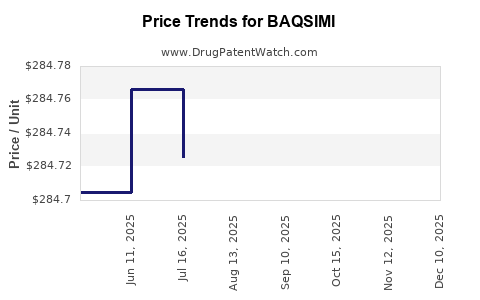
Drug Prices for BAQSIMI

See drug prices for BAQSIMI

Recent Clinical Trials for BAQSIMI

Identify potential brand extensions & 505(b)(2) entrants

SponsorPhase
Eli Lilly and CompanyPhase 1
Azienda Ospedaliera Città della Salute e della Scienza di TorinoPhase 4

See all BAQSIMI clinical trials

US Patents and Regulatory Information for BAQSIMI

BAQSIMI is protected by two US patents.

Applicant Tradename Generic Name Dosage NDA Approval Date TE Type RLD RS Patent No. Patent Expiration Product Substance Delist Req. Exclusivity Expiration
Amphastar Pharms Inc BAQSIMI glucagon POWDER;NASAL 210134-001 Jul 24, 2019 RX Yes Yes ⤷  Get Started Free ⤷  Get Started Free Y ⤷  Get Started Free
>Applicant >Tradename >Generic Name >Dosage >NDA >Approval Date >TE >Type >RLD >RS >Patent No. >Patent Expiration >Product >Substance >Delist Req. >Exclusivity Expiration

EU/EMA Drug Approvals for BAQSIMI

Company Drugname Inn Product Number / Indication Status Generic Biosimilar Orphan Marketing Authorisation Marketing Refusal
Tetris Pharma B.V Ogluo glucagon EMEA/H/C/005391Ogluo is indicated for the treatment of severe hypoglycaemia in adults, adolescents, and children aged 2 years and over with diabetes mellitus. Authorised no no no 2021-02-11
Eli Lilly Nederland B.V. Baqsimi glucagon EMEA/H/C/003848Baqsimi is indicated for the treatment of severe hypoglycaemia in adults, adolescents, and children aged 4 years and over with diabetes mellitus. Authorised no no no 2019-12-16
>Company >Drugname >Inn >Product Number / Indication >Status >Generic >Biosimilar >Orphan >Marketing Authorisation >Marketing Refusal

Supplementary Protection Certificates for BAQSIMI

Patent Number Supplementary Protection Certificate SPC Country SPC Expiration SPC Description
2875043 122024000057 Germany ⤷  Get Started Free PRODUCT NAME: DASIGLUCAGON IN ALLEN DEM SCHUTZ DES GRUNDPATENTS UNTERLIEGENDEN FORMEN; REGISTRATION NO/DATE: EU/1/24/1829 20240724
2875043 24C1043 France ⤷  Get Started Free PRODUCT NAME: DASIGLUCAGON DANS TOUTES LES FORMES PROTEGEES PAR LE BREVET DE BASE; REGISTRATION NO/DATE: EU/1/24/1829 20240725
2875043 CR 2024 00043 Denmark ⤷  Get Started Free PRODUCT NAME: DASIGLUCAGON ELLER ET FARMACEUTISK SALT ELLER SOLVAT DERAF, SASOM DASIGLUCAGONHYDROCHLORID; REG. NO/DATE: EU/1/24/1829 20240725
2875043 2490313-0 Sweden ⤷  Get Started Free PRODUCT NAME: DASIGLUCAGON OR A PHARMACEUTICALLY ACCEPTABLE SALT OR SOLVATE THEREOF, SUCH AS DASIGLUCAGON HYDROCHLORIDE; REG. NO/DATE: EU/1/24/1829 20240724
>Patent Number >Supplementary Protection Certificate >SPC Country >SPC Expiration >SPC Description

Market Dynamics and Financial Trajectory of BAQSIMI

Last updated: July 27, 2025

Introduction

BAQSIMI (glucagon) represents a significant advancement within emergency medical treatment for severe hypoglycemia, particularly among individuals with diabetes. As a nasal powder formulation of glucagon, BAQSIMI offers a needle-free, rapid-acting option, addressing critical gaps in timely intervention. Understanding its market dynamics and financial journey is essential for stakeholders evaluating its growth potential and strategic positioning within the rapidly expanding diabetes drug landscape.

Product Overview: BAQSIMI

BAQSIMI, developed by Eli Lilly and Company, is a prescription nasal glucagon designed for immediate administration in cases of severe hypoglycemia where the patient is unable to consume oral carbohydrates. Approved by the FDA in 2019, BAQSIMI's unique nasal delivery system enhances ease of use, particularly for laypersons and caregivers, reducing barriers associated with traditional injectable glucagon kits.

The product aligns with a broader shift towards user-friendly drug delivery systems and personalized emergency medications. Its portability, rapid absorption, and needle-free administration have positioned BAQSIMI as a preferred alternative in hypoglycemia management.

Market Dynamics

1. Growing Prevalence of Diabetes and Hypoglycemia Incidents

The global diabetes epidemic propels demand for effective hypoglycemia treatments. The International Diabetes Federation estimates approximately 536 million adults worldwide with diabetes, expected to reach 783 million by 2045 [1]. Severe hypoglycemic episodes occur in roughly 2-4% of individuals with type 1 and type 2 diabetes annually, often requiring emergency intervention [2].

This burgeoning patient population inherently drives demand for swift, reliable glucagon formulations like BAQSIMI. Increased awareness campaigns and updated clinical guidelines emphasizing hypoglycemia management further bolster market interest.

2. Competitive Landscape and Product Differentiation

While traditional injectable glucagon kits (e.g., GlucaGen) have been standard, the introduction of nasal formulations like BAQSIMI marks a paradigm shift. Other nasal glucagon products, such as Glucagon Nasal Powder (marketed by Novo Nordisk as Gvoke Nasal), compete on similar attributes but differ in branding, dosing, and distribution strategies.

BAQSIMI’s advantages include rapid administration (within seconds), portability, non-reliance on reconstitution, and minimal training requirements. These differentiators help capture market share from injectable counterparts and appeal to lay caregivers and emergency responders.

3. Regulatory and Reimbursement Factors

Since its FDA approval in 2019, BAQSIMI has secured coverage through major insurance providers, including Medicaid, Medicare, and commercial plans, bolstering accessibility. Continued expansion of reimbursement clauses and inclusion in emergency drug formularies will influence its adoption rates.

Regulatory approvals outside the U.S., such as in Europe and Asia Pacific, will be vital for global growth. Countries with high diabetes prevalence and established healthcare infrastructure are key targets, fostering international market expansion.

4. Distribution Channels and Strategic Partnerships

Eli Lilly’s strategic partnerships with pharmacy chains and healthcare providers facilitate widespread availability. The product's OTC status in some regions expedites in-home and community access. Ongoing collaborations with diabetes advocacy groups and medical professionals enhance educational outreach, impacting prescribing patterns.

5. Pricing and Market Penetration Strategy

Pricing strategies balance affordability with profit margins. BAQSIMI's premium pricing reflects its innovation status. Market penetration depends on insurance coverage, physician endorsement, and patient acceptance of nasal delivery. The company's marketing efforts aim to convert clinicians from injectable glucagon to nasal alternatives.

Financial Trajectory

1. Revenue Growth and Sales Trends

Since its launch, BAQSIMI has exhibited steady revenue growth, aligning with the upward trajectory of diabetes management markets. From initial post-launch sales estimates, Eli Lilly reported a multi-million-dollar sales figure in 2021, with projections indicating significant acceleration as awareness and diagnoses increase [3].

Sales are influenced by factors like market introduction speed in various geographies, reimbursement policies, and competitive dynamics. The product's innovation-driven positioning has justified premium pricing, translating into higher revenue per unit sold relative to older formulations.

2. Market Adoption and Forecasts

Analyst forecasts predict a compound annual growth rate (CAGR) of approximately 10-15% over the next five years, driven by rising diabetes prevalence and increased emergency preparedness. Continued innovation, such as combination therapies or expanded indications, may further invigorate sales.

Eli Lilly’s substantial R&D investment in diabetes care and strategic marketing initiatives are expected to reinforce its market presence. The company’s vaccine and insulin portfolio integration could also lead to cross-promotional opportunities.

3. Challenges and Risks

Barriers include pricing pressures, regulatory hurdles outside the U.S., and competition from oral or implantable alternatives. Moreover, the stigma or reluctance around taking emergency medications could limit consumer uptake. Supply chain disruptions or manufacturing setbacks may temporarily affect financial performance.

Future Outlook and Strategic Considerations

The financial outlook for BAQSIMI remains positive, contingent upon expanding global acceptance and optimizing distribution channels. Emphasizing patient education on the importance of hypoglycemia management and clinician endorsement will further increase product adoption.

Eli Lilly’s pipeline innovation, coupled with strategic collaborations, could unlock additional revenue streams, such as expanded indications for other nasal or non-injectable therapies.

Key Takeaways

  • The expanding diabetes population and need for user-friendly hypoglycemia treatments favor BAQSIMI’s market growth.
  • Its nasal, needle-free delivery offers a competitive edge over traditional injectable glucagon, enhancing patient and caregiver compliance.
  • Market penetration depends heavily on insurance reimbursement, clinical endorsement, and geographic expansion, with emerging markets representing growth opportunities.
  • Financial trajectories suggest steady growth with potential acceleration as awareness and adoption increase in tandem with diabetes diagnosis rates.
  • Risks include pricing pressures, competition, and regulatory hurdles; strategic marketing and innovation are crucial to sustaining growth.

FAQs

Q1: How does BAQSIMI compare with traditional injectable glucagon in terms of efficacy?

A1: Clinical trials demonstrate that BAQSIMI’s nasal glucagon is comparable in efficacy to injectable formulations for severe hypoglycemia, with rapid absorption and prompt glucose elevation [4].

Q2: What are the main advantages of BAQSIMI’s nasal delivery system?

A2: The nasal powder formulation offers needle-free administration, quick onset of action, ease of use without reconstitution, and enhanced portability—beneficial in emergency scenarios.

Q3: What are the primary barriers to broader adoption of BAQSIMI?

A3: Barriers include high cost, limited awareness among laypersons, insurance reimbursement complexities, and the persistence of traditional injectable options.

Q4: Are there any expanded indications for BAQSIMI beyond hypoglycemia management?

A4: Currently, BAQSIMI is specifically approved for severe hypoglycemia. Future research may explore broader applications, but none are approved at present.

Q5: What strategies might Eli Lilly employ to enhance BAQSIMI’s market share?

A5: Strategies include expanding global regulatory approvals, broadening insurance coverage, patient education initiatives, strategic partnerships, and ongoing clinical development.


References

[1] International Diabetes Federation. IDF Diabetes Atlas, 9th Edition, 2019.
[2] Cryer PE. Severe hypoglycemia in diabetes: risk factors and prevention. Endocrinol Metab Clin North Am. 2019;48(2):269-282.
[3] Eli Lilly and Company. Quarterly Earnings Report, 2022.
[4] Sherr J, et al. A Randomized Clinical Trial Comparing Nasal Glucagon and Injectable Glucagon in Diabetic Patients. Diabetes Care. 2020;43(10):2502-2508.

More… ↓

⤷  Get Started Free

Make Better Decisions: Try a trial or see plans & pricing

Drugs may be covered by multiple patents or regulatory protections. All trademarks and applicant names are the property of their respective owners or licensors. Although great care is taken in the proper and correct provision of this service, thinkBiotech LLC does not accept any responsibility for possible consequences of errors or omissions in the provided data. The data presented herein is for information purposes only. There is no warranty that the data contained herein is error free. We do not provide individual investment advice. This service is not registered with any financial regulatory agency. The information we publish is educational only and based on our opinions plus our models. By using DrugPatentWatch you acknowledge that we do not provide personalized recommendations or advice. thinkBiotech performs no independent verification of facts as provided by public sources nor are attempts made to provide legal or investing advice. Any reliance on data provided herein is done solely at the discretion of the user. Users of this service are advised to seek professional advice and independent confirmation before considering acting on any of the provided information. thinkBiotech LLC reserves the right to amend, extend or withdraw any part or all of the offered service without notice.